PART 1
At 6:04 in the morning, with the car already running in front of the house in the Portales neighborhood, Teresa told Natalia that she was no longer going on the trip.
She said it softly, as if asking for permission to change the time for dinner, not to shatter something inside.
—Honey, Laura is going in your place. I knew you'd understand. You've always been so mature.
Natalia was sitting in the driver's seat, the ticket folder on her lap, the passports neatly arranged, the printed reservations, and a small bag of lavender candies she had bought because her mom got anxious on planes.
In the back, her dad, Don Ernesto, was loading the last suitcase without saying a word.
He didn’t hold her gaze.
That hurt the most.
Not her mom’s words. Not the quick kiss on the cheek. Not the way Laura left the house in her white jacket, her pink suitcase, and the swollen face of someone who hadn’t slept.
It was seeing her dad, that serious man who never cried even at funerals, staring at the floor as if that’s where shame was buried.
Natalia had planned that trip for two years.
She worked extra hours at the accounting firm where she handled payroll, sold her old laptop, stopped buying clothes, stopped going out with her friends, and noted every peso in a blue notebook.
Paris, Rome, and Florence.
That had been her mom’s dream since Natalia was a child. Teresa would watch French movies on regular TV and laugh, saying:
—Oh, honey, that’s not for people like us.
Natalia promised herself that one day it would be for them.
And that day, just when she was supposed to drive to the airport to join them, her own mother was pulling her down from the dream she had paid for herself.
—Why Laura? —Natalia asked.
Teresa pressed her lips together.
—Because she needs to clear her head. She’s been unwell. You’re strong, Nata. She’s not.
Laura didn’t say anything.
She just climbed into the back seat and placed her black bag at her feet. She had her phone switched off in her hand, which was odd, because Laura was always recording everything for Instagram.
During the drive to the AICM, Laura talked too much.
That she wanted a photo at the Eiffel Tower, that she had seen a viral café on TikTok, that she was going to buy sunglasses in Rome, that Paris looked beautiful at night.
Teresa smiled at her tenderly.
Natalia drove with her hands stiff on the wheel, feeling like a chauffeur to her own humiliation.
At a stoplight, Don Ernesto reached forward from the back and squeezed her knee.
Tightly.
Natalia thought it was guilt. That her dad wanted to apologize but didn’t dare.
Later she would understand that it wasn’t that at all.
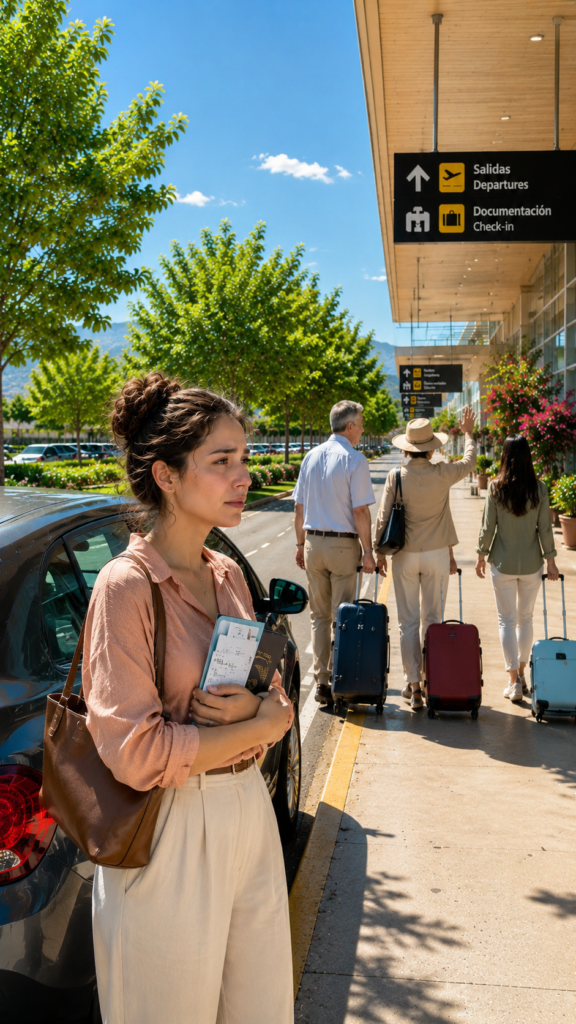
At the terminal entrance, Natalia unloaded the suitcases. Teresa hugged her as if nothing grave had happened.
—We’ll make it up to you, honey.
Laura avoided looking at her.
Don Ernesto walked slowly, pushing the cart. Before entering, he turned once, but his eyes were filled with something Natalia couldn’t decipher.
She watched them disappear with her money, with her savings, with her place.
Natalia remained in the parking lot for almost 15 minutes, without crying.
Then she opened the airline app and watched the dot of the plane until it left Mexico.
When she got home, she made coffee, opened her computer, and began canceling everything.
The hotel in Paris.
Canceled.
The Seine cruise.
Canceled.
The train to Florence.
Canceled.
The tour in Rome, the dinners, the transfers, the museum tickets.
Everything.
She only left the return tickets intact.
Her phone started vibrating non-stop.
Mom.
Dad.
Laura.
Mom again.
Natalia didn’t answer.
A voicemail came through, with Teresa’s broken voice and airport noise in the background.
—Daughter, please answer me. There’s something we didn’t tell you. Laura isn’t…
The message cut off.
Natalia turned off her phone.
That night she went out to move the car.
Then she saw Laura’s black bag lying in the back seat.
She opened it angrily, expecting to find makeup, expensive clothes, or some spoiled child’s nonsense.
But inside there was none of that.
There were medicine bottles with pharmacy labels, Laura’s name handwritten on them, and a folded paper with a hospital seal.
Natalia read it under the cold light of the garage.
And in a single line, she understood that the trip had never been a gift.
PART 2
The word was printed next to her sister’s full name.
Laura Méndez Salazar.
Confirmed diagnosis.
Natalia felt the ground open beneath her, but she didn’t scream. She stood frozen in the garage, barefoot, with the paper shaking between her fingers and the black bag hanging from her arm.
The bottles had strict instructions. Schedules. Doses. Warnings.
There were also lavender candies.
The same ones Teresa had passed to the back seat that morning.
Natalia recalled the scene with a cruel clarity.
—So you don’t get dizzy, honey.
She thought she was talking about the plane.
She wasn’t talking about the plane.
She was talking about the nausea Laura had been hiding for months.
Natalia turned on her phone.
She had 28 missed calls and 11 messages.
The last was from her dad.
“Please, honey. Don’t punish your sister. Punish me instead.”
Natalia sat on the garage step and replayed the full voicemail.
Teresa’s voice sounded broken.
—Daughter, please answer me. Laura isn’t well. The doctors said if she wanted to make the trip, it had to be now. After, she might not be able to. She didn’t want us to tell you. She made us promise. Don’t be mad at her, honey. Be mad at me.
She heard Don Ernesto say something in the background, as if he were trying to take the phone from her.
Then Teresa added:
—Your sister said she’d rather have you hate her for a while than see her as sick from the start.
Natalia closed her eyes.
Everything fell into place with horrifying violence.
Laura’s visits that week.
The closed door of Teresa’s room.
The quiet voices.
Her dad subdued.
Laura’s phone turned off.
The heavy bag.
The candies.
And the squeeze on her knee.
It wasn’t guilt for having left her.
It was a silent farewell. A desperate apology. An awkward way of saying: “Forgive me for not being able to save both of you.”
Natalia ran to the computer.
The Paris hotel had already accepted the cancellation without a full refund.
The Seine cruise was lost.
The train to Florence had penalties.
The Rome tour had already released the spots.
Natalia put her hands to her head.
That afternoon, canceling everything, she had felt powerful. For the first time in years, she felt she was setting a boundary.
It wasn’t just about the trip.
It was about a whole life of being “the mature one.”
When they were children, if Laura got sick, everyone rushed. Natalia waited with the neighbor.
If Laura cried, everyone hugged her. Natalia listened to her being told she had to understand.
If money was short, Natalia worked. If Laura made mistakes, Natalia helped fix them.
Always the same phrase.
“You’re big.”
“You’re strong.”
“You understand.”
So when Teresa told her at 6:04, “I knew you’d understand,” Natalia didn’t hear a worried mother.
She heard 30 years of abandonment.
She canceled out of rage.
Out of exhaustion.
Out of feeling used.
And now, she had before her the proof that this time, the story was worse than her anger could imagine.
That night she didn’t sleep.
She rebooked everything she could. Paid absurd fees. Called the bank. Used the emergency card. Begged in poorly pronounced English to a hotel operator in Paris.
She bought the first available flight.
She arrived at the airport in the same clothes as the day before, hair tied up and uncombed, and Laura’s black bag in her backpack.
During the flight, she didn’t eat.
She just squeezed a lavender candy in her hand until it deformed.
When she landed in Paris, it was already night.
She took a taxi to the hotel she had managed to recover. On the way, she saw lights, bridges, old buildings, people laughing on narrow sidewalks.
Everything was beautiful.
And it made her angry that it was beautiful just when her family was falling apart.
She knocked on the door of room 412.
Don Ernesto opened.
At the sight of her, her dad broke down.
He didn’t say “honey.” He didn’t ask how she got there. He didn’t fake anything.
He just hugged her with a clumsy strength and started crying on her shoulder, like an old child.
Natalia had never seen him like that.
—I’m sorry —he repeated—. I’m sorry, I’m sorry, I’m sorry.
Natalia hugged him too, but her voice came out small.
—Why didn’t you tell me?
Don Ernesto stepped back and wiped his face with his sleeve.
—Because we all thought we were protecting you. And because we were cowards.
Inside was Teresa, sitting on the edge of the bed, with swollen eyes.
Laura was by the window, wrapped in a huge sweatshirt, watching the lights of Paris as if afraid to blink.
She had lost weight.
A lot.
Natalia hadn’t realized because Laura always wore loose clothing and cracked jokes to fill any silence.
When Laura saw her, she tried to smile.
—How embarrassing for you, Nata. Not even for drama do I do it right.
Natalia placed the backpack on the chair.
She took out the black bag.
Laura lowered her gaze.
—You saw it.
—Yes.
The silence weighed on the four of them.
Teresa began to cry silently.
Natalia approached the bed.
—Why did you let me believe they were replacing me with you?
Laura swallowed hard.
Her lips were dry, but her gaze was still the same: proud, stubborn, desperately alive.
—Because it was easier for you to hate me.
—Easier for whom?
Laura let out a sad little laugh.
—For me, I guess.
Natalia squeezed the bag against her chest.
—You broke me.
—I know.
—You made me feel like I didn’t matter.
—I know.
—I canceled everything, Laura.
Teresa jolted her head up.
Don Ernesto closed his eyes.
Laura, however, wasn’t surprised. She just nodded slowly.
—I figured.
Natalia felt her breath leave her.
—What do you mean you figured?
Laura pointed to the bag.
—That’s why I left it in your car.
The room fell still.
Natalia looked at her sister as if she had just heard another hidden truth.
—You left it on purpose?
Laura nodded.
—I couldn’t tell you to your face. I’m really cowardly, you see? But I also didn’t want you to stay believing that Mom and Dad tossed you aside like nothing.
Teresa covered her mouth.
—Laura…
—No, Mom. Enough.
Laura took a deep breath, as if every word cost her.
—I asked them to take me. I told them to leave you behind. I made up that I needed a distraction. I asked them not to tell you about the diagnosis.
Natalia felt an impossible mix of tenderness and fury.
—And you thought that was fair?
—No. I thought it was the only thing I could control.
Laura looked out the window.
—The doctors took everything from me really fast, Nata. My hair, my strength, my plans, my desire to go out without everyone looking at me weird. But there was one thing I could still decide: how you were going to remember me.
Natalia finally began to cry.
Without elegance. Without strength. Without maturity.
Like a child finally given permission to break.
Laura cried too.
—I didn’t want to be your sick sister. I wanted to be Laura, the annoying one. The one who stole your blouses. The one who made you angry. The one who always won the arguments. I wanted that when you thought of me, you wouldn’t see a hospital.
—But you left me alone —Natalia whispered.
Laura closed her eyes.
—Yes. And that has no pretty forgiveness. I’m sorry.
That phrase disarmed Natalia.
Because it didn’t sound like an excuse.
It sounded like the truth.
That night, Teresa wanted to explain everything. That Laura had hidden symptoms for months. That the diagnosis came too late. That the doctor recommended avoiding stress, but also told them that if Laura had a pending dream, they should do it soon.
Laura asked for Paris.
Not just for herself.
For Teresa.
—Mom always said Paris wasn’t for people like us —Laura said—. And I thought: well, let her see it before everything gets worse.
Natalia remembered the blue notebook, the double shifts, the pesos saved.
She felt betrayed again, but now for something more complicated than selfishness.
She felt betrayed by poorly made love.
By that Mexican love that sometimes stays quiet to avoid worry, that sacrifices without asking, that thinks hiding the truth is caring.
And it can destroy.
The next day, they took the Seine cruise.
It wasn’t perfect.
Laura got dizzy before boarding, and Natalia gave her a lavender candy without saying anything.
Teresa cried seeing the Eiffel Tower from the water.
Don Ernesto took her hand for the first time in public after who knows how many years.
Natalia walked alongside Laura through cobblestone streets, carrying her bag, her medicines, and also her anger.
Because forgiveness didn’t come all at once.
It came in moments.
It came when Laura made a terrible joke in front of a statue.
It came when Teresa apologized for always using her as the strong daughter.
It came when Don Ernesto confessed one night that he did want to tell her everything in the car, but couldn’t.
—I squeezed your knee because it was the only way I found to ask you for forgiveness without breaking the promise.
Natalia didn’t tell him it was okay.
Because it wasn’t okay.
She just took his hand.
That was enough for that night.
In Florence, Laura had a crisis, and they spent six hours in the ER.
There Natalia understood the part no one mentioned.
That trip wasn’t a vacation.
It was a farewell disguised as an itinerary.
In Rome, Laura asked for a photo in front of a fountain.
—But don’t take me as sick, okay? Make me look good.
Natalia took 12 photos.
In one, Laura was laughing with her eyes closed, hair blown by the wind, and a lavender candy between her fingers.
That was the photo Natalia saved separately.
Months later, Laura died in Mexico City, in her bed, with Teresa on one side, Don Ernesto on the other, and Natalia sitting at her feet, holding her hand.
Before she left, Laura barely opened her eyes.
—Are you still mad?
Natalia cried and smiled at the same time.
—A ton.
Laura smiled a little.
—Good. That way you won’t forget me.
After that, the house never sounded the same again.
Teresa stopped saying “you’re the strong one.”
The first time it almost slipped out, Natalia looked at her, and her mom corrected:
—I’m sorry. You also have the right to be tired.
Don Ernesto hung a photo of the two sisters in the living room.
Not the one of Laura sick.
The one of Laura alive, laughing, stubborn, radiant.
A year later, Natalia found her blue notebook in a drawer. The same one where she had recorded every peso for the trip for two years.
On the last page, she wrote something she never told anyone:
“There are betrayals that stem from selfishness. And there are others that arise from the fear of loving poorly. Both hurt. Both leave scars.”
Inside her wallet, she still carries a lavender candy.
Just one.
It’s crushed, dry, scentless.
She doesn’t eat it.
Every time she boards a plane, she squeezes it during takeoff.
Not because she’s afraid of flying.
But because, for a few seconds, she feels Laura still sitting behind, pretending to be brave, feigning that she isn’t getting dizzy and waiting for her older sister to finally not have to understand everything alone.