PART 1
The storm hit a ranch in Tepatitlán as if the sky had decided to break apart all at once.
The dirt road disappeared beneath the mud, branches pounded against the tin roofs, and the only light visible for miles was that of Mateo Rivas’s home.
Mateo was 41, strong-bodied, with a serious gaze and a way of speaking that wasted no words.
He had spent 13 years in the Navy, returning to Jalisco after witnessing too many ugly sights, seeking silence among cattle, fields, and cold dawns.
But he wasn't completely alone.
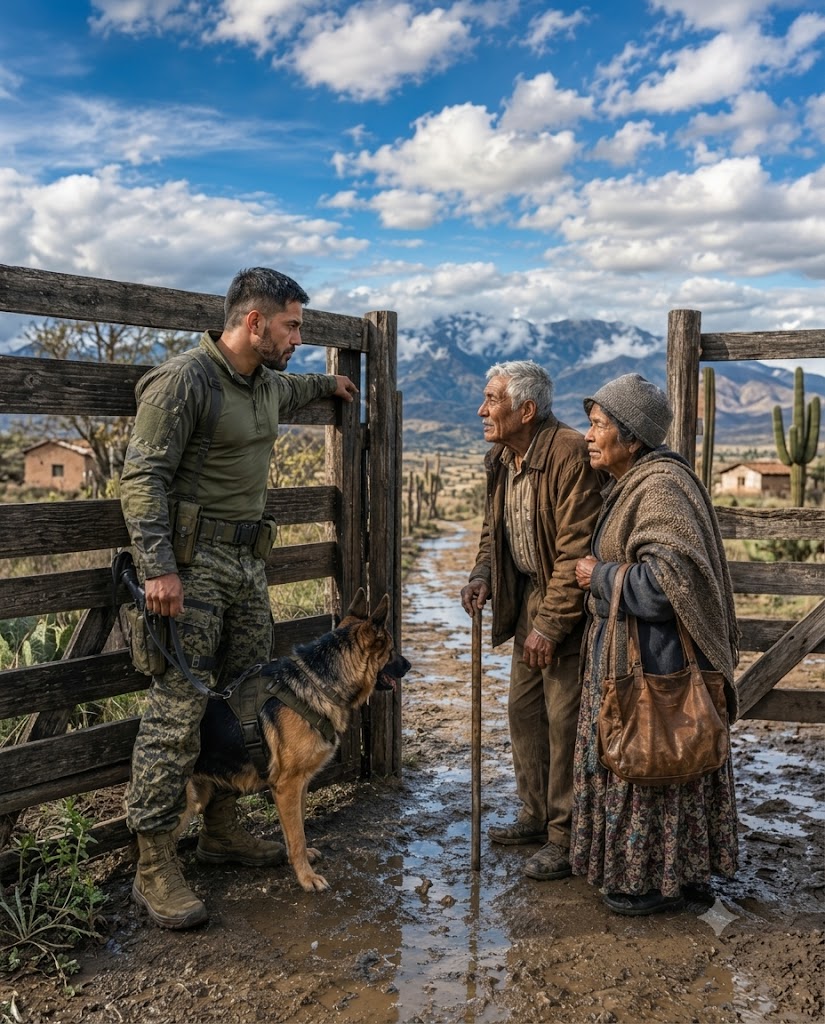
With him was Bruno, a large German shepherd, black with brown spots, trained, noble, and smarter than many men in the village.
That night, as Mateo warmed coffee in a pot, Bruno stopped wagging his tail.
The dog lifted his head.
He didn’t bark.
He just stared intently at the gate.
Mateo approached the window and saw two shadows advancing through the rain.
An elderly man walked bent over, leaning on an old cane. Beside him, a thin woman covered herself with a soaked sweater, trembling like a leaf.
Mateo stepped outside with a lantern.
—Are you looking for someone?
The old man raised his face. He was 83, tired but dignified, even as the rain ran down his wrinkles.
—Sorry to bother you, young man. We just saw a light. Would you let us sleep in your barn until the storm passes?
The woman didn’t speak.
She didn’t even look at Mateo.
She stared at the ground, as if afraid to take up too much space in the world.
Bruno walked toward her.
The old woman stepped back in fear, but the dog didn’t growl. He just sniffed her hand, lowered his head, and sat close to her legs.
Mateo then noticed something that squeezed his chest.
On the woman’s wrist were purple marks.
They didn’t look like a fall.
They looked like fingers.
—You’re not sleeping in the barn —Mateo said.
The old man swallowed hard.
—We understand. Sorry for the trouble.
—You’re coming into the house.
Inside, he gave them towels, dry clothes, and sweet bread. The old man’s name was Don Aurelio. The woman was Doña Carmen, his lifelong wife.
The two sipped coffee with trembling hands.
Not from the cold.
From fear.
Every noise outside made them glance toward the door.
—We’ll leave before dawn —Don Aurelio promised—. We don’t want to cause you any trouble.
Mateo watched Bruno, who remained beside Doña Carmen as if he already knew her.
—Trouble didn’t arrive with me —he replied—. It was following you.
Doña Carmen tightened her grip on the cup.
Before she could say anything, white lights cut through the rain.
A black truck screeched to a halt in front of the gate.
A tall, heavyset man in an expensive jacket and muddy boots jumped out, furious. He pounded his fist against the tin.
—Grandparents! I know you’re in there! Come out right now!
Doña Carmen turned pale.
—It’s Ulises… our grandson.
Mateo opened the door.
Bruno stepped out beside him, still, silent.
Ulises smiled as if the house already belonged to him.
—My grandparents are losing their minds. They left without telling me. I’m taking them back.
—No one takes anyone anywhere unless they want to go —Mateo said.
Ulises let out a dry laugh.
—Don’t get involved, buddy. They’re my family.
—Then treat them like family.
Ulises’s face hardened.
He looked inside and saw the elderly couple sitting at the table.
—Ungrateful old folks —he spat—. After everything I do for you.
Don Aurelio tried to stand, but Doña Carmen held his arm.
Mateo stepped forward.
—You heard. Leave.
Ulises came so close that the water from his jacket dripped onto the porch floor.
—Tomorrow I’ll come back with papers, with police, or with gasoline, but those old folks are leaving here even if I have to drag them out.
And when Bruno let out a low growl, Doña Carmen broke into tears, for she understood that this threat was not anger… it was a sentence.
PART 2
The truck left, kicking up mud, but the fear stayed inside the house.
Don Aurelio suddenly seemed older. His cane trembled in his hand, and Doña Carmen breathed as if each breath hurt her.
Mateo closed the door calmly.
That calm was stronger than any scream.
—Now —he said—. You’re going to tell me what’s going on.
The elderly couple exchanged glances.
For several seconds, no one spoke. It was as if they had forgotten they could tell the truth without asking permission.
Doña Carmen was the first.
—Ulises arrived two years ago. He said he just needed to stay a few weeks because he had lost his job in Guadalajara.
At first, he was kind.
He brought groceries, accompanied Don Aurelio to the doctor, handled paperwork, and told the neighbors he was “the responsible grandson.”
Then he started keeping the bank cards.
Then he took the pension.
Then the keys.
—He told us it was for our own good —murmured Don Aurelio—. That we were old, that we forgot things.
His voice broke.
—But it wasn’t true.
Ulises began to control everything. He locked the pantry. He hid Doña Carmen’s cell phone. He took Don Aurelio’s cane during arguments so he couldn’t leave.
He told the neighbors that his grandparents were making things up.
That they were already “getting senile.”
That poor things, but sometimes they got aggressive.
Mateo clenched his jaw.
He had seen violence with weapons, with blows, and with direct threats.
But this was dirtier.
It was violence disguised as care.
—What does he really want? —he asked.
Don Aurelio looked down.
—The 7 hectares we have beside the new highway. A construction company wants to buy them to build warehouses. My dad bought them when there wasn’t even electricity in that area.
Doña Carmen pulled a small key from her sweater pocket.
—That’s why we fled. Today we heard that Ulises was going to take us to a notary to sign something. He said that if we didn’t obey, he would put us in a place where no one would visit us.
Mateo took his cell phone.
He made two calls.
The first was to Ernesto Saldaña, a retired police officer and friend of his father.
The second was to Licenciada Julia Montes, an attorney from Lagos de Moreno known for defending the elderly in cases of dispossession.
As he spoke, Bruno began to get restless.
The dog sniffed Don Aurelio’s wet coat and nudged a seam with his snout.
—What did you find, Bruno? —Mateo asked.
Don Aurelio’s eyes widened in fear.
—No, not that...
Mateo didn’t touch him without permission.
He just waited.
Finally, the old man reached into the lining of his coat and pulled out a plastic bag wrapped in tape.
Inside were copies of deeds, receipts for withdrawals of 15,000 and 22,000 pesos, letters from a company called Grupo Horizonte, and a USB drive.
There was also a note written in shaky handwriting:
“If anything happens to us, it was Ulises.”
Doña Carmen covered her mouth.
—I thought he had already found it.
The next morning, Licenciada Julia arrived at the ranch wearing boots, carrying a black folder, and exuding a commanding calm.
She reviewed every paper on the table.
It didn’t take long for her to find the worst.
—Here it shows a power of attorney in favor of Ulises, signed four months ago —she said—. But according to this medical document, that day Don Aurelio was hospitalized for pneumonia.
Don Aurelio shook his head.
—I never signed that.
—Of course not —Julia replied—. The signature is forged.
Doña Carmen began to pray softly.
But the lawyer continued.
There were requests to change tax domicile, attempts to sell, suspicious bank movements, and a procedure to declare the two elderly people incapable of managing their assets.
Everything pointed to the same beneficiary.
Ulises.
—He didn’t want to care for them —Julia said—. He wanted to make them disappear legally.
Ernesto managed support to accompany the elderly couple to their home that same afternoon.
What they found made even Mateo, used to controlling his emotions, feel nauseous.
Don Aurelio and Doña Carmen’s bedroom had a latch on the outside.
The medicines were in a box locked with a padlock.
In the kitchen, there was expired food and hard tortillas.
In a notebook, Ulises kept precise accounts of pensions, withdrawals, false expenses, and names of potential buyers.
But the USB drive changed everything.
Doña Carmen, quiet and trembling, had recorded conversations for months.
In one, Ulises shouted:
—You sign and shut up. That land is mine now. If you keep breathing there, it’s because I allow it.
In another, Don Aurelio said weakly:
—Son, your grandmother needs her pills.
And Ulises replied:
—Then let her learn not to make me angry.
Julia filed the complaint.
Protection was requested immediately.
But Ulises didn’t wait for justice to move at its pace.
That night, around 11, Bruno jumped up suddenly.
He didn’t bark.
That made Mateo more anxious.
The dog was staring toward the barn, rigid, his back tense.
Mateo turned off the kitchen light and stepped out the back door. Ernesto was already alerted. They had set up small cameras near the gate because Ulises's threat sounded too specific.
The night smelled of wet earth.
Then three shadows appeared by the fence.
Ulises was in front.
The other two carried canisters.
—Pour it in the back —he ordered quietly—. Make it look like a short circuit. The ex-marine is going to understand that no one messes with my family.
Mateo stepped out of the darkness.
—Bad idea, Ulises.
The three froze.
One of the men dropped the canister.
Ulises tried to smile, but his mouth trembled.
—You should have handed my grandparents over to me.
—You should have loved them.
The other man pulled out a lighter.
Bruno lunged before he could ignite it. He didn’t bite, but his bark made the man fall backward into the mud. The lighter went flying.
Mateo knocked the first man against a fence.
Ernesto appeared with two patrol cars from the side road.
—On the ground! Hands visible!
Ulises ran toward the house.
—Grandpa! —he shouted—. Tell them this is all a lie!
The door opened.
Don Aurelio appeared with his cane. Doña Carmen followed behind, pale but firm.
Ulises stepped up a stair.
—Without me, you’re going to die alone.
The old man took a deep breath.
—Without you, we’re going to live again.
Ulises wanted to advance, but Bruno stood in front of them, showing just his teeth.
He didn’t need to touch him.
Ulises recoiled, slipped, and fell to his knees just as Mateo immobilized him.
Julia arrived minutes later with the file in hand.
—Forgery, asset abuse, domestic violence, trespassing, threats, and attempted arson —she said—. Thank you for helping us close the case.
Ulises looked at Doña Carmen.
For the first time, he didn’t seem powerful.
He seemed small.
—Grandma, tell them it was a misunderstanding.
Doña Carmen looked at him with sadness.
But no longer with fear.
—A misunderstanding is forgetting the salt in the food —she said—. You took our house, our voice, our food, and our peace.
Ulises hung his head.
—I also suffered when my parents left me.
Don Aurelio tightened his grip on the cane.
—And you decided to make the only ones who didn’t abandon you pay for it.
That phrase left him with nothing.
Ulises was arrested along with his accomplices. The construction company denied knowledge of the threats, but when the forged documents came to light, they withdrew from the deal in less than 24 hours.
The judge annulled the power of attorney, blocked the sale of the 7 hectares, and ordered protective measures for Don Aurelio and Doña Carmen.
But they didn’t return to their home immediately.
Mateo offered them to stay a few days at the ranch.
Then those days turned into weeks.
At first, they apologized for everything.
For serving themselves another tortilla.
For turning on the stove.
For using hot water.
For sitting near the window.
Mateo always replied the same:
—No one is in the way here.
Slowly, Doña Carmen stopped walking with her eyes on the ground. She began to comb her hair with care again, to make coffee in a pot, and to laugh when Bruno stole crumbs of bread.
Don Aurelio began to repair an old fence. He did it slowly but with pride.
The story spread through the village.
Some said Mateo meddled where he shouldn’t.
Others said they hoped more people would intervene before abuses turned into funerals.
Then neighbors began to arrive with similar cases.
An aunt whose nephew was taking her pension.
A grandfather locked up by his children.
A woman forced to sign papers she didn’t understand.
Julia began to give free consultations once a month on the ranch’s porch.
Ernesto helped file complaints.
Mateo never put up a sign, but people began to call that place “The House with the Light On.”
Months later, on a quiet afternoon, Don Aurelio sat beside Mateo in front of the barn.
The wood still bore marks from that night.
But it no longer smelled of fear.
It smelled of clean hay, old rain, and fresh coffee.
—That night we thought we were coming to ask for permission to hide —Don Aurelio said.
Mateo looked at Bruno, lying at Doña Carmen’s feet.
—You didn’t come to hide —he replied—. You came to remember that you were still the owners of your life.
From the kitchen, Doña Carmen shouted:
—Stop talking like you’re in a novel and come to dinner!
Don Aurelio burst out laughing.
Mateo smiled.
Bruno opened his eyes at the sound of “dinner” and stood up with the seriousness of a soldier on a mission.
Outside, the road where two elderly people had arrived soaked and trembling was dry under the stars.
And at the gate, Bruno looked into the darkness without fear.
Because sometimes justice doesn’t come with grand speeches.
Sometimes it begins with a door someone decides to open, a light turned on in the midst of a storm, and a loyal dog that recognizes pain before a victim dares to speak the truth.