PART 1
Doña Refugio Medina returned early from the health center because the doctor had to leave for an emergency.
She carried her shawl folded over her arm, a bag of groceries with warm tortillas, and that slow way of walking of a 62-year-old woman who no longer asked for much: just peace and that her son wouldn’t forget her.
She lived with her son Iván and her daughter-in-law Jimena in a house in Lomas del Marqués, Querétaro, because Iván had insisted for months.
—Mom, this way you have company. Jimena loves you very much.
But from the moment Refugio arrived, she understood that Jimena’s affection only existed when Iván was watching.
In front of him, she called her “Mommy Refu.”
When they were alone, she called her “annoying lady.”
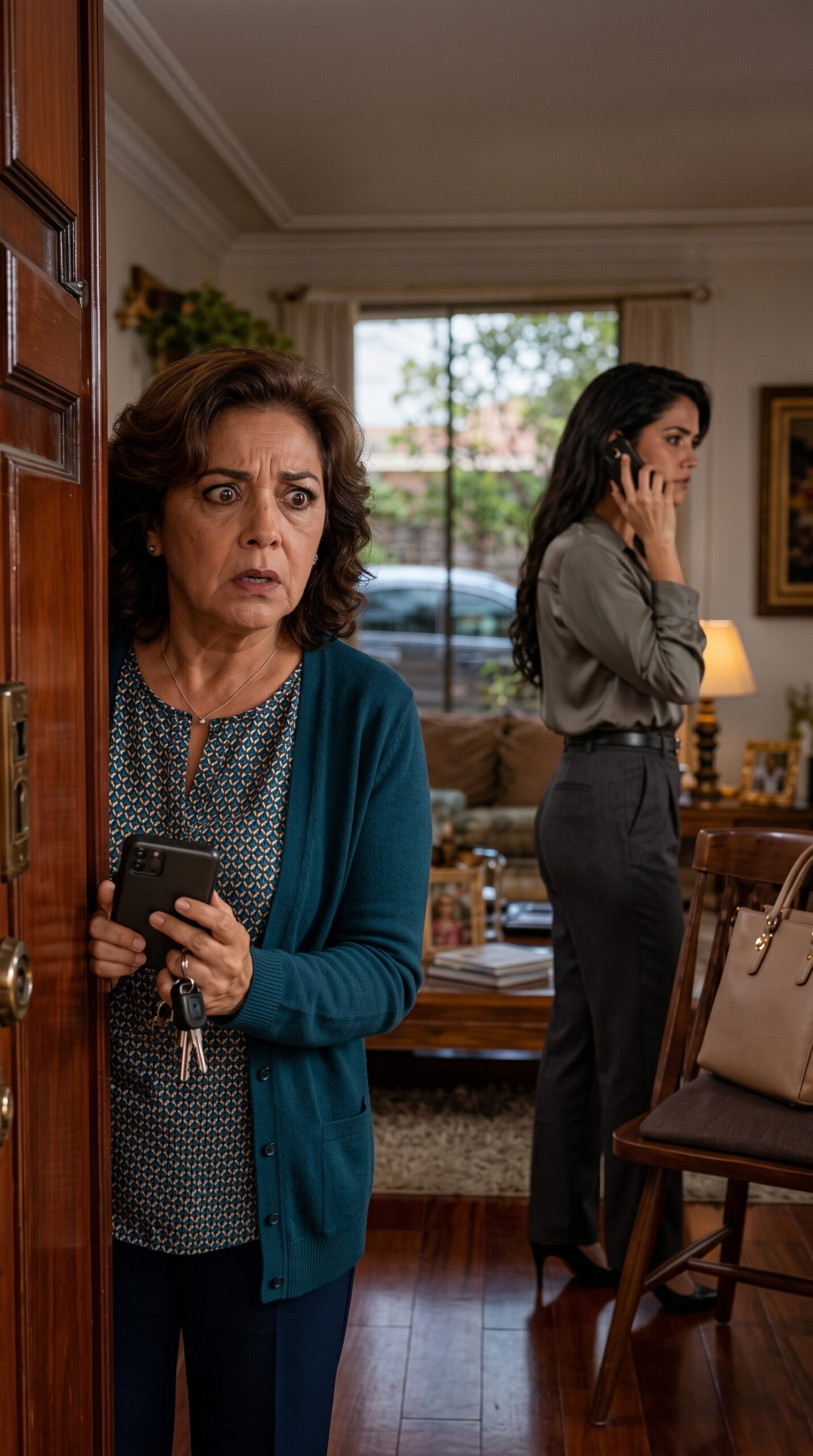
That Tuesday, Refugio entered without making a sound. The door was barely closed, and in the kitchen, she could hear Jimena’s voice talking on the phone.
She was going to announce herself, but a phrase left her frozen in the hallway.
—It’s done. I loosened the brake line. Tomorrow she’ll go down Bernardo Quintana, and that’ll be the end of the old lady.
Refugio felt the floor opening beneath her.
She didn’t drop the tortillas.
She didn’t scream.
She just pressed against the wall, biting her lip, because she understood that if Jimena heard her, she might not make it through the night.
Jimena let out a soft laugh.
—No one will suspect, darling. An old lady, an old Tsuru, a heavy descent… they’ll say she lost the pedal. And my poor Iván will be so destroyed that he’ll sign everything.
Refugio closed her eyes.
For six years, she had endured disdain to avoid pushing Iván away. Jimena cried every time Refugio tried to tell her something.
She claimed her mother-in-law hated her.
That she wanted to separate them.
That she was meddling in their marriage.
And little by little, Iván started to repeat words that were not his own.
—Mom, you’re exaggerating.
—Mom, Jimena also has the right to feel uncomfortable.
—Mom, you can’t live as a victim all the time.
Each phrase hurt more than a slap, but Refugio remained silent.
Until that moment.
Because one thing was to be humiliated in her own kitchen.
Another was to hear her daughter-in-law planning her death as if she were clearing a table in a restaurant.
With trembling hands, Refugio took out her cellphone and activated the recorder.
Jimena kept talking.
—After the accident, Iván won’t be able to think. I’ll tell him to sell his mom’s house, that we’ll move to San Miguel, and you’ll handle the paperwork. All nice and tidy.
Refugio felt nauseous.
It wasn’t just hate.
It was a business.
She exited slowly, just as she had entered. She walked to her white Tsuru parked in front of the house and looked at it in terror.
Then she called Chuy, the mechanic she’d known for 20 years.
—Chuy, I need you to come right now. And don’t ask me anything.
When Chuy checked the car, he emerged pale from under the hood.
—Doña Refu… this wasn’t a malfunction. They left it ready to blow up when you hit the brakes hard.
She breathed deeply.
For the first time in years, she didn’t feel fear.
She felt cold rage.
—Then bring me a tow truck.
—To take it to the Public Prosecutor’s Office?
—Yes —she said—. But first, we’re going to visit Jimena’s mom.
PART 2
The tow truck arrived 40 minutes later.
Doña Refugio didn’t cry as she watched them load her Tsuru onto the platform. She only squeezed between her fingers a sheet torn from an old notebook, where she had written in firm handwriting:
“Mrs. Elvira: your daughter Jimena prepared this car to kill me tomorrow. Before the authorities come for her, I wanted you to see what you raised.”
Chuy read the note and said nothing.
He simply touched her shoulder with respect.
Jimena’s mother lived in an elegant private community in Juriquilla, where the houses seemed dust-free and the neighbors greeted each other as if everyone were important.
When the driver unloaded the Tsuru in front of the sandstone facade, he rang the doorbell and began recording with his cellphone, just as Refugio had asked him to.
Elvira Saldívar opened the door with oversized glasses, red nails, and a face of a woman used to looking down on others.
She read the note.
Then she glanced at the car.
Then at the driver.
—What kind of nonsense is this?
—I’m just delivering what I was asked, ma’am —he replied.
Elvira folded the sheet in anger, but her hands trembled.
In that instant, Refugio’s phone began to ring.
It was Iván.
He called once. Then twice. Then five times.
Refugio sat in Chuy’s workshop, with the mechanic’s report in her lap, the audio saved on her phone, on Chuy’s phone, and in the email of a trusted neighbor.
She wasn’t going to make the mistake of confronting Jimena empty-handed.
On the sixth call, she answered.
—Mom, what did you do? —Iván shouted—. Jimena is crying. She says you sent a tow truck to her mom’s house to humiliate her. Have you seen how far you’re going?
Refugio felt the blow to her chest, but didn’t break.
It was the same old script.
Jimena was crying.
Iván was rushing.
Refugio was left as the villain.
—Iván, lower your voice.
—No, Mom! Enough. Jimena says you’re obsessed with destroying our marriage.
—Your wife cut the brakes on my car.
There was silence.
A thick, ugly silence, as if someone had shut off the world.
—What did you say?
—That Jimena planned to kill me tomorrow.
Iván let out a nervous laugh.
—Mom, please. I know you don’t get along, but that’s too much. Jimena may be intense, but she’s not a criminal.
Refugio looked at Chuy, who was clenching his jaw.
—I’m going to send you 25 seconds of audio. After that, you decide whether you keep defending her.
She hung up.
She sent the recording.
Jimena’s voice came clear, without fear, without guilt:
“I loosened the brake line. Tomorrow she’ll go down Bernardo Quintana, and that’ll be the end of the old lady. No one will suspect.”
Iván didn’t respond for 12 minutes.
Then he appeared in the workshop with his shirt half-tucked, red eyes, and the face of a man who had just discovered his home was a lie.
—Mom… —he barely said.
Refugio didn’t get up.
Not because she didn’t love him.
But because for six years, he hadn’t gotten up when Jimena trampled on her.
Iván walked toward her and stood there, unsure what to do with his hands.
—I’m sorry. I didn’t know.
—You knew —Refugio said, soft but firm—. You didn’t know about the brakes, but you knew how she spoke to me. You heard it many times. You just chose to do nothing.
Iván lowered his gaze.
That reproach hurt him more than the audio.
Refugio played the full recording for him.
Iván listened to Jimena talking to a man she called “my love.” He heard how they calculated the descent, the time, the bank, the funeral, and even the way he was supposed to cry.
But when the phrase about the house came, Iván froze.
—After the accident, he’ll sign the sale. With the guilt, I’ll make him soft. You prepare the contract, and we’ll take off with the money.
Iván swallowed hard.
—Who is that man?
Refugio looked at him with old sadness.
—Licenciado Mauro, the one Jimena brought over three times to the house claiming he was a property advisor.
Iván felt a chill down his spine.
He remembered Mauro sitting in the living room, with his expensive watch, saying it was better to “organize the assets” before Refugio got sicker.
He remembered Jimena insisting that Refugio’s house should be transferred to Iván’s name.
He remembered his own cowardice.
—I told her not to press —he murmured.
—But you let her pressure me —Refugio answered.
Iván’s cellphone began to ring.
Jimena.
He answered on speaker.
—My love, where are you? Your mom is crazy. My mom is shaking. She says she sent a beat-up car to the private community to make us look bad.
Refugio closed her eyes.
That sweet voice was the same one she used at Christmas when she served romeritos and said family was the most important thing.
Iván took a deep breath.
—Who is Mauro?
Jimena’s voice barely changed.
—What?
—I asked you who Mauro is.
—Oh, Iván, don’t start with your insecurities. He’s a lawyer. You know that already.
—In the audio, you call him “my love.”
There was another silence.
Small.
But deadly.
—Your mom edited that —Jimena said—. That lady is sick. She always wanted to see you alone, glued to her skirts. Seriously, how boring with your mom.
Iván gritted his teeth.
Refugio noticed her son was trembling, but this time not out of doubt.
—You also said you cut the brakes.
Jimena let out a fake laugh.
—Are you really going to believe that resentful old lady over me?
The word “old lady” fell like a stone.
Iván turned to look at Refugio.
And for the first time, he saw what he had chosen not to see for years.
—My mom has audio, a mechanic’s report, video of the car, and a witness —he said—. Let’s go to the Public Prosecutor’s Office.
Jimena stopped pretending.
—If you do that, I’ll sink you. I’ll say you wanted to sell the house. That you asked me for help. That your mom invented everything to not give you anything. Don’t be an idiot, Iván. Without me, you’re nobody.
Iván hung up.
He went pale.
—Mom, we have to move.
—We already moved —Refugio replied.
At that moment, a patrol car entered the workshop.
Then a unit from the Prosecutor’s Office arrived.
Iván looked at her in surprise.
Refugio was not the confused old lady Jimena described.
She had been the head nurse in the emergency room for 34 years. She knew how to act when someone was losing blood, when a family was screaming, and when a second of doubt could cost a life.
That’s why she had called 911, sent the audio, and asked Chuy not to touch any more parts of the car.
Everything was documented.
That same afternoon, they filed the complaint.
Chuy testified.
The tow truck operator delivered the video.
Elvira, cornered in her own community, had to admit she received the car and the note, although she tried to say that Refugio was “a troublesome lady.”
But the real blow came when the agents entered Iván and Jimena’s home.
In the bedroom, they found a laptop hidden in a suitcase.
Inside were messages from Jimena to Mauro.
They weren’t from a few days ago.
They were from 18 months.
There were photos of Refugio’s documents, screenshots of deeds, property value calculations, and a folder labeled “Plan After.”
In that folder was a list with steps written as if it were a recipe.
“Cry in front of Iván.”
“Do not allow autopsy.”
“Push for cremation.”
“Sell house quickly.”
“Use pregnancy to bind him.”
Iván read that last line and felt air leaving him.
Jimena had been telling him for two months that she wanted to have a child.
That a baby would unite them.
That Refugio would stop interfering when they were “a real family.”
But in the messages, Jimena wrote to Mauro:
“If that fool gets pregnant, Iván will sign even with blood.”
The phrase broke him completely.
Because he understood that even the future they promised him wasn’t his.
It was another trap.
When they went for Jimena at Elvira’s house, the scene was worse than any neighborhood gossip.
Jimena came out in expensive sweats, her hair loose, and her face disheveled.
First she screamed.
Then she cried.
Then she tried to faint.
But when an officer asked her to put her hands out front, her act fell apart.
—That old lady ruined me! —she shouted—. I just wanted to live better! Iván never had ambition! His mom had a house, land, and pretended to be humble!
The neighbors came out with their cellphones.
Elvira tried to silence her.
—Jimena, please, don’t say anything else.
Jimena turned against her mother.
—You told me not to be foolish! You said that if I married a regular man, I had to ensure something!
Elvira froze.
Her pearl necklace no longer looked elegant.
It looked like a chain.
Iván arrived just as they were putting Jimena into the patrol car.
She saw him and changed again, like a cheap telenovela actress.
—My love, help me. I got scared. Your mom always treated me badly. I wasn’t going to do it. I was just angry.
Iván walked up to her.
Refugio felt fear.
For a second, she thought her son would fall again.
But Iván simply said:
—The worst part wasn’t that you wanted to kill my mom. The worst part was that I gave you six years to make her feel alone.
Jimena stopped crying.
She understood she had nowhere to hide anymore.
Mauro fell two days later at a booth heading to Celaya, with three cellphones, cash, and copies of Refugio’s documents.
The investigation revealed he wasn’t the first to “advise” families to move properties from elderly adults.
Jimena was charged with attempted murder, property damage, and conspiracy with Mauro.
Elvira hired expensive lawyers, sold jewelry, and still ended up being pointed at by everyone. No one in the community invited her to Thursday coffee anymore.
Iván filed for divorce.
He also left the house he shared with Jimena and went back to rent a simple apartment because he said he didn’t deserve to sleep peacefully yet.
For weeks, he visited Refugio every day.
She welcomed him in the living room but with distance.
She served him coffee from the pot.
She asked if he had eaten.
But she didn’t hug him.
Iván accepted every silence because he knew that forgiveness wasn’t a tortilla that could be heated in a minute.
One Sunday, he arrived with a cardboard box.
Inside were photos from when Refugio took him to elementary school, receipts for uniforms, prescriptions for medications she stopped buying to pay for his courses, and a letter from his dad, who died when Iván was nine.
Iván cried in front of her.
—You raised me alone, Mom. And I let someone treat you like you didn’t matter.
Refugio looked at her son.
She saw him as an adult, defeated, but she also saw the little boy who once promised her he would never leave her.
—Love isn’t just shown by saying “I love you” on Mother’s Day —she said—. It’s shown when someone disrespects you and you don’t stay silent.
Iván nodded, with a wet face.
That day there was still no hug.
But Refugio poured him another cup of coffee.
And for them, that was the first bridge.
Months later, in the hearing, Jimena entered dressed in beige, without heavy makeup and with a soft voice.
She said she was depressed.
That Refugio had rejected her from the start.
That Mauro had manipulated her.
That she never thought the plan would go so far.
Then the prosecutor played the full audio.
The room heard the phrase that sank her:
“When the old lady dies, Iván will be so broken that he won’t even ask.”
Refugio didn’t cry.
Iván did.
Jimena was sentenced.
Refugio fixed her Tsuru, though it took her a long time to drive it again. The first time she went out, Iván was in the passenger seat, silent, attentive to every intersection.
As they drove down Bernardo Quintana, Refugio pressed the brake gently.
The car responded perfectly.
Iván released the breath he had been holding for months.
Refugio glanced at him.
—Brakes can be fixed, son. Trust can also be worked on… but it never returns to being the same.
He lowered his head.
They continued moving forward in silence.
Because justice doesn’t return the years a mother swallowed tears to avoid losing her son.
It doesn’t erase the canceled Sundays.
It doesn’t erase the cruel words spoken in a sweet voice.
But it leaves a truth that many children should hear before it’s too late:
when a mother remains silent to avoid breaking the family, it doesn’t mean she doesn’t see.
Sometimes she’s just waiting for the lie to confess itself.