PART 1
The Thursday Natalia returned from Texas without warning, her mom’s house smelled of confinement, damp clothes, and old sadness.
It had been three years since she left for the other side after her dad died of a heart attack in the middle of the cornfield.
Someone had to send money.
Someone had to hold the house together.
And that someone was her.
Her younger sister, Rocío, stayed in San Miguel de Allende, in the yellow-walled house where they grew up.
Everyone understood it without saying it.
Natalia sent dollars every month.
Rocío took care of Señora Elvira.
At first, Natalia called every Sunday, and her mom answered with a tired but cheerful voice.
—I'm here, my girl. Just keep pushing. Don’t worry about me.
Then the excuses started.
—She’s sleeping.
—She just got a shot.
—She woke up feeling delicate today.
Natalia wanted to believe it.
She needed to believe it.
Because there, she cleaned offices at night, took care of kids during the day, and barely slept four hours.
Every month she sent 14,000 pesos.
She told Rocío:
—Make sure she has everything. No lack of medicine, food, diapers, or consultations.
Rocío always replied the same:
—Yes, Nati. I’ll take care of it.
The last time she truly heard her mom was in April.
Señora Elvira spoke softly, as if someone might scold her for saying too much.
—I don’t want to be poked anymore, daughter. Tell Rocío to let me rest.
Natalia nervously laughed.
—Oh, Mom, don’t say that. It’s for your own good. You have to keep fighting.
Then she hung up because she was late for work.
That memory burned her chest when she crossed the threshold of the house and saw that everything was different.
The master bedroom was empty.
The electric wheelchair she had bought with so much sacrifice was gone.
Neither the orthopedic mattress.
Nor the new blankets.
In the living room, an old television was on with no sound, a bucket of dirty water, and piled-up dishes.
Doña Chuy, the neighbor, peeked in from the hallway and crossed herself upon seeing her.
—Sweetheart… didn’t anyone tell you?
Natalia’s blood froze.
—Tell me what?
The woman lowered her gaze.
—They sold the wheelchair months ago. And hardly anyone sees your mom. They say they have her in the back room.
Natalia didn’t respond.
She rushed down the hallway.
The back room was the coldest, the one that faced the patio, the one they used to store boxes, old clothes, and tools.
She pushed the door open.
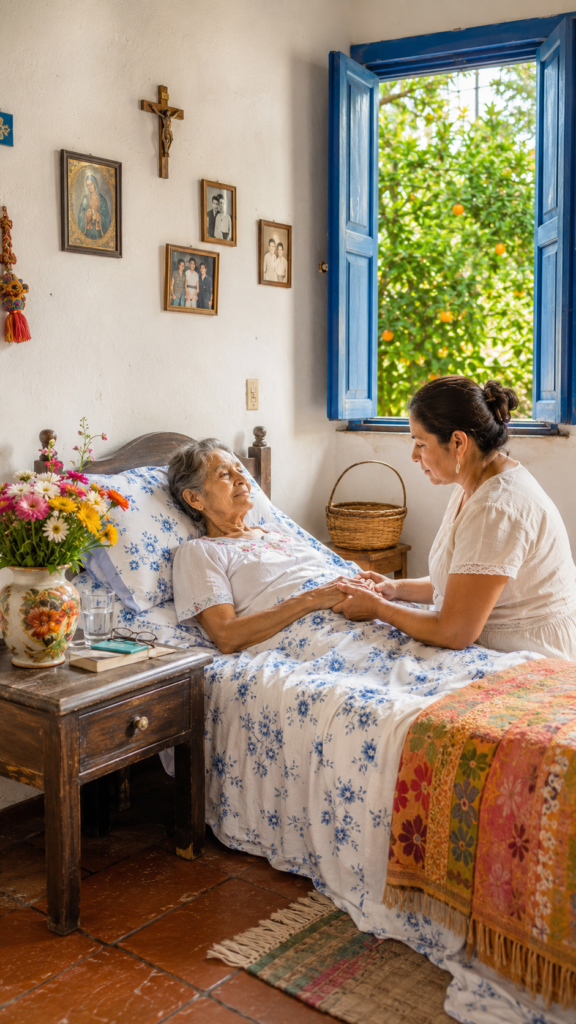
There was Señora Elvira.
Tiny.
Skinny as a shadow.
In a stained nightgown clinging to her body with trembling hands beneath a thin blanket.
Natalia felt the world split open.
—Mom…
The old woman barely turned her head.
Her eyes recognized her.
They filled with tears.
Natalia wanted to hug her, but first, she searched for clean clothes in the closet.
She opened a broken door, and a heavy black bag fell to the floor.
It was heavy.
Tied with a double knot.
She opened it with her nails, desperate.
Inside were the boxes of medicine.
All of them.
Sealed.
Intact.
The ones she paid for every month from the United States.
Not a single one was missing.
Natalia felt nauseous.
She counted mentally.
Three years.
14,000 pesos a month.
Her mom dying in a cold room while the medicines lay hidden like trash.
She stormed out with the bag dragging behind her in the hallway.
She found Rocío in the kitchen, washing the same glass over and over again.
She was emaciated.
With her hair tied back, sunken face, and an old shirt that Natalia recognized from before she left.
But anger blinded her from seeing that.
—Where’s the money? —she shouted.
Rocío did not respond.
—Where’s the wheelchair? Where are the consultations? What did you do with my mom?
The water kept running.
Natalia grabbed her arm and forced her to turn around.
—Answer me, Rocío! You have her locked up like an animal!
Rocío looked at her without crying.
That was the most frightening part.
She didn’t seem guilty.
She seemed broken.
—You weren’t here —she barely said.
—Because I went to support you both!
Rocío let out a dry, tiny laugh, without joy.
—You sent money, Nati. I was cleaning the blood from her mouth at three in the morning.
Natalia threw the black bag at her feet.
The boxes scattered across the kitchen.
—This is killing her slowly!
Rocío crouched down, picked up a box, and pressed it to her chest.
Then she said something that left Natalia breathless.
—I didn’t hide them to throw them away. I hid them so you wouldn’t force her to keep taking them.
PART 2
Natalia stood frozen, mouth agape and trembling hands.
—Force her? —she whispered—. It’s her treatment, Rocío. It’s the only thing that could save her.
Rocío slowly shook her head.
Her eyes were dry, but her face was breaking inside.
—No, Nati. I wasn’t saving her anymore. I was burning her alive.
Natalia felt anger rising again.
—Don’t make things up. Are you going to say that Mom wanted to die now?
From the back room came a soft moan.
The two sisters turned at the same time.
Rocío took off her apron, reached into the bag, and pulled out a folded envelope, dirty from being carried around.
—She made me promise not to tell you over the phone —she murmured—. She said you would come when you needed to come.
Natalia snatched the paper from her.
She recognized her mom’s handwriting.
Crooked.
Trembling.
The same handwriting that left her little notes in her lunch box when she was in middle school.
At the top, it read:
“Nati.”
The first line hit her like a slap.
“If you are reading this, you have seen what I didn’t want you to see. Don’t hate your sister. She is not hurting me. She is fulfilling what I begged her to do.”
Natalia continued reading.
At first aloud.
Then she couldn’t.
“I don’t want any more needles, daughter. I don’t want to vomit blood from medicines that don’t cure me. I don’t want to be taken to the hospital only to come back more exhausted. Forgive me for not telling you. I was afraid you would let everything go and come to see me die before my time.”
Rocío stood next to the stove.
She didn’t defend herself.
Didn’t explain.
Just waited.
Natalia lowered the letter.
She looked at her sister as if she was another person.
—Since when?
Rocío swallowed hard.
—Nine months ago, the oncologist said there was nothing more to be done. That the cancer was already in her bones, liver, and lungs.
Natalia closed her eyes.
She had sent money for a war that was already lost.
She had said every Sunday:
—Hold on, Mom. Keep fighting.
And unknowingly, she had asked her to endure a pain that had no reward anymore.
—Why didn’t you tell me? —she asked, her voice cracking.
Rocío leaned against the table.
It seemed like any word cost her her entire body.
—Because she forbade me. She said: “Your sister left to live, not to die with me little by little.”
Natalia crumpled the letter in her hand.
—She had the right to know.
—Yes —Rocío replied—. And I had a promise made to a dying woman. Choose which betrayal looks prettier, because none feel less ugly.
The kitchen fell silent.
Outside, a vendor shouted about sweet bread.
Life continued as if that house wasn’t collapsing inside.
Natalia walked to the back room.
Señora Elvira was awake.
She looked at the ceiling, breathing with difficulty.
When she saw Natalia, she searched for her hand.
—Is it true, Mom? —she asked, though the letter already said it all.
Señora Elvira slowly shook her head.
A tear rolled down to her ear.
—No… more —she said in a thread of voice.
Natalia sat beside her and kissed her fingers.
They smelled of cream, medicine, and tired skin.
For the first time since entering that house, she didn’t see abandonment.
She saw shame.
She saw pain.
She saw a woman who had wanted to hide her end so her daughters wouldn’t have to carry it.
That night, when Señora Elvira fell asleep, Rocío placed a shoebox on the table.
—Open it —she said.
Natalia obeyed.
Inside were receipts.
All organized by date.
Rent for the oxygen tank.
Adult diapers.
Gauze.
Gloves.
Cream for the sores.
Payment to a nurse who came twice a week.
Used hospital bed.
Morphine.
Private consultations when the Seguro gave them appointments months later.
There was also a receipt for the sold wheelchair.
Natalia picked it up.
—You sold it.
—Yes —Rocío said—. Because Mom couldn’t sit anymore. The wheelchair hurt her hip. With that, I bought the bed with rails.
Natalia covered her face.
Every single thing she had interpreted as cruelty had another explanation.
A sadder one.
A more human one.
—And the back room? —she asked—. Why there?
Rocío looked towards the hallway.
—Because Mom didn’t want to be seen like that. Doña Chuy would come in all the time to pray, and then the whole town would know if she got dirty, cried, or couldn’t swallow anymore. Mom asked me for that room because it faced the patio and she could hear the birds without people looking at her with pity.
Natalia felt something breaking inside her.
—I came thinking you were a monster.
Rocío shrugged.
—Half the town thinks that. A neighbor even called me a murderer. Another said I was spending your money on a man. Seriously, Nati, it didn’t even hurt anymore.
—Why didn’t you defend yourself?
Rocío lowered her gaze.
—Because to defend myself, I had to tell how Mom was. And she didn’t want her end to be market gossip.
Natalia cried then.
Not like in the movies.
Not prettily.
She cried with rage, with snot, with shame.
She knelt in front of her sister and hugged her waist.
—Forgive me. I said horrible things to you.
Rocío didn’t respond immediately.
Then she stroked her hair like when they were girls.
—You were alone there too, blonde. Don’t pretend to be strong with me.
That phrase disarmed her more than any accusation.
Because it was true.
Natalia had survived three years believing that sending money was love.
Rocío had survived three years believing that staying silent was care.
And Señora Elvira had survived three years trying to ensure that neither of her daughters completely broke.
At four in the morning, the sound of breathing changed.
It was a dry, deep sound, as if the air no longer wanted to enter.
Rocío woke first.
She ran to the room.
Natalia followed her with the cellphone in hand.
—I’m going to call emergencies.
Rocío grabbed her wrist.
—Wait.
—She’s choking!
—Nati, read the last part of the letter.
Natalia didn’t want to.
Her entire body screamed to do something.
To call.
To lift her to an ambulance.
To save her.
But Rocío opened the envelope and pointed to the last paragraph.
Natalia read with her eyes filled with tears.
“When my time comes, don’t let them take me to poke me again. I don’t want three more days of tubes, or doctors talking to me as if I’m no longer here. Let me go at home. I want to see my daughters’ faces. Not the lamp of a hospital.”
The cellphone kept dialing.
Someone answered on the other end.
—Emergencies, what is your situation?
Natalia looked at her mom.
Señora Elvira had her eyes open.
She didn’t seem to be asking for help.
She seemed to be asking for permission.
Natalia hung up.
Rocío exhaled as if she had been carrying a huge stone.
The two climbed onto the bed, one on each side.
Natalia took her right hand.
Rocío took the left.
Señora Elvira moved her lips.
Not everything was understood.
Only one word:
—Girls…
Natalia whispered in her ear.
She told her that she remembered the Sundays with mole.
Of when she did her hair for elementary school.
Of the scoldings for being late.
Of the burned tortillas that her dad would eat so no one would feel bad.
Rocío softly sang a song by José José, off-key and trembling.
Señora Elvira passed away 18 minutes later.
Without needles.
Without an ambulance.
Without strangers.
In her home.
With her daughters holding her hands.
They dressed her in her blue flowered dress.
Put on small earrings.
Styled her hair with a side part, just as she liked it.
None cried while they did it.
It was as if they were still caring for her.
As if the tears could wait just a little longer.
The wake was the next day.
Half the town showed up.
Uncles who never asked if Rocío needed anything also came.
Cousins who hadn’t brought a single broth.
Neighbors who had invented stories from the sidewalk.
Doña Chuy hugged Natalia and whispered in her ear:
—I’m glad you came, sweetheart. Your sister was neglecting her a lot.
Natalia tensed.
Rocío, from the other side of the coffin, shook her head.
It was a minimal gesture.
Don’t say anything.
Natalia understood.
Her mom had protected her dignity until the last day.
Rocío was willing to carry the bad reputation so that no one would remember Señora Elvira as a woman consumed by illness.
But Natalia couldn’t stay silent any longer.
She took a breath and stood in front of the coffin.
Didn’t recount details.
Didn’t talk about blood, or diapers, or nights of pain.
Just said:
—My sister took care of my mom until her last breath. And anyone who wasn’t here carrying a full night might as well close their mouth.
The room fell silent.
Rocío lowered her gaze.
Didn’t smile.
But for the first time in a long time, her shoulders seemed to relax.
After the burial, when the house was empty, Rocío took Natalia to Señora Elvira’s room.
She pulled out a small wooden box from the wardrobe.
—This was also for you.
Inside was an old cellphone.
One of those with almost no memory.
Rocío turned it on carefully.
—Mom didn’t know I sometimes recorded. I was afraid of forgetting her voice.
There were videos.
Dozens.
Señora Elvira drinking coffee from a red cup.
Señora Elvira scolding a skinny cat that sneaked through the patio.
Señora Elvira laughing because Rocío burned the beans.
Señora Elvira brushing her hair slowly, her face swollen from medicines, but still charming.
Natalia put a hand to her chest.
While she cleaned offices in Texas and said, “I’m almost saving to go back,” Rocío had been saving pieces of their mom for her.
Not to accuse her.
Not to make her feel guilty.
So that she wouldn’t arrive too late for all the memories.
The last video was from April.
Señora Elvira was in the back room.
She looked thin, but her eyes still sparkled.
Rocío recorded from the door, secretly.
Suddenly, the woman turned as if she knew.
Looked straight at the camera.
—Tell my Nati not to cry so much —she said with a weak smile—. I never felt like you left. I felt like I was making my way.
Natalia covered her mouth to keep from screaming.
The video continued for a few more seconds.
Señora Elvira took a deep breath and added:
—And tell Rocío not to believe everything they tell her. Caring is also loving even if no one applauds it.
Rocío broke down crying for the first time.
It wasn’t a loud cry.
It was a tiny sob, of a tired girl.
Natalia hugged her.
They stayed on the floor, next to the wardrobe, watching the video over and over again.
Outside, the town kept talking.
Always talking.
Some said Natalia came to seek justice.
Others that Rocío was hiding something.
Others that Señora Elvira suffered because of both.
But the truth doesn’t always fit in the tongue of the people.
Sometimes the truth is a black bag full of untouched medicines.
In a shoebox with receipts.
In a trembling letter.
In a sister who accepts being hated to protect her mother’s last shame.
Natalia didn’t return to Texas immediately.
She stayed for 40 days.
Fixed the house.
Paid debts.
Sat every afternoon with Rocío in the patio.
Sometimes they talked.
Sometimes they didn’t.
One Sunday, Natalia found the black bag still in the kitchen.
The medicines were still there.
Sealed.
Heavy.
Like an accusation that had lost its meaning.
Rocío asked:
—What do we do with that?
Natalia looked at her for a long time.
Then said:
—Nothing. Let them stay there a little longer. So we don’t forget that sometimes we judge with our eyes before listening with our hearts.
That night, Natalia watched her mom’s last video again.
She turned down the volume as if the house were sleeping.
And although Señora Elvira had asked her not to cry so much, Natalia cried anyway.
Cried for arriving late.
Cried for accusing the one who cared the most.
Cried because she understood that sending money helps, but it doesn’t embrace.
And cried because in Mexico, like in so many families, there’s always a daughter who leaves to save everyone and another who stays to break in silence.
The question Señora Elvira left wasn’t who loved more.
The question was more cruel:
How many times does a family need a tragedy to understand that caring can also look like abandonment when no one knows the whole truth?