PART 1
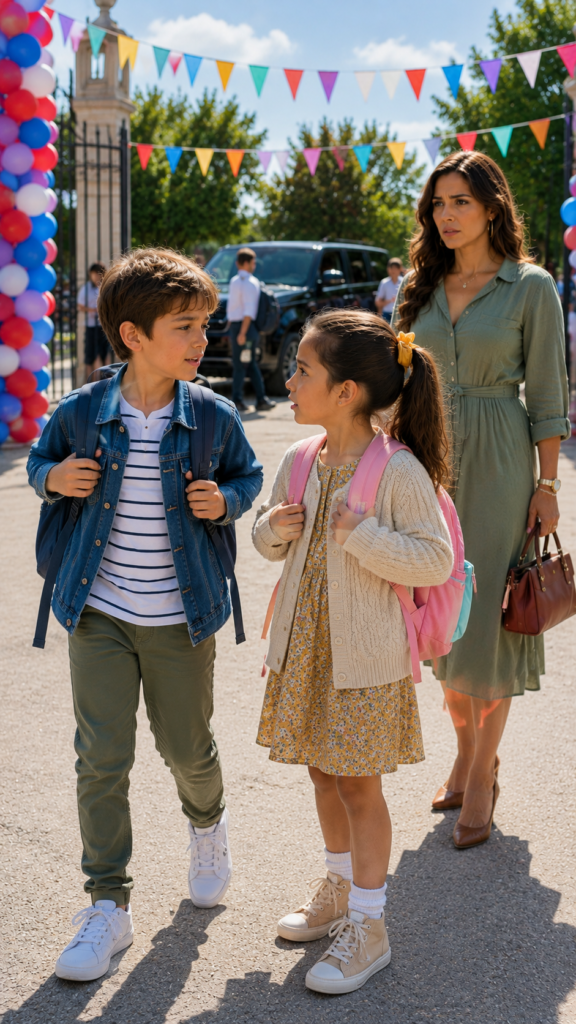
—Can I borrow your mom for a bit?
Jimena stopped fixing her ponytail and looked at the boy with the seriousness of someone who just heard madness.
He was 8 years old, wearing an immaculate white shirt, an expensive child’s watch, and a backpack that seemed fancier than all the dads’ put together.
But his eyes didn’t match any of that.
They were the eyes of a tired child.
—My mom? —Jimena asked, clutching her glass of horchata.
The boy nodded.
—Just for the activity. I’ll return her before the festival ends.
Luz, Jimena’s mom, listened from the concrete bench. She had arrived at the elementary school with a grocery bag full of ham sandwiches, bananas, jellies, and folded napkins.
She wasn’t an elegant lady.
She was a cashier at a pharmacy in Nezahualcóyotl, a single mother, one of those who got up before the sun rose and still asked at night if anyone wanted dinner.
—And why do you want my mom, kiddo? —she asked gently.
The boy lowered his gaze.
—Because today is family day.
The answer hit like a lead weight.
In the playground, a cumbia played, teachers rushed around with lists in hand, and dads prepared to compete in ridiculous games with more enthusiasm than necessary.
But that boy kept staring at the gate.
As if he were waiting for someone he already knew wouldn’t arrive.
—What’s your name? —Luz asked.
—Emiliano.
—And who was coming with you?
Emiliano swallowed hard.
—My dad said he was coming. My nanny was too, but she got sick.
Jimena looked at her mom and then at the boy. She was 9, but she understood more than any adult ever wanted.
—Then it’s settled —she said—. Today you’re on our team.
Emiliano’s eyes widened.
—Just like that?
—Yeah, dude. But if we lose, don’t cry.
Luz shot her a look.
—Jimena.
—Okay, don’t cry too much.
Emiliano let out a small, almost hidden laugh.
The first activity was the sack race. Jimena jumped like a frantic grasshopper. Emiliano tried to keep up, but he fell down repeatedly.
Luz ran alongside, shouting:
—Slow down, you’re not running for president!
They lost by a mile.
Jimena blamed the sack. Emiliano blamed his shoes. Luz blamed both of them for thinking they were Olympic athletes.
For the first time that morning, Emiliano stopped looking at the entrance.
Later, they sat under a tree. Luz took out the sandwiches wrapped in napkins and gave each of them their jelly.
Emiliano didn’t touch anything.
—Don’t you like it? —Jimena asked.
—I do like it.
—Then eat.
He pressed his fingers against his knees.
—I just don’t want to take food away from you.
Luz felt something break inside her. She didn’t show pity. She didn’t expose him. Just pulled out another sandwich, as if it had always been for him.
—Here, nobody takes anything from anyone, kiddo. Mexican moms always bring food for half the class.
Emiliano took the sandwich carefully.
He took a bite.
Then another.
And suddenly, he whispered very softly:
—No one has ever made me a sandwich for school.
Jimena stopped chewing.
So did Luz.
The music kept playing, the kids kept shouting, the dads kept taking pictures.
But in that shadow, a strange silence settled.
Emiliano tried to smile, as if he had said something trivial.
—It’s really good, ma’am.
Luz swallowed hard.
—My name is Luz.
—Yes, Mrs. Luz.
Jimena pushed her jelly towards him.
—Take mine too.
—I already have one.
—Well, now you have two. Borrowed kids eat double.
Emiliano finally smiled genuinely.
Then a white truck sped into the parking lot. A man in a blue suit got out, talking on the phone, wearing sunglasses and a face that poorly concealed guilt.
Emiliano recognized the engine before he saw it.
His smile faded.
The man walked toward them.
Any child would’ve run to their dad after waiting for him all morning.
Emiliano didn’t move.
He just left the sandwich on the napkin, as if suddenly he no longer had permission to be happy.
PART 2
Sebastián Rivas put away his phone when he saw his son sitting on the ground, next to a disheveled girl and a woman with horchata stains on her blouse.
He didn’t make up traffic.
He didn’t say a meeting had run late.
He didn’t pretend he was arriving on time.
He just crouched down in front of Emiliano.
—I’m sorry, son.
Emiliano nodded.
Not with anger.
Not with relief either.
He nodded like the children who have learned that complaining doesn’t do much good.
Luz saw that gesture and her chest tightened. She had seen kids throw tantrums for less. But Emiliano wasn’t crying. He wasn’t demanding. He wasn’t asking.
As if he already knew how to guard himself against pain.
Before leaving, the boy looked at Jimena.
—Thanks for lending me your mom.
Jimena lifted her chin.
—You behaved well. Maybe I’ll lend her to you another day.
Luz wanted to correct her, but she couldn’t. Because Emiliano smiled just slightly, and that smile was worth more than any rule of good manners.
Sebastián thanked her with careful words. It was clear he was a man of means, one of those used to having life open up with a call.
But there was something different in his eyes.
It wasn’t arrogance.
It was fear.
Luz stood up and told him directly:
—Sir, children aren’t raised with drivers or credit cards. They are raised by showing up.
Sebastián didn’t respond.
He just looked at Emiliano, who was already walking toward the truck without turning back.
That phrase followed him all the way home to Bosques de las Lomas.
Sebastián’s house looked like it came out of a magazine: black gate, cameras, perfect garden, clean pool, huge living room, and employees who spoke softly.
Everything sparkled.
Nothing embraced.
Emiliano went up to his room without asking for permission. His room had video games, imported toys, new books, and a giant bed.
But on the nightstand, there were no drawings.
No photos taped up.
Not a single thing made by hands that loved him without expecting something in return.
That night, Sebastián stayed in his study without touching dinner.
His assistant, Tomás, walked in with a folder of contracts.
—I canceled the Monterrey meeting for tomorrow, as you requested.
Sebastián didn’t look up.
—Thanks.
Tomás hesitated.
—Emiliano laughed today.
The silence grew heavier.
Sebastián tightened his grip on the pen.
—What did you say?
—He laughed. The driver heard him on the way back. He said he was telling a story about a sandwich and a girl who called him “borrowed kid.”
Sebastián covered his face with a hand.
It had been months since he had heard his son laugh like that.
The story went back much further.
Paola, Emiliano’s mother, had left when he was 5. She hadn’t left alone. She left with money, jewelry, documents, and a man who had worked for Sebastián.
Then came lawsuits, lies, interviews, lawyers, and a dirty custody battle.
Paola didn’t want to raise Emiliano.
She wanted to use him.
When the judge denied her primary custody, she disappeared for stretches of time. Sometimes she sent expensive gifts. Sometimes she called crying. Sometimes she promised to see him and didn’t show up.
Sebastián, hurt and distrustful, decided to shield everything.
He changed personnel.
Installed cameras.
Hired formal nannies, discreet drivers, tutors, and security.
He believed protecting his son meant keeping anyone from getting too close.
Without realizing, he also left him alone.
The next day, at breakfast, Emiliano stirred his cereal without enthusiasm.
—Dad.
—What?
—Can I go to Jimena’s house one day?
The nanny looked up.
Tomás, who was reviewing some papers by the door, pretended not to hear.
Sebastián stayed still.
He expected his son to ask for another toy, a trip, a new console.
Not for a small house in Neza.
—Yes —he finally replied—. But I’ll take you.
Emiliano didn’t shout with excitement.
He just smiled.
And for Sebastián, that was enough.
The following Saturday, the white truck stopped in front of a street where fruit stands coexisted with dogs lying in the sun, gossiping neighbors, and kids playing soccer with a crushed bottle.
Luz’s house was small, painted yellow, with flower pots at the entrance and laundry hanging on the rooftop.
It smelled of beans, toasted bread, and pine cleaner.
Jimena opened the door with a huge smile.
—The borrowed kid has arrived!
—I have a name —Emiliano said.
—Yeah, but that one’s cooler.
From the kitchen emerged Don Nacho, Luz’s dad. He had a white mustache, a striped apron, and a wooden spoon as if it were a scepter.
—Who finished my conchas?
Jimena pointed at Emiliano without thinking.
—Him.
Emiliano panicked.
—I haven’t even entered yet!
Don Nacho looked at him seriously.
—Fast thief. Extremely dangerous.
Jimena ran out to the yard. Emiliano stood frozen, unsure if it was a joke or a reprimand.
Then Don Nacho took a dramatic step toward him.
—Catch him!
Emiliano burst into laughter and chased after Jimena.
Sebastián, standing in the living room, felt a blow to his chest.
It wasn’t pure sadness.
It was something stranger.
It was seeing his son alive in a place with neither marble nor private security.
In the following weeks, the visits became routine.
Luz never treated Emiliano like a special guest. She gave him a plastic plate, sent him to wash his hands, and scolded him if he left toys lying around.
Jimena dragged him into absurd fights over the rules of Uno.
Don Nacho taught him how to make lemonade, plant cilantro, and discern when a bolillo was good for frying.
Sebastián started staying for 10 minutes.
Then 30.
Then a whole afternoon, drinking instant coffee from a chipped mug that said “Best Grandpa in the World.”
Luz didn’t flatter him.
She didn’t chase him.
She didn’t ask him for anything.
That disarmed him more than any flirting.
One Sunday, while the kids played with water balloons, a gray car parked across the street.
Inside was Paola.
She wore large glasses, perfect nails, and a rage that trembled in her jaw.
She saw Emiliano laughing with Jimena.
She saw Luz cleaning his face with a napkin.
She saw Don Nacho putting an old cap on him so he wouldn’t get sunburned.
And she saw Sebastián watching them from the door, with a calm she didn’t remember.
Paola didn’t feel love.
She felt threat.
Three days later, Luz received a message from an unknown number.
“Stay away from the boy. You don’t know who you’re dealing with.”
She showed it to Sebastián that same night.
He went pale.
—It’s Paola.
—His mom?
—Yeah.
Luz put her phone away.
—Then talk to her.
—It’s not that easy.
—Of course not. But easy doesn’t mean right.
Sebastián remained silent.
Because he knew Luz was right.
That week he sought legal measures to limit any irregular approach from Paola. He also notified the school and reinforced Emiliano’s security.
But he didn’t imagine Paola would dare to cross another line.
The following Saturday, Luz was making quesadillas in the kitchen. Jimena and Emiliano were playing Lotería with Don Nacho in the yard.
—The drunk! —Jimena shouted.
—That’s me when my knee hurts —Don Nacho said.
Emiliano laughed.
Then the gate swung open abruptly.
Two men entered.
They didn’t ask for anyone.
They didn’t greet.
One of them wore a black jacket and had a hard look.
—Who is Luz?
She stepped out with the comal in hand.
—I am. What do you want?
The man pointed toward the street.
—You’re going to stop meddling with other families.
Jimena hid behind her mother.
Emiliano didn’t run.
He didn’t scream.
He just stood still, with a Lotería token clenched in his hand.
And that’s what hurt Luz the most afterward: realizing that this boy already knew how to stay still when he was scared.
Don Nacho stood up slowly.
—Nobody comes here to threaten my daughter.
The man looked him up and down and laughed.
—Get lost, old man.
Don Nacho raised an eyebrow.
—Old your character. I’m Ignacio.
The guy shoved him.
Don Nacho fell against a flowerpot.
The thud sounded dry.
Jimena screamed.
Luz dropped the comal and ran toward her father.
But Emiliano reached him first.
He knelt beside Don Nacho, trembling.
—Are you okay? Does it hurt? Don’t fall asleep, Mr. Nacho.
The old man opened his eyes with effort.
—I wasn’t going to fall asleep, kid. I was just thinking about where to hit him.
The man advanced again.
Luz grabbed a broom from the yard.
She didn’t look like a movie heroine.
She looked like an angry Mexican mom.
—Take one more step and I’ll sweep you into the soul.
The second man hesitated.
The first smiled, but not for long.
Don Nacho, helped by Emiliano, stood up. He grabbed a plastic chair and threw it at the intruder’s shoulder.
The guy lost his balance and fell into a bucket of water.
Before he could get back on his feet, Don Nacho sat on him with all his weight.
Jimena’s mouth dropped open.
—Grandpa?
—Pest control —he said, adjusting his apron.
Neighbors emerged.
Doña Meche yelled from her window that she had already called the police.
A young man recorded with his cellphone.
The second intruder tried to flee, but Sebastián arrived at that moment with Tomás and two police officers who had been following him from the corner.
Sebastián jumped out in a panic.
—Emiliano!
The boy finally ran toward him.
Not in fear.
But in relief.
Sebastián hugged him so tightly it almost hurt.
—I’m okay, Dad —Emiliano said against his chest.
Sebastián looked at Luz, Jimena, and Don Nacho sitting on the aggressor.
—Did they hurt you?
Luz was breathing heavily.
—They pushed my dad.
Don Nacho raised his hand.
—But I won the second round.
The police took both men away.
On the detained man’s cellphone were messages, transfers, and audios.
All leading to the same name.
Paola Villaseñor.
Emiliano’s mother.
Hours later, at the Public Ministry, Paola arrived with perfect hair and rehearsed indignation.
—This is a disgrace. I am the boy’s mother.
The agent placed the cellphone on the table.
Then played an audio.
Paola’s voice filled the office.
—I don’t want any hard hits. Just scare her. Make her understand my son doesn’t need a ghetto mom.
Luz, who was sitting next to Sebastián, closed her eyes.
Sebastián clenched his fists.
Paola attempted to smile.
—That’s out of context.
The agent showed screenshots.
Payments.
Calls.
Locations.
Everything.
Every explanation from Paola unraveled before it could finish.
Then she dropped the mask.
—She’s trying to take my child away —she said, pointing at Luz—. A cashier, a nobody, wants to take my place.
Sebastián stood up slowly.
—Your place wasn’t taken by anyone.
Paola looked at him with disdain.
—Oh, really?
—No. It stayed empty for so long that Emiliano began to look for a place to sit.
The phrase hit like a stone.
Paola clenched her jaw.
—I am his mother.
Luz spoke for the first time.
—Being a mother is not just giving birth, ma’am. It’s also showing up when you promise to show up.
Paola turned toward her.
—You have no right.
—No —Luz said—. But he had the right to not feel alone.
Paola wanted to retort, but the agent announced that she would be detained while the file was prepared for threats, trespassing, injuries, and hiring third parties for intimidation.
For the first time, Paola didn’t scream.
She looked toward the door, where Emiliano was with Tomás, not fully entering.
The boy wasn’t crying.
He was watching her like someone looks at a familiar face, but distant.
That destroyed her more than the handcuffs.
That night, everyone returned to Luz’s house.
The gate was bent, a flowerpot was broken, the yard was wet, and the plastic chair was forever crooked.
But the kitchen smelled of hot chocolate.
Don Nacho was on the couch with a bag of ice on his shoulder.
Jimena sat on one side.
Emiliano on the other.
—Don’t look at me like I’m hospitalized —the old man complained—. I’m a warrior.
—You sat on a guy —Emiliano said, still impressed.
—Ancient Mexican technique.
Jimena burst into laughter.
Sebastián stayed in the doorway, watching that scene.
His son, who once ate alone at a huge table, now shared sweet bread with crumbs on his clothes.
Luz approached with two cups.
—You didn’t have to stay.
Sebastián took one.
—I did.
—For Emiliano?
He looked at the boy.
—For him. And because this house taught him something I couldn’t.
—What thing?
Sebastián swallowed hard.
—that being protected isn’t the same as being accompanied.
Luz said nothing.
The next morning, Sebastián sent for the gate to be repaired, the lock changed, and a light installed outside. Luz stepped out with her arms crossed.
—I don’t want you to think you can fix everything with money.
—I know.
—My house is not for sale.
Sebastián looked at her with respect.
—I’m not buying your house, Luz. I’m taking care of the place where my son learned to laugh again.
She lowered her gaze.
She didn’t smile.
But she didn’t close the door either.
Weeks passed.
Paola faced the legal process and lost any visitation without supervision. Sebastián began therapy with Emiliano and, for the first time, sat down to listen to him without checking his phone.
Emiliano continued going to Jimena’s house.
He no longer asked for permission.
He arrived with bread, homework, some plants for Don Nacho, or drawings to stick on the refrigerator.
One Saturday, Don Nacho gathered everyone in the yard.
He wore the same striped apron, though now it sported a stain he called a “battle medal.”
—I have an announcement.
Jimena whispered:
—Oh no, he’s going to say something weird.
Don Nacho pointed at Emiliano.
—You came asking to borrow a mom.
The boy looked down.
—And then you stole a sister, a grandpa, and half a refrigerator.
Jimena laughed.
—That’s true.
Don Nacho grew serious.
—But here we don’t lend family, kiddo.
Emiliano’s eyes filled with tears.
—So can I keep coming?
Jimena took his hand.
—You can’t keep coming.
He froze.
She smiled.
—You have to keep arriving. It’s different.
Luz wiped a tear with her sleeve.
Sebastián saw her.
That night, Don Nacho gave Emiliano an old notebook.
On the first page, it read:
“The Day a Boy Borrowed a Mom.”
Inside were memories written in shaky handwriting: the sandwich from the festival, the first laugh, the stolen conchas, the plastic chair, the afternoon Emiliano held his arm after the hit.
On the last page, Don Nacho had written:
“There are children born into a full house. And there are children who find family when someone saves them a place at the table.”
Emiliano read the phrase twice.
Then hugged the notebook to his chest and rested his head on the old man’s shoulder.
From the door, Sebastián understood that he had spent years paying for security, expensive schools, and new toys, while his son only needed someone waiting for him with a sandwich wrapped in a napkin.