PART 1
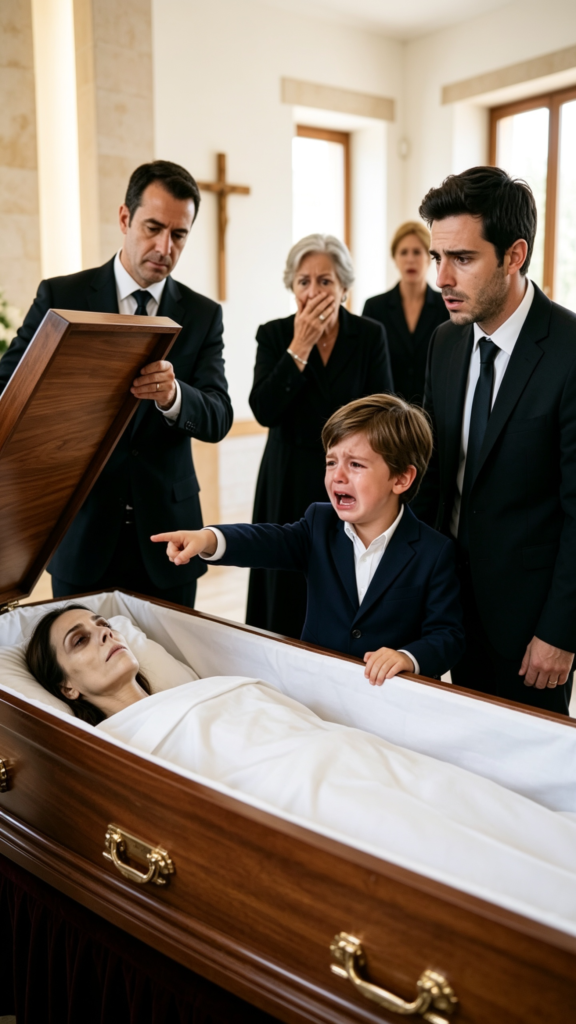
—If they nail that box shut, they’ll bury another woman.
Emiliano’s voice, a five-year-old boy, shattered the funeral like thunder.
No one prayed anymore. No one moved a chair. The candles continued to flicker on the table, beside Lucero's portrait, but the entire room froze.
Ramiro Santos, her husband, slowly lifted his face. His eyes were swollen, his two-day-old beard unkempt, and his black shirt stained with mud. Since the night before, he hadn't let go of Lucero's palm hat.
—Son… don’t say that —he whispered.
But Emiliano wasn't crying like his two little sisters. He stood by the coffin, clutching a red toy car to his chest, looking at everyone with a confidence that sent chills down spines.
—My mom talked to me —he said—. She said she’s cold. That her foot hurts. And that where she is smells like dried fish.
A murmur swept through the house.
Ramiro’s mother, Doña Candelaria, quickly crossed herself.
—This child is scared. He’s traumatized, poor thing. Get him out of here.
—I’m not scared! —Emiliano shouted—. That lady is not my mom!
The wake was held in a small metal and block house, in a town near Alvarado, Veracruz. Outside, the river was swollen from the rains. Inside, everyone repeated the same thing: Lucero had drowned.
Two afternoons earlier, she had left with a basin of clothes.
—I’ll just rinse the uniforms —she told Ramiro—. I’ll be back before dark.
Lucero was thirty-two, had three children, and a laugh that even made the neighbors turn their heads. Ramiro was a quiet bricklayer, one of those men who fix everything with wire, cement, and patience.
—Don’t go near the edge —he had asked her.
She laughed tenderly.
—Oh, Ramiro, you sound like my mom.
That was the last time he saw her walking toward the river, wearing a blue flowery shirt and her hair tied back.
When night fell and she didn’t return, Ramiro searched for her with a flashlight. He shouted her name until his throat was raw. The next morning, a fisherman reported that he had found a body caught among branches downriver.
The face was swollen. The water had distorted it. But the woman wore a blue flowery shirt.
Ramiro didn’t want to look closely.
He saw the clothes.
He saw the dark hair.
He saw the height.
And he broke.
—It’s her —he said, without a voice.
No one asked for an autopsy. No one called a forensic doctor. The municipal agent signed a paper, and everyone accepted the tragedy.
Until Emiliano pointed to the coffin.
—Mom says to check her hand —the boy said—. She says you know.
Ramiro felt his blood run cold.
Lucero had a scar on her right index finger, made with a knife while cutting limes. She also had a mole behind her left ear, dark, unmistakable.
He hadn’t checked anything.
He’d only seen the shirt.
—Open the coffin —he ordered.
—Ramiro, don’t make a scene —his father-in-law said, his voice trembling—. Let her rest.
—Open it!
The funeral home worker hesitated but lifted the cloth.
The smell hit the room. Several women covered their mouths. Ramiro stepped closer, trembling.
He took the hand.
There was no scar.
He searched behind the ear.
No mole.
The whole house ran out of air.
Ramiro stepped back as if pushed.
—It’s not Lucero —he said.
Doña Candelaria let out a scream.
—Holy God!
The municipal agent tried to close the coffin.
—This can’t be done like this. There are protocols.
Ramiro looked at him with a rage they had never seen.
—Protocols? You signed that it was my wife without looking at her properly.
Emiliano ran to his father and tugged at his pants.
—Dad, hurry. My mom said she can’t take it much longer.
And then Ramiro ran toward the river, while the whole town understood that they were not facing a funeral, but a lie that was just beginning to unravel.
PART 2
Ramiro descended the muddy path as if his feet were on fire.
Behind him ran three neighbors: Lalo, Toño, and his brother-in-law Darío. No one knew if they were going to help him or stop him. What was certain was that no one wanted to stay at the house watching a coffin that no longer had a name.
The sky was heavy, lead-colored. The river smelled of disturbed earth and rotten water. The branches hit the current like desperate arms.
Ramiro repeated a single phrase in his head:
“I saw the shirt and stopped looking.”
That was what hurt the most.
Not having doubted.
Not having touched the hand.
Not having defended Lucero even in front of death.
—Where are you going? —Darío shouted.
—To Doña Chela.
The others looked at each other.
Doña Chela sold dried fish on the other side of the river, near the old road to the packing plant. She was a sour widow, one of those whom no one visited unless necessary. Her house always smelled of salt, smoke, and hanging tilapia.
Lucero hated passing by there.
She said that smell got into her soul.
That’s why Ramiro knew Emiliano couldn’t have made it up.
They crossed the old bridge. The boards creaked under their muddy shoes. On the other side, the path grew darker from the mangroves.
Doña Chela’s house appeared between twisted palms, with a rusted tin roof and strips of fish hanging in the yard.
Ramiro didn’t knock gently.
He banged on the door with his fist.
—Doña Chela! Open up!
It took too long.
When the woman opened, she wore a brown shawl over her shoulders and had hard eyes.
—What do you want?
—My wife was here.
Doña Chela didn’t look surprised.
That silence was worse than a confession.
—Your wife is dead, Ramiro. The whole town is mourning her.
—I didn’t ask that.
The old woman tried to close the door, but Ramiro stuck his foot in.
—Don’t close it on me, or I’ll kick it down.
—You’re crazy.
—Maybe. But if Lucero is alive and you didn’t speak up, I’m not the crazy one.
Doña Chela paled.
Ramiro pushed the door.
The living room was dark, filled with sacks, baskets, nets, and buckets of salt. The smell of dried fish was so strong that Toño covered his nose. But beneath that scent was another: fever, wet clothes, cheap medicine.
—Lucero! —Ramiro shouted.
Nothing.
Only the river outside.
Lalo opened a side door. Darío moved some sacks. Ramiro walked to an old curtain that separated the kitchen from a back room.
Before touching it, he heard a faint thump.
Like nails scraping wood.
He pulled aside the curtain.
And the world slipped away.
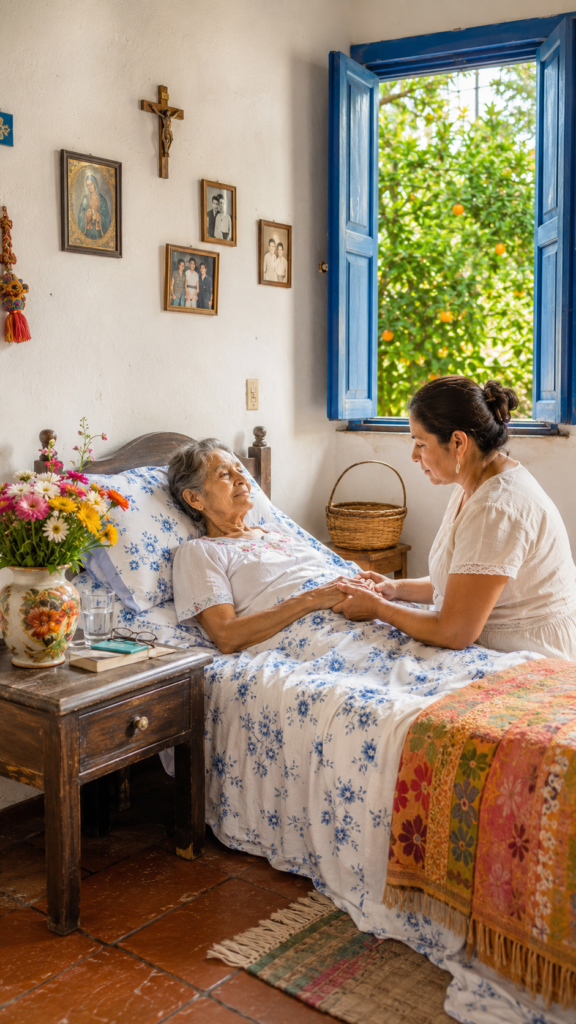
Lucero was on a cot, pale, sweating, with cracked lips. Her hair was stuck to her face, and her foot was wrapped in stained rags. She breathed softly, as if each breath cost her life.
—Ramiro… —she murmured.
He fell to his knees.
—My love… you’re alive. You’re really alive.
He embraced her gently, as if she could break.
Lucero tried to speak.
—I fell… I hit my head… the river swept me away… I couldn’t move.
Ramiro looked at her with tears and rage.
—Why didn’t anyone tell?
Doña Chela appeared behind them.
—I pulled her from the water. If it weren’t for me, she’d be dead already.
Ramiro slowly stood up.
—And then why is my house full of people mourning another woman?
The old woman lowered her gaze.
In a corner, there was a basin with wet clothes. On top lay the blue flowery shirt.
The same one the corpse wore.
—Explain that to me —Darío said.
Lucero closed her eyes.
—She took off my clothes because I was cold. She said she’d hang them to dry. Then I heard a truck… men’s voices… and she hid my shirt.
Ramiro felt relief turn into fear.
—What men?
Doña Chela tightened her shawl.
—People from the packing plant.
The three neighbors stood frozen.
The seafood packing plant was four kilometers from town. It provided jobs to half the region, but everyone knew that girls were exploited there. They paid late, yelled, threatened. The owner, Don Anselmo Barragán, was the municipal agent’s compadre and sponsored the patron saint's festivals.
No one messed with him.
—What did they do? —Ramiro asked.
Doña Chela shook her head.
—You don’t know what trouble you’re getting into.
Lucero opened her eyes with effort.
—There was another woman… outside… on a tarp.
Ramiro felt a knot in his throat.
—What woman?
The old woman covered her mouth, but it was too late.
Lucero continued, trembling.
—They brought her at night. They said they’d gone too far. That if everyone thought it was me, no one would ask about her.
Toño took a step back.
—No way…
Doña Chela broke down.
—Her name was Yaretzi. She was twenty-three. She worked packing shrimp. She came here to buy fish for her mom. That night, they brought her dead. They said she had claimed payments and threatened to report the boss.
Ramiro clenched his fists.
—And they dressed her in Lucero’s clothes?
—I didn’t do it —the old woman cried—. They saw the shirt in the basin. They already knew a woman was missing in the town. They said it was perfect.
Lucero cried weakly.
—I woke up for a moment. They covered my mouth. They said that if I lived, everything would fall apart.
Then they heard an engine outside.
Everyone stood still.
A truck stopped in front of the house.
Doña Chela closed her eyes.
—They’ve returned.
Someone knocked on the door.
—Chela! Open up, old woman!
Ramiro took Lucero in his arms.
She groaned from the pain in her foot.
—Hold on, my love.
—My children… —she whispered.
—Emiliano saved you.
Lucero shed a tear.
—I heard him crying in my dream.
Doña Chela pointed to a back door.
—Through the yard. Get out now.
—You’re coming with us —Ramiro said.
—Leave me be.
—No. You’ve been quiet for too long.
They slipped out among chickens, nets, and sacks of salt. Behind them, the front door splintered under a kick. They ran toward the gap, but Ramiro couldn’t move quickly carrying Lucero.
In the middle of the path, lights appeared.
For a second, they thought they were the men from the truck.
But they were neighbors.
Many.
They came with lanterns, lit cell phones, work machetes, and faces of terror. Leading the way was Emiliano, holding his grandmother’s hand.
When he saw his mom, he let go.
—Mom!
Ramiro knelt in the mud so the boy could hug her. Lucero barely lifted an arm and pressed it to her chest.
The entire town witnessed the impossible.
The woman they were mourning was alive.
Doña Candelaria fell to her knees.
—Forgive me, daughter. I told my grandson he was lying.
Lucero didn’t respond. She just kissed Emiliano’s head, over and over.
But the engine sounded again.
The truck emerged from the trees.
Two men got out: Hilario Barragán, Don Anselmo’s nephew, and a foreman named Mauro. The two feigned surprise at seeing so many people, but their faces fell apart when they saw Lucero alive.
—Look at this miracle —Hilario said, trying to smile.
Ramiro took a step forward, but Darío held him back.
—What did you do to Yaretzi? —Ramiro asked.
The name fell like a stone.
Mauro swallowed hard.
Hilario looked at the municipal agent, who was arriving, sweaty, trying to regain authority.
—I don’t know what you’re talking about, bricklayer.
Emiliano, still hugging Lucero, pointed at Hilario.
—That man was shouting at the fish house.
Hilario turned red.
—Shut that kid's mouth.
That was all it took.
The women were the first to advance, not with blows, but with cell phones recording.
—Repeat it —one neighbor said—. Say it again so Facebook can see it all.
The municipal agent raised his hands.
—Alright, calm down. No one is going to accuse without proof.
Darío pulled out the basin with the wet shirt.
—Proof? In Ramiro’s house, there’s a body that isn’t Lucero. In Doña Chela’s house, there are the clothes. And the woman you declared dead is alive.
People began to murmur.
—They wanted to see our faces.
—Who is the girl in the coffin?
—Why the rush to bury her?
Lucero, from Ramiro’s arms, spoke with a strength no one expected.
—Call the Veracruz Prosecutor's Office. And an ambulance. Not your buddies.
The municipal agent looked around.
He saw phones.
He saw angry neighbors.
He saw that fear was no longer on their side.
That night, forensics, state patrols, and paramedics arrived.
Doña Chela’s house was cordoned off. They found a tarp with blood behind the yard, fresh tire tracks, and a purple bracelet engraved with the name “Yare.”
In Mauro’s cell phone appeared messages from Hilario:
“Make it look like she drowned.”
“Use the other’s clothes.”
“The husband already accepted.”
When an officer read that last sentence, Ramiro felt his legs buckle.
“The husband already accepted.”
Lucero, on the stretcher, took his hand.
—You didn’t know.
—But I accepted.
—Because no one imagines such evil.
—And because I didn’t look.
She looked at him with fever-filled eyes.
—Then now look.
Ramiro lifted his gaze.
He saw Hilario handcuffed. He saw Mauro crying and blaming Don Anselmo. He saw the municipal agent being removed from the scene. He saw Doña Chela trembling, repeating that she should have spoken from the beginning.
And he saw Emiliano.
The boy was next to the ambulance, holding his red toy car.
Ramiro knelt before him.
—Son…
Emiliano looked at him with tired eyes.
—Now do you believe me?
Ramiro broke.
He hugged him so tightly that the boy let out a whimper.
—Yes, son. Forgive me for taking so long.
—Mom told me to shout.
—When?
Emiliano touched his ear.
—When they were going to close the box.
Ramiro didn’t know if it had been intuition, love, fear, or something no adult could explain. But he knew one thing: if Emiliano had stayed silent, Lucero would have disappeared from her own life, and Yaretzi would have been buried under another name.
Lucero spent ten days in the hospital. She had hypothermia, an infection in her foot, and two fractured ribs. She survived because Doña Chela pulled her from the water, although later the fear made her hide.
Yaretzi was buried a week later under her real name.
Her mother arrived at the funeral with a framed photo: a brown-haired girl, with a big smile, wearing the purple bracelet on her wrist. Lucero, still on crutches, left white flowers on the coffin.
—Forgive me —she whispered.
Yaretzi’s mother hugged her.
—You’re not to blame. If you don’t come back, they’ll erase my daughter even from death.
The investigation brought down half the town.
Don Anselmo Barragán was arrested while trying to leave for Puebla. Yaretzi had reported abuses, threats, and withheld wages at the packing plant. An argument ended in blows. Then came the plan: to take advantage of Lucero’s disappearance to hide the crime.
The municipal agent lost his position. Several police officers were investigated. The packing plant closed for months.
But the hardest part was what changed in Ramiro’s house.
Lucero no longer went to the river alone. Not because Ramiro forbade her, but because he couldn’t see that current without feeling he was losing her again. Emiliano slept near her and woke up several times to touch her hand.
One afternoon, sitting in the yard, Ramiro confessed:
—I still dream I’m at your funeral.
Lucero looked at Emiliano playing with his red car.
—I dream I want to scream and my voice doesn’t come out.
Ramiro lowered his head.
—I’ll never forgive myself for saying it was you.
She took time to respond.
—Then don’t stay alone with guilt.
—What do I do?
—Teach our children to look closely. To not believe something just because everyone repeats it. And to not stay silent when something doesn’t add up.
Since then, every year they brought flowers to the river. For Lucero. For Yaretzi. For that truth that they almost buried in a hurry.
And when someone from the town told the story, it always began the same way:
“They were about to bury her. They were already closing the coffin. But her son said: that’s not my mom.”
Some asked if Emiliano really heard a voice.
Ramiro never tried to explain it.
He just said: —I don’t know what my son heard. But he told the truth when all the adults were wrong.
Because in that house, no one silenced a child for saying something impossible again.
Not after his voice saved his mother.
Not after an open coffin showed that sometimes, the most dangerous thing is not death, but the living's haste to close their eyes.