PART 1
—Put on the apron, Lucía. The family didn’t come to see you sitting like a lady.
That’s what Doña Graciela Villaseñor said while arranging the talavera plates on the large table in the main dining room of her house in San Ángel.
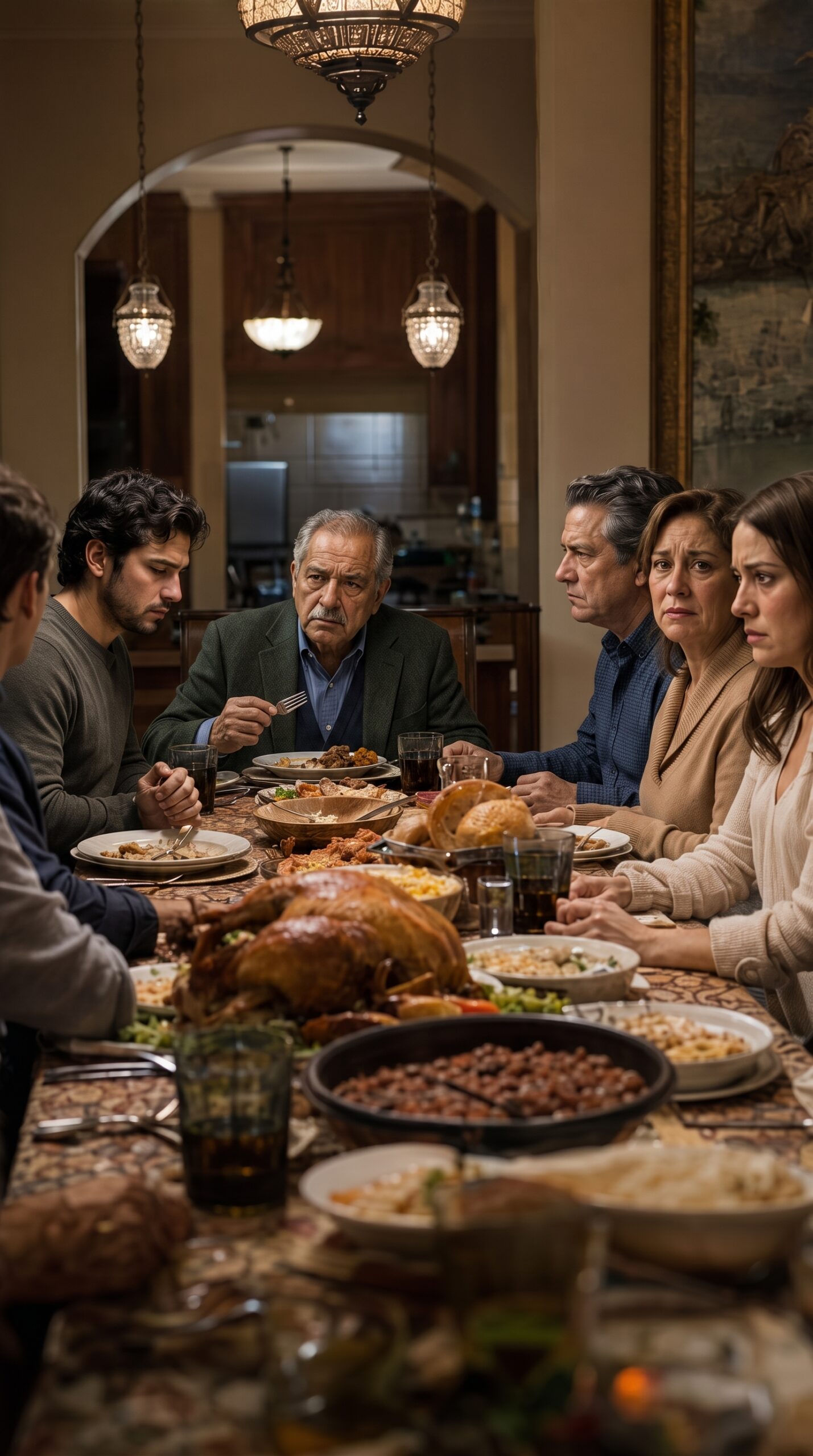
The dinner was to celebrate the 35th anniversary of the family business, Constructora Villaseñor, one of those gatherings where everyone smiled a lot, hugged little, and talked more about money than affection.
Don Ernesto Villaseñor, the father, had invited uncles, cousins, partners, important neighbors, and even a late-arriving deputy, escorted and wearing expensive perfume.
According to him, it was a night to “give thanks as a family.”
But Lucía wasn’t included in that gratitude.
Since 4 PM, she had been locked in the kitchen, checking the pork loin, heating almond mole, serving rice, cutting bread, and cleaning glasses that she wouldn’t even use.
She was 32 years old, wearing a dark green dress underneath the apron, her hair hastily tied back. She had spent the entire morning getting ready with a silly hope: maybe that night, at last, her family would treat her like a guest.
But as soon as she arrived, her mother handed her the apron.
—You know how to move better here. Don’t make faces, honey. Just help.
Help.
That word had been Lucía’s chain since she was 18.
She helped when her father nearly went bankrupt, and she left university to handle the accounts. She helped when her sister Paola went to study fashion in Madrid. She helped when her brother Iván opened two businesses that failed before paying rent.
She helped when her grandmother fell ill.
She helped when payments were overdue.
She helped when everyone needed something.
And still, at the table, her mother boasted about Paola’s “great aesthetic vision” and Iván’s “entrepreneurial spirit.”
Of Lucía, they only said:
—She’s very noble. She never complains.
As if not complaining were a virtue.
As if swallowing sadness were education.
At 8:15, dinner was served. The dining room shone with candles, red wine, and refined laughter. Paola wore a white dress that looked like it belonged in a magazine. Iván was recounting, for the fifth time, how he would soon open “a brutal gastronomic concept” in Roma.
Lucía went in and out with trays.
No one asked if she had eaten.
No one noticed that her place didn’t exist.
When she brought dessert, her aunt Mercedes said loudly:
—Oh, Lucía, you should put on a feast. You're not born to be a businessman’s wife, but you do have a knack for organizing.
Several laughed.
Lucía lowered her gaze.
Her mother pretended not to hear.
Then the doorbell rang.
Laughter slowly faded.
From the kitchen, Lucía heard quick footsteps and the nervous voice of the maid.
—Don Ernesto… there’s a man asking for you.
—Who? —Ernesto said, annoyed.
There was no immediate response.
Then a man appeared in the dining room entrance.
He wore a black suit, a gray coat, and his hair was damp from the rain. He was tall, elegant, with a calmness that made everyone straighten their backs without understanding why.
Lucía looked up just as he found her in the kitchen.
She had wet hands, a mole stain on her wrist, and the apron tied over her dress.
The man didn’t greet Don Ernesto.
He didn’t look at the deputy.
He didn’t ask for permission.
He walked straight toward her.
Lucía froze.
He took her hand with a delicacy that made the silence more scandalous; he leaned down and kissed her knuckles.
—Forgive me, my love —he said in a serene voice—. I arrived late.
The whole dining room froze.
Doña Graciela’s eyes widened as if she had seen a ghost.
Paola dropped her spoon.
Iván murmured:
—No way...
Because that man was no one ordinary.
He was Santiago Arriaga, owner of Grupo Arriaga Hotels, the investor that Don Ernesto had been chasing for eight months to save the construction company.
And he had just called the daughter, who everyone had been having serve plates, “my love.”
Don Ernesto stood up slowly, pale.
—Lucía… do you know Mr. Arriaga?
Santiago looked at the apron, then at the full table, then at the only corner without a chair for her.
His face hardened.
—I know her quite well —he replied—. She is my fiancée. And I want to know why my future wife is being treated like an employee in her own home.
PART 2
The word fiancée fell on the dining room like a sharp blow.
No one spoke for several seconds.
Doña Graciela tried to smile, but her mouth trembled. Paola looked at Lucía's hand, searching for a ring. Iván blinked several times, as if his brain couldn’t piece together the puzzle.
Don Ernesto was the first to regain his voice.
—Santiago, surely there’s an explanation. Lucía has always been very helpful. She likes to support at home.
Santiago didn’t move.
—Likes?
The silence grew again.
Lucía swallowed. For years she had accepted phrases like that because arguing seemed pointless. But that night, with the apron still damp and Santiago’s hand holding hers, something inside her found its place.
—No —Lucía said—. I don’t like it.
Her mother looked at her as if she had insulted her.
—Don’t start, Lucía. There are guests.
—Exactly why I never say anything —she replied—. Because there are always guests, partners, neighbors, appearances. There’s always someone more important than my dignity.
Paola let out a dry laugh.
—Oh, come on. Don’t exaggerate. Mom just asked you for help because you already know everything.
—I know everything because you never wanted to know anything.
Iván stood up, uncomfortable.
—Cool it, dude. Don’t ruin the night over an apron.
Santiago barely turned his head toward him.
—It’s not an apron. It’s the custom you have of using her and then calling it family.
Don Ernesto clenched his jaw.
—With all due respect, Santiago, it’s not wise to mix personal matters with business.
Lucía understood in that moment what hurt her father the most. It wasn’t seeing her humiliated. It wasn’t discovering that his daughter had hidden a commitment. It was losing the contract.
The 180 million peso contract that could save their stalled works in Querétaro and Puebla.
The contract he had been boasting about for months as if it were already his.
Doña Graciela moved closer to Lucía and lowered her voice, though everyone heard.
—Wipe that look off your face. Be grateful you have family. Many women would wish to have what you have.
Lucía looked around.
She saw her uncles lowering their eyes. She saw Paola with her arms crossed. She saw Iván calculating, as always, which side it was convenient to be on. She saw her father sweating over a business, not over her.
Then she untied the apron.
Slowly.
She left it on the bar, next to a pile of dirty plates.
—You’re right, Mom —she said—. Many women would wish to have family. I wanted that too.
No one expected that response.
Santiago grabbed his coat from the back of a chair.
—Let’s go.
Doña Graciela stepped forward.
—If you walk out that door, don’t come back tomorrow crying.
Lucía looked at her without anger. That was the strongest part. She no longer felt the urge to convince her.
—I’m not coming back to ask for permission to exist.
Don Ernesto followed her to the foyer.
—Lucía, think carefully about what you’re doing. That contract supports employees, suppliers, entire families.
She stopped with her hand on the door.
—How curious, Dad. When I left my career to support your company, you never said I was also an entire family.
The rain pounded against the windows.
Santiago opened the door of his black truck. Before getting in, Lucía looked back at the illuminated house, that place where she had learned to be useful before being loved.
And for the first time, she didn’t feel afraid to leave.
But what no one at that table knew was that Lucía wasn’t just taking her dignity.
She was also taking the truth that could sink them.
The truck moved along Insurgentes under a fine rain. The city lights reflected on the glass like golden and red stains.
Lucía sat silently, hands on her legs. She still smelled of the kitchen, of soap, of mole, of years of enduring.
Santiago drove without speaking. His face was calm, but she knew that tension in his jaw.
—I should have arrived earlier —he finally said.
Lucía shook her head.
—You came when I could no longer lie to myself.
Santiago took a deep breath.
—You told me your family was complicated. Not that they treated you like this.
She looked out the window.
—Because when one grows up like this, you learn to count the pain in an elegant version. You say “my mom is demanding” instead of “my mom uses me.” You say “my dad is tough” instead of “my dad only sees me when I serve him.”
Santiago didn’t reply.
He just took her hand.
They arrived at his apartment in Polanco a little before 10. It was spacious, sober, with a smell of coffee and clean wood. Doña Elvira, the woman who had cared for him since he was young, came out of the kitchen and saw Lucía with the apron still folded in her hand.
She didn’t ask anything.
—I’m going to heat up some chicken broth, dear —she said—. With that face, you can’t negotiate even with sadness.
Lucía almost smiled.
When she took off her coat, Santiago noticed the green dress that had been hidden all night.
—You look beautiful —he said.
Lucía lowered her gaze.
—I have mole stains.
—Then the mole was lucky.
She let out a tiny laugh, but broke down immediately. She covered her face and cried.
It wasn’t a pretty cry. It was a tired, old cry, one that doesn’t come out in just one day but from many years. She cried for the young woman who left university. For the daughter who believed sacrificing was loving. For the woman who confused being needed with being valued.
Santiago didn’t ask her to calm down.
He just held her.
Later, sitting in the kitchen with a bowl of broth and warm tortillas, her phone began to vibrate.
Mom.
Dad.
Paola.
Iván.
Aunt Mercedes.
A cousin who never looked for her.
She didn’t answer.
Then came a message from Don Ernesto.
Lucía, this is getting out of control. Call me before you ruin something important.
Lucía read the phrase three times.
Something important.
Not her pain.
Not her humiliation.
Not her place in the family.
The contract.
Santiago saw her face and took the phone. He read the message without saying anything for a few seconds.
—There it is —he murmured.
—What?
—The reason they’re looking for you.
Lucía closed her eyes. It hurt because it was true, not because it was a surprise.
The next morning, Don Ernesto called Santiago directly. He asked Lucía if she wanted to listen. She nodded.
Santiago put the phone on speaker.
—Santiago —Don Ernesto said in a friendly tone—, I think there was a family misunderstanding last night. Graciela is intense, Lucía is sensitive, and you know how these dinners are.
Lucía tightened the cup between her hands.
—It wasn’t a misunderstanding —Santiago replied—. It was a pretty clear display.
Don Ernesto let out an uncomfortable laugh.
—Look, we can’t allow an emotional issue to contaminate such an important alliance. Lucía has always been a fundamental part of the house. No one underestimates her.
Lucía lifted her gaze.
Santiago turned toward her.
—Lucía, do you want to respond?
She took a deep breath.
—Dad, for 14 years I worked for the construction company without a formal salary. I signed payments, reviewed invoices, covered Iván’s debts, and cared for my grandmother while everyone said I was “the noble one.” Last night, there wasn’t even a chair for me.
There was a heavy silence.
Don Ernesto changed his tone.
—That’s not something to discuss over the phone.
—No —Lucía said—. That should have been discussed years ago.
Santiago took over.
—Grupo Arriaga will not sign with Constructora Villaseñor.
The air seemed to stop.
—I’m sorry? —Don Ernesto said.
—There will be no contract.
—You can’t cancel over a family scene.
—I’m not canceling over a family scene. I’m canceling because the financial review confirmed lack of ethics, late payments, irregular permits, and three labor lawsuits that you concealed.
Lucía felt a chill run down her spine.
She knew of some problems. Not everything.
Don Ernesto breathed hard.
—Santiago, be careful with what you say.
—I’m careful. That’s why I’m not signing.
Then Don Ernesto made the mistake that changed everything.
—And did Lucía show you those papers? Because if she did, she stole private information from the company.
Lucía froze.
Santiago looked at her.
She understood the trap. Her father preferred to accuse her rather than admit his irregularities.
But Lucía was no longer alone.
—I didn’t steal anything —she said firmly—. Those documents have my name because for years you made me sign as the administrative responsible without a contract, without a fixed salary, and without explaining that you were leaving me holding your legal troubles.
Don Ernesto’s silence was different.
Now there was fear.
Santiago lowered his voice.
—We know that too.
Don Ernesto tried to fix it.
—Lucía, dear, don’t say things you might regret. The family protects itself.
She closed her eyes.
There was the phrase again.
The family protects itself.
But in that family, protecting meant silencing the one who carried the blame.
—No, Dad —she said—. The family doesn’t protect itself by using a daughter as a shield.
She hung up.
In the following days, the family version spread like wildfire. Doña Graciela said Lucía was manipulated by a rich man. Paola claimed her sister had always been envious. Iván posted a story with a ridiculous phrase: “Loyalty can’t be bought.”
That same day, he asked her for money.
Lucía didn’t respond.
The only different call was from her grandmother Carmen, who lived in Coyoacán with a nurse.
—It was about time, my girl —the elderly woman said.
Lucía was left speechless.
—You knew?
—I knew they loaded everything onto you. I also knew that one day the lie would fall apart.
—Why didn’t you say anything, Grandma?
The woman’s breathing sounded fragile.
—Because I was also raised to endure. And because in this family, we were taught that a good woman is one who doesn’t disturb, doesn’t demand, and doesn’t complain. But that’s not kindness, sweetheart. That’s abandonment disguised as education.
Lucía cried again.
But this time she didn’t feel broken.
She felt awake.
The real twist came two weeks later.
A labor lawyer contacted Lucía. He represented nine former employees of Constructora Villaseñor who could never prove withheld payments or unjustified dismissals. They all spoke of a “Licenciada Lucía” who had promised to review their cases, but afterward, the company disappeared documents.
Lucía reviewed her old emails.
There she found folders, receipts, and messages where she warned her father that they couldn’t continue delaying payments.
She also found something worse.
An email from Don Ernesto to Iván, sent by mistake with a poorly placed blind copy.
“As long as Lucía signs, the administrative responsibility falls on her. Let her not find out.”
Lucía stared at the screen for several minutes.
It wasn’t carelessness.
It wasn’t custom.
It was betrayal.
Her family hadn’t just used her to serve plates. They had also used her to cover up crimes.
Santiago wanted to accompany her to every legal meeting, but Lucía made the most important decision of her life: she would speak for herself.
She submitted documents to her lawyer, collaborated with the former employees, and requested a formal review of her labor situation. She didn’t seek revenge. She sought to clear her name.
When Don Ernesto received the notification, he went to look for her at Santiago’s apartment.
Doña Elvira wouldn’t let him in.
He shouted from the hallway:
—Lucía, don’t destroy your family!
She stepped out calmly.
—You destroyed it when you thought my life was worth less than your company.
Doña Graciela appeared behind him, wearing dark glasses and a broken voice.
—Honey, please. Your dad is sick from the pressure. Paola is very unwell. Iván can’t sleep. Is that what you wanted?
Lucía felt the old hook of guilt.
It almost worked.
But then she remembered the table without a chair.
She remembered the apron.
She remembered the email.
—No, Mom. I wanted a family. You wanted a servant with a last name.
Doña Graciela cried.
—I raised you to be strong.
—No. You raised me to endure. And I don’t want to be strong that way anymore.
Don Ernesto lowered his voice.
—How much do you want?
Lucía looked at him as if she finally saw the man she had idealized.
—You still think everything is about money.
He didn’t respond.
—I want you to tell the truth —she continued—. To the employees. To the lawyers. To me. I want you to admit you used me.
Don Ernesto pressed his lips together.
He couldn’t.
That silence was his confession.
Months later, Constructora Villaseñor lost the contract, faced lawsuits, and had to sell two properties to pay debts. Iván disappeared from social media for a while. Paola stopped talking about “class” when it was revealed that her trips came from company accounts.
Doña Graciela continued saying that Lucía had broken the family.
But people began to ask questions.
And questions, in a family accustomed to pretending, hurt more than screams.
Lucía never returned to the house in San Ángel.
She opened a small consultancy in Del Valle to help family businesses organize their accounts without hiding abuses behind the word “loyalty.” She hired two former employees of her father. She paid them well. She gave them contracts. She offered them chairs.
Santiago didn’t rescue her.
She always corrected anyone who said it.
Santiago arrived on time to see her choose an open door, but the one who walked was her.
A year later, they got married in a hacienda in Morelos, among bougainvilleas, mezcal, soft music, and a long table where no one had to earn their place by serving others.
Grandma Carmen was front row, with a blue shawl and tranquil tears.
Before dinner, Santiago took Lucía’s hand and kissed her knuckles again, just like that night.
—Forgive me, my love —he whispered—. I arrived late.
Lucía smiled.
—you didn’t arrive late. You arrived the day I stopped abandoning myself.
That night, when everyone sat down, Lucía looked at the table.
There was a chair for her.
Not by the kitchen.
Not after serving.
Not as a reward for behaving well.
A chair in the center, with her name written on a small card.
And she understood something that many people take a lifetime to accept: sometimes family isn’t who gives you the last name, but who notices when you’re not seated.
Sometimes love doesn’t come to save you.
It comes to remind you that you also deserve a place.
And sometimes the strongest act isn’t shouting the truth, but taking off the apron, opening the door, and never returning to a table where they only wanted you standing.