PART 1
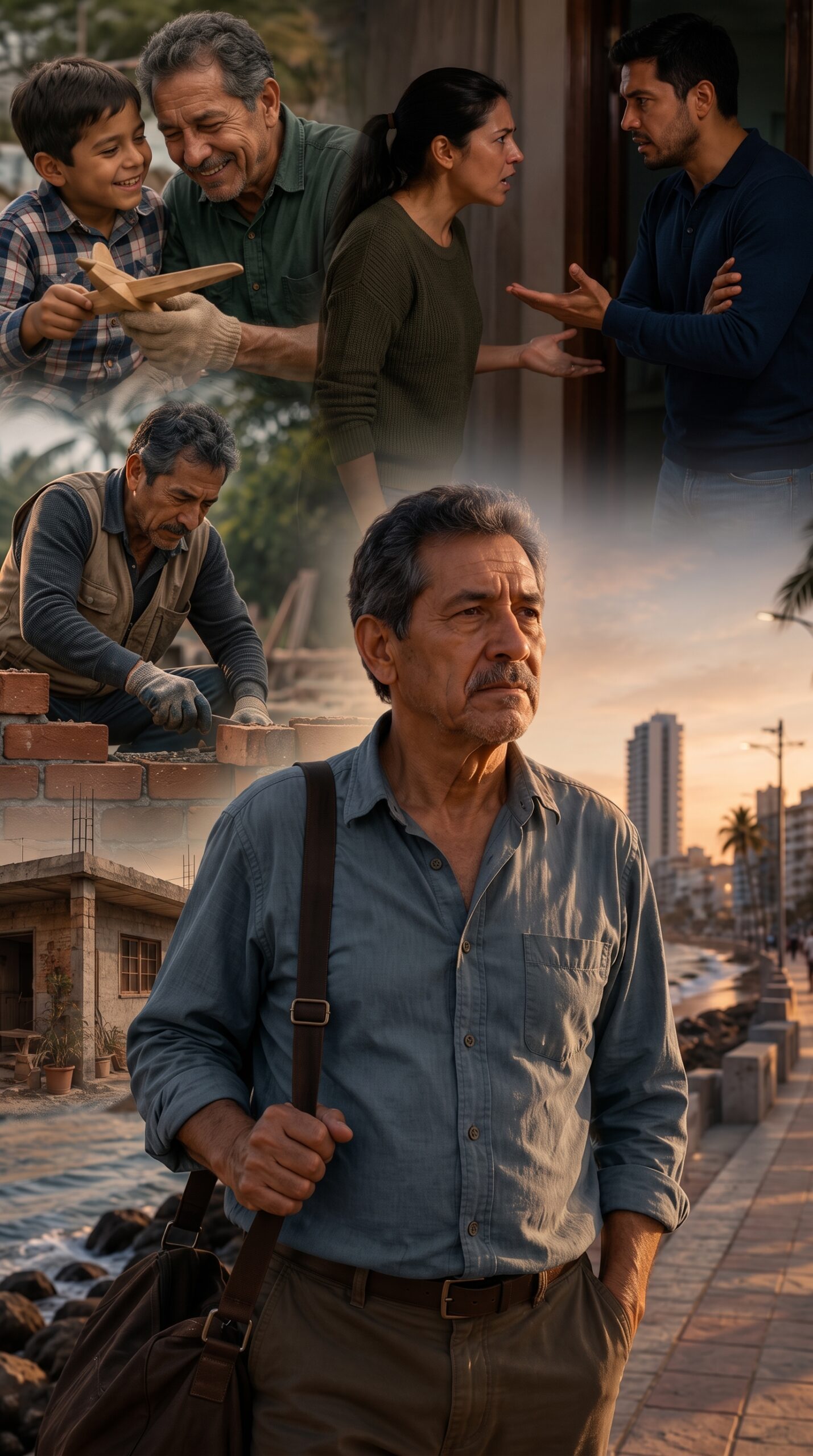
At 52, Don Julián Méndez walked out of the bank, the ledger clutched tightly against his chest, as if someone might tear away the miracle he had just received.
His older brother, Don Ramiro, a fisherman from Tecolutla, Veracruz, had died three weeks earlier, leaving him an inheritance that Don Julián never could have imagined: money, a plot of land near the sea, and a small fishing warehouse.
He wasn’t suddenly rich, but for the first time in his life, he could breathe without counting coins.
He walked along the main avenue of Toluca, his eyes wet with emotion. He envisioned fixing the roof of the house, expanding his grandchildren’s room, replacing the old stove, and starting a small family business.
He wanted to share it all with Daniel, his only son.
Daniel was the reason Don Julián had endured thirty years of carrying rebar, laying tiles, selling tamales on Sundays, and working as a night watchman when work was scarce.
He had become a widower when Daniel was just three years old.
Since then, his life had become a single promise: that his son would never lack a roof, food, or education.
That night, Don Julián bought sweet bread, a roasted chicken, and soda for dinner so they could all eat together. He arrived home smiling, his heart filled with plans.
But before he could enter the living room, he overheard the voice of Brenda, his daughter-in-law.
—Daniel, I seriously can’t stand your dad here anymore. He meddles in everything, comments on the kids, takes up the backyard room, and still wants us to treat him like the owner.
Don Julián froze by the hallway.
Daniel sighed.
—He’s my dad, Brenda. I can’t just kick him out.
—And what about us? —she snapped, annoyed—. We live cramped because of him. Plus, he’s 52, not a baby. He should rent a room or find somewhere to stay.
The old man swallowed hard.
Old. That’s what they called him, even though he still worked harder than many young men.
—He built this house —murmured Daniel—. It would look really bad.
Brenda let out a dry laugh.
—He built it for you, right? He always says this will be yours. So he should sign it over, and then we can figure out what to do with him.
Don Julián felt his legs give way.
The ledger felt like a stone inside his jacket.
—Tomorrow we’ll take him to the notary —Brenda insisted—. We tell him it’s to protect the house from a debt. Once he signs, we’ll find him a place. If he gets difficult, we’ll tell the doctor he’s losing his mind.
Daniel didn’t respond right away.
That silence hurt more than any insult.
Don Julián hoped for a defense, a word, a sign of love.
But then his son quietly said:
—Fine… but don’t let him suspect anything.
And Don Julián understood that, that very night, he had ceased to have a family within his own home.
PART 2
Don Julián didn’t enter the living room.
He didn’t demand anything.
He didn’t slam the door.
He didn’t cry in front of them.
He simply left the roasted chicken on the patio table, put the ledger in a plastic bag, and walked into his room as if nothing had happened.
That night he listened to the laughter of his grandchildren, the sound of the television, and Brenda’s voice asking who had bought dinner.
No one came to look for him.
At 4:30 in the morning, while the house was still asleep, Don Julián packed two changes of clothes, his documents, some photographs of his wife Carmen, and an old ledger where he had noted expenses since Daniel was a child.
Before leaving, he walked through the house in silence.
He touched the living room wall, the one he had plastered with his hands full of lime.
He looked at the kitchen where Carmen used to brew coffee.
Then he paused in front of Daniel’s room.
For one second, he wanted to open the door and ask him:
“Why, son?”
But he didn’t.
Some questions kill more when the answer has already been heard behind a door.
He left a brief note on the table.
“I’m going to Veracruz to take care of Ramiro’s affairs. Don’t look for me.”
Then he stepped out.
The bus departed for Tecolutla as the sky began to brighten.
During the journey, Don Julián gazed at the hills, the coffee stands, the gas stations, and the towns passing by like memories.
He thought of Daniel with a fever at five, when he sold his wedding watch to buy him medicine.
He thought of the used sneakers he bought at the market so his son could wear “new” shoes to elementary school.
He thought of the Christmases when he pretended not to want anything because all the money went to toys, uniforms, or school supplies.
And now, after everything, his son accepted to take him to the notary to strip him of the house and send him away.
When he arrived in Tecolutla, Mateo Salazar, an old friend of Ramiro, awaited him.
He was a dark-skinned man, wearing a palm hat and tough hands from fishing.
Upon seeing him step off the bus, he embraced him tightly.
—Julián, buddy… Ramiro always said you were too good for this world.
Don Julián could no longer hold back.
He cried on Mateo’s shoulder like he hadn’t cried since burying Carmen.
He didn’t cry for money.
He cried because at 52, he discovered he could be superfluous in the life of the person for whom he had given everything.
Mateo took him to a simple house near the river.
There were hammocks, the smell of fresh fish, and a wooden table where coffee was always brewed.
—Stay as long as you need —he said—. Here you won’t be a burden.
That phrase was like water for a man who had felt invisible for years.
In the first days, Don Julián barely spoke.
He woke up early, swept the patio, walked to the pier, and watched the fishermen return with their nets.
Little by little, he began to help.
He fixed motors, mended boats, repaired doors, built benches with old boards.
He hardly charged anything.
He said that working set his soul right.
In less than a month, everyone in town greeted him.
—Here comes Don Julián, the one from Toluca.
—That guy knows how to work.
—The man stands tall.
And he, who in his own house was a burden, felt needed again in a foreign town.
One afternoon, a lawyer from Papantla arrived to review the inheritance papers.
Don Julián thought everything was straightforward: the money and the warehouse.
But the lawyer placed a thicker folder on the table.
—Don Julián, your brother Ramiro also left you a large piece of land in front of the river, with access to the highway. It’s not just anything. There are interested buyers.
Mateo’s eyes widened.
—That land is worth a lot.
Don Julián looked at the blueprints, trying not to get too excited.
—And if I don’t sell it?
The lawyer adjusted his glasses.
—You can do as you wish. Legally, it’s yours.
Don Julián fell silent.
That night he couldn’t sleep.
He remembered other men like him: bricklayers, drivers, seamstresses, cooks, grandmothers who raised grandchildren and ended up tucked away in service quarters.
He remembered Doña Lucha, a neighbor from Toluca, who died alone because her children “didn’t have time.”
He remembered Don Nacho, who ended up sleeping in a workshop because his family sold their house.
At dawn, he made a decision.
He wasn’t going to buy a truck.
He wasn’t going to flaunt jewels.
He wasn’t going to beg for love with gifts.
He would build a place for elderly people who had been forgotten by their own children.
—I don’t want a sad asylum —he told the lawyer—. I want a house with a garden, a big kitchen, a workshop, music on Sundays, and clean beds. A place where no one ever hears they are a burden again.
Mateo smiled.
—Ramiro would be applauding, man.
Thus, “Casa Puerto Claro” was born.
Meanwhile, in Toluca, the absence of Don Julián began to weigh heavily.
At first, Brenda pretended to feel relieved.
—Look at the peace —she said on the first day—. The house even feels bigger.
But by the week’s end, peace turned into a problem.
No one was picking the kids up from school.
No one was fixing the bathroom leak.
No one was making beans when Brenda came home late.
No one was paying the electricity bill before it was due.
Daniel started finding gaps that his father had filled without boasting.
One afternoon, Brenda demanded he go to Don Julián’s room.
—Look for the deeds. If he doesn’t come back, we need to sort this out before he decides to leave something to other people.
Daniel opened the drawer of his father’s bed.
He found receipts, bills, old photos, and a blue ledger.
He opened it out of curiosity.
On the first page, it read:
“Daniel, 7 years old. Today he asked for a dinosaur backpack. I couldn’t afford it, but tomorrow I’ll pick up an extra shift.”
On another page:
“Daniel entered junior high. Carmen, I wish you could see how big he’s grown. My back hurts, but our son will study.”
Further on:
“Brenda doesn’t look at me with affection, but she is my son’s wife. I will do my best not to be a burden.”
Daniel continued reading with blurred vision.
The last page was recent.
“Today I went to the bank. Ramiro left me a blessing. I thought about fixing the house for Daniel, Brenda, and the kids. I thought about giving them everything. But I heard they want to take me to the notary and then say I'm losing my mind. If my son no longer wants me around, at least I must love myself.”
Daniel fell back onto the bed.
For the first time, he understood that his father hadn’t left out of stubbornness.
He had left because they had cast him out without touching him.
Brenda entered, annoyed.
—Did you find the deeds?
Daniel lifted his head.
—Did you know my dad received an inheritance?
She froze for just one second.
That gesture betrayed her.
—I don’t know what you’re talking about.
Daniel remembered something: days before the argument, Brenda had checked Don Julián’s jacket “to wash it.”
He went to the trash bin in the patio and found, among old papers, a torn bank receipt with his father’s name on it.
Brenda didn’t want to kick Don Julián out because he was a burden.
She wanted to get rid of him before he decided what to do with his money.
—You knew —Daniel said, his voice breaking—. That’s why you wanted him to sign.
Brenda exploded.
—Of course I knew! So what? That man was going to waste it all on who knows who. We are his family. You are his son. That money belongs to us!
Daniel looked at her as if seeing her for the first time.
—No, Brenda. That money doesn’t belong to us. My dad owes us nothing.
The argument was so loud that the neighbors could hear.
That night, Daniel tried to call Don Julián 17 times.
No one answered.
He searched among relatives.
No one knew anything.
Until he found Mateo’s number on an old card from Ramiro.
When he called, Mateo answered flatly.
—Yes, Don Julián is here.
Daniel felt air return to his lungs.
—I need to talk to him. I’m his son.
Mateo paused.
—Look, Daniel, I’m going to ask you something very clearly: Are you looking for him because you miss him, or because you found out your dad has an inheritance?
Daniel didn’t know what to say.
Shame choked his throat.
Because he understood that due to his actions, that question had every right to exist.
Four months passed.
Casa Puerto Claro opened its doors with six elderly residents.
Then nine more arrived.
Then eighteen.
There were brightly painted rooms, a kitchen where tortillas were made by hand, afternoons of dominoes, carpentry workshops, a cilantro garden, and bougainvilleas at the entrance.
Don Julián didn’t become a magazine millionaire.
He became something much harder: a man at peace.
The story made it to a local Facebook page.
“52-Year-Old Bricklayer Uses Inheritance to Create Home for Abandoned Seniors.”
The post was shared thousands of times.
And that’s how Daniel saw a photo of his father smiling, surrounded by people who embraced him like family.
Brenda saw it too.
—See? —she said furiously—. He’s giving away what was meant for your children.
Daniel turned off his phone.
—No. He’s using what’s his where it’s appreciated.
Two days later, Daniel traveled to Tecolutla with his two children.
Brenda didn’t go.
When he arrived at Casa Puerto Claro, he saw his father sitting under a palapa, teaching an elderly man how to sand wood.
Don Julián looked up.
Time seemed to stand still.
His grandchildren ran towards him.
—Grandpa!
Don Julián welcomed them with tears, knowing the kids were innocent of the greed of adults.
Daniel stood a few steps back, his face shattered with guilt.
—Dad… forgive me.
Don Julián didn’t respond right away.
He looked at his son, but no longer with fear or need.
—I heard you that night, Daniel.
The son lowered his head.
—I know.
—It didn’t hurt me that Brenda wanted to get rid of me. It hurt me that you kept silent.
Daniel cried like a child.
—I was cowardly. I let my wife speak about you as if you were an old piece of furniture. And you gave me everything.
Don Julián took a deep breath.
—You didn’t give me my place when I needed it most.
—I know, Dad. I’m not coming for money. I’m not coming for the house. I’m coming because I understood that I still have a father and that I was losing him because I was foolish.
Some elderly residents watched from afar.
Mateo did too.
Don Julián placed a hand on Daniel’s shoulder.
—I forgive you. But I’m not going back to Toluca.
Daniel closed his eyes, accepting the blow.
—I won’t ask you to.
—The house is still mine —Don Julián continued—. As long as my grandchildren need a roof, they won’t lack for one. But Brenda will never touch a single paper of mine, nor a peso, nor a decision.
Daniel nodded.
—I understand.
—And you will have to rebuild with me something more difficult than a house.
—What thing?
Don Julián looked at him with sadness and firmness.
—Trust.
That Sunday, they ate together at Casa Puerto Claro.
There was no perfect ending.
Brenda didn’t apologize.
Daniel didn’t recover the years of indifference all at once.
Don Julián hadn’t forgotten the phrase “have him sign and then we’ll see what to do with him.”
But something changed.
Daniel began to visit his father every two weeks with his children.
He helped in the garden, painted walls, and fixed chairs.
He didn’t do it to inherit.
He did it to learn to be a son before it was too late.
Over time, Casa Puerto Claro filled with stories.
Doña Meche, abandoned by three children.
Don Efraín, a retired driver who was kicked out of his room.
Doña Rita, who sold food for 40 years and ended up alone.
They all found there a table, a bed, and someone who called them by their name.
Don Julián then understood that his inheritance hadn’t been Ramiro’s money.
The true inheritance was that betrayal which forced him to remember his dignity.
Because there are children who believe their parents are eternal, until one day they find the empty room.
And there are parents who love so much that they forget themselves until disdain opens their eyes.
In the end, Don Julián didn’t lose a family.
He discovered that family can also be built where there is respect, gratitude, and sincere love.
And Daniel learned the hardest lesson of his life:
A father can forgive.
But when he leaves feeling like a burden, something breaks forever.
Neither an inheritance, nor a house, nor all the apologies in the world can restore the place that a son failed to cherish.