PART 1
The day Rodrigo gifted Mariana a luxury cream for their anniversary, she felt no excitement.
She felt suspicion.
They had been married for four years, but the beautiful gestures had long vanished from their home.
Only long silences, cold meals, and a mother-in-law who believed she owned even the air they breathed remained.
Rodrigo worked as a technical chief at a chemical company in Querétaro, although they lived in Guadalajara, in a neighborhood where everyone greeted each other with false smiles and genuine gossip.
That Friday, he told Mariana he had to travel to Monterrey for an important meeting.
Before leaving, he placed a black box on the dresser.
"It's a European treatment, extremely expensive. I got it directly from the lab. Use it tonight and tomorrow you'll wake up with a new face."
Mariana stared at the bottle.
It was elegant, heavy, with a golden cap and a label so discreet it looked like it belonged in a magazine.
But Rodrigo rarely looked her in the eyes anymore.
So that gift didn't feel like love to her.
It felt like a performance.
"Thank you," she replied, without arguing.
Rodrigo kissed her on the forehead, grabbed his suitcase, and left.
As soon as he shut the door, Mariana heard the keys at the back gate.
Doña Graciela, her mother-in-law, entered without knocking, as always.
She lived in the house next door but acted as if both properties belonged to her.
She rummaged through the fridge, drawers, bank statements, underwear, and even the electricity bills.
"What's this?" she asked upon seeing the box.
Mariana couldn't respond in time.
Doña Graciela already had the jar in her hand.
"Oh, come on. This looks exquisite. I bet it won't even suit you. Things like this are for well-cared skin, not for experimentation."
Mariana swallowed.
This wasn't her first humiliation.
Her mother-in-law had been telling her for years that Rodrigo had rescued her from "a mundane life," even though Mariana had her own baking business and had helped pay for half the house.
"It's my anniversary gift," said Mariana.
Doña Graciela smiled with contempt.
"Well, the anniversary is thanks to my son too. Besides, I know how to use these things."
And she left with the jar.
Mariana didn't stop her.
She was exhausted from fighting for every little thing.
That night, Rodrigo called from the hotel, or so he said.
"Did you use the cream?"
Mariana, fed up with pretending, let out a bitter laugh.
"No. Your mom took it. She said it was too fancy to waste on me."
There was no laughter on the other end.
No rebuttal.
Just a heavy silence.
Then Rodrigo breathed as if he had just received terrible news.
"What did you say?"
"That your mom took your gift."
"Where is she?"
Mariana sat up in bed.
"At her house, I suppose."
"Go right now! Run, Mariana!"
Rodrigo's voice didn't sound worried.
It sounded terrified.
"Why?"
"Just do what I say! If something happens to my mother, I swear you'll regret it for the rest of your life."
Mariana felt a cold hit in her stomach.
She ran barefoot, crossed the yard, and reached Doña Graciela's house.
The door was ajar.
From the hallway came a sour smell, like burnt plastic mixed with cheap perfume.
"Doña Graciela?"
No one answered.
Mariana moved toward the bedroom.
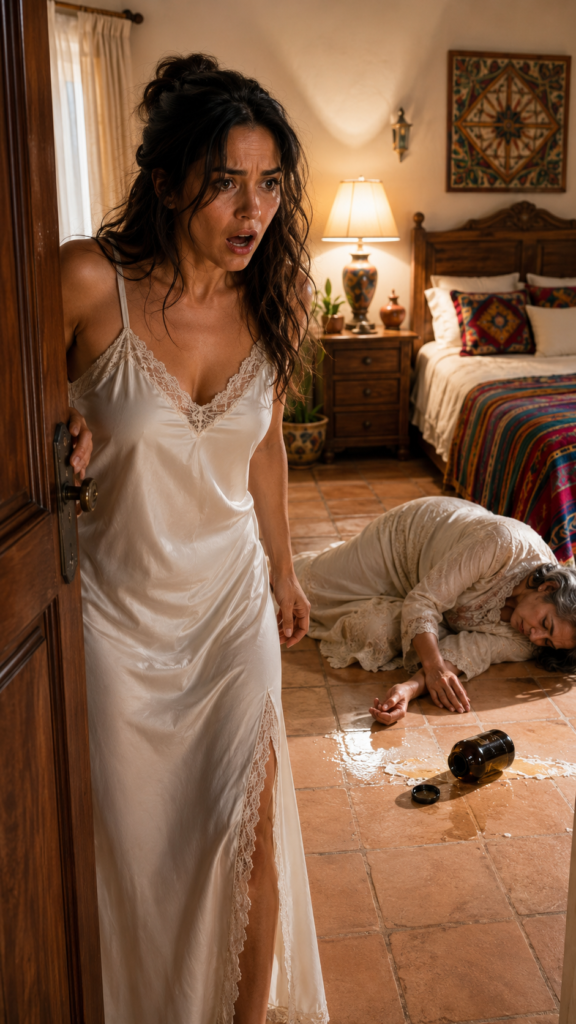
Then she saw her.
The woman was sprawled next to the nightstand, convulsing, her face covered in a white paste that burned her skin.
The black jar lay open on the carpet.
And in that instant, Mariana understood something that cut her breath.
That gift had never been a cream to rejuvenate her.
It was a trap prepared to kill her.
PART 2
Mariana called 911 with trembling hands.
The paramedics arrived quickly, along with patrols and curious neighbors who peeked out from their windows as if this were a prime-time drama.
Doña Graciela was taken away unconscious.
She had chemical burns on her face, neck, and parts of her hands.
As they loaded her into the ambulance, Mariana couldn't stop looking at the black jar.
The label didn't list ingredients.
It had no health registration.
It bore no recognizable brand.
It looked designed to appear elegant, not to be traced.
When the paramedics left, Mariana re-entered the bedroom.
Next to the nightstand, she saw a crumpled napkin stained with the same white substance.
She carefully picked it up using a plastic bag.
She didn't know why, but something inside her screamed not to leave it there.
At 3 AM, Rodrigo called again.
This time his voice was oddly calm.
"I was informed that my mom is stable. Don’t say anything strange. It was a domestic accident."
Mariana froze.
"Domestic accident? Rodrigo, your mom put something on her face and almost died."
"Exactly. She probably mixed creams or used something expired."
"It was your gift."
There was a pause.
"Mariana, listen to me carefully. Don’t talk to doctors, police, or neighbors. I’ll be there tomorrow and fix everything."
"Fix what?"
"Don’t be stubborn. You don’t understand these things."
Mariana hung up.
For the first time in years, fear didn’t paralyze her.
It awakened her.
She remembered something she had seen weeks earlier in Rodrigo's office: a folder with bank documents, policies, and notarized papers.
At that moment, she hadn’t thought much of them.
Now everything clicked into a horrifying picture.
She waited for dawn.
Then she entered the office and searched through the drawers with a calm that frightened her.
She found a life insurance policy for 10 million pesos.
The insured was Mariana.
The primary beneficiary was Rodrigo.
But there was an even stranger clause: if the death occurred under certain medical conditions or due to an accidental reaction to a personal product, the payout would be accelerated.
Mariana felt nauseous.
She also found drafts of documents to transfer the house, the baking business, and a warehouse that Mariana had bought before marrying.
All needed her signature.
Her signature, which Rodrigo had been pressuring her to provide for months.
That same day, she sought out Óscar, an old college friend who worked at a private lab.
She didn’t tell him everything.
She only handed him the napkin and requested an urgent analysis.
"Where did you get this?" he asked, barely sniffing the bag.
"From my house."
Óscar looked serious.
"Then don’t touch anything without gloves, alright?"
For two days, Mariana pretended everything was normal.
She responded to Rodrigo's messages.
She went to the hospital.
She listened to family members say Doña Graciela had always been nosy, but didn’t deserve to end up like this.
And even though Mariana had hated her many times, she couldn’t feel satisfaction.
The woman was in intensive care, bandaged, breathing with assistance, paying with her body for a cruelty that wasn’t aimed at her.
On the third day, Óscar summoned her to a small café near Chapultepec.
He didn’t want to talk on the phone.
That scared her more.
"Mariana," he said, leaving a folder on the table, "this wasn’t a cream."
She closed her eyes.
"I already knew."
"Not like you think. It’s a highly corrosive experimental compound. It’s not authorized for human use. And someone altered it to have the texture, smell, and appearance of facial treatment."
Mariana clenched her coffee cup.
"Where did it come from?"
Óscar hesitated.
"The chemical marker matches a development line from Quimex Norte."
Rodrigo’s company.
Mariana's body went limp.
It was no longer a suspicion.
It was proof.
That night, when Rodrigo finally returned, he entered the house with a pale face and wrinkled shirt.
He tried to hug her.
Mariana stepped back.
"How's my mom?" he asked.
"Alive."
He exhaled.
It wasn’t relief.
It was calculation.
"We need to be careful about what’s said. If the company finds out an experimental product left their facilities, this becomes hell."
"Experimental product?" Mariana asked.
Rodrigo froze.
He had said too much.
"I figured it out from the smell," he muttered.
Mariana looked at him as if finally seeing the real man behind the husband.
"From the smell, or because you did it?"
Rodrigo changed his expression.
He no longer feigned tenderness.
"Don’t start with your dramas."
"Your mom almost died."
"Because she's an abusive old lady who doesn’t know how to respect others' things."
The phrase fell like a stone.
Mariana understood that Rodrigo wasn't heartbroken.
He was furious because the plan had gone awry.
That night, while he slept, Mariana took his phone.
For years, she hadn’t checked anything.
That night, she broke her own rule.
She found an archived conversation titled "M."
Half-deleted messages.
Photos.
Audios.
Transfers.
And a phrase that left her breathless:
"When Mariana is gone, we sell everything and leave for Mérida. You, me, and the money."
The woman’s name was Mónica.
She was a lawyer.
And not only was she Rodrigo's mistress.
She had also drafted documents to strip Mariana of her properties.
The betrayal no longer came from an unfaithful man.
It was a web.
A cold, patient, sickly plan.
Mariana took screenshots, sent everything to a new email, and hid a USB drive inside a flour box in her workshop.
The next day, she went to the prosecutor's office.
She didn’t arrive crying.
She arrived with the jar retrieved from Doña Graciela's house, the napkin, the chemical analysis, the policy, the screenshots, the transfers, and the legal drafts.
At first, an agent tried to treat her like an exaggerated woman.
"Sometimes marital problems get out of control," he said.
Mariana fixed her gaze on him.
"My mother-in-law has half her face burned because she used something my husband prepared for me. Is that also a marital issue?"
The agent stopped smiling.
The investigation began.
Rodrigo was interrogated.
Quimex Norte provided internal records.
And then the second blow came.
The compound had come from a restricted batch, under Rodrigo's direct supervision.
The cameras showed that he entered the lab outside of hours.
Records indicated he withdrew small amounts over three weeks.
And Mónica had received payments from a hidden account, the same week she modified the notarized documents.
But something was still missing.
Rodrigo continued to deny everything.
He claimed Mariana was inventing a revenge because the marriage was going poorly.
He said his mother had stolen the jar and mixed substances.
He claimed he was the real victim.
Then Doña Graciela woke up.
She couldn’t speak well.
Her face was covered in bandages, and her eyes held a shame Mariana had never seen.
She requested to see her alone.
Mariana hesitated but entered.
For several minutes, neither spoke.
The room smelled of medicine, gauze, and regret.
Doña Graciela raised a trembling hand.
"I... helped him," she whispered.
Mariana felt the floor shift beneath her.
"Helped him how?"
The mother-in-law cried.
Not with tantrums.
With fear.
"Rodrigo told me you wanted to keep everything. That if you signed some papers, he would protect the family home. I pressured you for that. I opened the office door for him. I told him where you kept documents."
Mariana pressed her lips together.
"Did you know he wanted to kill me?"
"No. I swear to God. I thought he just wanted to scare you or leave you with nothing in the divorce. But that night, when I put on the cream... I felt it burning my soul."
The old woman began to sob.
"And before I fainted, I understood. My son was not punishing you. He was disappearing you."
That declaration changed everything.
Doña Graciela agreed to testify.
She told how Rodrigo had been talking to Mónica for years.
That there were enormous debts from failed investments.
That the family no longer had the money they pretended to have.
He needed to collect the insurance to save himself and start another life.
She also confessed something that shattered Mariana completely: Rodrigo had told his mother that Mariana was sterile, cold, and ambitious, when in reality Mariana had lost two pregnancies alone, without him wanting to accompany her to the hospital.
That lie made Doña Graciela hate her even more.
And Mariana, who had carried her pain in silence, understood that her husband had not only wanted to take her life.
He had first stripped her of dignity in front of everyone.
Months later, Rodrigo was arrested as he exited a labor hearing.
He tried to scream that it was all a setup.
But the evidence was no longer enough for him to pretend.
Mónica also fell.
She had contracts, messages, and a document titled "widow scenario" on her computer, where she calculated times, payments, and property movements.
Justice advanced slowly, as it often does, but it advanced.
Doña Graciela survived.
She was forever marked.
She sold her house, moved in with a sister in Colima, and before leaving sought out Mariana.
She arrived at the baking workshop with a shawl covering part of her face.
Mariana was decorating a fifteen-year-old's cake.
The mother-in-law stood at the entrance, not daring to step inside.
"I’m not here to ask for your forgiveness," she said in a broken voice. "That would be very cynical of me."
Mariana didn’t respond.
"I'm here to tell you that I was cruel to you because I preferred to believe my son rather than see you as a person. I humiliated you, stole from you, made you feel like an outsider in your own home. And in the end, you were the one who saved my life."
Mariana placed the piping bag on the table.
For a moment, it seemed she would cry.
But she didn’t.
"I didn’t save you out of kindness, Doña Graciela. I saved you because I’m not like you."
The old woman lowered her gaze.
There was no embrace.
No movie-style forgiveness.
Just an uncomfortable truth between two women destroyed by the same man.
Mariana filed for divorce, regained her properties, and turned her business into a famous bakery in the neighborhood.
People continued to tell the story with morbid fascination.
That the nosy mother-in-law stole the cream.
That the son tried to kill his wife.
That the mistress fell for her ambition.
But Mariana knew that the most terrifying thing wasn’t the poison.
It was having slept for years next to someone capable of smiling at her during dinner while calculating her death.
And that’s why, when someone said that family should always forgive, she would only respond:
"Blood doesn’t justify evil. And sometimes, to stay alive, a woman has to close the door even if all her family is on the other side."