PART 1
Don Aurelio stopped chewing when he heard the word "rent."
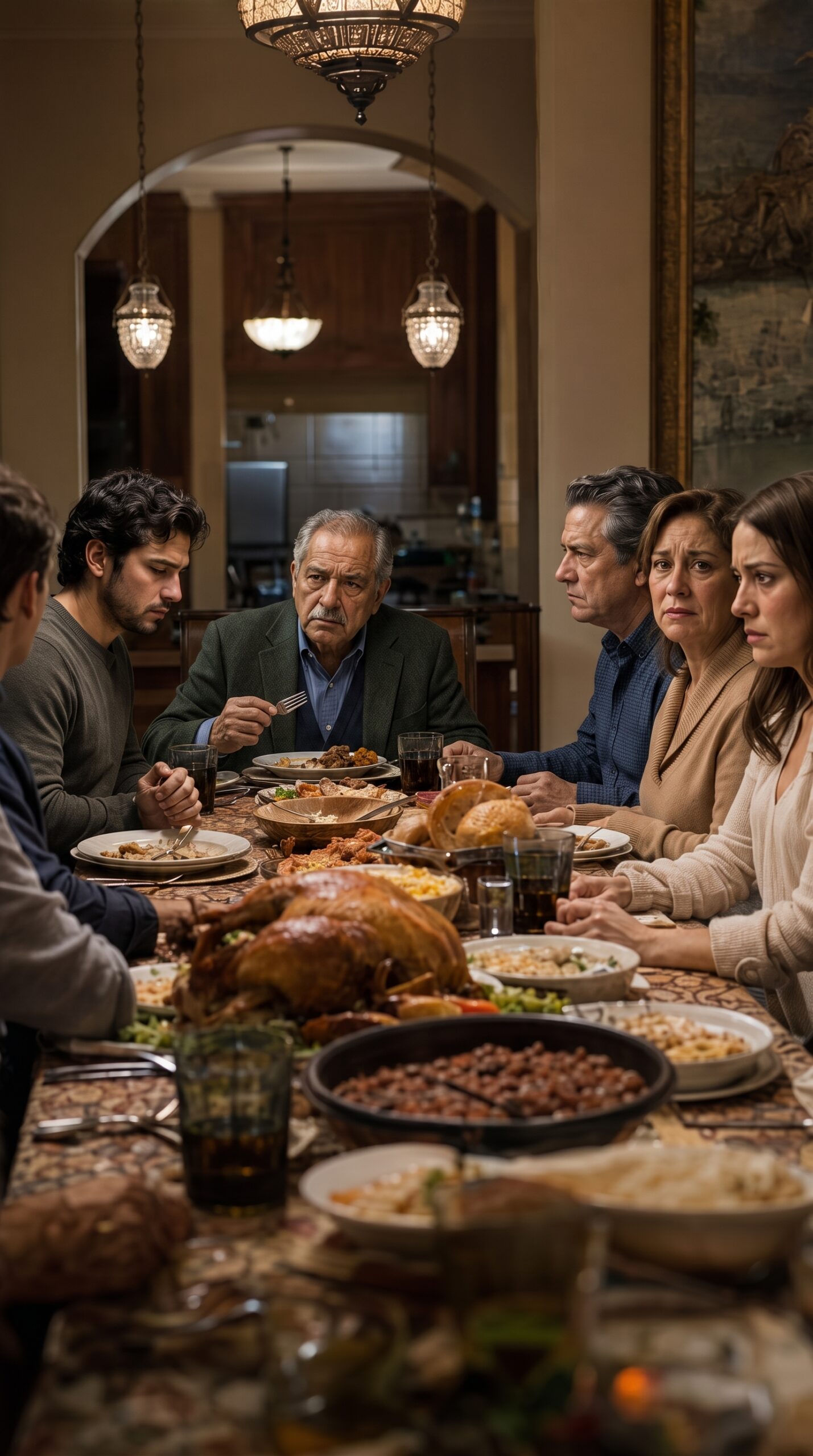
The Sunday family dinner froze in my parents' house, in a quiet neighborhood of Monterrey, where everyone pretended we were a united family while resentment was served alongside the red rice and grilled meat.
Santiago, 27 years old, sat at the end of the table, his plate barely touched.
His sister Camila occupied her usual spot, close to their mother, with her two children playing in the living room and her new cellphone next to a glass of fresh water.
—What do you mean Santiago pays rent here? —Don Aurelio asked slowly.
No one answered.
Santiago's father, Martín, let out an awkward laugh and waved his hand as if shooing away a fly.
—Oh, Dad, don’t exaggerate. He helps with the house. He’s all grown up now.
Don Aurelio didn’t look at Martín.
He stared straight at Santiago.
—I asked you, son. How much do you pay?
Santiago felt his throat tighten.
His mother, Clara, squeezed the napkin between her hands.
Camila lowered her gaze to her plate, as if suddenly the guacamole was of utmost urgency.
—I pay 8,000 pesos a month —Santiago said.
Grandma Teresa’s eyes widened.
—8,000?
Clara hurried to speak.
—It’s not rent, it’s a contribution. We all help out here.
Santiago let out a dry laugh.
—I live in the back room, next to the boiler. I buy my own food. I pay for my gas, my cellphone, my insurance, and sometimes even the bills when they’re overdue.
Camila raised her head, offended.
—You say that like you’re a martyr.
—No, I say it like it is.
Martín banged his fingers on the table.
—That’s enough. Your sister has two kids. She needs more support.
Don Aurelio laid his fork down on the plate.
The sound was tiny, but everyone heard it like a hammer dropping.
—And doesn’t Santiago need anything? —he asked.
Martín clenched his jaw.
—Santiago works. Camila is just recovering from her divorce.
Don Aurelio turned to Camila.
—Since when are you recovering?
She froze.
—Grandpa, you don’t have to talk to me like that.
—I asked you something.
Camila swallowed hard.
—Three years.
Don Aurelio nodded slowly.
—Three years living for free, with food, a roof, and a built-in babysitter.
Clara turned pale.
—Dad, please.
—Don’t tell me please when your son has been charged for existing in his own home.
The silence grew heavy.
Even the kids stopped running.
Santiago didn’t want to talk anymore. For years, he had learned to stay silent because every time he said he couldn’t, his mom cried, his dad called him ungrateful, and Camila stopped talking to him like he had abandoned his nephews.
But Don Aurelio wasn’t going to let the topic go.
—Besides those 8,000, what else do you pay?
Santiago lowered his gaze.
—Sometimes the electricity. The internet. The repairs on Dad’s Sentra. Leo’s enrollment. Renata’s school supplies. Once I even paid Camila’s dentist.
Camila crossed her arms.
—That was because you wanted to help.
Santiago looked up.
His eyes were red, but his voice was steady.
—No. I did it because when I said no, Mom told me the kids weren’t to blame.
Clara began to cry.
Martín half stood up.
—Don’t talk to your mother like that!
Don Aurelio stopped him with a look.
—Sit down, Martín.
And Martín, for the first time in a long time, sat down.
Santiago pulled his cellphone from his pocket with trembling hands.
He opened a folder labeled "Family."
There were the transfers, the messages, the audio files, the receipts.
—I’ve been keeping track for two years —he said—. Between rent, loans, bills, school, repairs, and Camila’s stuff… it’s 412,000 pesos.
Grandma Teresa covered her mouth with a hand.
Camila paled.
Martín murmured:
—You’re sick if you kept track of that.
Santiago looked at him with pain.
—No, Dad. Sick was making me feel guilty for wanting to save up to move out.
Then Don Aurelio pushed his plate to the center of the table.
He wasn’t going to eat anymore.
And when he reached into his jacket and pulled out a yellow envelope with Santiago’s name written in pen, everyone understood that this meal was not going to end like any other.
PART 2
Martín looked at the envelope as if it were a threat.
—What do you have there, Dad?
Don Aurelio didn’t answer immediately.
He wiped his mouth with the napkin, took a deep breath, and placed the envelope in front of Santiago.
Then he pulled out another, thinner one, with Camila’s name on it.
Camila straightened in her chair.
For the first time all afternoon, she didn’t seem offended.
She seemed interested.
—Six years ago, I sold a piece of land in Linares —Don Aurelio said—. I didn’t tell you all because I wanted to see what each of you would do with your lives. I set aside a part for my grandchildren. It wasn’t an inheritance to squander. It was an opportunity.
Clara closed her eyes.
As if she already knew what was coming.
Martín frowned.
—And why didn’t you say anything?
Don Aurelio looked at him with sadness.
—Because I wanted to know if my children would raise decent people or people used to stretching out their hands.
The phrase fell on the table like a bucket of cold water.
Camila turned red.
—Is that about me?
—It’s also about you —he responded—. But not just you.
Martín clenched his fists.
—You have no right to interfere in how I run my house.
Don Aurelio let out a bitter laugh.
—Your house is held up by your son’s salary, Martín. So yes, I have the right to ask why one sleeps next to the boiler and the other occupies two bedrooms with her children without contributing a single peso.
Camila stood up.
—I’m a single mother!
—And that deserves support, not permission to abuse.
Don Aurelio’s voice didn’t rise.
That’s why it hurt more.
Camila looked at Santiago.
—Did you tell him all this?
Santiago shook his head.
—I didn’t tell him anything. You just heard it.
Clara was crying silently.
It wasn’t that melodramatic cry with screams.
It was worse.
It was the cry of someone who knows they can’t defend themselves because the truth is sitting right in front of them.
Don Aurelio opened Santiago’s envelope.
He pulled out folded sheets, a deed copy, and small keys taped together.
—Santiago, four months ago, I bought an apartment in San Nicolás, near your work. It’s simple, two bedrooms, small kitchen, but it’s paid for. It’s in your name.
Santiago didn’t understand at first.
He looked at the keys.
Then at his grandfather.
Then at his mother.
—What?
—It’s yours —Don Aurelio said—. So you can stop paying for a corner where you were never allowed to feel at home.
Clara let out a sob.
Martín went pale.
Camila opened her mouth, incredulous.
—And what about me?
Don Aurelio picked up the second envelope.
—Yours is an educational fund for Leo and Renata. You can’t touch it. It’s not for nails, clothes, outings, phones, or to rescue Óscar when he shows up crying at the door.
Camila stiffened.
The name Óscar, her ex-husband, extinguished any protest for one second.
—That’s not fair —she said—. My children need stability.
—That’s why the money is for them —Don Aurelio responded—. Not for your decisions.
Camila began to cry, but her cry didn’t sound the same as Clara’s.
It had anger.
It had fear.
It had that desperation of someone who discovers that the free floor is ending.
—So you’re going to leave me on the street?
—No —Don Aurelio said—. I’m going to pay for six months of rent in a small apartment. I will also cover daycare while you look for a job or finish training. After that, you’ll have to support yourself.
Camila let out a broken laugh.
—Six months? Is that all?
Don Aurelio pointed at Santiago.
—It’s more time than he was given to get tired.
Martín stood up suddenly.
—I won’t allow you to humiliate my daughter!
Santiago also stood up, but he didn’t shout.
He just took the keys.
—Dad, no one is humiliating her. They’re just stopping protecting her at my expense.
Martín looked at him with fury.
—After everything we did for you, this is how you repay us?
Santiago swallowed hard.
That phrase had haunted him all his life.
The same phrase when he asked to change jobs.
The same when he wanted to rent with a friend.
The same when he broke up with Valeria because he was embarrassed to invite her to a room with humidity and old boxes.
But this time he didn’t lower his head.
—I’m not paying you anything, Dad. That was the problem. I thought I had to pay you to be loved.
Clara covered her mouth.
—Santi…
—Don’t call me Santi right now, Mom. Not when I was being charged 8,000 for a room that wouldn’t be offered to a guest.
Camila murmured:
—Always exaggerating.
Santiago looked at her.
And something in his face made her shut up.
—When Óscar left you the first time, I lent you 15,000 for the move. When he came back, I told you not to trust him, and you called me envious. When he left you again, I paid for Leo’s therapy because he wouldn’t stop crying at school. I loved your kids, Camila. But you used that love to take my money.
Camila wanted to respond.
She couldn’t.
Then came the twist no one expected.
Grandma Teresa, who had remained silent, pulled out a blue notebook from her bag.
She placed it on the table.
—I also kept track.
Everyone turned to look at her.
Her voice trembled, but not out of fear.
—For three years, Clara asked me for money saying Santiago was short, that he wasn’t making enough for his payments, that poor thing, that the bank was squeezing him.
Santiago felt a chill in his chest.
—What?
Clara lifted her gaze, terrified.
Teresa opened the notebook.
—I gave her 96,000 pesos. According to her, it was to help you.
Santiago looked at his mother.
—Mom…
Clara started shaking her head.
—I was going to pay you back. It’s just that something else always came up.
Don Aurelio closed his eyes in pain.
—Rosa Clara, tell me you didn’t use your son’s name to ask for money.
Clara broke down in tears.
—I didn’t know what to do. Camila needed it, Martín was behind, the house…
Santiago took a step back.
That blow didn’t feel like anger.
It felt like someone had opened a door and behind it was another betrayal, older, deeper.
—So while I was giving you money, you were asking my grandma saying it was for me.
Clara couldn’t respond.
Martín lowered his gaze.
And there Santiago understood something else.
His dad knew too.
—you knew —Santiago said.
Martín pressed his lips together.
—The situation was tough.
—No, Dad. The tough thing was admitting you preferred to drown me than to tell Camila it was enough.
Camila was crying without speaking.
For the first time, she wasn’t the center of the tragedy.
For the first time, everyone looked at her like an adult.
Don Aurelio stood up, leaning on his cane.
—This ends today. Santiago is leaving this house. Clara and Martín will pay him back, even if it’s little by little, what they used in his name. Camila has six months to get back on her feet. And if anyone tries to make Santiago feel guilty, they’ll have to deal with me.
Martín let out a bitter laugh.
—So now you’re in charge?
Don Aurelio looked at him with a terrible calm.
—No. The truth is in charge. And the truth arrived late, but it arrived.
That night, Santiago didn’t take everything.
He packed clothes, documents, his laptop, and an old photo where he was a child sitting on Don Aurelio’s lap.
When he stepped into the hallway, Leo, his 9-year-old nephew, hugged him.
—Are you leaving because of me, uncle?
Santiago crouched down.
His heart shattered.
—No, champ. You’re not to blame for anything.
—Will I be able to come to your house?
Santiago smiled with tears in his eyes.
—Always. But now you’ll knock before entering, okay?
Leo laughed softly and hugged him tighter.
Camila watched the scene from the doorway.
She didn’t say anything.
Maybe because she didn’t know how to apologize.
Maybe because she was still too busy feeling like a victim.
In the first few weeks, Martín didn’t talk to Santiago.
Clara sent him messages every day.
At first, she said: “Come back, the house feels empty.”
Later: “I’m sorry, I didn’t know how to be fair.”
Santiago replied little.
Not out of cruelty.
For his health.
Because some wounds don’t heal if every day someone touches them with guilty hands.
The apartment was small, yes.
But it had something Santiago had never had: silence.
A clean bed.
A fridge with food that no one touched.
A bathroom without humidity.
A door that only opened with his key.
The first night he cried sitting on the living room floor, without furniture, eating tacos from a disposable plate.
He didn’t cry out of pure sadness.
He cried because peace also scares when one is used to mistreatment disguised as family.
Camila accepted Don Aurelio’s help with anger.
She got a job at a large stationery store near Avenida Universidad.
It wasn’t glamorous.
It wasn’t easy.
But for the first time, she paid for her own groceries.
Leo and Renata started in daycare after school.
Clara stopped babysitting every day and began to seek therapy at the community center.
Martín took longer.
His pride weighed like a stone.
But four months later, he arrived at Santiago’s apartment with a toolbox and an envelope.
—Your mom said your lock came loose —he murmured.
Santiago let him in.
Martín fixed the lock, checked a leak, and before leaving, left the envelope on the table.
—I sold the Sentra —he said—. Here’s part of what I owe you.
Santiago opened the envelope.
There were 38,000 pesos.
It wasn’t everything.
Not even close.
But it was the first time his dad wasn’t asking him for money.
He was paying him back.
—It doesn’t fix everything —Santiago said.
Martín nodded.
—I know.
There was a long silence.
—I’m sorry for making you feel less important than your sister.
Santiago took a deep breath.
He didn’t rush to hug him.
He didn’t say it was okay.
Because it wasn’t.
And it had not been for years.
—Thank you for saying that —he replied.
A year later, they celebrated Don Aurelio’s 79th birthday in his backyard.
There was grilled meat, warm tortillas, salsa from the mortar, and soft norteña music because Teresa said at his age she didn’t want scandals.
Camila arrived with Leo and Renata.
She looked tired but different.
More humble.
More real.
She approached Santiago when the kids went to play.
—I owe you an apology —she said.
Santiago looked at her without smiling.
—Yes.
Camila lowered her eyes.
—I got used to everyone solving my problems. And when you stopped doing it, I hated you for forcing me to see myself. I was unfair to you.
Santiago felt something old stirring in his chest.
But it didn’t hurt the same anymore.
—I don’t want your children to pay for your mistakes —he said—. I love them very much.
Camila cried.
—I know. And that’s why I’m even more ashamed.
Don Aurelio tapped his glass with a spoon.
Everyone fell silent.
The old man stood up slowly, with his cane and that look that still silenced anyone.
—I want to toast to this family —he said—. Not because it’s perfect. That doesn’t exist. I toast because we finally understood that loving someone isn’t letting them destroy themselves to hold up others.
He looked at Santiago.
—And I toast to my grandson, because he had the courage to leave a house where he paid rent but never felt at home.
Everyone raised their glasses.
Santiago looked at his mother crying openly.
At his father, who for the first time held his gaze.
At Camila hugging her children.
And at Don Aurelio, the only one who stopped eating so that everyone would stop swallowing the lie.
Then he understood something many confuse:
Family isn’t who charges you with guilt for every favor you never asked for.
True family is who lets you grow without making you feel like a traitor for saving yourself.
And that afternoon, under the Monterrey sun, Santiago didn’t feel like he had lost his place.
He felt that he had finally stopped paying for one that was never his.