PART 1
Julián Montes de Oca grew up hearing that a surname like his should never be tarnished by love.
His mother, Doña Rebeca Montes de Oca, repeated it to him since he was a child, as they walked through the marble halls of their home in Las Lomas, surrounded by family portraits, silent servants, and well-groomed secrets.
The Montes de Oca family owned hotels in Los Cabos, buildings in Polanco, land in Mérida, and had enough connections to silence any judge, businessman, or politician who dared to cross their path.
To Doña Rebeca, love was beautiful.
But the inheritance was sacred.
So when Julián fell in love with Elena Robles, she smiled politely.
But her eyes turned to ice.
Elena didn’t come from a wealthy family. Her father had been a mechanic in Iztapalapa for 40 years, and her mother a primary school teacher. She was studying pedagogy and working in the afternoons tutoring middle school students.
Her dream was to open an educational center for adults who hadn’t finished school.
Julián met her in the library at UNAM, where he had been staring at a commercial law book for an hour as if it were his enemy.
Elena sat across from him and said:
—You’re looking at it so ugly it seems like it owes you money, dude.
Julián let out a laugh he couldn’t control.
That’s how it all began.
She helped him study, then helped him breathe. With Elena, Julián wasn’t an heir or the future president of the family group. He was simply a man who could make mistakes, laugh, and eat tacos on the sidewalk without feeling judged.
He promised her a house with a garden, Sunday breakfasts, children running down the hall, and a real family.
But the first time Julián took Elena to his mother’s mansion, Doña Rebeca began her silent war.
During dinner, she raised her glass and said:
—Being a good person is valuable, Elena. But a family like ours needs more than good feelings.
Elena understood the blow.
Julián pretended not to hear it.
That was the first wound.
The second came when Doña Rebeca suggested medical studies before any formal commitment.
—It’s not distrust — she said —. It’s responsibility. A lineage isn’t improvised.
Elena accepted because Julián swore they would face everything together.
But the outcome was unexpected.
The doctor explained that Julián had fertility problems and that Elena had complications that could hinder a pregnancy.
It wasn’t impossible.
Just difficult.
Doña Rebeca heard “difficult” and turned it into a sentence.
—A woman who can’t give my son children is not a good choice.
Elena looked at Julián, hoping he would defend her.
He lowered his gaze.
That silence hurt more than any insult.
That night, Elena left with a small suitcase and a heart full of broken promises.
Julián didn’t follow her.
Two months later, Elena discovered she was pregnant.
At seven weeks, the ultrasound showed three heartbeats.
Triplets.
Scared, alone, and with no desire to return to a house where she was treated like a factory defect, Elena disappeared.
Four years passed.
Julián became the man his mother wanted. He ran hotels, graced magazines, gave speeches at foundations, and smiled alongside the right people.
Then Doña Rebeca organized the perfect wedding.
The bride was Valeria Hinojosa, heiress to a family that owned construction companies in Monterrey.
Beautiful, elegant, immaculate.
Doña Rebeca adored her.
But Julián never seemed completely alive.
A week before the wedding, Doña Rebeca sent a golden invitation to Elena.
—Let her see what she lost — she said with a venomous smile.
Elena held it in silence.
On the day of the ceremony, at a hacienda in San Miguel de Allende, everyone expected her to arrive alone, humiliated and broken.
But when the doors opened, Elena walked in holding the hands of three children.
And the smallest girl looked directly at Julián, smiled innocently, and asked:
—Mommy, is that man the dad who appears in our pictures?
PART 2
Silence fell over the hacienda as if someone had turned off the music, the air, and even the thoughts.
The orchestra left a note hanging in the air.
The guests turned to look.
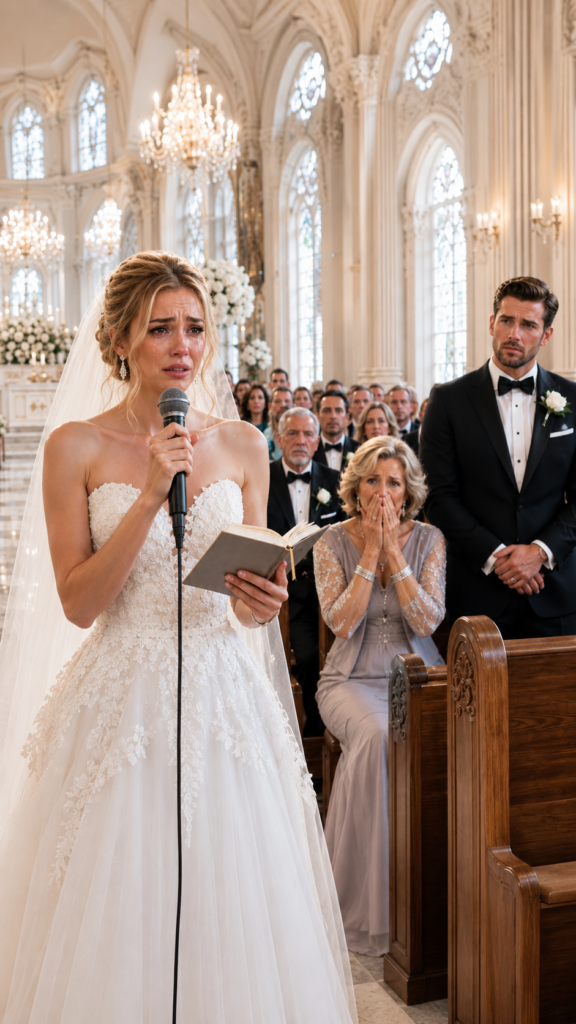
Valeria, dressed as a bride, stood frozen beside the altar, clutching her bouquet tightly between her fingers.
Julián felt the world tilt.
In front of him were three children with dark eyes, brown hair, and an expression so familiar it shattered his chest before he could understand.
A girl in a yellow dress held Elena’s hand.
A boy wore a white shirt and a blue bowtie.
The other, shyer, hid behind his sister, clutching a red toy car.
They were four years old.
All three.
Doña Rebeca rose from the front row with a hardened expression.
—What does this vulgarity mean?
Elena did not lower her gaze.
She wasn’t dressed to compete with anyone. She wore a simple burgundy dress, her hair pulled back, and a calm that hurt more than the shouting.
—It means I accepted your invitation, Doña Rebeca.
A murmur swept through the hall.
Some guests raised their cell phones.
Others looked at each other with that dirty thrill of those who know the real show has just begun.
Julián took a step toward Elena.
—Elena… what’s happening?
The girl in the yellow dress looked at him again.
—I’m Camila. This is Mateo and this is Nico. Mommy says we shouldn’t interrupt weddings, but the lady sent us a really nice card.
Doña Rebeca paled slightly.
Valeria turned to her future mother-in-law.
—Did you invite her?
Doña Rebeca pressed her lips together.
—It was a courtesy. I didn’t imagine she would show up with… with this.
Elena took a deep breath.
—They are not “this.” They are my children.
Julián swallowed hard.
—My children?
The word came out broken.
Elena looked at him with ancient sadness.
—you never asked.
—I didn’t know.
—No, Julián. You didn’t want to know.
He opened his mouth but couldn’t find a defense.
Four years had passed, yes. But so had hundreds of nights during which he could have searched for her, called Elena’s mother, asked at the university, knocked on a door, done something.
He did nothing.
Because it was easier to believe that she had left out of pride.
Doña Rebeca struck the floor with her luxury cane, although she didn’t need it to walk.
—This is a setup. A scorned woman can invent anything for money.
Elena smiled without joy.
—Honestly, ma’am, I’ve spent four years raising triplets alone, and you still think I had time to set up a show.
Some guests let out a nervous laugh.
Doña Rebeca turned towards them, furious.
—Silence!
Valeria slowly stepped down from the altar. Her veil brushed the stone floor.
—Julián, tell me this isn’t true.
He couldn’t respond.
His eyes remained fixed on the children.
Mateo looked up.
—Do you have big cars? My grandpa says rich people drive as if the street were theirs.
Elena gently squeezed his shoulder.
—Mateo.
The boy fell silent.
Julián felt something inside him crack.
—Elena, please… tell me when they were born.
—On March 18, four years ago.
Julián closed his eyes.
He did the math.
The blow was brutal.
Valeria understood too.
—So they are yours.
Doña Rebeca interjected.
—Don’t accept anything without proof. This woman always wanted to climb the social ladder.
Elena looked at her steadily.
—I didn’t want to climb the social ladder. I wanted your son to have value.
The phrase fell like a slap.
Julián lowered his head.
But Doña Rebeca wasn’t going to let her perfect wedding crumble in front of half the Mexican elite.
—Security — she ordered —. Get this woman and her children out of here.
Two men dressed in black advanced from the entrance.
Camila got scared and clung to Elena.
—Mommy, did we do something wrong?
Elena knelt in front of her.
—No, my love. Telling the truth is never wrong.
Julián raised his voice for the first time.
—Nobody touches them.
The guards stopped.
Doña Rebeca slowly turned to her son.
—Julián, don’t make a bigger fool of yourself.
He looked at her as if for the first time he saw the woman who had dictated his life for years.
—The foolishness began when you invited Elena to humiliate her.
Valeria watched him with contained tears.
—Did you love her?
Julián didn’t answer immediately.
And that silence was a sufficient answer.
Valeria let out a bitter laugh.
—How nice. I’m here in a wedding dress and you’re buried in a story you didn’t even have the courage to resolve.
Doña Rebeca approached her.
—Valeria, dear, don’t let this scene ruin an alliance between families.
Valeria looked at her as if she had just heard something disgusting.
—Alliance? Was I that? A contract with a veil?
Nobody moved.
Then Elena pulled a folder from her bag.
Doña Rebeca’s expression changed.
Just for one second.
But Elena noticed.
—I didn’t come to ask for anything. I came because you invited me. And because I’m tired of my children growing up believing their father abandoned them because of them.
Julián took another step.
—I would never have…
—You would have — Elena interrupted him —. Because you did that with me.
The phrase left him breathless.
Elena opened the folder.
—When I found out I was pregnant, I called your house. Three times. I left messages. I sent a letter with the ultrasound. Your mother responded with this.
She pulled out a folded sheet.
Doña Rebeca’s face hardened.
Julián took it with trembling hands.
It was a letter signed by Vivian Legal Consultants, the family's private firm.
It said that Elena should refrain from contacting Julián, that any attempt to attribute a pregnancy would be considered extortion, and that if she insisted, they would face legal action.
At the end was a handwritten phrase. “Your son has already chosen his future. Don’t destroy what little dignity you have left.”
Julián recognized his mother’s handwriting.
The entire hall seemed to hold its breath.
—Mom — he said, almost voiceless —. Did you receive her calls?
Doña Rebeca didn’t respond.
—Did you see the ultrasound?
She lifted her chin.
—I did what was necessary to protect you.
Julián recoiled as if he had been struck.
—You hid my children from me.
—I saved you from a trap.
Elena pulled out three photos.
In each one was a newborn baby, tiny, connected to monitors.
—They were born premature. They spent 23 days in the incubator. Camila stopped breathing twice. Mateo needed therapy. Nico couldn’t gain weight.
Elena’s voice broke, but she didn’t fall.
—I signed papers alone. I slept in a hospital chair. I sold my dad’s car to pay for medications. And all the while, you were here building a lie.
Julián looked at the photos.
Tears fell without permission.
Camila approached slowly.
—Why are you crying?
He squatted in front of her but didn’t dare touch her.
—Because I should have been there.
The girl looked at him with a seriousness that didn’t belong to her four years.
—My mommy was there.
The comment was innocent.
But it shattered Julián.
Valeria slowly removed her engagement ring.
Doña Rebeca panicked.
—Valeria, think carefully about what you’re doing.
—I’m thinking clearly.
Valeria placed the ring on a table.
—I’m not going to marry a man who doesn’t know who he is without his mother’s permission.
Julián didn’t stop her.
He couldn’t.
Valeria looked at Elena.
—I’m sorry for standing in the middle of something I never understood.
Elena nodded respectfully.
—You’re not to blame.
—Maybe not — Valeria said —, but I’m also not going to stay to save face for anyone.
Then she turned to the guests.
—The wedding is canceled.
A roar of murmurs filled the hacienda.
Doña Rebeca lost control.
—No! This is not going to be canceled because of three children who appeared and a resentful teacher!
Mateo frowned.
—My mommy isn’t resentful. My mommy works a lot.
Nico, who had barely spoken, hugged Elena’s leg and whispered:
—Are we going now?
Elena stroked his hair.
—Yes, my love.
Julián stood up desperately.
—Wait. Don’t leave again. Please.
Elena looked at him firmly.
—Don’t confuse this. I didn’t come to return you a family. I came to show you the truth.
—Let me get to know them.
—That’s not something you ask in the middle of a canceled wedding, Julián. It’s earned with time, responsibility, and lawyers.
The word “lawyers” made Doña Rebeca regain her venom.
—See? Money. It was always about money.
Then Elena pulled out the last document.
—No. That’s why I did the tests before coming.
Julián looked up.
—What tests?
—DNA.
The hall exploded with whispers.
Elena left three envelopes on the main table.
—When Camila needed a genetic study for a respiratory condition, the lab found compatibility with family samples that were registered in a private database due to the studies you all had done before. After that, I requested the complete legal process.
Julián took the first envelope.
99.99% probability of paternity.
Then the second.
Then the third.
His hands trembled more with each page.
There was no doubt.
Camila, Mateo, and Nicolás were his children.
Doña Rebeca sat down slowly.
For the first time, she looked old.
Not powerful.
Old.
Julián looked at her with a mixture of rage and mourning.
—You robbed me of four years.
—I gave you a clean life.
—No. You gave me an empty life.
Elena put away the photos.
—My children don’t need a perfect family. They need adults who don’t use them as shame, currency, or punishment.
Julián walked toward her.
—I’m going to fix this.
Elena shook her head.
—you don’t fix a lost childhood with flowers or surnames.
—Then tell me how.
She looked at him for a long time.
—Start by not lying. By not hiding behind your mother. By showing up before a judge. By paying what’s due without believing that it buys you affection. And by understanding that they are not an extension of your surname. They are people.
Julián nodded, devastated.
Camila raised her hand and touched the sleeve of his jacket.
—Do you know how to make pancakes?
He let out a broken laugh between tears.
—Not very well.
—My mommy does. She makes them with a happy face.
Julián looked at Elena.
There was everything he had lost.
No mansions.
No weddings.
No magazines.
Sundays with flour on the table. Children laughing. A brave woman holding alone what he failed to defend.
Doña Rebeca tried to stand.
—Julián, let’s go. This is over.
He didn’t turn.
—Yes, Mom. It’s over.
His voice came out firm.
—It’s over that you decide for me. It’s over that you use my life as a business. And it’s over that you call my children shame.
The guests were left speechless.
Valeria, still in her wedding dress, barely smiled.
Not out of happiness.
But relief.
Elena took the hands of her three children and walked towards the exit.
Julián didn’t stop her.
This time he understood that love wasn’t about chasing someone when it was too late, but about standing up when it was still possible to do the right thing.
Days later, Julián voluntarily appeared before the family judge.
He legally recognized Camila, Mateo, and Nicolás.
He accepted child support, supervised family therapy, and gradual visitation. He also resigned from directing the trust his mother controlled and ordered an internal audit of the firm that had threatened Elena.
Doña Rebeca tried to say it had all been a misunderstanding.
But the letter, the call logs, and the lawyer’s emails proved otherwise.
The society that had guarded so much stopped inviting her.
Not out of morality.
But out of fear of appearing in the next scandal.
Valeria returned to Monterrey, sold the exclusive rights to the canceled wedding to a magazine, and donated the money to a shelter for single mothers.
When she was asked if she hated Elena, she replied:
—No. I admire her. She came with three children and more dignity than all of us put together.
Six months later, Julián arrived at a small educational center in Coyoacán.
On the facade, it said:
“Robles Center: It’s Never Too Late to Learn.”
Elena had opened it with support from scholarships, donations, and years of work that no one from the Montes de Oca family had seen.
Camila ran towards him with a drawing.
Mateo showed him a new toy car.
Nico stayed close to Elena, still distrustful.
Julián didn’t force anything.
He just squatted and said:
—Hi. I brought flour. I want to learn how to make pancakes.
Camila smiled.
—They’re going to turn out ugly.
—For sure.
—But you can practice.
Elena watched him from the door.
There was no complete forgiveness.
There was no soap opera ending.
There was something harder: consequences.
And perhaps, with years of truth, a new form of family.
Because sometimes the harshest punishment isn’t losing a lavish wedding.
It’s discovering in front of everyone that the woman you wanted to humiliate was the only one who had raised with love what your family called shame.