PART 1
At 2 AM, when Renata Morales pulled down the curtain at the boarding house in the Obrera neighborhood, the rain poured over Mexico City as if someone were dumping buckets from the sky.
The CLOSED sign barely stopped swinging when something slammed against the back door.
It wasn't a knock.
It was a body.
Renata froze, a damp cloth in one hand and the other pressed to her chest, feeling her heart rise to her throat.
Another bang rattled the metal sheet.
—Who’s there? —she called.
No one answered.
Only a broken, heavy breath came, like someone dragging themselves from hell.
Renata was 24 years old, living in a tiny room above the boarding house and had been working double shifts for three years since she dropped out of nursing school to care for her sick mother.
Her mother died.
The debts remained.
And the boarding house, named La Esquina de Doña Lucha, was all that still smelled like home.
The sensible thing would be to call 911.
But the part of her that almost became a nurse walked toward the door.
She grabbed a chef’s knife from the prep table and opened it just a crack.
The man fell inside.
He was tall, broad-shouldered, soaked, wearing a black coat that looked expensive despite being stained with blood.
He had a bullet wound in his side and a scraped face, as if he had been dragged across the pavement.
—Don’t call the police —he murmured.
Renata swallowed hard.
—You’ve been shot.
—No police.
—Hospital?
He clenched his jaw.
—Neither.
Renata thought he was crazy until the man tried to sit up and the coat opened slightly.
Then she saw them.
He wasn’t wearing a bulletproof vest.
He had two babies strapped to his chest with a double baby carrier.
A boy and a girl, about six months old, wrapped in a gray blanket, wet at the edges, their eyes wide open and too silent.
Renata felt the floor shift beneath her.
The man followed her gaze.
And for the first time, his face stopped looking like stone.
—Hide them —he whispered—. For everything you hold dear.
Headlights illuminated the alley.
The sound of tires splashing through puddles stopped in front of the door.
Renata didn’t think twice.
—Get up, come on.
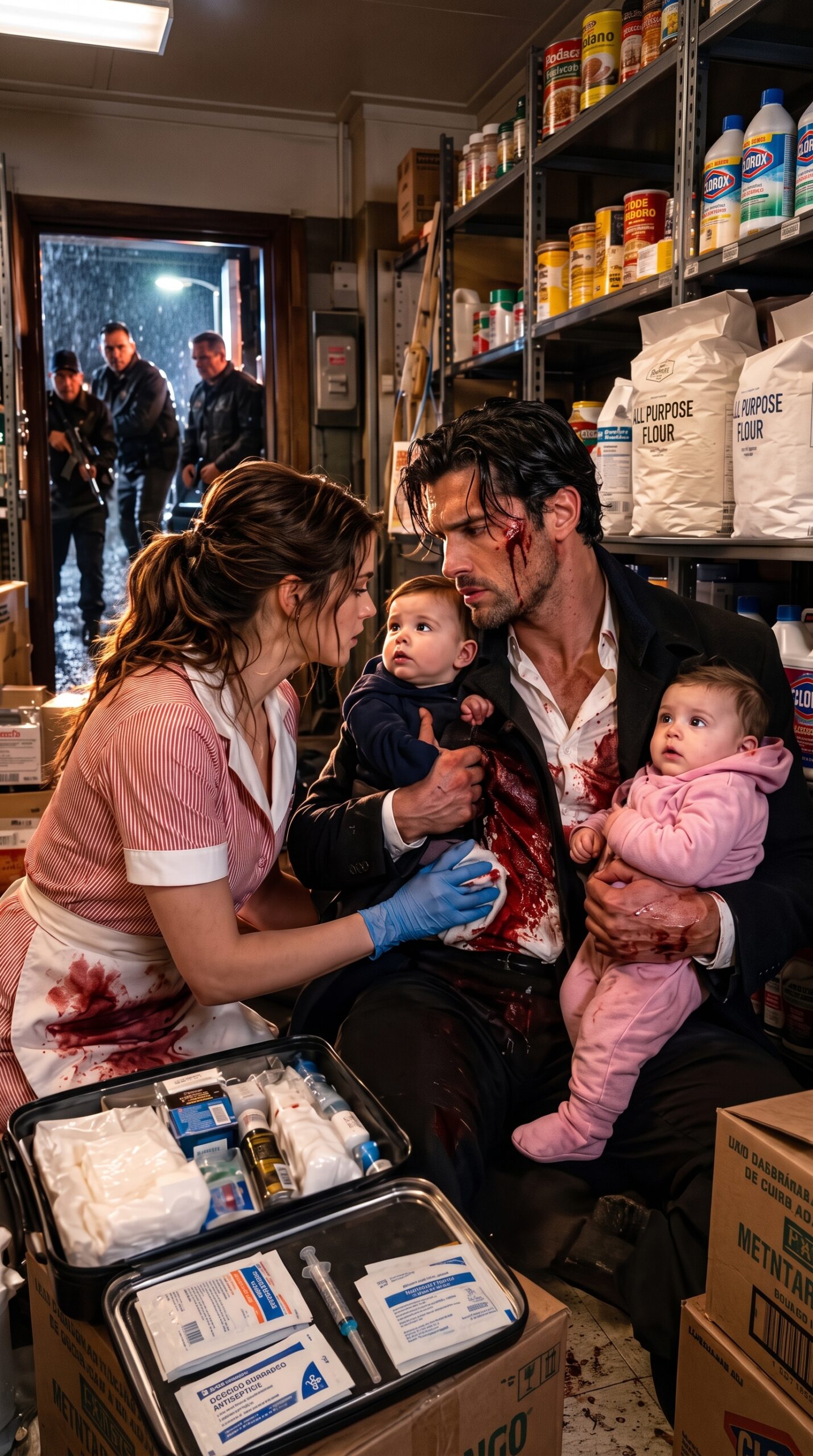
She threw her arm around his shoulders and dragged him toward the kitchen pantry, between sacks of rice, boxes of oil, and cans of chili.
The man slumped against the wall.
Renata closed the door almost completely.
—Don’t fall asleep.
She ran back, grabbed bleach, a mop, and industrial soap, and started scrubbing the blood off the floor as if her life depended on it.
Because, suddenly, it did.
Outside, footsteps echoed.
Boots.
Men's voices.
—Check everything, man —one said—. He couldn’t have gone far.
The doorknob rattled violently.
Renata crouched behind the counter, covering her mouth to stifle any sound.
The footsteps lingered for an eternity.
Then they faded away.
The truck revved up.
Only then did Renata realize she was trembling.
When she returned to the pantry with the first aid kit, the man had already unbuckled the baby carrier and had the two children on his lap, shielding them with his arms as blood continued to seep from him.
The baby let out a faint whimper.
The man, nearly unconscious, adjusted the blanket with a tenderness that didn’t fit with the fear he inspired.
Renata knelt beside him.
—Let me see the wound.
He stared at her.
His eyes were dark, hard, tired.
—First, I need to tell you something.
—Tell me fast.
The man breathed heavily.
—My name is Alejandro Salvatierra.
Renata felt her blood freeze.
That name belonged to no stranger.
It was the surname that appeared in news about disappearances, shady businesses, bought politicians, and settling scores that no one dared to explain.
And as the sound of an engine approached slowly outside, Renata understood that the impossible was just beginning.
PART 2
Renata stared at him as if the wounded man had stopped bleeding to become a bomb.
Alejandro Salvatierra.
In Mexico, everyone knew that name, even if no one said it too loudly.
The news called him a restaurant entrepreneur, a benefactor, a transportation and construction mogul.
The street called him something else.
The man whom no one dared say no to.
The man who, according to rumors, could sit a deputy, a commander, and a killer at the same table without raising his voice.
And now he lay in the pantry of a boarding house, with two babies in his arms, begging a girl not to call anyone.
—You already know who I am —he said—. If you want to run, do it now.
Renata looked at the children.
The baby girl slept with her cheek pressed against the coat. The boy clutched Alejandro’s blood-stained shirt with his tiny fingers, unaware that the body protecting him could shut down at any moment.
—I’m not leaving two babies with a shot man —she replied.
Alejandro let out a weak, bitter laugh.
—I really chose the right boarding house.
—You didn’t choose anything. You fell on my doorstep.
Renata cut the shirt with the scissors from the first aid kit.
The bullet had pierced his side, but he had lost a lot of blood. Too much.
—You need a hospital.
—No.
—You could have internal damage.
—There’s no time.
—Stubborn people always say that before they die.
He closed his eyes, not from sleep, but from pain.
—If I go to a hospital, they’ll get there before any doctor.
Renata pressed the bandage against the wound.
—Who are “they”?
Alejandro looked toward the babies.
—People who think my children are worth more alive than dead.
Renata’s stomach churned.
—They’re babies, not merchandise.
—To some bastards, everything is merchandise.
Rage flushed her face.
She didn’t know what kind of monsters were chasing two innocent creatures, but at that moment, she stopped caring whether Alejandro was a saint, a demon, or something worse.
The babies were blameless.
—What are their names?
Alejandro looked down.
—Mateo and Lucía.
—Are they yours?
—Yes.
—And their mother?
The silence weighed more than the rain.
—She died.
Renata didn’t ask how.
The way Alejandro swallowed told her enough.
Lucía began to stir. Mateo made a soft sound, hungry.
Alejandro tried to lift him, but pain doubled him over.
—Still —Renata ordered.
—My son is hungry.
—And you’re bleeding out, national danger.
He looked at her, surprised by her tone.
Renata searched in the baby carrier and found two bottles of formula, diapers, and a tiny change of clothes.
—You came prepared.
—I tried.
—Did you know they were going to attack?
Alejandro took time to respond.
—I suspected that someone from my side sold information.
—From your side?
—Don’t ask things that could get you killed.
Renata held his gaze.
—You’re bleeding in my pantry. I think that line’s already been crossed, right?
He didn’t answer.
Renata fed Mateo first. The baby took the bottle desperately, one tiny, cold hand wrapped around her finger.
Something broke inside her.
Her mother always said that a quiet child amid fear wasn’t a calm child; it was a child tired of being scared.
The phrase hit her like a memory and a warning.
Soft knocks sounded at the front door.
Three knocks.
They weren’t the men from the truck.
Renata stood up.
Alejandro grabbed her wrist.
—Don’t open.
—It could be someone I know.
—At 2:30 AM, no one familiar brings good news.
—I work in a boarding house; weird people come in at all hours.
—Renata.
She froze.
—How do you know my name?
He looked at an old photo stuck next to the sacks: Renata and her mother, in red aprons, smiling in front of the boarding house.
—It's written on the wall —he said—. “Renata and Doña Lucha, reopening.”
Renata barely breathed.
—Let me go.
He complied.
She crossed the kitchen and opened a crack.
On the other side was Officer Camilo Herrera, a patrolman from the area, soaked under the awning.
Camilo had been coming to the boarding house for years. He knew Doña Lucha. He had helped unload boxes when Renata was left alone with the business.
—All good, Reni? —he asked.
—Yes. Just cleaning up.
Camilo squinted.
—Shots were reported on Eje Central. A black truck passed by here. Did you see anything?
Renata felt the lie burning her tongue.
—No.
Camilo looked over his shoulder.
—Can I come in?
—I’ve closed.
—I’m not asking for coffee.
His radio crackled.
Renata thought about telling him everything.
A shot man.
Two babies.
A truck without plates.
A cursed name hidden among cans of beans.
But she also thought about how Alejandro had said someone sold information. If there were traitors among his people, there could be among the police too.
And if Camilo filed a report, the whereabouts of the babies would be written in some system too many people could read.
—I’m fine —she said.
Camilo didn’t believe her.
That was the worst part.
Because he knew her.
—Lock up —he finally said—. And if you hear anything, call me. Don’t play the brave one, mija.
—Yes.
When Renata returned to the pantry, Alejandro was standing, pale as a wall.
—We’re leaving —he said.
—You can’t even walk two steps.
—Then drag me.
—How considerate.
Alejandro pulled a small key from his pocket.
—There’s a blue Beetle in a parking lot two blocks away. The key’s on the keychain.
Renata looked at him like he was insane.
—Your escape plan is a Beetle?
—No one looks twice at an old Beetle.
—For the first time, you say something smart.
She grabbed diapers, formula, water, gauze, and the money hidden under the register.
Then she left a note for the morning cook:
“Family emergency. Don’t open until I call.”
It wasn’t exactly a lie.
In that moment, Mateo and Lucía were someone’s emergency.
They slipped out through the basement door, which connected to the service hallway of the neighboring store.
The rain had eased, but the city still shone wet, empty, dangerous.
Alejandro carried the babies under a clean coat Renata found in lost and found.
She walked beside him, ready to support him if he fell.
The Beetle was where he said.
Old, blue, with a rosary hanging from the rearview mirror and two baby seats installed in the back.
Renata stared at it.
—You prepared this car for them.
—Three days ago.
—So you did know something was coming.
Alejandro sat down with difficulty.
—I knew someone wanted to take them from me.
Renata settled the babies and started the engine.
The motor sounded like a blender with stones.
—Where to?
—to a house in Tepoztlán.
—Another hideout of yours?
—It was my grandmother’s.
—And no one knows?
—I hope not.
The city faded behind them.
For several minutes, only the engine, the rain, and Alejandro’s heavy breathing could be heard.
Renata checked the mirrors every five seconds.
Every headlight looked like a threat.
Every shadow looked like a truck.
—You’re turning gray —she said.
—I’ve always had bad color.
—Quit playing the clown. You’re going to get a fever.
—There’s medicine in the house.
—Why?
—My sister was a doctor.
Renata barely turned.
—Was?
Alejandro looked at the road.
—She disappeared 24 years ago.
The number hit her oddly.
24 years.
His age.
—What happened to her?
—She tried to leave my world. I helped her hide. I thought no one would find her.
—And did they find her?
Alejandro pressed his lips together.
—I never saw her again.
Renata felt a strange chill.
—What was her name?
—Isabela.
The name hung in the car.
Mateo began to cry.
Renata pulled over at a closed gas station.
—We need to feed him.
—We can’t stop.
—They are babies, Alejandro. Not chess pieces.
He didn’t argue.
Renata moved to the back seat and picked up Mateo. Alejandro, awkwardly and in pain, held Lucía against his chest.
For a few minutes, that man of dark legends didn’t seem like a boss, a businessman, or a threat.
He seemed like a defeated father.
A father in fear.
Lucía tugged at a chain he wore around his neck.
The locket slipped out of his shirt.
It was an oval locket.
The interior light of the Beetle flickered, and Renata caught a glimpse of the photo.
A young woman with big eyes, dark hair, and a gentle smile.
Renata stopped breathing.
—Show me that.
Alejandro closed his hand over the locket.
—No.
—That woman…
—No.
—I know her.
Alejandro looked at her sharply.
—Don’t say things without knowing.
Renata pulled out her phone with trembling hands and opened an old photo.
Doña Lucha in front of the boarding house, younger, laughing, with the same look as the woman in the locket.
—That’s my mom —Renata said.
Alejandro stood frozen.
—Impossible.
—My mom was named Lucía Morales. Everyone called her Lucha.
Alejandro took the phone.
Color drained from his face.
—She wasn’t named Lucía.
—Don’t ever speak of my mother that way.
—She was named Isabela Salvatierra.
Renata felt the world tear in two.
—Shut up.
Alejandro reached into the inner pocket of his coat and pulled out a plastic envelope, stained with blood in one corner.
He opened it carefully.
Inside was an old sheet, folded many times.
A hospital record.
Two tiny footprints.
Date from 24 years ago.
Mother’s name: Isabela Salvatierra.
Multiple birth.
Baby A: female.
Baby B: male.
Renata read the handwritten line next to Baby A.
“Renata.”
The sheet slipped from her fingers.
—No...
Alejandro looked at her as if he were just seeing her face for real.
—My sister gave birth to two babies before disappearing.
—My mom didn’t steal me —Renata said, tears of rage streaming down her face—. My mom saved me.
Alejandro nodded slowly.
—Maybe.
The silence was brutal.
Then Alejandro lowered his voice.
—Baby B never appeared.
Renata looked toward the front seats, toward the blue dawn that was just beginning to rise.
—Who was he?
Before Alejandro could answer, headlights appeared at the entrance of the gas station.
A black truck.
Without plates.
Alejandro closed his eyes.
—They’ve found us.
Renata didn’t wait.
She lunged for the steering wheel, turned the key, and pressed the accelerator.
The Beetle screeched out, clumsy but alive, as the truck followed them.
Lucía cried.
Mateo did too.
Alejandro unbuckled his seatbelt.
—No.
Renata glared at him.
—If you’re going to pull out a gun, I swear I’ll throw you out of the car.
—I don’t have a weapon. I left it at your boarding house.
—Then sit down.
—Listen to me. If they catch us, they don’t want to kill me.
—They want the babies?
—And now maybe you too.
The truck drew closer.
Renata took a turn onto a side road.
The Beetle jumped over potholes.
—Why me?
Alejandro breathed painfully.
—Because if you’re Isabela’s daughter, you have the right to a part of everything my family hid.
—Money?
—Proof.
Renata gripped the wheel.
—Proof of what?
—Of who worked with my father. Politicians, judges, commanders. Isabela hid documents before fleeing.
—And you?
He looked down.
—I inherited the monster thinking I could control it.
The truck slammed into the back.
Renata screamed.
Alejandro braced himself against the dashboard.
—To the right! —he ordered—. There’s an old bridge.
—You said you wouldn’t give me orders.
—Please, to the right.
She turned.
The Beetle crossed a narrow bridge.
On the other side was an improvised checkpoint: two patrol cars, lights flashing, officers with guns.
Renata hit the brakes hard.
—Is this yours?
Alejandro shook his head.
The black truck stopped behind them.
For a second, Renata believed they were trapped between two hells.
Then she saw Camilo get out of a patrol car.
—No way —she whispered.
Camilo ran toward her.
—Get out of the car, Renata!
Alejandro raised his hands.
—If he’s bought, it’s over.
But Camilo opened Renata's door and saw the babies.
Then he saw the blood.
Then he saw Alejandro.
His face changed.
—I knew you were lying —he said—. But I didn’t know it was this.
The black truck tried to reverse.
The patrol cars closed in.
There were shouts, hits, metal against metal.
Three men were thrown to the pavement.
One of them, seeing Alejandro alive, went pale.
—It was your brother —he spat—. He sent for the kids.
Alejandro froze.
—What brother?
The man smiled with blood on his lips.
—The one your father hid. The twin of the girl.
Renata felt her legs buckle.
The Baby B.
The lost brother of Renata.
The traitor who grew up in the same world Isabela tried to destroy.
Camilo called for an ambulance, reinforcements, and protection for minors.
Alejandro, now out of strength, fell to his knees by the Beetle.
Renata took Mateo and Lucía, wrapped them against her chest, and for the first time understood that blood doesn’t always bind.
Sometimes it hunts.
Sometimes it takes its toll.
Sometimes it arrives at dawn, bleeding, with two innocent babies and a truth capable of burning an entire life.
As the sun rose over the highway, Alejandro was taken to the hospital under custody.
The babies remained in Renata's arms until a social worker arrived.
Camilo didn’t take his eyes off her.
—Your mom protected you all these years —he said.
Renata looked at the blood-stained locket.
In the photo, Isabela smiled, unaware that one day her daughter would discover the truth at the worst possible moment.
Renata didn’t know if Alejandro deserved forgiveness.
She didn’t know if her lost brother deserved jail, hatred, or pity.
But she did know one thing.
Doña Lucha, or Isabela, or whatever she had called herself before choosing to live as a mother, had left her one last lesson:
Family isn’t who shares your blood.
Family is who, when everyone comes to take your life, stands to hold the door for you.