PART 1
Rodrigo only intended to stop by his dad's house for 10 minutes.
Nothing more.
Just a quick hello, let his daughter hug her grandfather, and head back before the traffic got heavy on the way to Guadalajara.
But what he saw on that table left him frozen.
That Sunday, he hadn’t even planned to go.
Like almost every Sunday.
He had clothes piled on a chair, pending bills, unanswered work messages, and a Zoom meeting that he could supposedly check "quickly."
Nothing was truly urgent.
But everything seemed enough to keep postponing what was important.
His daughter Camila was sitting in the kitchen of their apartment, playing with a cold tortilla on her plate.
Suddenly, she looked up and asked:
—Dad, does my grandpa still remember how I talk?
Rodrigo put his phone down on the table.
—Why do you ask that, my love?
Camila lowered her eyes.
—Because it’s been a long time since we’ve gone. And when someone doesn’t hear a voice for a long time, maybe they forget.
Rodrigo felt a sharp blow to his chest.
He didn’t know how to respond.
Because it was true.
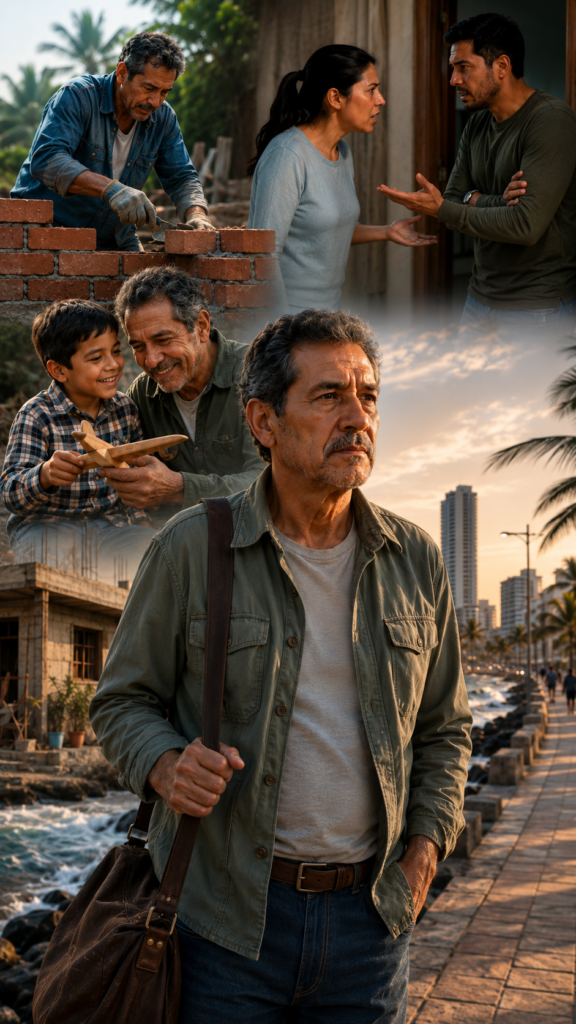
His father, Don Julián, lived alone in a small town in Jalisco, a little over an hour’s drive away.
It wasn’t far.
It wasn’t impossible.
But Rodrigo always found an excuse.
Work.
Tiredness.
Camila’s school.
Traffic.
The grocery store.
Life.
He always said the same thing:
—We’ll go on Sunday, Dad.
And then Sunday would come.
And they wouldn’t go.
Don Julián called almost every week.
Always in the afternoon.
Always with the same simple question:
—Have you eaten, son?
Rodrigo answered quickly, his mind elsewhere.
—Yes, Dad. Everything’s fine. I’m a bit busy. I’ll call you later when I have time.
But that time never came.
That Sunday, after Camila's question, Rodrigo turned off the computer and took the keys.
—Put on your sneakers. We’re going to see Grandpa.
Camila smiled as if she had been given a trip to the sea.
When they arrived, Don Julián opened the door slowly.
He wore an old brown sweater, worn dress pants, and leather sandals that Rodrigo remembered from his childhood.
He looked thinner.
More hunched.
With a whiter mustache.
But his eyes lit up as soon as he saw Camila.
—Come on —he said with a trembling voice—. Look who just showed up.
Camila ran to hug him.
Don Julián held her against his chest for a long time.
Too long.
As if he feared she might slip away.
The house smelled of hot soup, old wood, and Roma soap.
Everything was clean.
Neat.
Silent.
The photo of Rodrigo’s mother still sat on the side table, next to a burned-out candle and a rosary hung in the frame.
Rodrigo walked toward the kitchen.
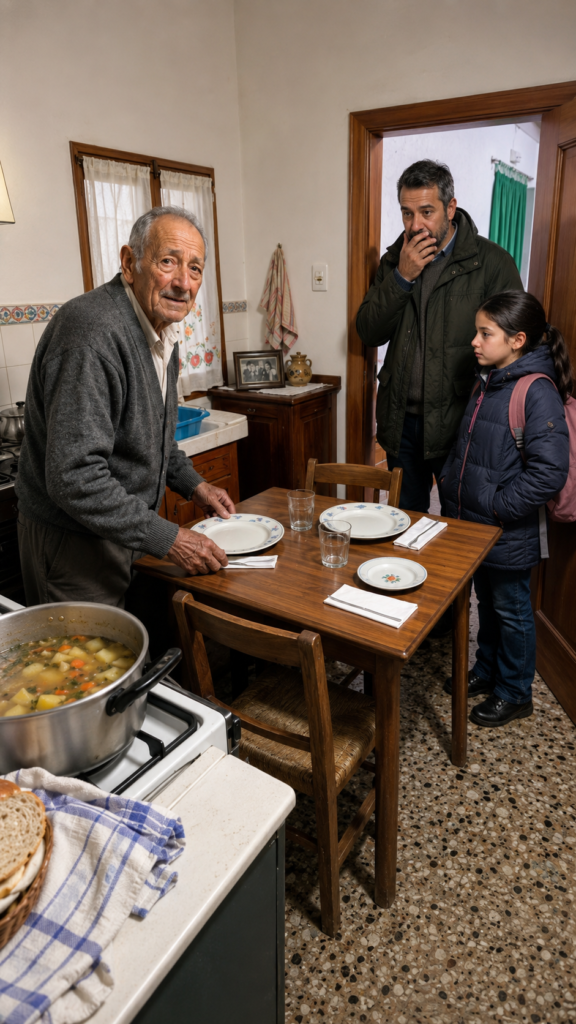
And then he saw the table.
Three plates.
Three glasses.
Three folded napkins.
A large plate at the head of the table.
Another in front of him.
And one more small plate, with small utensils, to the side.
Rodrigo tried to smile.
—Dad… did I tell you we were coming and I forgot?
Don Julián shook his head.
—No, son.
—Then how did you know?
The old man looked at the table.
Then lowered his voice, almost shamefully.
—I didn’t know. Every Sunday, I always set three places. Just in case you might come.
Rodrigo stood still.
Camila looked at her dad, not quite understanding.
But Rodrigo understood.
His father didn’t say it with reproach.
He didn’t make a drama out of it.
He didn’t sigh.
He didn’t ask why it had taken so long.
He just spoke the truth.
And that truth hurt more than any accusation.
On the stove, there was a pot of noodle soup, zucchini, carrots, and a piece of shredded chicken.
On a cloth napkin, there were bolillos.
Don Julián scratched the back of his neck.
—It’s not much. But the food tastes less sad when one doesn’t eat alone.
Rodrigo sat down, unsure where to put his hands.
Camila began to talk immediately.
She told her grandfather about a girl in school who always sang, that her teacher said “órale” when she got excited, and that she wanted to learn to play the guitar.
Don Julián listened to her as if each word were gold.
Sometimes he laughed late.
Sometimes he asked her to repeat herself.
But Camila didn’t mind.
She kept talking.
Rodrigo watched his father’s hands.
Those hands that used to fix everything.
The bicycle.
The creaky door.
The bathroom key.
His childhood fears.
Now they were thin hands, with marked veins and age spots.
After eating, Don Julián opened a cupboard and took out some animal crackers.
—These are for the girl.
Camila smiled.
—Thank you, Grandpa.
Rodrigo took the package to open it.
Then he saw the date.
They were about to expire.
His blood ran cold.
He hadn’t bought them that morning.
He had bought them before.
And he had waited.
One Sunday.
Maybe two.
Maybe many more.
Camila went to the living room to look at old photos.
Rodrigo stayed in the kitchen, helping to wash the dishes.
It was then that he saw the calendar hanging by the window.
Several days were marked with a red circle.
Medical appointments.
Not one.
Several.
Rodrigo pointed at the calendar.
—What’s that, Dad?
Don Julián continued drying a glass.
—Nothing. Check-ups.
—Dad.
The old man didn’t look at him.
—Why didn’t you tell me?
Don Julián carefully set the glass on the table.
Then he replied:
—When I called you, you were always busy.
Rodrigo felt the phrase pierce his chest.
It didn’t come with anger.
It didn’t come with accusation.
But it weighed like a stone.
He was an adult.
He had a daughter, responsibilities, debts, gray hair in his beard.
And yet, in that small kitchen, he felt like a child.
Small in front of his father.
Small in front of that set table.
Small in front of all those “I’ll call you later”s he never fulfilled.
Before leaving, Camila hugged her grandfather again.
—Are we coming back next Sunday?
Don Julián smiled.
—If you come, I’ll tell you about the time your dad fell asleep with a tamale in his hand.
Camila's eyes widened.
—Did my dad really do that?
—Of course. And he still said he wasn’t sleepy.
Rodrigo smiled.
But his throat felt tight.
In the car, Camila fell asleep.
Rodrigo drove in silence.
Suddenly, he felt something in his jacket pocket.
An envelope.
Inside was an old photo.
Rodrigo would have been 6 years old.
He was sitting on his father’s shoulders at a town fair.
They were both laughing.
Behind, in shaky handwriting, Don Julián had written:
"The days when you needed me every day. I still keep them here."
Rodrigo had to pull over to the side of the road.
He kept his hands on the steering wheel, crying silently.
He thought Camila was asleep.
But he felt her little hand on his shoulder.
—Dad —she whispered—, are we really going to come back next Sunday?
Rodrigo nodded.
But just as he was about to respond, his phone began to ring.
It was a call from the town hospital.
And what he heard when he answered took the air from his lungs.
PART 2
—Are you a relative of Mr. Julián Morales?
Rodrigo gripped the phone tightly.
—I’m his son. What happened?
The voice on the other end sounded serious.
—Your dad has some pending tests. The doctor needs to speak with you as soon as possible.
Rodrigo glanced in the rearview mirror.
Camila was awake, looking at him with fear.
—Is he serious? —he asked.
There was a silence.
That silence was worse than any answer.
—It’s better if you come tomorrow morning.
Rodrigo didn’t sleep that night.
He walked around the apartment as if the walls had become too narrow.
He thought about the soup.
About the cookies.
About the three plates.
About all the times his father had called just to ask if he had eaten.
And he, like a fool, had always answered in haste.
The next day he went to the town health center.
Don Julián didn’t want him to go inside with him.
—Don’t make such a fuss, son. I’m not made of glass.
But Rodrigo went in.
Not to invade him.
Not to take away his dignity.
But to be there.
The doctor explained that Don Julián had a heart problem he had been managing alone for months.
There were medications.
There were care routines.
There were good days and bad days.
But there was also a difficult truth:
Don Julián could no longer continue living as if nothing was wrong.
Rodrigo felt shame.
Not for his father.
But for himself.
Because while he claimed to be busy with “life,” his father had learned to suffer in silence.
When they left, Don Julián walked slowly down the hallway.
He carried a folder full of folded papers.
Rodrigo wanted to carry it for him.
—Give it to me, Dad.
Don Julián pressed it to his chest.
—I can still carry my papers.
Rodrigo lowered his hand.
He understood something.
Caring wasn’t treating him like a child.
Caring was walking at his pace.
Without pushing.
Without commanding.
Without arriving late and wanting to decide everything.
That Sunday, they returned.
And the next one too.
Not always perfectly.
Not always on time.
But they returned.
Sometimes they ate noodle soup.
Sometimes beans with cheese.
Sometimes just sweet bread with olla coffee.
Camila turned those visits into a small celebration.
Every Friday she would ask:
—Is this Sunday Grandpa’s?
And Rodrigo no longer replied with “we’ll see.”
He replied:
—Yes. It’s Grandpa’s.
The house began to change.
Not because they painted the walls.
Not because they bought new furniture.
But because the noise returned.
Camila’s pencil doing homework at the table.
Don Julián’s laughter when he told a story.
The clattering of plates.
The television on during a game that nobody watched completely.
One afternoon, Camila brought a blue notebook.
She placed it in front of her grandfather with great seriousness.
—I’m going to write your life.
Don Julián let out a quiet laugh.
—My life isn’t that interesting, little one.
Camila wrinkled her nose.
—You don’t decide that. I decide it because I’m the writer.
Rodrigo laughed.
Don Julián did too.
And thus the blue notebook was born.
Camila asked him questions during each visit.
What was his first job?
How did he meet Grandma?
What was he afraid of as a child?
What had been the happiest day?
What had been the saddest?
Don Julián answered slowly.
Sometimes he would say: —Don’t write that one.
And Camila respected it.
Because she learned that not all memories fit on a page.
One Sunday, while they searched for pictures to paste in the notebook, Camila found a strange image.
Don Julián was sitting in the kitchen.
Alone.
The table had three plates.
But Rodrigo wasn’t there.
Camila wasn’t there either.
The photo seemed to have been taken with a timer.
Rodrigo held it between his fingers.
—When was this?
Don Julián lowered his gaze.
—Your mom’s birthday.
Silence filled the room.
Rodrigo felt something break inside him.
—Dad…
The old man raised his hand.
—I don’t say it to make you feel bad.
But Rodrigo already felt bad.
Very.
Don Julián looked at the photo with serene sadness.
—There are days when one sets the table not because they believe someone will come. They set it because they need to remember that once, there was someone.
Camila set the notebook aside.
She walked over to her grandfather and sat next to him.
She hugged his neck.
Don Julián closed his eyes.
Rodrigo then understood that sometimes children repair things that adults don’t even dare to touch.
From that day on, Camila brought something every time.
A drawing.
A paper flower.
A pretty stone.
A list of questions.
A little saint of the Virgin of Guadalupe that they gave her outside of school.
Don Julián kept everything.
As if they were treasures.
The blue notebook filled up.
Page after page.
Camila’s handwriting grew stronger.
And Don Julián’s voice stayed there, trapped in the most beautiful way.
Not as a farewell.
But as company.
One Thursday afternoon, Rodrigo was at work when his phone rang.
It was his father.
Before, he would have seen the screen and thought:
“Not now.”
That day he answered.
—What’s wrong, Dad?
Don Julián took a while to speak.
—Are you very busy?
Rodrigo looked at the papers on his desk.
The computer.
The pending tasks.
The usual.
He took a deep breath.
—No, Dad. Tell me.
The old man was silent for a few seconds.
—Nothing. I just wanted to hear your voice.
Rodrigo closed his eyes.
Once, that phrase would have made him uncomfortable.
That day it broke his heart softly.
—Well, here it is, Dad. All for you.
They talked for 20 minutes.
About nothing.
About bread.
About Camila.
About a chair that squeaked.
About a plant that was drying out.
When he hung up, Rodrigo hadn’t resolved any pending tasks.
But he had done something more important.
He had been there.
Don Julián’s 79th birthday arrived in September.
He didn’t want a party.
—At my age, birthdays aren’t celebrated. They’re respected.
Camila said that was nonsense.
And when Camila said something like that, she said it with absolute authority.
So they organized a simple meal.
Nothing luxurious.
Nothing formal.
Just family, two neighbors, a cousin of Rodrigo’s, and a huge pot of red pozole.
Don Julián sat in his chair, wearing a white shirt and his hair combed back.
He looked at the full table.
Not with food.
But with voices.
With hands passing tostadas.
With laughter.
With people asking for more oregano.
With Camila reading excerpts from the blue notebook.
When she read the part where Don Julián said that the happiest day of his life was when Rodrigo was born, he had to look down.
His father touched his hand from under the table.
A small gesture.
As if to say:
“Don’t run away from this.”
And Rodrigo didn’t run away.
At the end of the meal, Don Julián asked to speak.
Everyone fell silent.
He raised his glass of water.
—I don’t have much to say.
That was a lie.
Don Julián always had something to say.
—I just want to give thanks. Because for a time, I thought this house would only hear my footsteps. And now it’s heard noise again.
Camila smiled.
He looked at her.
—And the sound of a girl asking questions is one of the best sounds there is.
Everyone laughed.
Then he looked at Rodrigo.
—And thanks to my son for coming back.
Rodrigo shook his head.
He didn’t want to be thanked for something he should have done earlier.
But Don Julián continued:
—It doesn’t matter when one returns, as long as one returns for real.
That phrase stayed living inside Rodrigo.
That night, when everyone left, Rodrigo was washing the dishes and his father was drying them slowly.
Camila was sleeping on the couch with the blue notebook on her chest.
Suddenly, Don Julián spoke:
—Son.
—Yes, Dad.
—When I’m not here, don’t let this table fall silent.
Rodrigo felt a chill in his chest.
—Don’t say that.
Don Julián looked at him calmly.
Not sadly.
Calmly.
—We all leave someday. But a house doesn’t die if someone continues to sit in it with love.
Rodrigo swallowed hard.
—I promise.
And this time, it wasn’t a promise to get by.
It was a promise that changed his life.
Soon after, they organized everything a bit differently.
Don Julián didn’t want to move.
He said his walls knew his name.
But Rodrigo adjusted schedules.
He spoke with a trusted neighbor.
He prepared a room to stay over when needed.
Camila started doing homework some afternoons at her grandfather’s house.
Don Julián accepted help.
In his way.
With pride.
With jokes.
With that quiet stubbornness he had always had.
One day he told Rodrigo:
—Don’t take care of me like I’m an antique.
—Then how do you want me to take care of you?
—Like your father.
And that’s what Rodrigo did.
Not perfectly.
Never perfectly.
But for real.
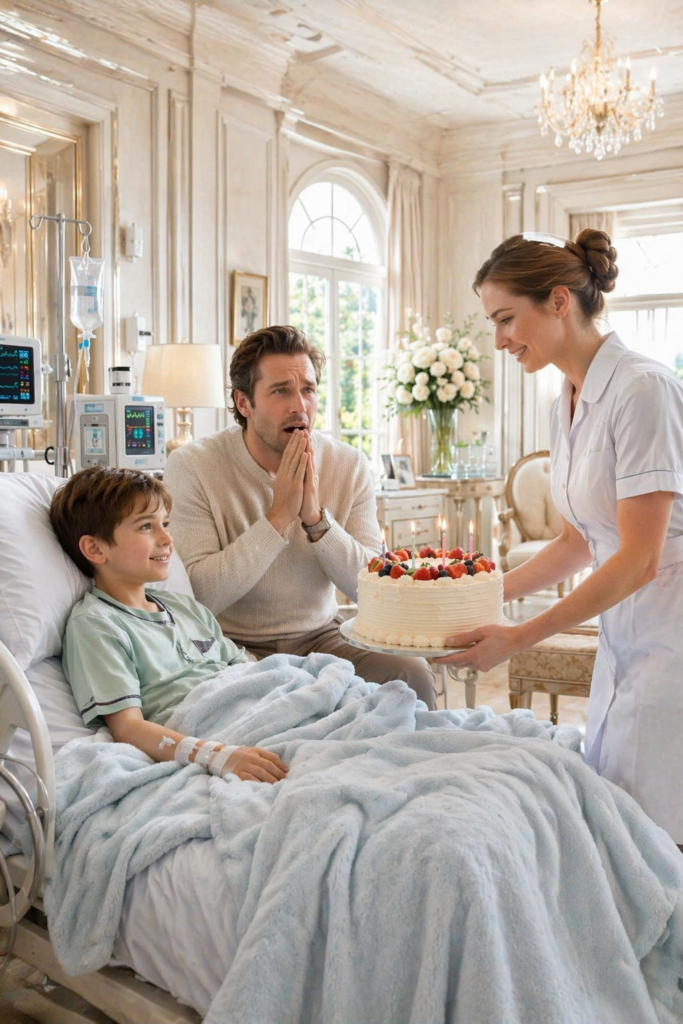
Months later, Don Julián had to stay in the hospital for a few days.
It wasn’t like in the movies.
There were no screams.
No dramatic runs.
It was just fatigue.
It was age.
It was the body asking for help.
Camila took the blue notebook to the hospital.
Rodrigo hesitated.
—Maybe it’s not a good time.
She looked at him seriously.
—Dad, stories also visit.
And she was right.
Don Julián was in bed, smaller than ever.
But when he saw the notebook, he smiled.
Camila sat next to him and began to read.
The story of the tamale.
The broken bicycle.
Grandma dancing in the kitchen.
The day Rodrigo was born.
Don Julián closed his eyes.
Rodrigo thought he had fallen asleep.
But then the old man whispered:
—What a good life.
Rodrigo leaned closer.
—Do you really think so?
Don Julián opened his eyes.
He looked at Camila.
Then at his son.
—I had love. I had family. I had Sundays that returned. That’s a lot, son.
Rodrigo cried in front of him.
He didn’t hide anymore.
Don Julián, with little strength, squeezed his fingers.
Like when Rodrigo was a child.
Like when they crossed the street.
Like when his father silently told him:
“I’m here.”
Don Julián left the hospital a week later.
Slower.
More fragile.
But he left.
The following Sunday, he wanted to eat in his kitchen.
—No soup today —he said—. Today I want chilaquiles.
Rodrigo cooked.
Regular, to be honest.
Don Julián said they were good.
Camila said they needed more sauce.
The three laughed.
The table had three plates.
Three glasses.
Three napkins.
And for the first time, Rodrigo didn’t feel guilt looking at it.
He felt gratitude.
Because that table was no longer a symbol of his absence.
It was the place they had learned to return to.
In time, they began inviting more people some Sundays.
The widow neighbor.
A cousin who lived alone.
An old friend of Don Julián’s.
Nothing formal.
Just simple food and chairs around.
The kitchen filled with voices.
Don Julián said the house would become too small for them.
But he said it with a smile.
One night, before heading back to Guadalajara, Don Julián walked Rodrigo to the door.
He walked slowly.
Camila was already in the car.
The old man handed him the blue notebook.
—I want you to keep it.
—No, Dad. It’s yours.
Don Julián shook his head.
—It’s already where it needed to be.
Rodrigo opened it.
On the last page, there was a phrase written in shaky handwriting:
"My son came back before it was too late. That’s why I’m finding peace, even while I’m still here."
Rodrigo closed the notebook.
He hugged his father.
It wasn’t a quick hug.
Not one of those given with half a body thinking about leaving.
It was a full hug.
Don Julián rested his forehead on his shoulder.
And for a few seconds, they weren’t an adult man and a tired old man.
They were once again father and son.
Nothing more.
Nothing less.
When he got into the car, Camila asked:
—Is Grandpa okay?
Rodrigo looked in the rearview mirror.
Don Julián was still at the door, waving.
The kitchen light was on behind him.
—Yes —Rodrigo said—. He’s okay.
And it was true.
Not because everything was easy.
Not because time had stopped.
Not because life promised to stay still.
He was okay because he was no longer alone.
Because his table no longer waited in silence.
Because his granddaughter knew his voice.
Because Rodrigo finally understood that no Sunday comes back twice.
Since then, when someone tells him they’re too busy to visit their father, mother, brother, or someone they love, Rodrigo doesn’t preach.
He doesn’t feel entitled.
He too was often late.
He just says the only thing he learned:
Go.
Even if it’s just for 10 minutes.
Even if you bring nothing.
Even if you don’t know what to say.
Even if you’re tired.
Go.
Because sometimes 10 minutes open a door that has been closing for years.
And sometimes, at a simple table, with three plates and a humble soup, a family discovers that they are still on time to return home.