PART 1
"No."
The room turned icy.
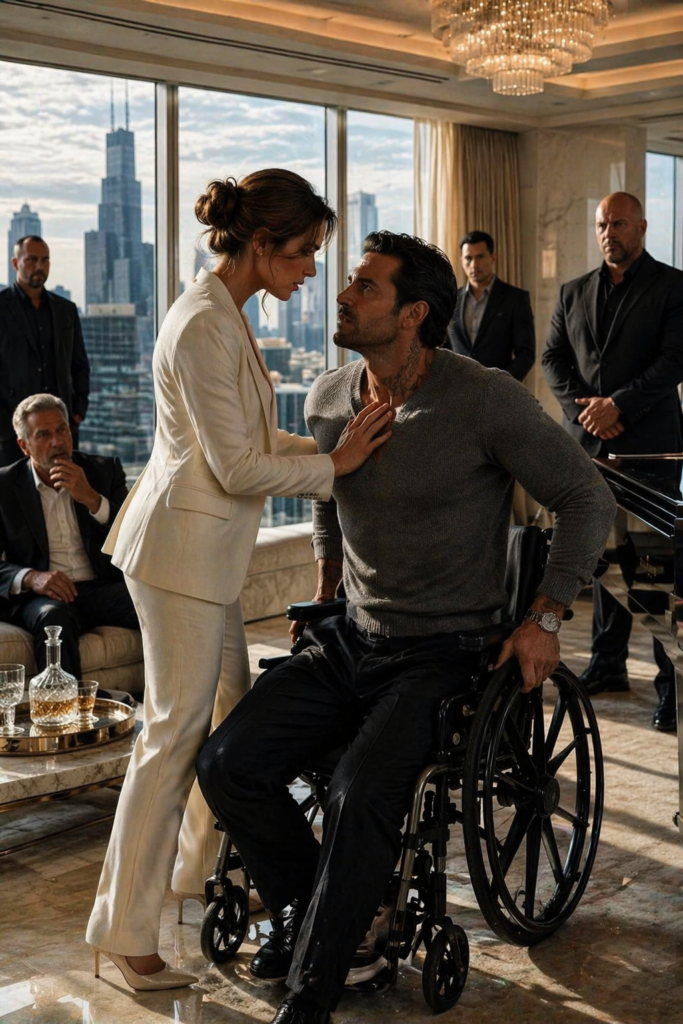
María Santos didn’t lift her gaze. At 31 years old, with a worn backpack, short nails, and the hands of a physical therapist who had learned to remain steady even when the pain of others seemed to scream from their skin.
Before her, seated in a custom black wheelchair, was Sebastián Armenta, the man whose name made half of Guadalajara lower their voices.
Owner of construction companies, bars, transport services, and things no one dared to say out loud.
Paralyzed for 20 years.
Feared long before that.
"I said no," he repeated, with a dangerously calm demeanor.
María took a deep breath. She thought of Mateo, her 8-year-old son, asleep in their Iztapalapa apartment with a borrowed nebulizer and a cough that didn’t forgive the night.
She thought about the overdue rent.
She thought about the public hospital that had told her: "Ma'am, there’s no bed."
And she placed her fingers on the old scar along Sebastián's lower back once more.
"And I said there's an answer here," she replied.
The bodyguard, Gabriel Rivas, took a step toward her.
Sebastián barely lifted two fingers, and the man halted.
"Careful, licensed therapist," Sebastián said. "Many people have regretted touching me without permission."
"I didn’t come to touch you out of curiosity," María responded. "I came because I was paid to evaluate you."
The mansion in Zapopan resembled a museum steeped in fear. Shiny marble, enormous windows, hidden cameras, and armed men pretending to be part of the decor.
They had brought María there at night, not telling her the patient’s name until they crossed the gate.
When she saw Sebastián, she understood why three private clinics had turned down the case.
He was not a patient.
He was a threat with a pulse.
"Your injury was severe," she said, pressing around an old scar near his left hip. "But your body isn’t dead. It’s defending itself."
Sebastián let out a dry laugh.
"My legs don’t feel anything."
"They don’t feel because they’ve been locked away behind pain, fear, and hardened tissue for 20 years."
He turned his head.
"Fear?"
"Yes. Your body has learned to protect itself. That doesn’t mean all is lost."
Sebastián's jaw tightened.
"Doctors from Houston, Germany, and Monterrey examined me. They all said the same thing."
"Maybe they all saw the chair before they saw the man."
Silence fell like a slap.
Gabriel looked at her as if she had just signed her own death sentence.
But María couldn’t stop. She put her elbow on the hardest point of his lower back and applied pressure with brutal precision.
Sebastián stopped breathing.
His hands clenched around the arms of the chair.
"Get off me," he murmured.
"No."
"Pardon?"
"If I stop now, your body will close the door again."
Sebastián’s face turned pale.
A hot, impossible pain shot down his left thigh like lightning.
After 20 years of feeling nothing, that man made a broken sound, half rage, half fear.
"What did you do to me?"
María didn’t answer. She lowered by two centimeters, changed the angle, and pressed again.
Then it happened.
At the end of the chair, beneath the dark fabric of his pants, Sebastián Armenta's left foot moved.
A little.
Almost nothing.
But it moved.
Gabriel swore under his breath.
Sebastián looked at his foot as if he were witnessing a dead man return.
Then he fixed his gaze on María.
"If this is a lie," he said, his voice trembling with fury, "no one will find you."
María swallowed hard but didn’t lower her gaze.
"If it were a lie, I would have chosen a less dangerous man to give hope to."
Just as Sebastián was about to respond, the door swung open and his cousin stormed in, shouting:
"What the hell is that woman doing to you?"
PART 2
Raúl Armenta entered as if the house belonged to him.
He wore an expensive suit, strong perfume, and a smile that didn’t reach his eyes. He scanned María from head to toe, then Sebastián’s foot, and for one second, his face lost color.
Just one second.
Then he became furious again.
"I told you not to bring strangers here," he spat. "Especially not some neighborhood therapist who’s probably here to sell you miracles."
María gathered her backpack, but Sebastián raised his hand.
"She stays."
Raúl let out a laugh.
"Why? Because she touched your back and made you believe you’ll walk? Come on, cousin. Get over it."
The air shifted.
Gabriel looked to Sebastián, awaiting an order.
But Sebastián didn’t yell. He didn’t threaten. He simply spoke low.
"Get out of my house."
Raúl clenched his jaw.
"You need me. I talk to the partners. I manage the routes. I take the heat while you stay trapped in that chair."
"Precisely for that reason," Sebastián said. "Get out."
Raúl left, but before crossing the door, he shot María a cold, furious look.
That day, she understood that danger wasn’t just outside the mansion.
It also bore the same last name as Sebastián.
For the next six weeks, María lived two lives.
By day, she returned to Iztapalapa to take Mateo to school, fight with pharmacies over expensive medicines, and smile when he asked if everything would be alright.
By night, a black truck picked her up silently.
In Zapopan, an abandoned rehabilitation room awaited her, two parallel bars, new equipment, and a man who hated obeying more than he feared pain.
"Again," Sebastián grunted, sweating through his shirt.
"You’ve been standing for 18 seconds. That’s enough."
"Not enough."
"For your spinal cord, it is."
"I don’t negotiate with my spinal cord."
"Well, today you’re going to, boss."
Gabriel, standing in the corner, hid a smile.
Sebastián hated that.
Hated falling.
Hated that his legs trembled as if they didn’t belong to him.
Hated that María looked at him without fear when everyone else bowed their heads.
One night, attempting to take a step, his right knee buckled. María caught him as best she could, and they both fell onto the mat.
He was half on top of her, gasping, their faces inches apart.
"I’m pathetic," he murmured.
María touched the nape of his neck, where the tension felt like stone.
"Pathetic is giving up. You’re starting over after 20 years."
Sebastián looked at her differently.
Not as a boss.
Not as the owner of a house full of armed men.
As a man who had gone too long without someone speaking to him with tenderness.
"Why aren’t you afraid of me?" he asked.
"Because I’m already afraid of worse things."
"Like what?"
"Like my son stopping breathing in the night and me not having the money to save him."
Sebastián lowered his gaze.
The next day, Mateo received care from three pediatric pulmonologists. Within 24 hours, his room had a medical purifier, new oxygen, an allergy-free mattress, and a treatment María could never have afforded.
She cried in the hallway, one hand covering her mouth.
Gabriel saw her.
"You don’t owe him anything," he said.
"I owe him my son’s life."
Gabriel looked toward the rehabilitation room.
"And he owes you his."
But hope didn’t come alone.
It arrived with war.
Dante Ibarra, an old enemy of the Armentas, began burning warehouses in Tlajomulco, robbing trucks on the road to Lagos de Moreno, and buying people within the house itself.
Sebastián knew.
What he didn’t know was how deep the betrayal ran.
One afternoon, María was climbing the stairs with some towels when she heard Raúl’s voice in the library.
"Dante wants the woman."
María froze.
Sebastián replied calmly.
"What woman?"
"Don’t play dumb. The therapist. He wants to know what she’s doing to you. He wants to know why you suddenly cancel meetings, change routes, and start giving orders like before."
"He knows nothing."
"Then hand her over. Her and the boy. Dante calms down, we buy time, and you stop acting like a lovesick teenager."
María’s stomach dropped.
There was a silence so long that even the lights seemed to hum.
Then Sebastián said:
"You’re talking about a mother and a sick child."
"I’m talking about a weakness."
"No," Sebastián replied. "You’re talking about my home."
Raúl laughed.
"Your home? This house survived because I kept it alive while you were half a man."
The next phrase came out like ice.
"Get out, Raúl."
"You’re going to regret it."
"I already regretted letting you stay close for so long."
María stepped back, but the floor creaked.
Below, the voices fell silent.
She ran to Mateo’s room and locked the door.
That night, she didn’t sleep.
The next day, the attack came.
María was leaving a pharmacy in the Americana neighborhood with medicines for Mateo when two men shoved her against a wall. One covered her mouth. The other pulled out a knife.
"Easy, doll," he said. "We just want to know what Sebastián Armenta is hiding."
María tried to break free.
The man smiled.
"We know about the boy. Mateo, right? Severe asthma. Real delicate."
María's knees buckled.
"Please. Not him."
"Then talk."
Car headlights illuminated the alley.
Gabriel’s truck mounted the curb.
He didn’t scream.
He didn’t negotiate.
He just got out and walked as if the consequence had a human form.
In less than a minute, the men were on the ground, disarmed, crying in pain.
Gabriel grabbed María by the shoulders.
"Are you hurt?"
"They know about Mateo," she sobbed. "They know about my son."
Gabriel’s face hardened.
He pulled out his cell phone.
"Boss. It was Dante. They threatened the boy."
He listened.
Then he said:
"Understood."
He put away the phone and looked at María.
"We’re going for your son."
"I can’t leave like this."
"María."
His voice left no room.
"If you go back to your apartment tonight, tomorrow there will be no apartment. Not for you."
An hour later, Mateo was wrapped in a blanket in the back of the truck, hugging a stuffed dinosaur.
"Mom, did we do something wrong?"
María stroked his hair.
"No, my love. We’re going to a safe place."
As they crossed the gates of the mansion, Mateo opened his eyes.
"Does a president live here?"
María couldn’t respond.
Sebastián was waiting for them in the library.
He wasn’t in his chair.
He was standing.
Holding a black cane with a silver head. His legs trembled, his face pale, and his jaw clenched in pain.
But he was standing.
María gasped.
Mateo hid behind her.
Sebastián looked at María's scratched arms, her torn coat, the dry tears.
"They touched you," he said.
"I don’t care about that," she replied. "They threatened my son."
Sebastián took a clumsy step toward Mateo.
The boy looked at him with fear and curiosity.
"Are you bad?"
Gabriel closed his eyes as if waiting for a disaster.
Sebastián took time to answer.
"I was."
Mateo squeezed his dinosaur.
"And now?"
Sebastián lowered his gaze to his own legs.
"Now I’m trying not to be."
That answer broke something inside María.
But there was no time for tenderness.
That very night, Sebastián ordered the house to be closed. He changed codes, moved guards, and had María and Mateo installed in the east wing, behind reinforced doors.
Raúl arrived the next day for a family meeting.
He smiled when he saw María.
"Some people rise quickly, huh?"
She didn’t respond.
Sebastián did.
"Watch your mouth."
Raúl raised his hands.
"Calm down, cousin. It could still do something to you."
What he didn’t know was that for three days, Gabriel had been recording every one of his calls.
And in one of them, Raúl made the mistake of talking too much.
He wasn’t just selling information to Dante.
He had also paid, years ago, for certain doctors to hide a possibility of recovery.
Sebastián’s chair was not merely the consequence of a bullet.
It had been a prison upheld by his own blood.
When María read the old report, she felt sick.
The original neurosurgeon had written: "partial preserved response in the left lumbar root."
That document disappeared from the official file.
The payment signature came from a ghost company linked to Raúl.
Sebastián said nothing for five minutes.
Then he closed the folder.
"My father died believing I would never walk again."
Gabriel lowered his head.
"I’m sorry, boss."
Sebastián looked toward the hallway where Mateo was watching cartoons.
"No. I’m sorry."
That night, at 2:13, the mansion lost power.
The generators didn’t start.
The cameras died.
The rain pounded against the windows like stones.
Gabriel took María and Mateo to a reinforced room under the main staircase.
"Whatever happens, don’t open."
Mateo trembled.
"Mom, is this a game?"
María hugged him.
"It’s a very silly game, my love."
Upstairs, gunshots rang out.
Mateo cried silently.
In the foyer, ten of Dante’s men entered through the service door.
Someone had given them the code.
Raúl.
He didn’t go to the front.
He went straight to the library, thinking he would find Sebastián trapped in his chair.
He entered with a gun in hand.
"It’s over, cousin."
The chair was empty.
Raúl blinked.
In the shadows, by the window, Sebastián Armenta stood.
With the cane in one hand.
And a folder in the other.
"No," Raúl whispered.
Sebastián smiled without joy.
"That’s what I said when I saw your signature."
Raúl aimed the gun, but his hand trembled.
"You should have stayed broken."
"That’s what you wanted for 20 years."
"I kept this running."
"You kept me seated."
Raúl screamed and fired.
Sebastián moved awkwardly, painfully, without grace. The bullet shattered a vase behind him. Then he swung the cane against Raúl's wrist with a dry crack.
The gun fell.
Raúl fell afterward.
Sebastián remained over him, breathing as if every muscle were on fire.
"You sold my home," he said. "You sold a mother. You sold a child."
Raúl cried in rage.
"Dante was going to kill me!"
"No. You were already dead the moment you thought blood gave you the right to betray."
Gabriel entered with four loyal men. Behind came agents from the Prosecutor’s Office and the National Guard.
Raúl’s eyes widened.
"Did you bring cops?"
Sebastián looked down at him.
"I brought witnesses."
The net fell before dawn.
Dante Ibarra was arrested at a ranch in Chapala with accounts, weapons, bribery lists, and recordings delivered by Sebastián himself.
Raúl tried to negotiate.
But the calls, the medical payments, the sold codes, and the threat against Mateo were documented.
For the first time in years, the Armenta name didn’t buy silence.
It bought convictions.
The newspapers spoke of a historic break.
The neighbors spoke of betrayal.
People on Facebook debated for days whether a man like Sebastián deserved another chance just because he had protected a mother and her child.
María didn’t defend him as a saint.
He never was.
But she saw something others didn’t want to see.
A dangerous man choosing, for the first time, to no longer be one.
Six months later, the Zapopan mansion no longer had armed men at every door.
The east wing had become a respiratory clinic for children from families without money.
Mateo began to run without choking every five steps.
María directed the rehabilitation of patients that other doctors called impossible.
And Sebastián continued to walk little.
Sometimes with two canes.
Sometimes with one.
Sometimes he would revert to the chair, furious and ashamed.
María never allowed him to call it failure.
"A bad day doesn’t erase a real step," she told him.
One afternoon, under a jacaranda tree, Sebastián managed to cross three meters without stopping.
Mateo cheered as if Mexico had just won the World Cup.
"We did it!"
Sebastián almost smiled.
María approached, hands ready in case he fell.
"You did it."
He looked at her, tired, sweating, alive.
"No," he said. "You found me."
Mateo wedged himself between them.
"So can we order pizza now?"
Sebastián raised an eyebrow.
"After 20 years of tragedy, is that what matters?"
Mateo nodded seriously.
"With extra cheese."
María let out a laugh that filled the garden.
And Sebastián understood something he had never been taught in his world of fear, money, and blood.
Being obeyed was not the same as being loved.
Being feared was not the same as being alive.
And sometimes, the person who saves you doesn’t arrive with big promises.
They arrive with tired hands, a sick child, and the courage to touch exactly where it hurts the most.