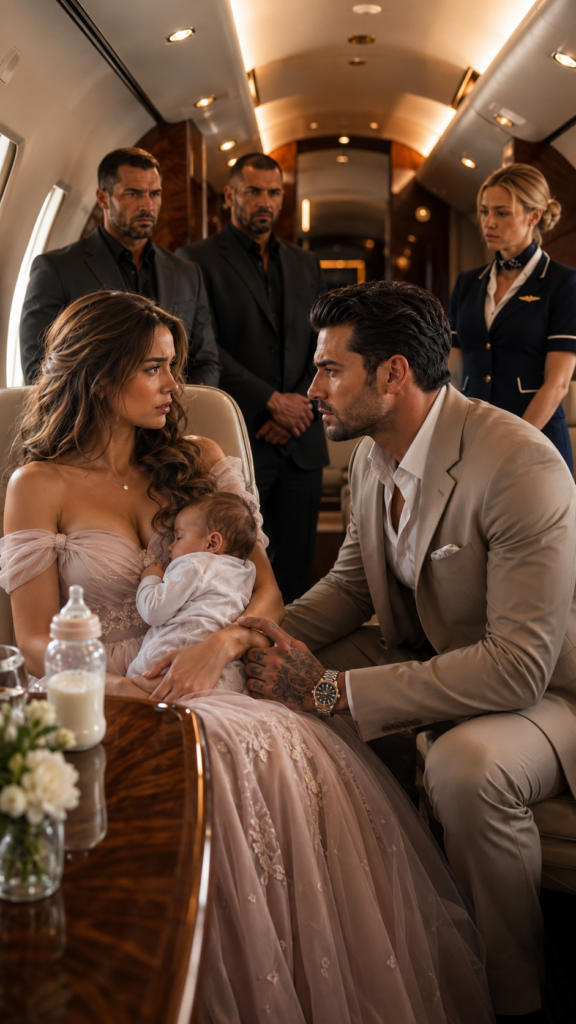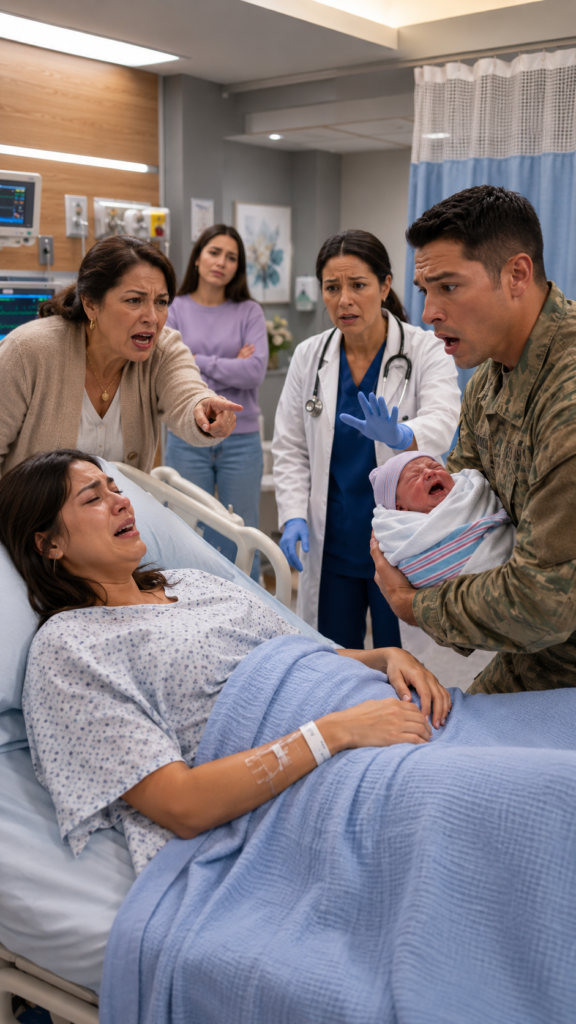
PART 1
The first thing Julián Medina heard when he opened the door to his home in Puebla was the broken cry of his newborn son.
It wasn’t a normal cry.
It was a dry, exhausted whimper, as if the baby no longer had the strength to ask for help.
The second thing he heard was his mother’s voice from the living room:
—Leave him. This is how children learn not to manipulate.
Julián dropped his military backpack in the hallway.
After eight months away, assigned to a mission in the south of the country, he had learned to recognize danger before it appeared.
And something in that house was rotten.
The smell of sour milk.
The stifling heat.
Baby bottles strewn in the sink.
And that strange silence between each whimper of Mateo, his six-week-old son.
Julián walked straight to the baby’s room.
There he found Valeria, his wife, sprawled beside the crib.
Her hair was plastered to her face with sweat, her lips cracked, and one eye swollen.
On her arms were purple marks, like fingers buried in rage.
—Vale…
She lifted her gaze.
First, she felt fear.
Then she recognized him.
—¿Julián?
Her voice came out like a thread.
He crouched down, touched Mateo’s forehead, and felt that his skin was burning.
The baby was on fire.
—How long has he had a fever?
Valeria tried to answer, but a woman appeared in the doorway.
It was Doña Carmen, Julián’s mother.
She wore a fine robe of Valeria’s, as if she owned everything.
Behind her came Patricia, Julián’s younger sister, holding a glass of red wine with a look of annoyance.
—Stop making a scene —Carmen said—. The girl needed discipline.
Patricia let out a dry laugh.
—And the child is her problem. We are not servants.
Julián didn’t respond.
He just took Mateo in his arms and wrapped him in a blanket.
Valeria crawled a little, desperate.
—I was taken my phone. They wouldn’t let me go. Mateo had a temperature of 104 last night. I begged them to take me to the hospital.
Carmen clicked her tongue.
—Always exaggerating. You chose a delicate wife, son. She doesn’t know how to cook, doesn’t know how to clean, doesn’t know how to obey.
Patricia leaned against the wall.
—Seriously, Julián, you left for eight months and left a useless woman here.
He breathed slowly.
Rage surged in his chest, but he wouldn’t let it out.
In the Army, he had been taught something very simple: fury makes men clumsy.
Calm makes them dangerous.
—Why is Valeria on the floor? —he asked.
Carmen smiled with that smile of a woman who believes she still rules.
—Because this is my house. And she forgot her place.
That was where she made her worst mistake.
The house had never been Carmen’s.
Three years earlier, Julián had bought it with the money his grandfather Tomás left him, the only man who truly raised him.
Carmen lived there by temporary permission, not by right.
She had no deeds.
No contract.
Nothing.
During the mission, Valeria’s messages had become rare.
First short.
Then cold.
Then they stopped coming.
Carmen told him over the phone that Valeria was depressed, that she didn’t want to talk to anyone, that she spent her days shut in.
Julián pretended to believe her.
But while pretending, he spoke with his commander, with a lawyer, and with Valeria’s father, who had saved several desperate emails that she managed to send from an old account.
He also checked cameras, bank accounts, and deleted messages.
Because Carmen and Patricia still saw an obedient soldier.
They forgot he was also a man trained to plan.
Julián stood up with Mateo in his arms.
—I’m going to the hospital.
Patricia stepped in front of him.
—And where do you think you’re going, dude? First, you’re going to listen to our side.
Carmen raised her chin.
—Your wife is manipulating you. If you walk out that door, you’ll regret it.
At that moment, blue and red lights illuminated the living room windows.
Then several cars screeched to a halt in front of the house.
Carmen stopped smiling.
Patricia lowered the glass slowly.
Julián looked toward the entrance and said, without raising his voice:
—I didn’t come alone.
PART 2
The front door opened before Carmen could move.
Two members of the Military Police entered, a prosecutor commander, a DIF worker, two paramedics, and attorney Mariana Salcedo, Julián’s lawyer.
They all moved forward with a calm that froze the house.
Carmen stepped back a pace.
—What is this nonsense? —she shouted—. You brought police to a family matter?
The commander observed Valeria’s face, her marked arms, the dirty crib, and the baby trembling in Julián’s arms.
—Beatings, confinement, and a child in danger are not family matters, ma’am.
The paramedics immediately approached Mateo.
They took his temperature.
104.3.
One of them looked up, worried.
—He’s dehydrated. We need to transport him now.
Valeria tried to get up but doubled over in pain.
Julián wanted to help her, but she clutched his sleeve as if fearing he would disappear again.
—Don’t leave me here.
—Never again —he replied.
Carmen pointed at Valeria with rage.
—She’s acting. She always does that. She doesn’t clean, doesn’t cook, doesn’t respect. We’re just trying to bring order to this house.
Patricia added:
—Besides, Julián, you told us to keep an eye on her. We have messages from you.
Attorney Mariana placed a thick folder on the dining table.
—That’s exactly why we’re here.
Patricia frowned.
—What’s that supposed to mean?
Mariana pulled out several printed sheets.
—Those messages didn’t come from Julián’s phone. They came from a cloned account from your computer.
Patricia fell silent for just two seconds.
Then she let out a nervous laugh.
—You can’t prove that.
—Yes we can —Mariana said—. Device history, cloud backup, IP address from this house, and screenshots sent from your own email.
Carmen glanced at her daughter out of the corner of her eye.
For the first time that night, their security began to crack.
The commander asked an officer to place a tablet on the table.
There, the recording from Mateo’s room appeared.
Carmen paled.
—That camera didn’t work.
Julián stared at her unblinkingly.
—That’s what you thought.
Before leaving for the mission, Julián had installed a small camera in front of the crib.
Carmen had disconnected it several times from the internet, sure that would erase everything.
What she never knew was that the camera had internal memory and uploaded the videos when the connection returned.
The first video showed Valeria holding Mateo while crying.
Carmen entered the room, yanked her hair, and screamed that the food was cold.
The second video showed Patricia snatching Valeria’s phone.
—You’re not going to be calling your dad —Patricia said in the recording—. We’re in charge here.
The third video was worse.
Valeria tried to give Mateo medicine, but Carmen snatched the spoon from her and dumped the syrup down the sink.
—You’re not going to turn that child into a useless person like you —Carmen said.
The DIF worker pressed her lips together.
—Where’s the medication record?
Valeria, trembling, pointed to a box of diapers.
Julián opened it and found a folded notebook.
Valeria had noted every dose, every hour, every fever.
The worker reviewed it.
—The mother was following medical instructions. There’s no negligence on her part.
Carmen exploded.
—Of course there’s negligence! That woman isn’t fit for this family. Julián needed a strong wife, not a crying child.
Julián carefully lowered Mateo onto the stretcher.
Then he approached his mother.
He didn’t yell at her.
That scared her more.
—How long did you have her like this?
Valeria swallowed hard.
—Since two weeks after you left. They told me you had given them permission. They showed me messages where you supposedly said I was exaggerating, that I had to obey them.
Patricia looked at the floor.
Carmen did not.
Carmen was still trying to maintain her act.
—I did what a mother must do. I took care of your house while you were off playing hero.
Mariana opened another envelope.
—She also took good care of the money, it seems.
On the table appeared bank statements, receipts, transfers, and a copy of a forged signature.
Julián finally spoke with the hardest voice of the night.
—They took $38,000 from the emergency family account. They used Valeria’s signature. They sold her wedding earrings. They canceled two medical appointments for Mateo. And they told the neighbors she was crazy.
Patricia lifted her head suddenly.
—That wasn’t theft! It was family money.
—It was money for my wife and my child —Julián said.
Carmen let out a bitter laugh.
—And what about us? Are we not family? After everything I did for you?
The phrase fell like poison.
Julián walked to the wall where there was an old photo of his grandfather Tomás.
A serious man, wearing a straw hat, sitting in front of a humble house in Cholula.
—You didn’t raise me —Julián said—. My grandfather did, after you left for five years with another man and abandoned your children.
The room fell silent.
Patricia opened her mouth but said nothing.
Carmen clenched her fists.
—Shut up.
—Grandfather Tomás taught me that blood doesn’t make family. Loyalty does. That’s why he put this house in my name.
Mariana pulled out the trust deeds.
Carmen approached as if she couldn’t believe what she was seeing.
She read the name of the owner.
Julián Medina.
Not Carmen.
Not Patricia.
Julián.
Carmen’s face crumbled.
—No… that house was for me.
—No —Julián replied—. It was for whoever protected their own. You turned this place into a prison.
Patricia, desperate, tried to grab the folder.
A police officer held her wrist.
The glass of wine fell and shattered on the floor.
The noise made Mateo cry again.
That cry shattered something inside Julián.
The paramedics lifted the baby’s stretcher.
Valeria was also placed on another, carefully.
One of the paramedics murmured that he had a possible fractured rib and signs of malnutrition.
Carmen rolled her eyes.
—Oh, please.
The DIF worker turned toward her.
—Ma’am, please be quiet.
Julián kissed Valeria’s forehead.
—I’ll follow you to the hospital.
But Mariana gently stopped him.
—First, sign this. Today they lose access to the house.
Carmen let out an ugly laugh.
—Lose access? I live here.
Mariana handed her two notifications.
—Your permission to occupy is terminated due to violence, criminal activity, and endangerment of a minor. A locksmith is outside. The prosecutor will supervise that you only take clothes, medicine, and identification.
Patricia began to scream.
—You can’t kick us out! We have nowhere to go!
Julián looked at her with cold sadness.
—Valeria didn’t have anywhere to go when you took her phone.
Carmen approached him, lowering her voice as if she could still manipulate him.
—Son, think carefully. If you continue with this, you will destroy your own mother.
—No —Julián said—. You destroyed yourself.
Then came the final blow.
Mariana opened one last folder.
—Mr. Tomás Medina’s trust had a clause. Carmen and Patricia retained a conditional inheritance, as long as they did not commit crimes against another beneficiary.
Patricia blinked.
—Another beneficiary?
—Valeria and Mateo —Mariana replied—. They were also included.
Carmen froze.
Mariana continued:
—With the evidence of assault, forgery, theft, and financial abuse, the funds are frozen from this moment. The judge will decide on the final loss, but none of you will touch a penny.
Patricia put her hands on her head.
—My inheritance?
Julián felt no pleasure at seeing her like that.
Just exhaustion.
—You traded it for $38,000 and the satisfaction of humiliating a woman who couldn’t defend herself.
Carmen tried to lunge at him.
The commander stopped her.
—Mrs. Carmen Rivas, you are under arrest for assault, illegal deprivation of liberty, domestic violence, theft, forgery, and endangerment of a minor.
Patricia was also handcuffed.
She screamed that it was all Valeria’s fault.
That Valeria had bewitched Julián.
That no decent man chose his wife over his mother.
The neighbors began to peek from the sidewalk.
The same people Carmen had used to spread gossip now watched her leave in handcuffs.
Without an elegant robe.
Without a crown.
Without power.
As they loaded her into the patrol car, Carmen looked at Julián and spat:
—Someday you’ll need your mother.
He held her gaze.
—That day has happened many times. And you were never there.
At the hospital, Mateo received IV fluids, medication, and monitoring throughout the night.
The doctors said he had arrived in time by a hair.
Valeria had two fractured ribs, a mild concussion, bruises all over her body, and extreme exhaustion.
When she awoke, Julián was sitting beside her with Mateo sleeping against his chest.
Valeria looked around, confused.
—Are they gone?
Julián took her hand.
—Forever.
She cried silently.
It wasn’t a cry of fear.
It was a cry of relief.
One of those that comes when the body understands it no longer has to survive another minute.
At dawn, Carmen and Patricia were already booked.
The protection order prohibited them from approaching, calling, texting, or sending third parties.
That same day, the locksmith changed all the locks.
Their clothes were kept in bags under supervision.
The house they thought was theirs returned to those who truly needed peace.
In the following months, Carmen tried to defend herself by saying Valeria was unstable.
But the videos spoke for her.
So did the medical records, the bank transfers, the false messages, and the emails where Valeria pleaded for help.
Patricia tried to blame her mother.
Carmen tried to blame Patricia.
In the end, both accepted sentences to avoid a longer public trial.
The trust court revoked their inheritance.
Part of the money was allocated for Valeria’s recovery and another part to an educational account for Mateo.
Carmen wrote two letters from prison.
In both, she said a mother always deserves forgiveness.
Julián didn’t open them.
He handed them to Mariana to be recorded as an attempt at contact.
Patricia tried to sell her version on social media, playing the victim.
But the video where she hit Valeria while Mateo cried was enough for people to stop believing her.
And then the debate ignited everyone on Facebook:
How far should a child go to protect his wife?
Does a mother deserve forgiveness just for being a mother?
Or are there wounds that blood cannot erase?
Six months later, Julián requested a transfer to a training unit near home.
He no longer wanted to miss a fever, a smile, or a birthday.
Valeria began therapy.
Then, with the support of other military wives, she opened a small group for women suffering economic control and violence within their own homes.
She never introduced herself as a heroine.
She always said the same thing:
—I wasn’t weak. I was left alone. And it’s not the same.
On Mateo’s first birthday, the house filled with light.
There were no shouts.
No orders.
No fear walking through the halls.
Just Valeria holding her son, Julián taking photos, and a candle lit on a simple cake.
Mateo’s room still had a camera.
But it was no longer there to prove beatings.
It was there to record his first laughs.
And as the boy clumsily applauded in front of the cake, Julián understood something that many still debate:
Sometimes protecting your family means closing the door in the face of those who share your blood.