PART 1
When Diego Armenta crossed the threshold of his home in Guadalajara, still with dirt-filled boots and a uniform marked by months of patrol, he did not hear the joyful wail of a newborn.
He did not hear Valeria’s voice, calling his name as he had imagined so many times.
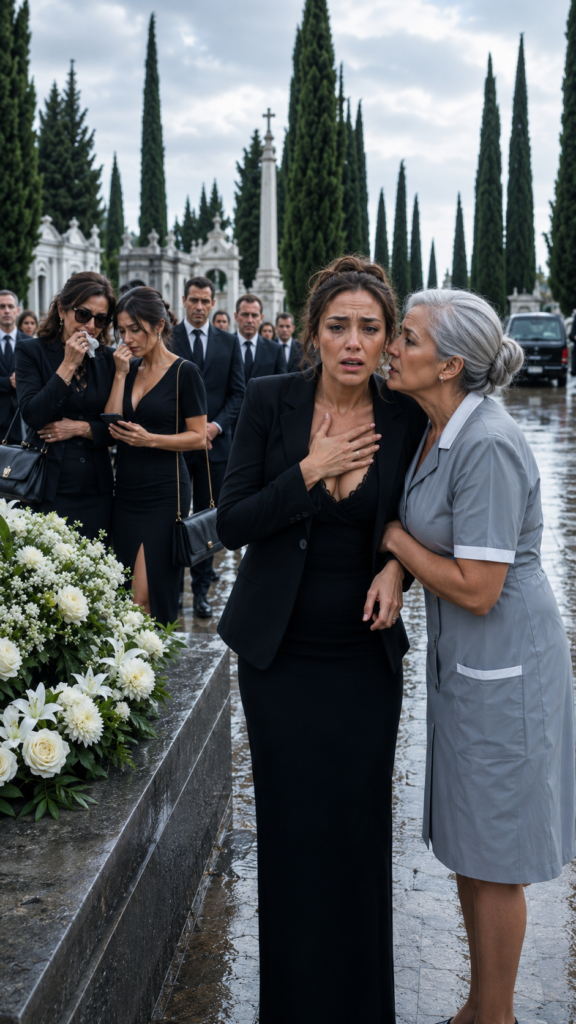
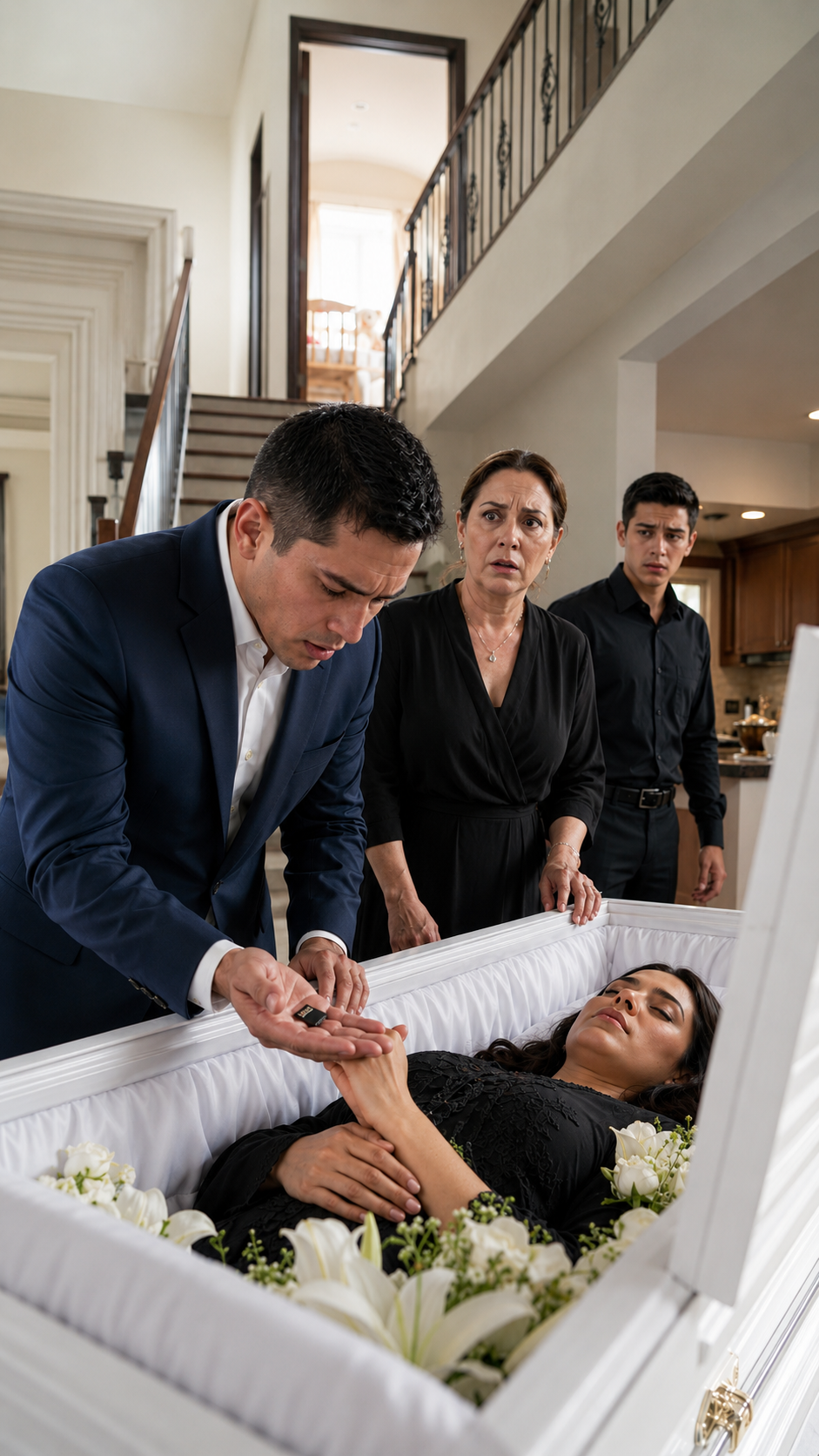
Instead, he was met by a white coffin in the middle of the living room.
Flowers surrounded it, candles flickered, and a silence so heavy it felt deliberate.
Beside the coffin stood his mother, Doña Rebeca, dressed in black, immaculate, with a hard face and dry eyes.
“Your wife died during childbirth,” she said without embracing him. “And yes, Diego… if you had been here, maybe things would have turned out differently.”
Diego felt something crack in his chest.
He had spent nine months deployed with the National Guard in the mountainous region of Michoacán. Each night he counted the days until he could return, kiss Valeria, and hold their child for the first time.
In his backpack, he carried a small wooden truck he had bought on a roadside, because Valeria had written to him that their baby kicked every time he heard his voice in a recording.
But Valeria could no longer hear him.
She was inside the coffin.
Dressed in a lavender gown, styled as if for a photo that no one should take.
His younger brother, Iván, sat near the dining room, sipping coffee from a clay mug with trembling hands.
“You’re late, brother,” he murmured. “As always.”
Diego didn’t respond.
He approached the coffin slowly. He looked at Valeria’s face. She was too heavily made up. Too groomed. Too ready to be buried without him asking anything.
“Where is my son?” he asked.
A faint cry echoed from the second floor.
It wasn’t the loud wail of hunger.
It was a dry, weary whimper, as if the baby had been pleading for hours.
“He’s alive,” Doña Rebeca replied. “Though that girl almost took him with her out of stubbornness.”
Diego lifted his gaze.
“Stubborn how?”
“For being distrustful. For not listening. We’ll talk later. Tomorrow at eight, we bury her. Right now, you need to sign some papers.”
Diego blinked.
He had just arrived, and his mother was already talking about burial, signatures, and decisions made.
There was no doctor present.
No paperwork in sight.
No hospital bracelet.
Valeria’s best friend wasn’t there, nor her aunt, nor any neighbor crying.
Just his mother, his brother, and a room that was too clean.
Diego had learned to read difficult scenes. He knew when someone was speaking an incomplete truth. He could sense when a house smelled of lies, even with fresh flowers around.
Then he looked at Valeria’s left hand.
It was closed.
Tight as if she had died holding onto something.
“What does she have in her hand?” he asked.
Doña Rebeca took a quick step forward.
“Nothing. Leave her alone.”
Diego didn’t move.
“I’m going to say goodbye to my wife.”
“I told you no.”
She tried to grab his arm.
Diego lowered his gaze to his mother’s hand and then looked at her intently.
“Don’t touch me again.”
For the first time, Doña Rebeca lost color.
Diego took Valeria’s cold hand. Her fingers were stiff, but not empty. Beneath her nails were small dark smudges, as if she had scratched something before dying.
Carefully, he opened her fingers one by one.
Something fell into his palm.
A microSD memory card.
Iván dropped his mug.
The coffee spilled onto the floor.
“Give me that,” he said, rising abruptly.
Diego closed his fist.
“Why do you want it so badly?”
Doña Rebeca tried to smile, but her mouth trembled.
“Valeria recorded nothing but nonsense. Since the pregnancy, she’s been intense, paranoid. Seriously, son, don’t make a scene.”
The baby cried again upstairs.
This time quieter.
Diego tucked the memory card into his uniform and rushed upstairs.
The baby’s room was dimly lit. In the crib, his son was wrapped in a green blanket, with dry lips and a flushed little face.
Diego picked him up with clumsy hands.
“Here I am, champ,” he whispered, breaking.
Next to the crib was a half-drunk bottle. Diego smelled it and detected a strange, sweet aroma, like medicine hidden among milk.
It didn’t smell like formula.
He put it in a clean bag from his first aid kit.
Then Doña Rebeca appeared in the doorway.
“Come down. The house and the baby should be with someone who can take care of them properly.”
Diego held his son tighter.
“I’m not signing anything.”
His mother’s face transformed completely.
“You have no idea the trouble you’re getting into.”
Diego locked the door with the baby in his arms, the hidden memory card, and the sealed bottle.
And there he understood the worst.
Valeria hadn’t just died.
Someone wanted to bury her before she could tell the truth.
PART 2
Diego placed the baby on his chest and felt his small, irregular breath against his uniform.
The child barely had strength, but when Diego brought a finger close, the baby grasped it with minimal pressure.
That was enough to keep him from collapsing.
Outside, Doña Rebeca knocked on the door.
“Diego, open up. You’re upset. We have to resolve this as a family.”
He didn’t respond.
With one hand, he held the baby, and with the other, he opened Valeria’s desk drawer. He found an old pink laptop, with a sticker of the Virgin of Zapopan stuck on the lid.
Valeria kept photos, recipes, name lists, and audio recordings that Diego had sent her from the checkpoints.
Diego connected the memory card with an adapter he had in his backpack.
The screen took a few seconds to respond.
A folder appeared.
“IF DIEGO RETURNS.”
He felt the air choke him.
Inside were five files.
He opened the first.
Valeria appeared, sitting on a bed, disheveled, with deep dark circles under her eyes and a hospital gown. She was alive. One hand rested on her belly while the other held the cell phone.
“Diego,” she said, her voice broken. “If you’re watching this, don’t believe your mother. Don’t sign anything. Don’t let her take the baby.”
Diego stood frozen.
Valeria took a deep breath, as if speaking was hard for her.
“Your mom says that since you’re away, someone has to take charge of everything. She brought me some papers to sign. According to her, it’s for security, but I’ve read them carefully. They want me to relinquish the house, and for her to decide about our son if something happens to me.”
Diego looked around.
This house did not belong to Doña Rebeca.
The house had belonged to Valeria’s parents. She inherited it before they married, and although her mother-in-law always said “our house,” she had never paid a bill.
The video continued.
“Iván owes money, Diego. A lot. I heard him crying in the kitchen. He said some guys were looking for him because of bets and loans. Your mom told him that selling this house would fix everything. I told her no. I told her you and I would decide together when you returned.”
Valeria wiped her tears.
“Since that day, they treat me like I’m crazy. They hide calls from me. They say no one will believe me because I’m pregnant and emotional. But I know what I heard. I’m scared, love. Very scared.”
The video ended.
Diego couldn’t cry.
Rage consumed his entire body.
He opened the second file.
It was an audio recording from the kitchen.
First, Iván’s nervous voice was heard.
“Mom, those guys have already been to the shop. They said if I don’t pay by Sunday, they’re coming for me.”
Then Doña Rebeca’s voice, cold and firm.
“Then stop whining and do what I say.”
“Valeria isn’t going to sign.”
“She will sign. All women sign when they’re scared.”
There was a silence.
Then Doña Rebeca said something that made Diego feel nauseous.
“If she doesn’t sign willingly, she’ll sign after childbirth. Already weak, already without family, already not thinking clearly.”
Diego clenched his jaw.
He opened the third file.
It contained photographs of documents.
A petition for temporary guardianship of the newborn.
A power of attorney regarding the house.
A letter where Diego supposedly accepted that his service had left him “emotionally unstable.”
And a signature.
His signature.
But it was forged.
Very similar, yes.
But Diego knew his own handwriting. His “D” always ended with a long stroke downward. That signature was copied, stiff, shaky, like made by someone who practiced it twenty times.
His mother not only wanted the house.
She wanted to take his child.
He opened the fourth file.
It was another video, recorded from a corner of the baby’s room. The image was tilted, as if the laptop had been hidden among diapers.
Valeria stood, nine months pregnant, breathing difficulty.
“They want to take me to a clinic in Tonalá,” she whispered. “Rebeca says that there they don’t ask so many questions. I asked to go to the hospital, but she got angry. She says that in the hospital they’ll put ideas in my head and then everything gets complicated.”
Valeria looked toward the door.
“I saw Iván with a jar. He hid it in the changing table drawer. I asked him what it was, and he said it was to help the baby sleep. But the baby isn’t even born yet. I don’t understand.”
Doña Rebeca’s voice sounded from outside.
“Who are you talking to, Valeria?”
The image moved.
The video ended.
Diego felt his heart pound in his throat.
The fifth file was a blurry photo of a folded piece of paper.
Valeria had handwritten:
“If something happens to me, check the bottle. Don’t let them put him to sleep. And don’t let them bury me without an autopsy.”
Diego looked at the baby.
His son was too still.
Then he acted.
He copied all the files to a USB drive and sent them to a secure email he used for operations. Then he called 911.
“My wife died after childbirth under suspicious circumstances,” he said, his voice controlled. “There’s a newborn possibly intoxicated. There’s a body in the living room they want to bury tomorrow. I need an ambulance, police, and forensics. The scene must not be disturbed.”
He gave the address.
He gave names.
He gave times.
He didn’t shout.
He didn’t insult.
He spoke like he reported a finding in the field: precise, firm, without letting fear creep in.
When he hung up, he heard voices on the other side of the door.
“He can’t come out of there with that baby,” Doña Rebeca whispered. “If the police arrive, everything falls apart.”
“Mom, that’s enough,” Iván said with a broken voice. “I can’t take it anymore.”
“Shut up. I did all this to save you.”
Iván let out a sob.
“I never asked you to let her bleed out.”
Diego opened the door.
The hallway fell silent.
Doña Rebeca stood before him, rigid. Iván was behind her, his eyes red and the face of someone who could no longer bear his own guilt.
“Repeat what you said,” Diego ordered.
Iván lowered his gaze.
Doña Rebeca tried to enter the room.
“Give me my grandson. You’re not well.”
Diego blocked her way with his body.
“You don’t come near my son.”
She looked at him with contempt.
“You’re ungrateful. While you played hero in the mountains, this family was falling apart. Someone had to make decisions.”
“What decisions?” Diego asked.
Iván exploded.
“Valeria asked for an ambulance! She was having a hard time! She said she felt dizzy, that she was bleeding, that something wasn’t right!”
Doña Rebeca turned and slapped him.
“Shut up, animal!”
But it was too late.
Diego didn’t need to touch anyone. The truth had already come out of the mouth of the son she claimed to protect.
“You took her to that clinic so no one would ask questions,” he said.
Doña Rebeca raised her chin.
“I took her to trusted people. I wasn’t going to let that woman take from us the only thing that could save Iván.”
“And when she started bleeding?”
She didn’t answer.
Iván covered his face.
“She said to sign first. That we’d call later. That she wasn’t going to die waiting a while.”
Diego felt the room spin.
Sirens began to sound from the street.
Doña Rebeca wanted to run downstairs, perhaps to hide documents, perhaps to approach the coffin, perhaps to destroy what was left.
Diego stopped her with a single phrase.
“Today, your theater ends, Mom.”
The paramedics arrived first.
They checked the baby in the room. One of them smelled the bottle and frowned.
“Who gave him this?”
Diego pointed to the sealed bag.
“I found it next to the crib. I don’t know what it contains.”
“Don’t give him anything else,” the paramedic said. “We need to take him to the hospital right away.”
Diego felt his legs weaken.
“Is he serious?”
The paramedic looked at the child, then at him.
“He arrived on time. That matters a lot.”
Those three words nearly broke him in two.
Then municipal police entered, investigative agents, and forensics. Doña Rebeca began shouting that her son was traumatized, that the uniform had damaged his head, that Valeria was manipulative, and that Iván was a useless fool who made things up.
No one played along.
The coffin was secured.
So were the documents.
The jar appeared in the changing table drawer, hidden behind new diapers and wipes.
The entire house was cordoned off.
At the hospital, the baby received immediate attention. The pediatrician confirmed signs of exposure to a sedative that should never touch a newborn.
“The amount wasn’t fatal,” he explained, “but if they continued giving it to keep him asleep, it could have ended very badly.”
Diego leaned against a cold wall.
There, at last, he cried.
He didn’t cry as a soldier.
He didn’t cry as a son.
He cried as a father who understood that they almost took his baby away in the same house where they promised to care for him.
Days passed with statements, analyses, and calls.
The Prosecutor’s Office opened a formal investigation.
The clinic in Tonalá had expired permits. The supposed doctor who attended the delivery wasn’t an obstetrician. The records were incomplete. The time of birth didn’t match the messages Valeria had sent before losing consciousness.
The autopsy confirmed what Diego feared.
Valeria suffered a hemorrhage after childbirth.
She could have survived if they had taken her to a hospital in time.
But Doña Rebeca delayed the help.
First, she wanted the signature.
Then she wanted to control the baby.
After, she wanted a quick burial.
Iván testified before the Public Ministry.
He admitted he owed money for bets, loans, and shady businesses. He said his mother promised to “solve it” with Valeria’s house. He confessed that they forged Diego’s signature using old documents he had left before leaving.
He also admitted he put the jar in the baby’s room, although he swore his mother told him it was “just to help the baby sleep.”
Diego listened without blinking.
He didn’t hit him.
He didn’t insult him.
He just said:
“You didn’t kill her with your hands, Iván. But you stayed silent while my wife asked for help.”
Iván broke down.
“Forgive me, brother.”
Diego looked at him as if seeing a stranger.
“Don’t ask me for something that doesn’t exist in me yet.”
Weeks later, Doña Rebeca was arrested.
They found her at a cousin’s house in Zapopan, trying to convince everyone that she was a sacrificial mother, a concerned grandmother, a victim of an ambitious daughter-in-law.
When they put the handcuffs on her, she didn’t cry.
She looked at Diego with the same coldness she had on the night of the coffin.
“I did everything for my family,” she said.
Diego held his son against his chest. The baby slept peacefully, wrapped in a blue blanket that a nurse had given him.
“No,” Diego replied. “You did it for your pride, for your control, and for a house that was never yours.”
Doña Rebeca pressed her lips together.
“One day you’ll understand.”
“No,” he said. “One day my son will know that his mother died protecting him from you.”
That sentence struck her harder than any scream.
They loaded her into the patrol car.
Iván also faced charges for forgery, concealment, and supplying a substance to a minor.
Diego didn’t celebrate.
There was no victory in seeing his mother handcuffed and his brother destroyed.
Justice didn’t bring Valeria back.
It only prevented the lie from breathing.
Diego never slept in that house again.
Every wall reminded him of something: Valeria’s desperate steps, the bottle next to the crib, the white coffin in the living room, the closed hand guarding a truth that no one wanted to hear.
He sold the house months later, but not to keep the money.
Part of it went into a trust for his son.
Another part he donated to an organization that supported pregnant women without family safety nets, those often ignored because “they’re probably exaggerating.”
He moved to a small apartment near the Metropolitan Park.
It wasn’t luxurious.
It had a simple kitchen, a window with morning light, and a tiny room where he placed the crib.
He named the child Santiago, as Valeria had written in a list hidden in her planner.
Every night, when Santiago cried, Diego held him and told him about his mom.
He told him how Valeria danced cumbia while sweeping.
How she made chilaquiles that were too spicy and then laughed.
How she said “neta” when something excited her.
How she had been brave even when everyone wanted to make her feel crazy.
On the dresser, he left the wooden truck he had bought on the roadside.
It was no longer the gift of a broken welcome.
It was a promise.
A promise that Santiago would grow up knowing the truth.
Not with hatred, but with memory.
Months later, Diego took his son to the cemetery with purple flowers, Valeria’s favorites.
He sat in front of the grave and placed the baby’s tiny hand on the tombstone.
“I saved him,” he whispered. “As you asked.”
Santiago squeezed his father’s finger.
Small.
Strong.
Alive.
Diego closed his eyes.
He understood that some families break not when the police arrive, nor when secrets come out, nor when someone is imprisoned.
They break the day someone decides a house is worth more than a life.
Valeria couldn’t raise her son.
She couldn’t see him walk.
She couldn’t hear his first word.
But she left evidence.
She left love.
She left a hidden memory in a cold hand.
And she left a truth that burned more than any candle at the wake: sometimes danger doesn’t come through the door wearing an enemy’s face.
Sometimes it waits in the living room, dressed in black, saying it did everything for the family.