PART 1
Valeria was 11 years old when she heard the word that shattered her life in two.
—Forgive me!
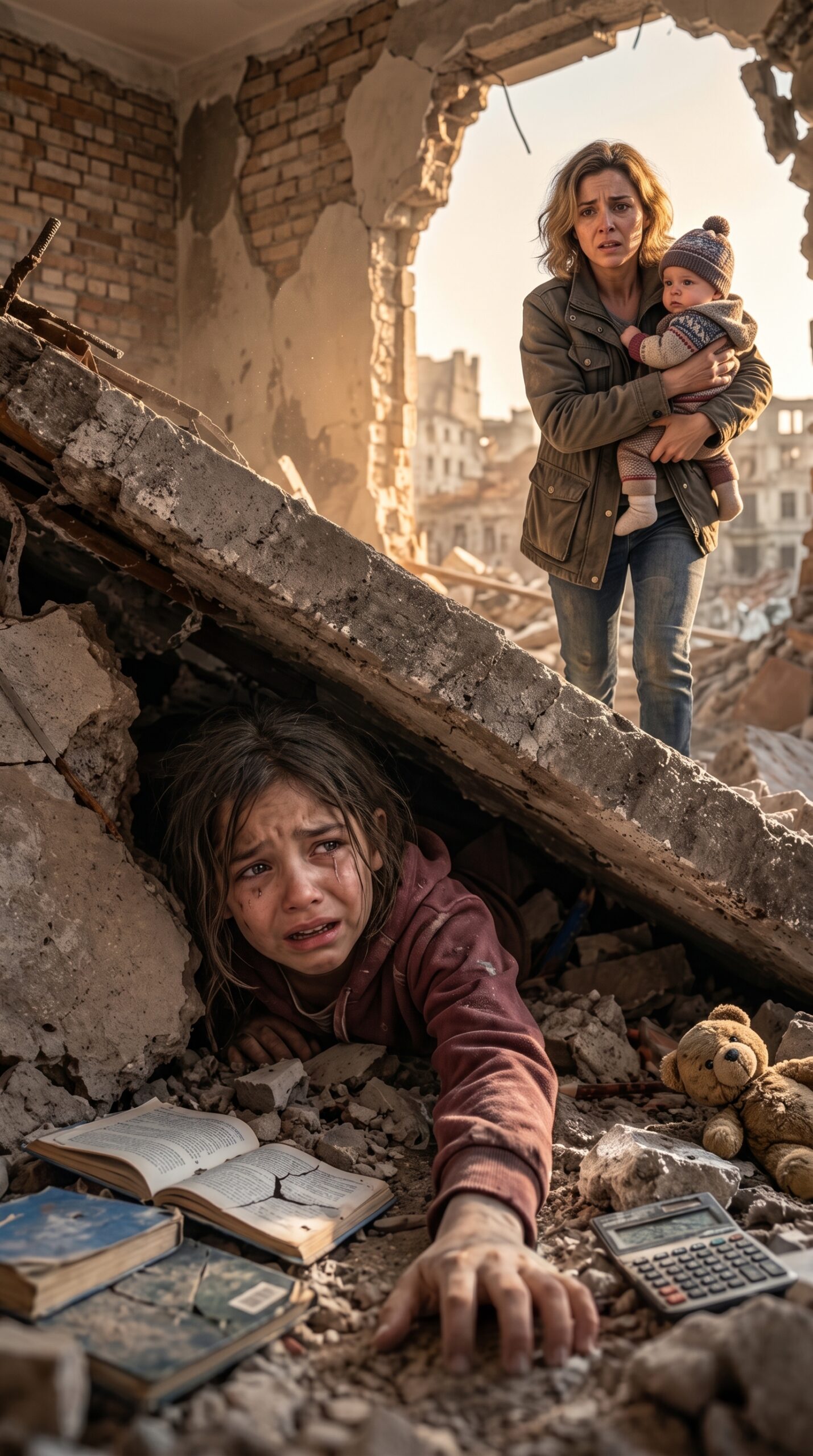
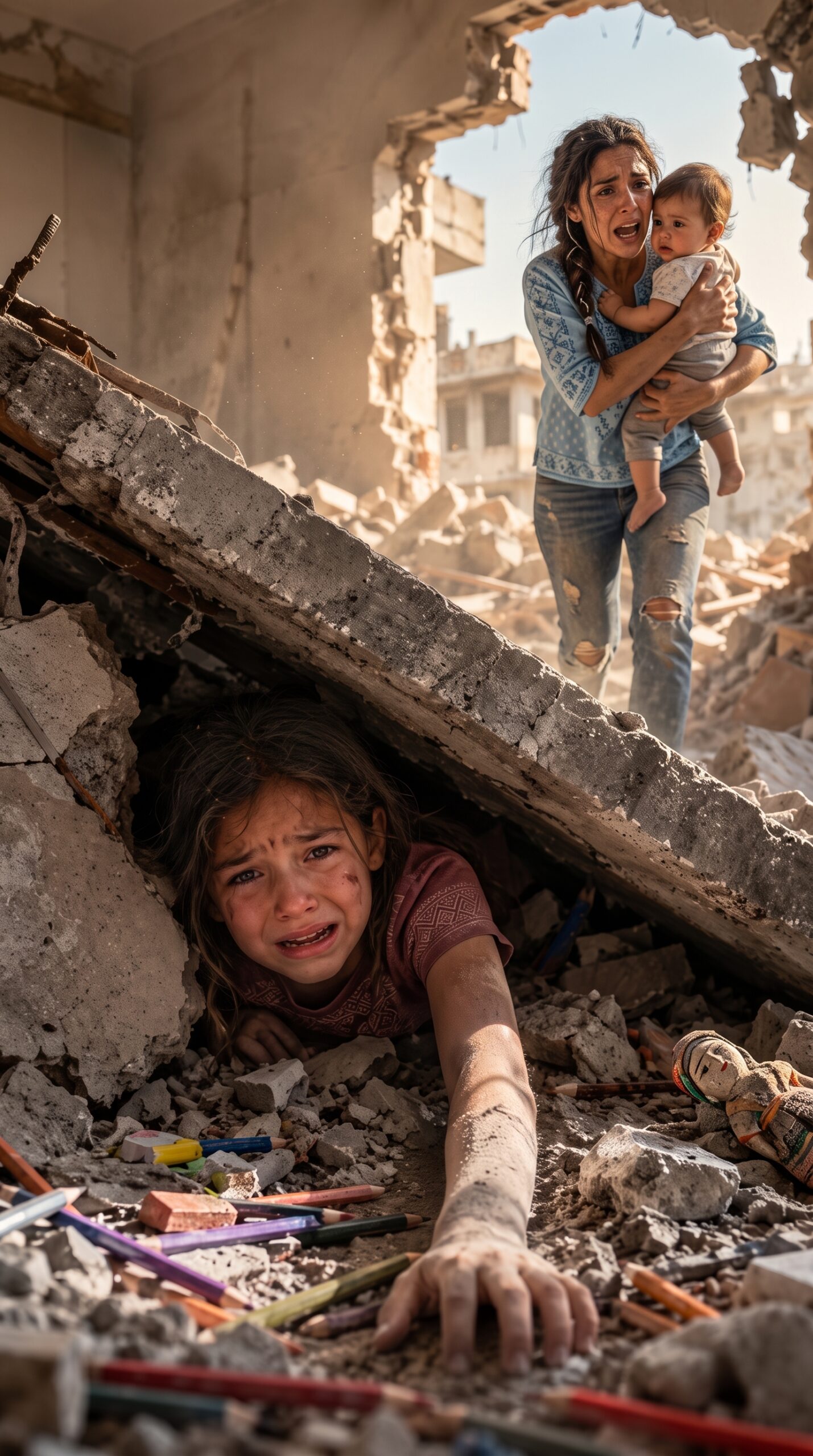
That was the last thing her mom shouted before vanishing in a cloud of dust, with Diego, her one-year-old brother, clutched against her chest.
Valeria was trapped under a beam.
She couldn’t move her leg.
She couldn’t breathe properly.
And yet, what hurt the most wasn’t the concrete pressing down on her, but watching her mom run away without her.
That morning had started like any other Saturday in an old house in Atlixco, Puebla.
Her grandmother was boiling beans.
Her dad, Ernesto, was checking for a leak in the yard.
And Valeria was trying to do a drawing assignment while Diego chewed the markers like they were lollipops.
—Mom, tell your baby to leave my stuff alone! —Valeria complained.
Mariana, her mom, laughed from the kitchen.
—He’s your brother too, Vale.
—Yeah, but he’s your favorite.
Mariana came over, kissed her on the forehead, and tousled her bangs.
—Oh, you dramatic girl. You’re my life too.
Valeria said nothing.
On the outside, she put on an angry face.
On the inside, that phrase hurt beautifully and terribly at the same time.
Because for months, she had known something no one had explained well.
She had found some papers in a metal box.
Adoption papers.
Her name.
Her date.
Signatures.
Since then, a question had been lodged painfully in her chest:
“If one day my mom has to choose, will she pick me or the child who was actually born of her?”
She had never dared to say it.
She was embarrassed.
Also scared.
At 12:18, the floor began to roar.
At first, they thought it was a truck passing by.
Then the windows shook.
Plates fell.
The wall cracked wide open, as if someone had sliced it with a knife.
—It’s shaking! —Ernesto shouted.
Mariana picked up Diego.
Valeria ran to her.
But the house creaked with a horrible sound.
A beam fell between mother and daughter.
The impact threw Valeria to the ground.
Then came dust.
Darkness.
Screams.
When she opened her eyes, half her leg was trapped and her mouth was full of dirt.
On the other side of the rubble, Mariana stood, crying, with Diego in her arms.
—Mom! —Valeria begged—. Don’t leave me!
Mariana took a step toward her.
She reached out.
Valeria watched her try to get closer.
But above, pieces of the ceiling kept falling.
Diego cried.
Ernesto shouted from outside:
—Mariana, get out! It’s all coming down!
Mariana looked at Valeria.
Her eyes didn’t seem cold.
They looked shattered.
But she still made a decision.
—Forgive me! —she screamed.
And she ran toward the exit with the baby.
Valeria stopped screaming.
Not because it didn’t hurt anymore.
But because something in her heart went dark.
The voice that had been hiding inside her for months spoke clearly:
“You see? She chose the blood child.”
Then a second crash fell on the house.
And Valeria understood, at 11 years old and with her soul in pieces, that maybe her mom had never really been hers.
PART 2
When the neighbors finally managed to pull her out, the sky was gray and the street looked like an open wound.
There were people praying.
Dogs barking.
Women crying names.
Houses split in two.
A man named Chuy, a bricklayer from the neighborhood, held her hand as they moved stone by stone.
—Don’t fall asleep, little one. I’m here with you.
Valeria could barely speak.
—My mom left —she murmured.
Chuy pressed his lips together.
He didn’t respond.
He just wiped her forehead with a shirt covered in dust.
When they finally lifted her into a truck to take her to the hospital, Valeria saw Mariana running toward her.
She came without Diego.
There was blood on her blouse.
Her face was pale.
Her eyes were wild.
—My girl! Vale, my girl!
Valeria closed her eyes before her mom could touch her.
From that moment, she decided she didn’t want to hear explanations again.
In the hospital, Ernesto tried to talk to her.
—Honey, your mom…
—I don’t want to see her —Valeria said.
—Vale, things didn’t happen the way you think.
—They did.
Ernesto fell silent.
That silence became evidence.
Mariana entered the room with chocolate, stuffed animals, handwritten notes.
Valeria turned her face away.
One afternoon, Mariana sat next to her bed and touched her fingers.
Valeria pulled her hand away as if it burned.
—Is Diego okay? —she asked, without looking at her.
—Yes, my love. He’s fine.
—That’s good.
Mariana began to cry.
—I came back for you.
Valeria let out a dry laugh.
An old laugh from an 11-year-old girl.
—Later.
—You don’t know what happened.
—I know what I saw.
Mariana swallowed.
—You are my daughter.
Then Valeria looked at her for the first time.
—Not really.
The room turned cold.
Ernesto lowered his head.
Mariana put a hand to her chest.
—Who told you that?
—I saw the papers.
—Vale…
—That day, it was clear who was really who.
Mariana wanted to speak.
She couldn’t.
And Valeria kept that silence for 12 years as if it were a sentence.
The family moved to Cholula, to an apartment borrowed from an aunt.
Diego grew up not remembering the earthquake.
Valeria, on the other hand, remembered it every night.
She remembered the dust.
The beam.
The word.
Forgive me.
Mariana did everything.
She took her to therapy.
She made her rice pudding.
She left notes in her backpack.
She bought new markers even though Valeria no longer drew.
Nothing worked.
Valeria built a wall harder than any wall.
At 15, she didn’t want Mariana to help her with the dress for the party.
At 18, she left to study architecture in Mexico City.
At 23, she was already working reviewing building structures.
She said she wanted to prevent tragedies.
But deep down she wanted to understand why some houses fall even when they seem strong on the outside.
Just like families.
Mariana called her every Sunday.
Valeria almost never answered.
Sometimes she saw the name on the screen and let it ring.
“Why bother,” she thought.
Until one early morning, at 2:07, Ernesto called.
—Valeria —he said with a broken voice—. It’s your mom.
She sat up abruptly.
—What happened?
—She’s in the hospital. She fainted. They found a tumor.
Valeria drove to Puebla before dawn.
She arrived with her stomach in knots.
Ernesto was in the waiting room, older than she remembered.
—It’s advanced —he said—. She didn’t want to tell you so you wouldn’t worry.
That phrase hit her strangely.
So you wouldn’t worry.
As if Valeria were an uncomfortable visitor.
As if so many years of distance had taught her mother not to ask for anything.
She entered the room.
Mariana was sleeping.
She was thin.
Pale.
With her hair stuck to her forehead.
For the first time in a long time, Valeria didn’t see the woman who had left her under the rubble.
She saw her mom.
Tired.
Human.
Fragile.
On the chair was a canvas bag.
Ernesto handed it to her.
—She asked me to give you this when you were ready.
—What is it?
—What you never wanted to hear.
Valeria opened the bag in the hallway.
Inside was the metal box she had seen as a child.
There were photos.
A hospital bracelet.
An old drawing of a crooked house and four smiling stick figures.
And a yellow envelope.
Valeria opened it with trembling hands.
Inside was a report from Civil Protection, a statement from Chuy, and a letter from Mariana.
The report said that Mariana hadn’t escaped.
She had taken Diego out because a slab was about to fall right on the stroller.
She left him in the arms of a neighbor.
And she went back.
She went back for Valeria.
But as she tried to enter again, part of the ceiling collapsed.
A rebar opened her side.
She lost blood.
Even so, she tried to crawl toward the entrance.
Three neighbors had to stop her because she wanted to go in even as the house kept falling.
Chuy's statement read:
“Mrs. Mariana was shouting that her daughter was still inside. She didn’t say ‘the adopted girl’ or ‘the other one.’ She said ‘my daughter.’ She kept repeating: ‘Valeria is my daughter, let me in for her.’”
Valeria felt the hallway spinning.
Then she read the letter.
“My Vale:
If you’re reading this, maybe I couldn’t explain it to you with my voice.
That day, I didn’t run because I loved you any less.
I ran because I had two children in front of death and only two arms.
Diego couldn’t walk. He was under a slab that was coming down.
You were trapped, but breathing.
I made the most horrible decision of my life: to take the baby out first and come back for you.
I came back, daughter.
I swear to God I came back.
But the house fell again.
Since then, I live with your eyes piercing my soul.
I know you thought I chose blood.
But you didn’t come from my body, Valeria.
You came from my decision.
I chose you when you came into my arms.
I chose you when you had a fever.
I chose you when you cried on your first day of school.
I chose you when you shut the door on me.
And that day, I chose you too, even though you couldn’t see it.
Forgive me not for abandoning you.
Forgive me because I couldn’t save you without breaking your heart.”
Valeria couldn’t stand anymore.
She collapsed on the floor and cried like she hadn’t cried in 12 years.
She cried for the trapped girl.
For the mother who did come back.
For all the ignored Sundays.
For every rejected hug.
For turning a wound into a false truth.
Ernesto sat next to her.
He didn’t say “I told you so.”
He didn’t scold her.
He just held her.
—Your mom wanted to explain it to you many times —he whispered—. But you weren’t ready.
—I hurt her so much.
—Pain hurts too when it doesn’t know where to go.
That night, Valeria entered Mariana’s room.
She took her hand.
—Mom.
Mariana slowly opened her eyes.
Upon seeing her, it seemed she was afraid to hope.
—Vale…
Valeria broke down.
—I read everything.
Mariana’s lips trembled.
—I came back.
—I know.
—I came back for you, my girl.
Valeria carefully leaned down and hugged her.
Not as an adult.
Not as an architect.
But as that girl who had waited 12 years under the rubble.
—Forgive me for you.
Mariana stroked her hair.
The same gesture as before.
The gesture Valeria had missed even though she would never admit it.
—I have nothing to forgive you for —Mariana said—. You were a scared little girl.
—I hated you for a long time.
—I loved you all that time.
The following months were tough.
Chemotherapy.
Hospital.
Silences.
Vomiting.
Fear.
But there was also something Valeria didn’t expect: time.
Time to talk.
To look at photos.
To hear the story of her adoption.
To laugh at how Diego used to bite markers.
One afternoon, Diego, now 13, sat with Valeria on the rooftop.
—Did you hate me? —he asked.
Valeria felt a pang in her chest.
—No, Diego.
—But Mom took me out first.
—You were a baby.
—Sometimes I think it was my fault you guys separated.
Valeria hugged him.
—It wasn’t your fault. It was the earthquake. It was fear. It was my pain. But not you.
Diego cried against her shoulder.
And Valeria understood she hadn’t been the only one trapped.
Each had remained buried in a different part of that day.
Mariana improved for a time.
It wasn’t a miracle from a novel.
It was a gift.
A year.
A whole year to rebuild what silence had shattered.
One Sunday, Mariana asked to go to the lot where the house used to be.
Now there was a small neighborhood park.
Some benches.
Young trees.
A plaque with names.
Mariana walked arm in arm with Valeria to the spot where the kitchen used to be.
—This is where it happened —she said.
Valeria took a deep breath.
For years, she thought going back would break her.
But it didn’t.
The place no longer felt like a tomb.
It felt like a closed scar.
Mariana pulled a little box from her bag.
Inside were two chewed markers.
Old.
Stained.
Almost colorless.
—I found them among the things they salvaged —she said—. I could never throw them away.
Valeria took them and covered her mouth.
She didn’t cry out of rage.
She cried out of tenderness.
For that broken morning.
For the girl she used to be.
For the mother who never stopped waiting for her.
—Mom —she said—, you chose me when you adopted me.
Mariana nodded, her eyes filled with water.
—But I choose you too.
Mariana smiled.
A tired smile, but bright.
—Then we’re at peace now, my girl.
Three months later, Mariana died at home.
There were no screams.
No dust.
No collapse.
Ernesto held one hand.
Diego held the other.
Valeria stroked her hair.
Before leaving, Mariana opened her eyes.
Valeria thought she was going to hear that word that had haunted her for half a lifetime.
Forgive me.
But no.
Mariana whispered:
—My daughter.
And Valeria replied:
—My mom.
Then the house fell silent.
At 30, Valeria specialized in seismic structures.
She reviews schools, hospitals, and homes in risk areas.
On her desk, there’s a photo of Mariana, another of Ernesto, one of Diego, and next to them, the two chewed markers.
To anyone else, they’re trash.
For her, they are proof that a family can break, sink beneath tons of guilt, and still breathe again.
For 12 years, she believed her mom had left her under the rubble.
But the truth was different.
Mariana did come back.
It was Valeria’s pain that hadn’t let her see.