PART 1
"Mr. Elías, forgive me for butting in, but every afternoon, there are screams of a girl coming from inside your house."
Elías Mendoza stood frozen in front of the gate, his construction helmet in one hand and keys in the other.
He returned home exhausted, covered in dust, with heavy boots and a battered back after overseeing a construction site in Santa Fe.
The last thing he wanted to hear was Doña Matilde, the neighbor across the street, meddling in his affairs.
"It must be the TV, Doña Mati," he replied, trying to keep his tone polite. "At that hour, no one is home."
The woman didn't lower her gaze.
"Then you don’t know what happens when you leave."
That phrase hit him like a bucket of cold water.
Elías was 43 and had always considered himself a good father.
He paid the rent on their house in Tlalpan, stocked the refrigerator, bought school supplies, and never let gas, electricity, or internet go missing.
To him, that was fulfilling his role.
His wife, Rebeca, worked at a dental clinic in Coyoacán.
His daughter, Josefina, was 15, studying high school, and lately had been holed up in her room.
She ate little.
Responded with monosyllables.
No longer laughed at silly videos on her phone, sang in the shower, or asked for tacos al pastor on Fridays.
Elías kept telling himself:
"It’s just the age. Teenagers are so weird."
That night, when Rebeca got home, he told her what Doña Matilde had said.
Rebeca dropped her bag on the couch and let out a dry laugh.
"That woman lives alone, Elías. Lonely people invent things to feel important."
He wanted to believe her.
It was easier that way.
But two days later, Doña Matilde was waiting for him on the sidewalk again.
"Today she screamed louder," she said, her voice trembling. "She kept saying: 'Please, no more.' I’m not a gossip, son, but that’s not normal."
Elías felt a pang in his chest.
That night he went up to Josefina’s room.
He found her sitting on the bed, wearing headphones, staring at the blank screen of her phone.
"Everything okay, sweetheart?"
Josefina snapped her head up too quickly.
"Yeah, Dad. Everything’s normal."
Normal.
The word sounded false.
The next day, Elías pretended to leave for work.
He had coffee with sweet bread, put on his jacket, kissed Rebeca on the cheek, and waved goodbye to Josefina as she left in her uniform with her backpack.
Then he drove four blocks, parked behind a store, and walked back through side streets.
He slipped in through the back door.
The house was silent.
He checked the living room, the kitchen, the bathroom, his daughter’s room.
Nothing.
He felt ridiculous.
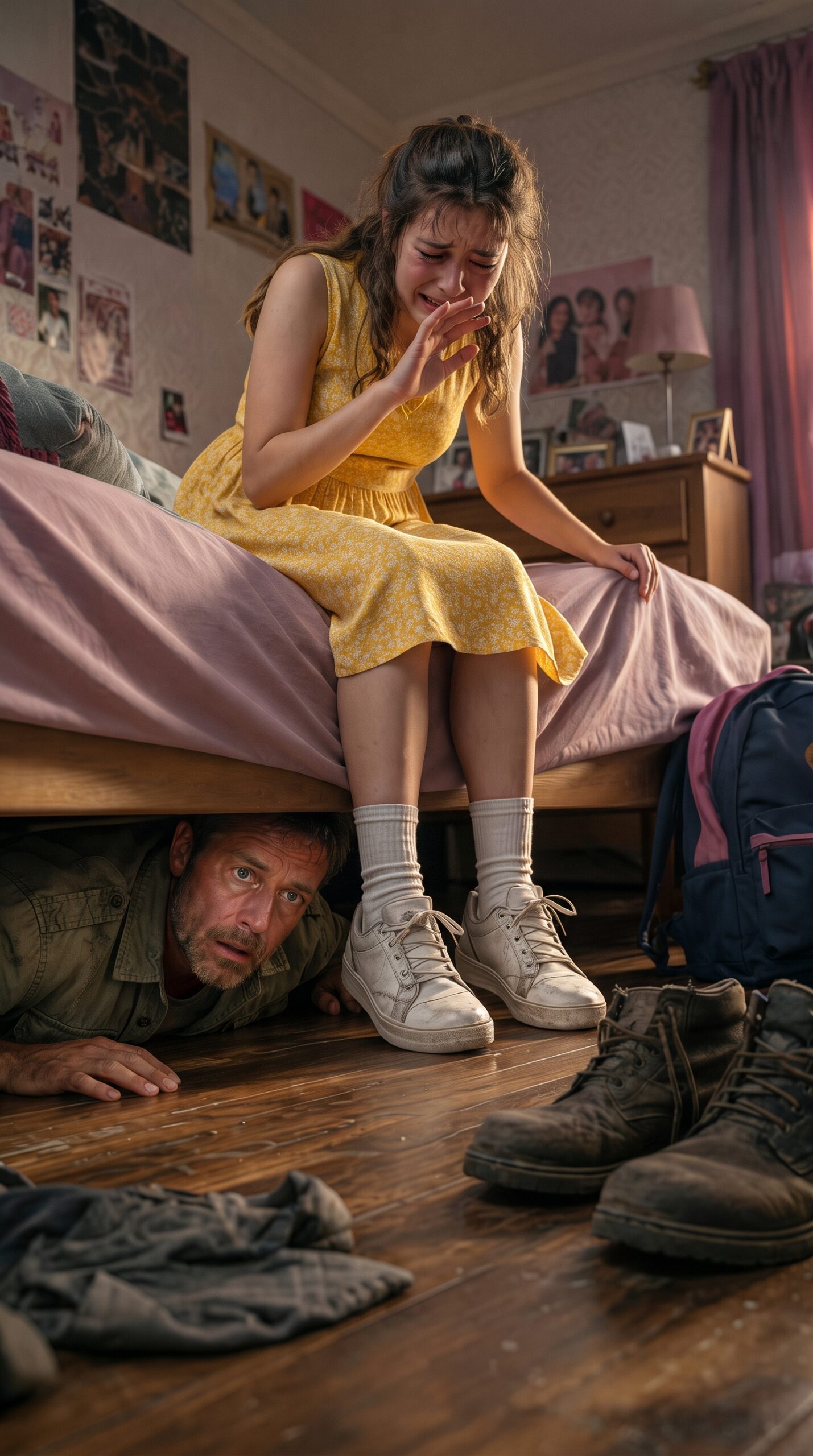
Then he crawled under his own bed.
Twenty minutes passed.
Then he heard the door open.
Footsteps climbed the stairs.
Someone entered the master bedroom.
The mattress sank.
First, he heard a sob.
Then another.
And a broken, soft voice pleaded:
"Please… stop."
It was Josefina.
Elías lost his breath.
From under the bed, he could only see her white sneakers and the socks of her uniform.
The girl who was supposed to be at school was sitting on her bed, crying as if her soul were breaking.
"I’m not going to let you destroy me," she murmured. "Not again."
Then another key turned in the front door.
Josefina shot up.
And Elías heard Rebeca’s voice climbing the stairs:
"Here again, brat? I told you we were going to finish this today."
PART 2
Elías didn’t move.
He didn’t even breathe.
Rebeca’s footsteps advanced down the hallway with a calmness that froze his blood.
It wasn’t the walk of a worried mother.
It was the walk of someone who knew exactly what she was doing.
The bedroom door swung open.
"Where is she?" Rebeca demanded.
Josefina stepped back.
"I don’t have her."
"Josefina, don’t lie to me. Give me that memory stick."
Elías felt the world tilt.
Memory stick?
What were they talking about?
Rebeca locked the door.
"Your dad isn’t going to believe you, do you understand? To him, you’re just a dramatic, whiny girl, a teenager acting out because of your age."
Josefina cried silently.
"He loves me."
Rebeca let out a low, cold laugh.
"He loves you, sure. But he’s never around. And when he is, he’s tired. You think a man like him will change his life for your tantrum? Seriously, don’t be naive."
Each word struck Elías like a slap.
Because it hurt more to know that Rebeca wasn’t making it all up.
He was tired.
He did come home late.
He had left his daughter alone with his silence.
"I saw the messages," Josefina said, trembling. "I saw the transfers. I saw the one with Arturo."
Rebeca fell silent for a few seconds.
Then her voice dropped, more dangerous.
"And what do you think you’ll accomplish with that?"
Josefina answered through tears:
"That my dad knows you’re stealing from him."
Elías clenched his fists against the floor.
Rebeca was siphoning money from the family account to another account.
And Arturo, the supposed director of the dental clinic, was not just her boss.
He was the man Rebeca had been secretly communicating with for months.
Josefina had stumbled upon it one afternoon while searching for a school assignment on her dad's laptop and found an open email session.
There were the receipts.
42,000 pesos.
18,500 pesos.
9,900 pesos.
Small and large transfers, all disguised as medical payments, dental repairs, clinic supplies.
But there was more.
She also found a conversation where Rebeca told Arturo:
"As long as Elías keeps working like a mule, we can save enough to leave. The girl suspects, but I have her under control."
Since that day, the house changed.
Rebeca began to keep a close eye on Josefina.
She took away her phone "to help her study."
Called the school, inventing that the girl had migraines, cramps, or anxiety attacks, pulling her out early.
Brought her home.
Locked her in her room.
Yelled at her.
Threatened to say she was crazy, that she was making things up, that she needed to be committed.
And when Josefina tried to defend herself, her screams crossed the walls.
That’s why Doña Matilde heard them every afternoon.
"Give me the memory stick," Rebeca repeated.
"No."
A sharp thud echoed against the nightstand.
Elías wanted to leave, but something held him back.
He needed to hear more.
He needed to understand how far this nightmare reached.
"Your dad signed a life insurance policy three months ago," Rebeca said. "Did you see that too?"
Josefina stopped crying.
Elías felt the blood drain from his face.
"What insurance?" the girl asked.
Rebeca took a deep breath, as if she had just made a mistake.
But it was too late.
"An insurance policy, that’s all. Adult stuff."
Josefina took a step back.
"It wasn’t to leave with Arturo… it was for something worse."
The silence was horrifying.
Rebeca didn’t respond.
That was the twist no one saw coming.
Josefina hadn’t just discovered an affair.
She had uncovered that Rebeca and Arturo were planning to leave Elías ruined, making him sign more loans and, if anything happened to him at work, cashing in the insurance as the perfect widow.
That’s why Rebeca insisted he take dangerous jobs.
Why she urged him to accept night shifts.
Why she had bought him drops "to sleep better" that left him dizzy in the mornings.
Josefina had kept pictures of the bottles, message screenshots, and audio recordings.
Everything was on a hidden USB stick sewn inside an old stuffed animal.
And Rebeca knew.
"You’re ungrateful," Rebeca spat. "I gave you a home, food, school."
"My dad gave me that," Josefina replied. "You gave me fear."
Then came the sound that split Elías in two.
A slap.
Josefina fell to the floor.
Elías sprang out from under the bed as if someone had yanked him from the earth.
"That’s enough!"
Rebeca froze.
Her face went from rage to panic in less than a second.
"Elías…"
He took Josefina by the arm and gently lifted her.
The girl clung to him as she did when she was little, when she was afraid of the dark.
But this time, the darkness was inside her own home.
"Since when?" he asked, looking at his wife.
Rebeca tried to cry.
"It’s not what it looks like."
Elías pulled his phone out of his pocket.
The screen was still recording.
He had activated the recorder since he heard the key turn.
Rebeca saw the phone and the act dropped from her.
"Delete that."
"No."
"Elías, we can talk."
"Don’t say my name as if you’re still my family."
Josefina trembled.
"I didn’t want anything to happen to you, Dad," she said. "I screamed because I thought one day you would hear me."
That phrase destroyed him.
She wasn’t screaming for the neighbor to hear.
She was screaming for her father to be a father again.
At that moment, the doorbell rang.
Once.
Twice.
Three times.
Elías went down, Josefina following.
When he opened the door, he found Doña Matilde on the sidewalk, her gray shawl draped over her shoulders and her phone in hand.
"I called the police," she said. "It sounded really bad today. I’m sorry, son, but one can’t stay silent."
Elías couldn’t respond.
He just lowered his head.
The police arrived eight minutes later.
Rebeca tried to say that Josefina was having a crisis, that she was making things up, that she was a troubled teenager.
But Josefina, with a broken voice, asked to speak.
And she spoke.
She recounted the threats.
She recounted the lock-ins.
She recounted the false calls to school.
She recounted how Rebeca told her that no one would believe her because her dad "only knew how to work and obey."
Then she went up for the stuffed animal.
Inside, sewn into the belly with red thread, was the USB stick.
Elías recognized it immediately.
It was a teddy bear he had given her when Josefina was six, after selling his motorcycle to pay for her appendix surgery.
The girl had hidden the truth in the one object that still reminded her that her father had once truly cared for her.
At the precinct, the story grew larger.
The memory stick contained screenshots, audio files, bank statements, and messages.
There was also a video recorded from Josefina’s laptop where Rebeca appeared talking to Arturo via video call.
"If the girl speaks, we’ll make her seem unstable," he said. "You’re her mom; everyone will believe you first."
That phrase weighed like a sentence.
The school confirmed that Rebeca had taken Josefina out eleven times in two months.
The dental clinic reported that Rebeca had requested leave for "family emergencies" precisely during the afternoons when Doña Matilde heard screams.
The bank detected unusual movements from Elías’s account.
And the insurance doctor explained that the drops Rebeca gave him were not vitamins or natural relaxants.
They could cause drowsiness, confusion, and slow reflexes.
On a construction site, that could kill him.
Elías vomited in the bathroom of the Prosecutor’s Office when he understood everything.
Not out of fear.
But guilt.
He had been inches away from losing his daughter and hadn’t seen it.
He had dined at the same table with the woman who was breaking her from the inside.
He had confused silence with peace.
Tiredness with an excuse.
Money with love.
Rebeca was removed from the house with a protection order.
Arturo tried to disappear, but the messages were already in the hands of the Public Ministry.
The clinic suspended him the next day.
Rebeca still had the nerve to call Elías from another number.
"You’re going to destroy 16 years of marriage for a manipulative girl," she said.
Elías didn’t shout.
Didn’t insult.
He just replied:
"No. I’m going to save my daughter from the woman who turned her into a prisoner."
And hung up.
The following months weren’t a fairy tale.
There was no magical ending or hug that healed everything in one night.
Josefina started therapy.
She gradually returned to school.
For weeks, she couldn’t hear keys in the door without becoming rigid.
She couldn’t stand someone locking a room.
Sometimes she woke up crying, apologizing for "causing problems."
Elías learned not to respond with silly phrases like "it’s all over."
Because it wasn’t over.
It was just beginning to heal.
He also went to therapy.
For the first time in his life, he understood that providing wasn’t the same as being present.
That a house with food can feel like a prison if no one listens.
That an absent father also leaves wounds, even if he never raises his hand.
One Sunday, Doña Matilde rang the bell with a plate of rice pudding.
Josefina opened the door.
The woman became nervous.
"I just wanted to see how you were, sweetie."
Josefina hugged her without saying a word.
That hug lasted longer than any explanation.
Elías watched from the living room and wiped his eyes with his sleeve.
Because the person who saved his daughter wasn’t the one living under the same roof.
It was a neighbor he had silently called a gossip.
Some time later, when the case progressed and Rebeca had to testify, she still tried to play the victim.
She said she was pressured.
That Arturo manipulated her.
That Josefina exaggerated.
But the audio from under the bed, the memory from the teddy bear, and the school records left no room for lies.
Elías filed for divorce.
Sold his truck to pay for lawyers and therapy.
Changed jobs to leave earlier.
And every afternoon at five, he was home.
Not as a guard.
As a father.
One afternoon, Josefina came down to the kitchen while he was making burnt quesadillas.
"They’re turning out terrible," she said.
Elías smiled.
"But with love."
She let out a small laugh.
It was barely a sound.
But to him, it sounded like a house coming back to life.
That night, before going to bed, Josefina left the old teddy bear on the dining table.
She no longer needed to hide evidence inside.
Elías looked at it and understood the message.
The truth no longer had to be sewn and hidden.
Now it could be out in the open.
Sometimes people say not to interfere in other families’ matters.
That the screams behind a wall are nobody’s business.
That children exaggerate.
That neighbors are gossips.
But if Doña Matilde had stayed silent, Josefina might have kept screaming in a house where everyone thought "everything was normal."
And the question that lingered in the neighborhood was uncomfortable, painful, and necessary:
How many people hear a plea behind a wall and prefer to think it’s not their problem?