PART 1
—If you chose to destroy your marriage, don’t come asking us to pick up the pieces.
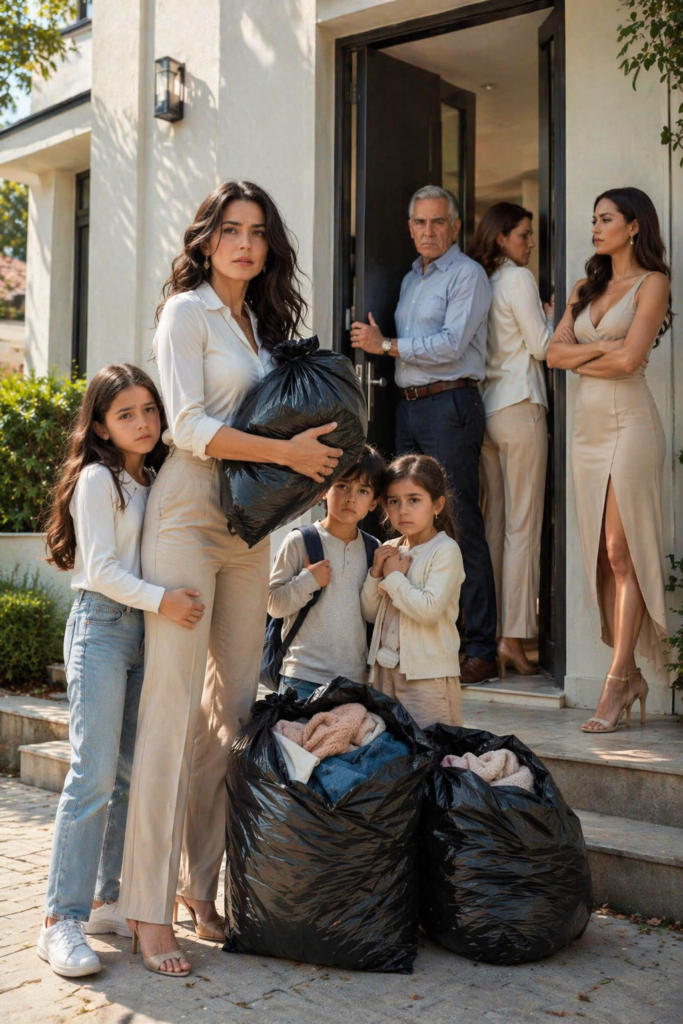
That’s what Doña Rebeca told her daughter Clara from the other side of the gate, not fully opening it, as if her three grandchildren weren’t trembling from the cold outside.
Clara carried a torn backpack slung over her shoulder, a black bag filled with clothes, and her youngest son sleeping against her chest.
The street in the Álamos neighborhood was damp from the rain. The yellow streetlamps glimmered on the puddles, and Sofia, 9, clutched her little sister Natalia’s hand, age 6.
Tomás, age 4, understood little. He only knew that his mom had driven a long way, that his dad no longer lived with them, and that grandma didn’t want to open the door.
Clara didn’t ask for money.
She didn’t ask for them to fix her life.
She only asked to sleep a few nights in the house where she had grown up.
The same house where as a girl she ate noodle soup on Fridays, where her dad took her for churros at the park, where her mom bragged on Facebook that “family always comes first.”
But that night, family was just a pretty phrase with no open door.
—Mom, please —Clara said, lowering her voice—. It’s just for a few days. The kids have nowhere to sleep tonight.
Behind Doña Rebeca appeared Don Ernesto, her father, arms crossed, eyes fixed on the ground.
—Your mom and I talked —he murmured—. We believe it’s best you go back to Iván.
Clara felt something inside her break.
Iván, her husband for ten years, hadn’t yelled at her or hit her. He didn’t make scenes. He was worse.
He was one of those men who smiled at parties, carried bags at the supermarket, and greeted everyone with perfect manners.
But at home, he made her feel small.
If he came home late, it was because she didn’t understand his job.
If he forgot to pick up the kids, it was because she hadn’t reminded him.
If she cried, it was because she was intense.
And then another woman appeared.
Clara discovered it one afternoon, through three messages on Iván’s phone while making quesadillas for the kids.
There was no novel, no perfume, no lipstick on his shirt.
Just a lit screen and the collapse of ten years.
For two months, she tried to forgive. She went to therapy, listened to promises, swallowed her anger. But every time Iván said, “It was a mistake,” Clara saw her children’s faces and understood that staying also meant teaching them something.
So she filed for divorce.
And that’s where the real betrayal began.
Her mother told her over the phone that there was no space. Clara thought it was just a momentary excuse.
But that night it was in person.
And there was space.
The house had four bedrooms. Her brother Óscar occupied one, even though he was 32 years old, didn’t pay rent, and spent his life playing video games.
The other room was filled with old boxes that nobody touched.
And the back room, the guest room, was empty.
Then Óscar came out, a cup of coffee in hand and a lazy smile on his face.
—Come on, Clara, don’t make a drama. Iván is a good dad. All marriages have problems.
Then her younger sister, Marisol, freshly married, appeared with perfect nails and that look of someone who believes that a wedding makes her an expert in life.
—The stability of your children comes first —she said—. You can’t break up a family out of pride.
Sofia looked up.
Clara felt her daughter’s little hand tighten around hers.
—It’s not pride —she replied—. It’s dignity.
Doña Rebeca sighed, as if she were the victim.
—Oh, daughter, always so exaggerated. Iván made a mistake, but he supports you. What are you going to do alone with three kids?
Clara didn’t answer.
Because if she opened her mouth, she would cry.
And she didn’t want her kids to remember their mother begging at a gate.
She hefted the black bag, adjusted Tomás in her arms, and stepped down the stairs.
Sofia stayed looking at her grandparents.
—Why don’t they want us? —she asked quietly.
No one answered.
Not Doña Rebeca, not Don Ernesto, not Óscar, not Marisol.
Clara opened the truck, loaded her children, and before starting the engine, looked at the lit house.
She didn’t scream.
She didn’t insult.
She just pulled out her phone, saved the messages, the calls, and the location from that night.
And while her children cried silently on the way to a cheap motel on Calzada de Tlalpan, Clara still didn’t know that 18 months later those proofs would blow apart the perfect version of her entire family.
PART 2
The motel smelled of chlorine, dampness, and reheated coffee.
It had two beds, an old television stuck to the wall, and a curtain that didn’t close properly. For Clara, it was a defeat. For the kids, she tried to turn it into an adventure.
—Tonight we sleep like explorers —she said, taking off Tomás’s shoes.
Natalia asked if they could order pizza.
Sofia said nothing. She arranged her brother's backpack next to the bed and lined up everyone's shoes, as if organizing something small could prevent the world from collapsing.
When the three fell asleep, Clara entered the bathroom.
There, she cried.
She cried sitting on the toilet seat, covering her mouth with a towel to avoid waking anyone.
She didn’t cry just for Iván.
She cried for the gate.
For her dad not looking her in the eye.
For her mom talking about stability while three kids were out on the street.
For her brother mocking her.
For her sister calling “pride” a woman just trying not to break.
The next morning, Clara took the kids to school as if nothing had happened. She bought them a juice and a sandwich from a little shop because she hadn’t had time to prepare lunchboxes.
Then she went to work.
Clara was an administrative assistant at a private clinic in Roma Sur. She worked part-time, earned just enough, and had a boss named Teresa who almost never smiled, but saw more than she said.
Upon seeing Clara come in with puffy eyes, Teresa closed the folder she was reviewing.
—Clara, come here.
Clara thought she was going to get scolded.
But Teresa closed the door and asked:
—Are you in trouble?
Clara shared a little, enough to keep her voice from breaking.
Teresa didn’t hug her. She didn’t say “poor thing.” She just opened a drawer and pulled out some papers.
—There’s a full-time opening in the clinical records department. Benefits, insurance, vouchers, and fixed schedule. I haven’t offered it to anyone because I needed someone reliable. Do you want it?
Clara said yes before hearing the salary.
That same week, she contacted a recommended pro bono attorney. Her name was Patricia Salgado, a woman with short hair, thick glasses, and sharp patience.
—Keep everything —she told her—. Messages, receipts, chats, transfers, medical appointments, school emails. Everything.
Clara was already doing that.
She had years’ worth of evidence.
Pediatrician visits.
Vaccines.
Tuition receipts.
Chats where Iván asked basic things like “What classroom is Natalia in?” or “Is Tomás still on syrup?”
Photos from festivals where he didn’t appear.
School permissions signed only by her.
Daily life, the kind no one applauds, became a file.
At first, Iván played at being remorseful.
He sent her long messages:
“Think about the kids.”
“You’re destroying the family.”
“I failed you, not them.”
But when he realized Clara wasn’t going back, he changed.
He hired a lawyer, requested shared custody almost 50%, and claimed Clara was manipulating the kids to punish him.
He also started talking to Clara’s family.
Doña Rebeca sent audios to her daughter:
“Daughter, don’t make this bigger.”
“The kids need their dad.”
“People make mistakes; you too will want forgiveness someday.”
Clara listened to those audios on the bus, one hand holding the pole and the other clutching the grocery bag.
She didn’t reply.
But she saved them.
Three months passed between the motel, a room borrowed from a coworker, and finally a small apartment in Iztapalapa, near the school.
It had two bedrooms, old tiles, and a leak in the kitchen.
But it had a door Clara could close from the inside.
That was already a lot.
Natalia chose yellow curtains because, according to her, “a sad house needs a bit of sun.”
Tomás stuck plastic stars on the wall.
Sofia put her books in a box and wrote in marker: “Don’t throw away.”
One afternoon, while Clara was setting up a used nightstand she bought on Marketplace, she received a message from an unknown number.
“Clara, I’m Brenda, Marisol’s cousin. I don’t know if I’m doing the right thing, but I think you deserve to know this.”
Then came the screenshots.
It was a family chat where Clara wasn’t included.
The date was one week before she discovered Iván’s affair.
Doña Rebeca had written:
“We already know Iván is being foolish, but Clara shouldn’t separate. Alone with three kids, she won’t manage.”
Don Ernesto replied:
“If she comes to the house, we won’t receive her. If we receive her, she won’t go back to him.”
Óscar wrote:
“Let her hit rock bottom a bit. The drama will pass.”
And Marisol added:
“Exactly. Sometimes a woman needs to understand that not everything is solved by being dignified.”
Clara stood frozen.
They hadn’t closed the gate for lack of space.
They closed it to push her back to the man who had betrayed her.
That night, she didn’t cry.
That night, she understood.
The next day, Patricia read the screenshots in silence.
—This isn’t just family gossip —she said—. It serves to demonstrate pressure, abandonment, and a network trying to force you back into an emotionally damaging environment.
—And does it work against Iván?
—It works against his version of a concerned father and husband. Because while you were looking for a place to sleep, he knew your family was closing doors.
Clara felt nausea.
—He knew?
Patricia pointed to another screenshot.
Iván had written in that same chat:
“Thanks for supporting me. If she sees she has nowhere to go, she’ll come back. Don’t give her wings.”
At that moment, Clara stopped feeling shame.
She felt pure rage.
The kind that doesn’t scream but walks straight.
The first hearing was two months later.
Iván arrived in a white shirt, expensive cologne, and the face of a man unjustly destroyed. He greeted everyone politely. He even asked Clara if the kids were well, as if he hadn’t spent months depositing late and demanding every penny.
His lawyer spoke of reconciliation, stability, and “parental alienation.”
He said Clara had been impulsive.
He said Clara didn’t allow visitation.
He said Iván was a responsible provider.
Patricia waited.
Then she placed the evidence on the table.
Messages where Iván canceled visits for “meetings.”
Audios where he said he couldn’t deposit because “he had expenses too.”
Screenshots where he asked about ages, schedules, and medicines a present father should know.
And then she showed the family chat.
The room’s temperature changed.
There were the phrases.
“Let her hit rock bottom.”
“We won’t receive her.”
“If she sees she has nowhere to go, she will come back.”
“Thanks for supporting me.”
Iván lost color.
Doña Rebeca, who had gone as “moral support,” lowered her gaze.
Marisol turned red.
Óscar stopped checking his phone.
Don Ernesto rubbed his face as if he had just awakened in the middle of a fire.
The judge demanded silence.
Clara didn’t smile.
Because it wasn’t victory.
It was seeing in cold letters what her children had lived through in the cold on the street.
Meanwhile, Sofia began to change.
She no longer asked how much things cost out of curiosity. She asked out of fear.
If Clara said they would buy shoes, Sofia responded:
—I can still hold out with these.
If she was invited to a party, she asked:
—Isn’t that too much expense?
Clara understood that betrayal is inherited if no one names it.
That’s why she took her to therapy.
One afternoon, as they were leaving, Sofia asked her:
—Did grandma know that dad hurt you?
Clara swallowed hard.
—Yes.
—And that’s why she didn’t open the door for us?
Clara could have lied.
She could have softened it.
She could have said, “Adults get confused.”
But there were lies that only served to save the guilty.
—She didn’t open for us because she thought that way I would go back to your dad.
Sofia looked out the car window.
—So it wasn’t that we didn’t fit.
Clara tightened her grip on the steering wheel.
—No, my love. We did fit.
The provisional ruling came eight months later.
Clara obtained primary physical custody.
Iván received alternate weekends, two weeks in summer, and a mandated retroactive support obligation.
Additionally, the judge ordered that communication be only through a family application, with no insults, no manipulation, and a record of each exchange.
Iván left furious.
—You ruined me —he told her in the hallway.
Clara looked at him for the first time without fear.
—No, Iván. I just stopped helping you lie.
The news spread quickly through the family.
Querétaro, CDMX, or any city in Mexico can feel enormous until there’s divorce, trial, and screenshots.
Doña Rebeca called eleven times.
Clara didn’t answer.
Then she sent a message:
“We’re relieved that everything turned out well. We’ve always been worried about you.”
Clara read that in the supermarket line, holding a bag of rice and two yogurts on sale.
“We’ve always been worried.”
She didn’t respond.
Because worrying wasn’t closing a gate.
Worrying wasn’t leaving three kids to sleep in a motel to save the image of a decayed marriage.
Don Ernesto asked to see her weeks later at a café near the clinic.
Clara accepted, not for him, but because she needed to hear if at least one of them could tell the truth without polishing it.
He arrived thinner, wearing a blue shirt and dark circles under his eyes.
—Your mom doesn’t know I came —he said.
—I’m not surprised.
He ordered coffee. Clara ordered water.
They talked about the children for a few minutes. About Tomás’s loose teeth, Natalia’s drawings, and Sofía and her books.
Then Don Ernesto lowered his gaze.
—I was wrong.
Clara didn’t feel relief.
She felt an old sadness rising.
—Yes —she replied.
—That day I should have opened the door.
—Yes.
He closed his eyes.
—Your mom thought that if we received you, you would destroy your family.
Clara looked at him fixedly.
—My family was already broken, Dad. Iván broke it. You just made sure I bled outside.
Don Ernesto tightened his grip on the cup.
—Can I repair something?
Clara thought of the motel.
Of Tomás sleeping with his jacket on.
Of Natalia choosing yellow curtains to brighten someone else’s walls.
Of Sofía asking why they didn’t want them.
—I don’t know —she said—. But repairing isn’t coming to feel better. Repairing is accepting that my kids remember too.
He nodded.
He didn’t cry.
But he aged before her.
With Doña Rebeca, it was different.
She didn’t want to repair.
She wanted to erase.
She wanted a random Sunday for Clara to arrive with the kids to eat pozole and for everyone to act as if nothing happened.
As if dignity were a tantrum.
As if abandonment could be fixed with sweet bread.
She sent an audio on Mother’s Day:
“I’m a mom too, Clara. Someday you’ll understand what it hurts for a daughter to close the door on you.”
Clara listened to it once.
Then she deleted it.
Because she understood perfectly what a closed door felt like.
The difference was that she didn’t close it on a desperate woman with three kids on the street.
She closed it on adults who chose to abandon her and then wanted to come in when there was already light, furniture, and stability.
Life didn’t suddenly become easy.
Clara continued counting, taking buses, cooking rice when there wasn’t enough for more, and folding uniforms at midnight.
But she no longer walked asking for permission.
Teresa recommended her for the clinical records coordinator position. The salary increased. It wasn’t wealth, but it was hers.
With that increase, Clara moved to a three-bedroom apartment.
Small, yes.
With walls that needed painting, too.
But each child had their bed.
Sofia put a lamp on her desk.
Natalia drew huge flowers on a poster board.
Tomás said his room was “his castle.”
One night, while Clara made noodle soup, Sofia came over and looked at her in silence.
—Mom, I think we’re okay now.
Clara left the spoon in the pot.
—Yes, my love. I think so too.
She didn’t cry in front of her.
Or maybe she did, a little, with her back turned.
Because sometimes a mother cries when fear finally begins to release the house.
Eighteen months after that night at the gate, Sofia’s school held a family exhibition.
Each child had to present an important word.
There were posters on friendship, respect, honesty.
Sofia chose resilience.
On her poster, she wrote about plants that grow back after the storm, about people who lose everything and learn to rise up with fear.
At the bottom, in careful handwriting, there was a phrase that didn’t come from any book:
“A closed door hurts, but it also teaches who deserves to enter when you build your own house.”
Clara read it three times.
—Is it okay? —Sofia asked.
Clara hugged her tightly.
—It’s more than okay.
That night, Clara understood that she hadn’t raised a broken girl.
She had raised a girl who saw the truth and still chose to grow.
Iván ended up separating from the woman for whom he had destroyed his marriage. They lasted less than a year.
Clara didn’t celebrate.
By then, she didn’t care anymore.
Her family continued living in the same house in the Álamos neighborhood. The same bedrooms, the same furniture, the same excuses.
Óscar never apologized.
Marisol sent long messages talking about “good intentions.”
Doña Rebeca continued saying that Clara was resentful.
But Clara no longer needed to convince them.
She had a job, a roof, a small savings account, three children who laughed loudly on Sundays, and a peace that no one gave her.
She built it from a motel, a black bag, and a question that still burned in her chest:
“Why don’t they want us?”
Sometimes blood doesn’t open doors.
Sometimes it closes them so one learns to stop knocking.
And when someone tells you there’s no space for you, maybe it’s not because you don’t fit.
Maybe it’s because they know that as soon as you find your own place, you’ll never live on your knees again.