PART 1
At 10:15 PM, Mateo Salgado opened the door to his apartment in Guadalajara, his back shattered from exhaustion.
He had worked 12 hours moving pallets in a distribution center in El Salto. All he wanted was a hot shower, a warm meal, and to feel a kick from his son under his hand.
But as he stepped inside, he was hit with the stench of cold pizza, spilled soda, and grease.
The living room looked like a bar after a championship game. Open boxes littered the table, disposable plates were thrown on the couch, and napkins were strewn all over the floor.
His mother, Ofelia, lay sprawled under a blanket, watching a reality show at full volume. His three sisters filled the rest of the space as if they owned the place.
Brenda flaunted a new phone that Mateo was still paying off in installments. Karla laughed while watching videos. Ximena complained that the pizza didn’t have enough cheese.
None of them lifted a finger.
None seemed embarrassed.
And Mateo was footing the bill for everything: rent, utilities, internet, Ofelia’s medications, his sisters’ debts, and even the dinner that had been left to rot.
“Where’s Renata?” he asked.
Brenda didn’t even look up.
“In the kitchen. Washing the dishes we used.”
Karla let out a giggle.
“She’s pregnant, not disabled, dude.”
Ofelia sighed in annoyance.
“Oh, Mateo, your wife exaggerates. When I was pregnant, I worked, cooked, and took care of your father. Women today think they deserve applause just for breathing.”
Mateo walked toward the kitchen without responding.
Water was running.
When he reached the door, his blood turned to ice.
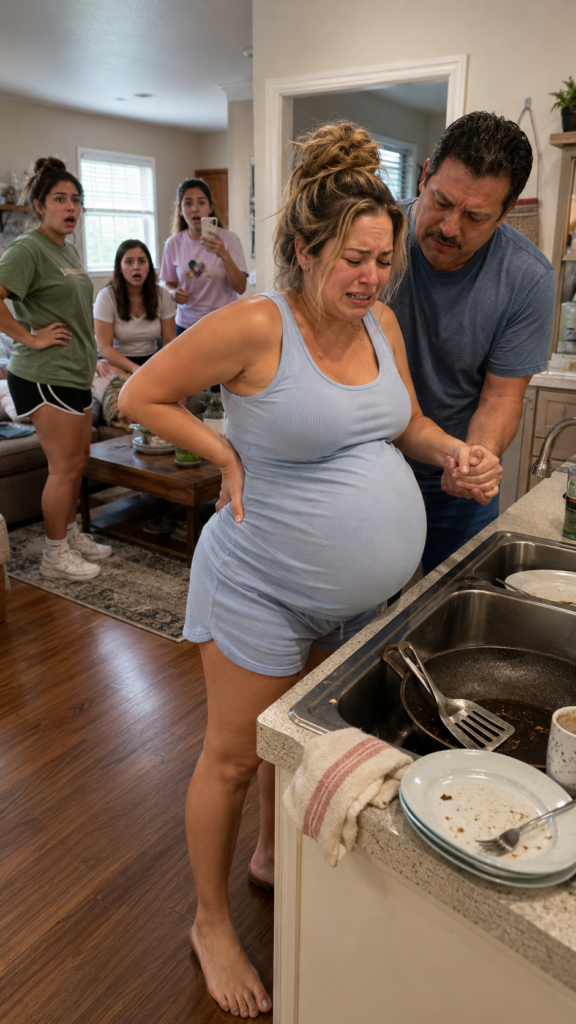
Renata stood barefoot in front of the sink. Her eight-month belly nearly touched the counter. One hand held a greasy pan; the other pressed against her lower back.
She was trembling.
Her face was pale, lips dry, and eyes swollen. She cried silently, trying to keep her sobs hidden.
“Renata…”
She jumped and forced a smile.
“You’re home, love. I’ll warm up dinner in a bit. Just finishing this.”
Her voice cracked.
Mateo turned off the water and took the pan from her.
“It’s over.”
Fear immediately flickered in Renata’s eyes.
“Don’t start a fight. I can handle it. I don’t want issues with your mom.”
“You’re shaking.”
“I’m fine.”
“Look at me.”
Renata held his gaze for two seconds before crumbling against his chest.
“Your mom says I’m a freeloader,” she sobbed. “Your sisters say you work yourself to death while I pretend to feel sick. I just wanted them to accept me.”
“Since when?”
She lowered her eyes.
“For two months.”
Mateo felt something inside him die.
For two months, he had worked overtime believing he was protecting his family, while his own family humiliated the woman carrying his child.
Then Renata let out a scream.
She doubled over her belly, and a plate crashed to the floor, shattering into pieces.
In the living room, they continued laughing.
No one went to check on her.
No one asked about the baby.
Mateo held her as another contraction tightened her abdomen. In that moment, he understood that this night would not end with apologies.
It would end with consequences none of them could imagine.
PART 2
Mateo lifted Renata and shouted for them to call 911.
Ofelia appeared in the doorway, irritated that the noise had interrupted her show.
“Don’t make a scene. It’s probably just cramps.”
“Call now.”
Brenda raised her new phone.
“An ambulance costs a fortune. Can’t you take her yourself?”
Mateo snatched the phone and dialed.
The paramedics arrived nine minutes later. Renata had been in labor for almost an hour and had only eaten a slice of bread.
As they loaded her onto the stretcher, Ofelia grabbed Mateo’s arm.
“Before you leave, let me have some money for the weekend.”
He looked at her as if she were a stranger.
For years, he had confused obedience with love. Ofelia called him a bad son, and he paid off another debt; his sisters failed, and he rushed to rescue them.
Now, strangers were taking better care of Renata than his own family.
“Get out.”
Ofelia blinked.
“What did you say?”
“All four of you. Out of my apartment.”
“Are you going to kick your mother out for a bellyache?”
“She hasn’t eaten all day.”
“It’s not my fault.”
“She was cleaning while having contractions.”
Ofelia stiffened her face.
“That woman lives here for free.”
“She’s my wife. This is her home. You are the guests.”
Then Ofelia said something Mateo didn’t understand at that moment.
“You have no idea what she wants to take from us.”
The paramedic shouted for them to clear the way. Mateo pointed to the door.
“When I come back, I don’t want to see you here.”
At the Civil Hospital, they confirmed the baby was still strong, but Renata was dehydrated, exhausted, and at risk of premature labor. She would be admitted.
When Mateo sat by her bed, he noticed four dark bruises on her arm.
They were shaped like fingers.
“Who grabbed you?”
Renata tried to cover herself.
“Brenda.”
Mateo felt air leave his lungs.
“Why?”
“I tried to stop her from coming into our room. They were looking for a blue envelope.”
Renata explained that two months earlier, a certified letter arrived. Ofelia took it, claiming it was a medical bill.
Later, Renata found pieces in the trash and read “trust” and “descendant.”
She called the law firm. They wouldn’t give her details but told her they had been trying to locate her husband for almost six years.
Shortly after, Ofelia appeared with documents. She claimed they were insurance to protect the baby and demanded Renata sign them.
She refused upon seeing phrases like “waiver of rights” and “alternative trustee designation.”
That’s when the harassment began.
Ofelia convinced her daughters that Renata wanted to steal from them. They would come over when Mateo was at work, insult her, make her clean, and threaten to accuse her of tearing the family apart.
“Why didn’t you tell me?” Mateo asked, heartbroken.
Renata looked at him without reproach.
“Because every time I tried to talk about the money they were taking from you, you defended them.”
The truth hurt more for being spoken without anger.
“I failed you.”
“You didn’t know.”
“I should have known.”
Renata squeezed his hand.
“Three weeks ago, another blue envelope arrived. I hid it. Today they came looking for it. Brenda found the box in the closet and grabbed me when I tried to stop her.”
“Where is it?”
“Inside the flour bin, above the refrigerator.”
A bitter laugh escaped Mateo.
“My mom never cooks,” Renata said.
Then she revealed something else.
She had installed the baby monitor camera in the living room, and everything was stored in the cloud.
Mateo opened the recording. Ofelia and her daughters entered like thieves: opening drawers, checking cushions, and forcing doors.
Then Ofelia’s voice rang clear:
“Find the envelope before Mateo gets back. When that child is born, we lose our chance.”
Brenda asked what would happen if Renata had already called the lawyer.
“We’ll make Mateo believe she wants the money,” Ofelia replied. “He always chooses us when we make him feel guilty.”
Then Renata appeared, demanding they leave the bedroom.
Brenda grabbed her by the arm.
Ofelia approached and spoke inches from her face.
“You’re going to sign. Everything of Mateo belongs to this family. Neither you nor that baby is going to take it from us.”
Then she forced her to wash dishes to humiliate her.
Mateo watched the 27 minutes.
When it finished, Renata whispered:
“I’m sorry for bringing this into your life.”
He rested his forehead against hers.
“You didn’t bring it. You just showed me what was always there.”
At 4:00 AM, he returned to the apartment.
Ofelia and her daughters had left, taking the television, two suitcases, appliances, and Renata’s jewelry box.
Mateo climbed onto a chair and pulled down the flour bin.
Inside was the blue envelope.
The letter spoke of the Salgado Trust and his deceased father’s stake in Transportes Horizonte del Bajío.
Mateo stopped breathing.
He had worked for nine years at the company that owned the warehouse.
Julián Salgado hadn’t died without a dime, as Ofelia had claimed. He was a founder and left protected shares.
The estimated value was 218,000,000 pesos.
But the hardest blow came at the end.
The trust would be irrevocable upon the birth of Mateo’s first child. Renata and he would be custodians; the baby, the primary beneficiary.
There was also a handwritten letter from Julián.
He warned that Ofelia used guilt as a leash and that family should be measured by who protects the vulnerable without expecting reward.
“When the time comes, choose the family you’ve built,” it said.
Mateo sat on the floor.
He had spent years financing those who destroyed his true home.
At 9:00, he called the law firm.
Víctor Arriaga, his father’s lawyer, arrived with even worse documents.
Ofelia intercepted letters, forged signatures, diverted payments, and opened credit cards in Mateo’s name.
She had stolen at least 12,600,000 pesos.
The vacations, bags, and tuition for his sisters had been paid with Mateo’s money while he ate cookies, sending them nearly all his salary.
Julián set the birth condition because he feared Mateo would give everything to Ofelia. He trusted that being a father would teach him to set boundaries.
Mateo felt shame because his father had been right.
He authorized an investigation into every signature, every card, and every transfer. He also submitted the baby monitor recording and reported the apartment theft.
That afternoon, Ofelia sent him 17 messages.
She claimed Renata had poisoned him and that a son should repay his mother for raising him.
The last message was a threat: if he didn’t come to the apartment by 6:00, she would report that Renata had hit Brenda.
Mateo arrived with two detectives, a lawyer, and the property manager.
Ofelia waited in the living room. Her daughters returned some of the stolen items, as if that erased the crime.
“Was it necessary to bring the police?” she asked.
“You threatened my wife.”
“I was angry.”
“You forged my signature.”
Brenda started crying.
“Mom said you knew about the cards.”
Karla yelled at her to shut up.
“You said Mateo would never turn us in!” Brenda shot back.
In seconds, the supposed family unity began to crumble.
Mateo played the video.
Ofelia’s voice filled the room: “When that child is born, we lose our chance.”
When it ended, no one could deny anything.
Ofelia showed no remorse.
Only rage for having been discovered.
“I did it for my daughters,” she said.
“And what am I?”
For the first time, his mother was honest.
She confessed that she resented Julián for protecting Mateo and not her three daughters from a previous relationship.
“He married me. He should have supported them.”
“So you stole from me.”
“I balanced things out.”
“You made me work until I got sick while you hid millions.”
“I raised you. You owe me everything.”
Mateo remembered his father’s saying: guilt is a leash.
“You didn’t protect me. You invented emergencies, leaving me without friends, opportunities, or relationships.”
Ofelia smiled with contempt.
“When that woman leaves you, you’ll come back begging.”
Mateo opened the door.
“I’m not begging anyone to love me anymore.”
Karla handed over conversations and revealed the final plan.
Ofelia wanted to present false documents naming her as the administrator if Renata became “incapacitated” during childbirth.
That’s why they had forced her to work without eating, even seeing that she was having contractions.
They expected to benefit if something went wrong.
Brenda was arrested for assault and theft. Ofelia was under investigation for fraud, forgery, and identity theft.
As they took them away, the four blamed each other. Their loyalty vanished when the consequences arrived.
Renata left the hospital two days later, on strict bed rest.
Mateo took unpaid leave, stopped paying Ofelia, and learned to cook, clean, and arrange six pillows so Renata could sleep.
Three weeks later, during a storm, their son was born.
He was small, noisy, and perfect.
They named him Julián, in honor of the man who had tried to warn Mateo even after death.
Months later, Ofelia was sentenced to repay the money. Her daughters faced consequences according to their involvement.
Mateo did not attend the sentencing.
He understood that closing a wound sometimes means stopping the support for those who hurt you.
The trust activated ten days later. The money belonged to the child and could only be used for his well-being.
Julián had protected his grandson from Ofelia, from his sisters, and even from Mateo.
Mateo felt relief: that money would never again be a leash.
A year later, Mateo found one last note from his father along with an old photograph of the first warehouse:
“A house can be filled with relatives and still have no family. Family begins where someone finally says: you are safe here.”
Mateo took the photo to the kitchen.
Renata held Julián, who had cake all over his face. The apartment smelled of vanilla, not cold pizza.
No one was shouting.
No one was demanding money.
No one was making Renata feel afraid.
Mateo embraced his wife and his son.
For years, he believed being good meant enduring everything.
That night, he understood that love isn’t measured by how much abuse you endure, but by what you’re willing to end so that those who trust you can live without fear.