PART 1
Emilio Cárdenas thought silence was a refined way to punish.
He thought that if Valeria walked alone in the rain, her heels sinking into the mud of the family ranch, she would understand who was in charge.
He thought pride made him look strong.
At dawn, he discovered that pride could also destroy an entire city.
It all began in Zapopan, at a party filled with politicians, businessmen, awkward cousins, and aunts smiling with poison behind expensive tequila.
The Cárdenas family was celebrating Doña Elvira's 70th birthday, Emilio's mother, a woman who spoke softly but made everyone obey.
Valeria sat next to Emilio, dressed in dark green, her hair up, and a tired look that nobody dared to notice.
During dinner, Doña Elvira made a toast.
She said a powerful family stayed united because the women knew how to keep quiet.
Some laughed.
Others lowered their gaze.
Valeria could take no more.
"A family isn’t held together by silence," she said. "It’s held together by respect."
The table froze.
Emilio looked at her as if she had just thrown a glass in his face.
"Valeria," he murmured, "not now."
But she had spent months swallowing tears.
Months watching Emilio decide for her, answer for her, cancel her plans, check who she talked to, and then tell her it was all for her protection.
"I’m not a child, Emilio. I’m not an ornament for your mother to show off that her son has a pretty, obedient wife."
Doña Elvira let out a dry chuckle.
"What a common little voice you have, dear."
Valeria’s lips trembled.
Emilio did not defend his wife.
He only clenched his jaw.
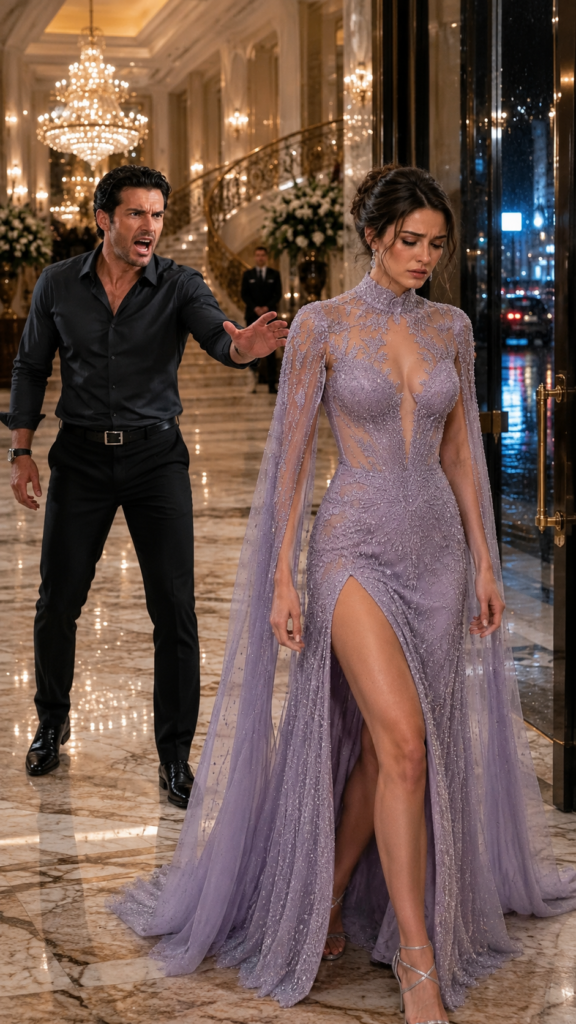
When the party ended, Valeria followed him to the entrance of the ranch.
Outside, it was pouring.
"Take me home," she pleaded.
Emilio adjusted his watch.
"No."
Valeria blinked.
"Excuse me?"
"I said no. You humiliated me in front of everyone."
"I asked you to listen to me."
"You challenged me as if I were just some guy."
Valeria let out a broken laugh.
"You’re my husband, not my owner."
He opened the door to his truck.
"Then figure it out yourself."
Valeria stood still.
She waited for him to regret it.
She waited for him to get out of the car.
She waited for, just once, him to choose her over his pride.
Emilio drove off.
He left her there, at the entrance of the ranch, the rain hitting her face and several employees pretending not to look.
Valeria walked to the road.
An old driver from the ranch offered to take her.
She said no.
She wanted no charity from anyone in that family.
She requested a taxi from her cellphone, but the signal was failing.
At 2:40 in the morning, she finally managed to get one.
She didn’t go to the mansion in Puerta de Hierro.
She went to the little house where she had grown up, in Tlaquepaque, a blue house with cracks in the walls and a dry bougainvillea at the entrance.
She had been happy there before meeting Emilio.
There were still a few photos of her mother left.
At dawn, Emilio returned to the mansion.
He thought he would find her crying.
He thought she would apologize.
But the house was empty.
Her simplest clothes were gone.
So was her diary.
And the gold necklace her mother had left her before dying.
Emilio called.
Voicemail.
He called again.
Voicemail.
At 7:18, his security chief arrived, pale.
"Sir, we found Mrs. Valeria's bag."
Emilio felt something freeze inside him.
They went to the blue house.
The door was open.
A chair was overturned.
There was blood on the kitchen floor.
And on the table, a note written in black marker:
"You left her alone. Now you will learn what it costs to abandon a woman."
Then Emilio's cellphone rang.
Unknown number.
A female voice whispered:
"Did you really think your pride wouldn’t come with a price?"
PART 2
Emilio said nothing for several seconds.
The man who always had an order ready, a threat prepared, a bought solution, stood silent in the middle of that humble kitchen.
The house smelled of dampness, old coffee, and fear.
On the wall hung a photo of Valeria with her mother, when she was 15 and still smiled without asking for permission.
"Where is my wife?" Emilio finally asked.
The woman on the phone let out a low laugh.
"How curious. Last night, she was also your wife, and you left her standing in the rain."
Emilio closed his eyes.
The phrase hit him harder than any insult.
"I want to talk to her."
"She wanted to talk to you for years."
"If you do anything to her…"
"There you go again. Threatening before listening. You don’t change, Emilio."
The call ended.
Emilio turned to his men.
"Shut down Guadalajara."
No one asked if he was serious.
Because when Emilio Cárdenas gave an order, half the city moved.
In less than an hour, they reviewed cameras from toll booths, hotels, hospitals, streets, parking lots, and gas stations.
His partners’ businesses closed early.
The family's contacts in the police began calling acquaintances.
Drivers, waiters, receptionists, and guards whispered the same thing:
Cárdenas's wife had disappeared.
But Marco, the security chief, noticed something odd.
"Sir, whoever took her isn’t hiding well."
Emilio looked at him.
"Explain."
"They left clues. The bag, the note, a camera that was off for only 42 seconds. This isn’t a normal kidnapping. They want you to follow."
At 9:03, they found another sign.
Valeria's gold necklace was hanging on the gate of an abandoned factory near El Álamo.
It was her mother’s necklace.
Valeria never took it off.
Emilio took it with trembling hands.
For the first time, he didn’t seem like a boss.
He seemed like a frightened man.
At 9:17, the phone rang again.
"You’re starting to understand, right?" said the same woman.
"I want proof of life."
"How cold that sounds for a husband. As if you were negotiating cement."
"Let me hear her."
There was silence.
Then he heard a broken breath.
"Emilio…"
Valeria’s voice was shattered.
He felt his chest open up.
"Valeria, love, I’m going to get you out of there."
She didn’t respond with relief.
She responded with something worse.
"Don’t bring another war."
The line cut off.
Emilio stared at his cellphone.
That phrase haunted him.
Don’t bring another war.
Because that was what he always did.
When something hurt him, he sent people.
When something threatened him, he crushed it.
When Valeria cried, he bought flowers.
When she asked for respect, he provided private security.
He never understood that a cage with a driver was still a cage.
The next call came at 10:00.
The woman gave an address.
An abandoned cinema in the center, near a street Emilio hadn’t set foot on since he was young.
"Come alone," she ordered. "No visible weapons. No dogs at your heels. If you cheat, you lose her for real."
Marco immediately shook his head.
"It’s a trap."
"Yes," Emilio said.
"He can’t go alone."
"I’m not going alone. But she said visible."
Marco swallowed hard.
"If there’s gunfire, she’s in the middle."
Emilio tucked the necklace into the inner pocket of his jacket.
"If anyone shoots without my order, they won’t work for me again. Not today, not ever."
The abandoned cinema looked like a wound in the middle of the city.
The old posters were torn down.
The seats were covered in dust.
On the broken screen, someone had written in red paint:
"The women you break also have memories."
Emilio entered alone.
His footsteps echoed in the empty hall.
In the middle of the stage was a chair.
On the chair was the earring Valeria had lost at the party.
Then a woman stepped out of the darkness.
Emilio took a moment to recognize her.
Not by her face.
By her rage.
It was Carmen Salgado.
The widow of a contractor who had worked for the Cárdenas years ago.
Her husband, Raúl, was accused of stealing money from a public work project.
The Cárdenas family buried him.
They took away contracts.
They froze accounts.
They exposed him in newspapers.
Then Raúl was found dead in a motel in Tonalá.
Emilio always said he had nothing to do with it.
And technically, it was true.
But he did nothing when Doña Elvira ordered the destruction of the entire Salgado family to clean the Cárdenas name.
Carmen looked at him with a calm that was terrifying.
"Finally, you come down to where others walk."
"Where is Valeria?"
"Always going straight for the prize. Always without looking at the bodies you left behind to get here."
"Valeria didn’t do anything to you."
Carmen pressed her lips together.
"That’s the worst part. She did try to do something."
Emilio furrowed his brow.
"What are you talking about?"
Carmen pulled out a folded sheet of paper from her coat.
"Your wife contacted me three weeks ago."
Emilio's stomach dropped.
"You’re lying."
"No. She found documents. Statements. Emails. Proof that your family manufactured your husband’s debt."
Emilio felt the air grow heavy.
Carmen took a step forward.
"Valeria wanted to give me everything. She wanted to help me reopen the case. But she was afraid of you."
"She never told me anything."
"And when was she going to tell you? Between your orders? Between your 'don't make a scene'? Between your 'my mom is like that, don’t provoke her'?"
Each phrase tore down a defense.
Because they were all true.
Emilio remembered Valeria sitting on the bed, many nights, trying to talk.
He remembered answering calls.
Saying, "We’ll deal with it tomorrow."
Kissing her forehead like someone silencing an alarm.
"Where is she?" he repeated, but it no longer sounded like a threat.
It sounded like a plea.
Carmen raised her hand.
A side door opened.
Two men entered with Valeria.
Her hands were tied in front of her.
Her hair was wet.
A red mark on her cheek.
But she walked by herself.
Emilio wanted to run to her.
One of the men raised a gun.
"Stay put," said Carmen.
Emilio stopped.
Valeria looked at him.
Not with love.
Not with hatred.
With caution.
As if Emilio were another danger she had to measure.
That gesture shattered him.
"Did they hurt you?" he asked.
Valeria let out a sad laugh.
"Now you ask."
Carmen smiled without joy.
"See? Even she knows how to read the scene better than you."
Emilio lowered his gaze.
"Let her go. Whatever you want with me, do it with me."
"How generous. The king offering his body when he can no longer buy his way out."
"Carmen, please."
She raised her voice.
"Don’t say please to me. I begged you years ago at the entrance of your office. I told you my son was sick, that we needed Raúl's insurance, that we couldn't even pay for medicine. And do you know what you did?"
Emilio didn’t answer.
Carmen did.
"You kept walking."
The room fell silent.
Valeria closed her eyes.
She knew that part.
That’s why she had searched for the documents.
Not for revenge.
For guilt.
Because she had lived among luxuries paid for with the pain of others.
"My son died two months later," Carmen said. "Not from a bullet. Not because someone killed him with their hands. He died because everything we had was frozen and no one wanted to help us. He died because your name weighed more than his life."
Emilio felt nauseous.
"I didn’t know."
Carmen approached, furious.
"That’s the favorite phrase of the powerful. I didn’t know. I didn’t see. It wasn’t my problem."
Valeria lifted her head.
"Carmen, don’t kill him."
The woman turned to her.
"You still defend him?"
"No. I’m defending myself."
Everyone stood still.
Valeria took a deep breath.
"If you kill him, his men will kill yours. Then Doña Elvira will use that to bury everything again. And in the end, your son, your husband, and everyone else will become a rumor again."
Carmen tightened her grip on the gun.
"So what do you want me to do?"
"Force him to sign."
Emilio looked at Valeria.
She didn’t look at him as a wife.
She looked at him as a witness.
"Before leaving the blue house, I hid a memory in the frame of my mother’s photo," she said. "There are the documents. The names. The transfers. The stolen properties. Everything."
Emilio felt the twist hit him like a slap.
Valeria hadn’t fled just out of pain.
She had gone to protect the truth.
And he, by leaving her alone, had placed her directly in the path of those who were following her too.
"Your mother already knew," Valeria added.
Emilio looked up.
"What?"
Valeria swallowed hard.
"Doña Elvira sent someone to check my things when she suspected I had copies. That’s why I went to the blue house. I thought no one would look there."
Carmen let out a bitter laugh.
"Your own mother opened this door, Emilio. I just walked in."
At that moment, Emilio’s cellphone vibrated.
It was a message from Doña Elvira.
"Do what’s necessary. That girl has always been a problem."
Emilio looked at the screen.
For one second, everything that had been his life shattered.
The family.
The name.
The power.
The obedience.
Everything sounded hollow.
Emilio knelt.
Not as theater.
Not as strategy.
He knelt before Valeria and placed the cellphone on the floor.
"Last night, you asked me to take you home, and I said no because I wanted to punish you."
His voice came out low.
"I wanted you to feel fear. I wanted you to come back broken. I wanted to win."
Valeria had tears in her eyes.
"Don’t say it just because there’s a gun."
"No. I say it because I’ve realized that the gun wasn’t what put you in danger first. It was me."
Carmen was breathing heavily.
Emilio looked up at Valeria.
"If you leave here and never come back to me, I will respect it. If you report me, I will sign. If you ask for a divorce, I won’t fight you. But today, I will not confuse saving you with possessing you."
Valeria cried.
Not out of love.
Out of exhaustion.
Out of rage.
Out of knowing she had to disappear for her husband to hear a complete phrase.
"Then sign," she said.
Marco appeared from a back door with a folder.
He didn’t have a weapon in hand.
Just documents.
Emilio understood Valeria had planned more than anyone imagined.
Carmen did too.
There was the true twist.
Valeria had contacted Marco weeks before.
She had told him that if anything happened to her, he should find the memory and bring everything to light.
Marco didn’t betray Emilio.
He betrayed silence.
Emilio signed.
He authorized the delivery of documents to the prosecutor's office.
He authorized opening accounts.
He authorized renouncing illegally taken properties.
He authorized testifying against his own mother.
Each signature sounded louder than a gunshot.
Carmen lowered the weapon.
Her eyes were filled with hatred but also with an old sadness.
"This doesn’t bring my son back."
Valeria took a step toward her.
"No. But it can prevent another mother from having to beg a man like him."
Carmen closed her eyes.
When she opened them, she looked twenty years older.
"Let her go."
The men cut the ties.
Emilio stood up but didn’t touch Valeria.
She walked toward the exit.
Passed by him.
Stopped.
"Don’t come after me if you do it out of fear."
Emilio swallowed hard.
"And if I do it out of respect?"
Valeria looked at him.
"Then walk beside me. Not in front."
They left the cinema as the city was just starting to wake up.
Outside, there were patrols, reporters, and Emilio’s men unsure whether to obey the old boss or the man who had just destroyed his own kingdom.
Doña Elvira was arrested two days later.
She didn’t scream.
She didn’t cry.
She just told Emilio:
"A wife isn’t worth a family."
He replied something no one expected:
"A family that demands you abandon your wife isn’t worth anything."
Valeria never returned to the mansion.
She rented a small apartment in Americana, with large windows and a door she chose herself.
Emilio offered to pay for security.
She said no.
This time he didn’t argue.
Weeks later, the jewelry Emilio had given her after each fight was sold.
With that money, a fund was created for families affected by the Cárdenas's dirty business.
Valeria didn’t announce it on social media.
She didn’t need applause.
The city did talk.
Some said she destroyed a powerful man.
Others said finally someone brought him down from his cloud.
Many blamed Carmen.
Many blamed Valeria.
Few wanted to accept that the first abandonment didn’t happen in the cinema, nor in the blue house, nor in the factory.
It happened at a family dinner when a wife requested respect and everyone called her problematic.
Months later, Emilio and Valeria walked through the Metropolitan Park.
They weren’t holding hands.
He walked by her side.
She stopped in front of a tree and said:
"I still dream of the ranch entrance."
Emilio looked down.
"Me too."
"In my dream, I stop and you come."
He swallowed hard.
"In mine too."
Valeria looked at him without softening the truth.
"But you didn’t come."
"No."
This time the word wasn’t punishment.
It was responsibility.
Valeria kept walking.
Emilio didn’t ask if she had forgiven him.
He didn’t ask to go back.
He didn’t promise to change forever like in novels.
He just walked beside her, in silence, learning that sometimes love isn’t shown by reaching for someone.
Sometimes it’s shown by stopping chasing her as if she were yours.
Because a woman isn’t recovered like a property.
She is listened to.
She is respected.
And when she says "no," the true man doesn’t break with pride.
He learns to stay still.