PART 1
—Mom, look! Dad bought me a guitar!
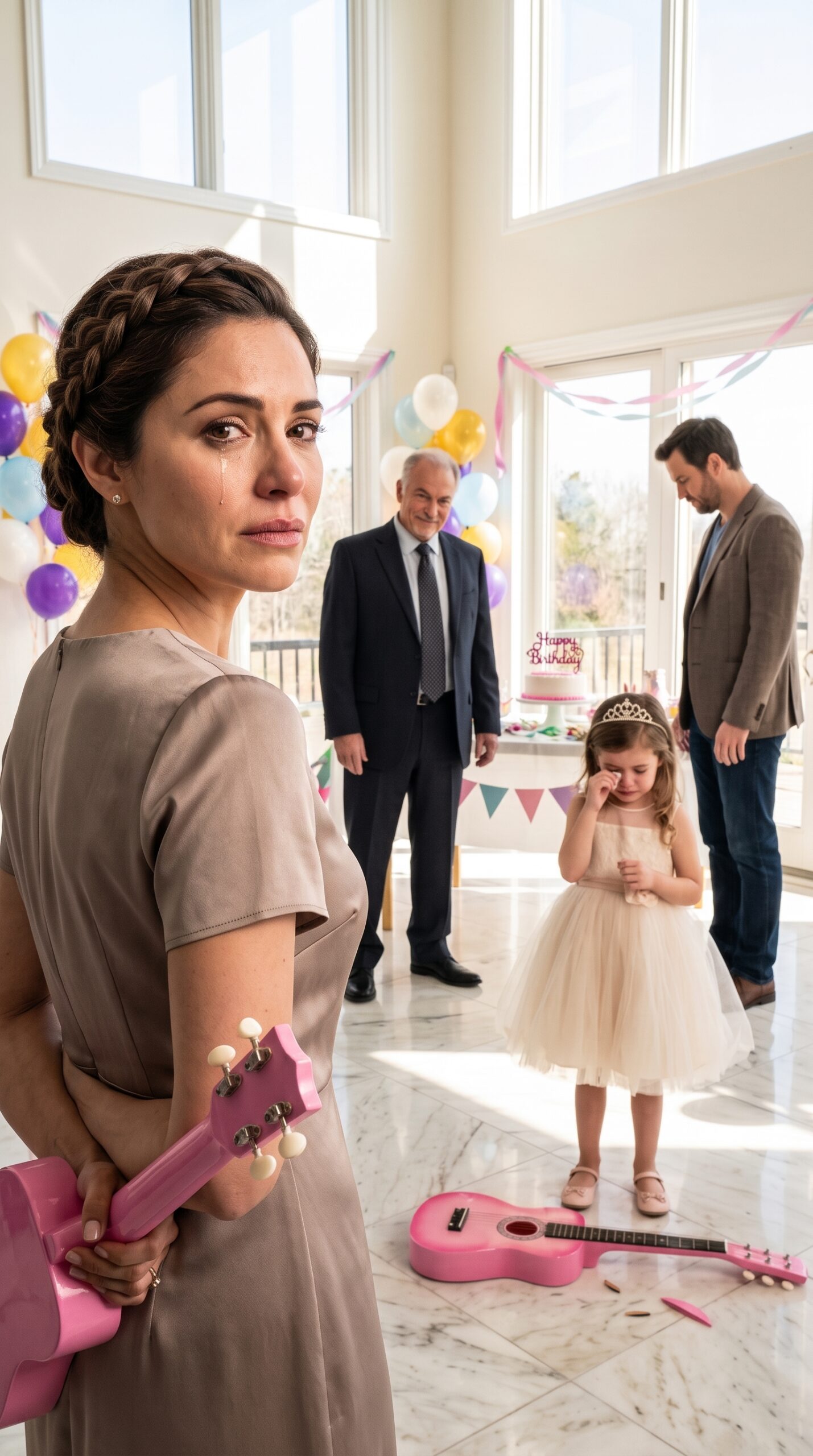
Lía burst into the Valdés estate’s living room, her smile so wide that even the workers paused in their task of arranging chairs to see her.
She was six years old, with two crooked braids and a pink dress that her mom, Mariana, had ironed with all the love in the world that morning.
The little girl clutched a small, polished guitar, its neck adorned with a red ribbon.
Daniel, her dad, watched from the entrance, a nervous smile on his face.
He had secretly bought it at a shop in downtown Guadalajara, fully aware that his father, don Evaristo Valdés, despised anything that didn’t display wealth, lineage, or power.
That Sunday, the entire family had gathered at the estate in Tequila, Jalisco, to celebrate Don Evaristo's 82nd birthday.
There was mariachi music, food, expensive bottles of liquor, and relatives who smiled in your face while tearing you apart behind your back.
Lía didn’t understand those things.
She just wanted to show her grandfather the most beautiful gift she had ever received.
—Grandpa, when I grow up, I’m going to play on stage — she said, moving closer to him.
Don Evaristo sat in his leather armchair, his silver cane resting on his leg, with his eldest daughter, Renata, standing beside him like a shadow.
The old man didn’t smile.
His eyes swept over the guitar as if it were nothing but trash.
—Who put that idea in your head? — he asked.
Lía froze.
—No one. I want to learn.
Mariana, who stood by the dessert table, felt a knot form in her throat.
She recognized that tone.
It was the same tone with which Don Evaristo had humiliated waiters, nephews, employees, and even his own son Daniel for years.
—Dad, it’s just a guitar — Daniel said, trying to sound calm.
Don Evaristo lifted his gaze.
—That’s why you are the way you are. You think life can be fixed with ridiculous details.
The room fell silent.
Lía clutched the guitar tighter.
—But I like it, Grandpa.
That seemed to infuriate him even more.
Don Evaristo stood up slowly. Everyone thought he was going to scold her.
No one imagined what he would do next.
He ripped the guitar from her hands.
Lía let out a scream.
—No! It’s mine!
The old man lifted the instrument and smashed it against the cantera floor.
The wood splintered with a dry, cruel sound, as if something alive had been crushed.
A string snapped and grazed the girl’s cheek.
Lía froze.
Then she began to cry silently, staring at the shattered pieces of her dream strewn among the family’s expensive shoes.
—Useless girls don’t need dreams — said Don Evaristo. — They need to learn their place.
Mariana felt her chest ignite in anger.
Daniel lowered his gaze.
And that hurt more than the blow to the guitar.
—Apologize to my daughter — Mariana said.
Her voice came out low, icy.
Renata laughed.
—Oh, Mariana, don’t put on your little act. Dad is just correcting the girl.
Don Evaristo shot her a disdainful look.
—You don’t give me orders in my house. You came here because my son got infatuated with a music teacher from the neighborhood.
Several relatives looked away.
No one defended the girl.
No one defended Mariana.
She walked to the floor, bent down, and picked up a broken tuning peg from the guitar.
She tucked it into her bag like it was evidence.
Don Evaristo scoffed.
—What are you going to do with that? Cry on Facebook?
Mariana lifted Lía, who trembled against her neck.
Then she looked at Daniel.
—Aren’t you going to say anything?
Daniel clenched his jaw.
—Mariana, don’t make this bigger.
In that moment, she realized that her husband wasn’t weak by accident.
He was obedient out of habit.
Don Evaristo smiled, convinced he had won.
But Mariana leaned closer to his ear and said something only he could hear:
—You just broke the only thing you shouldn’t have touched.
The old man frowned.
Then Mariana left the living room, carrying her daughter.
And while everyone thought she was leaving defeated, she opened her bag and checked a folder she had kept hidden for three years.
PART 2
The next morning, Don Evaristo had breakfast in the main corridor of the estate as if nothing had happened.
In front of him were coffee, sweet bread, orange juice, and newspapers folded exactly the way he liked.
Renata was reviewing some documents with a stern smile.
Daniel sat at the back, not touching his plate.
Mariana arrived, holding Lía’s hand.
The girl had a small scratch marking her cheek, but her eyes were dry.
That broke the soul more than seeing her cry.
—I’m glad you came down — Don Evaristo said. — I’ve made a decision.
Mariana didn’t respond.
—The girl will stop music lessons. I’m also going to sell the piano from your apartment. Those silly things only make her sassy.
—That piano is mine — Mariana said.
Don Evaristo let out a laugh.
—Everything this family touches ends up being mine.
Renata pushed a folder across the table.
—Sign this and let’s avoid embarrassment.
Mariana opened it.
There were papers from a private boarding school in Mexico City, educational authorizations, family decision cessions, and a clause to limit Lía's interaction with her mother if Mariana “disrupted the minor’s emotional order.”
It was a perfect trap.
Or so they thought.
—You wanted to send her away? — Mariana asked.
—We wanted to correct her — Renata replied. — Before she ends up just like you, believing that singing and playing guitar is a future.
Daniel murmured:
—Mariana, maybe it’s best to calm down for a few days.
She looked at him with a sadness that made him lower his head.
—Yesterday your daughter needed you for one minute. Just one. And you didn’t even give her that.
Daniel couldn’t respond.
Don Evaristo slammed his cane on the table.
—Sign.
Mariana closed the folder.
—No.
The old man smiled slyly.
—Then you’ll leave without my son, without my support, and without a penny. Let’s see how long you last with your bravado.
Mariana pulled out her cellphone.
—It’s going to last a long time, Don Evaristo.
She played an audio.
Renata’s voice filled the corridor.
—We need to pressure Daniel. If Mariana stays close to the girl, Grandma Carmen's influence will never die. Dad says we need to break Lía from a young age.
Don Evaristo stood frozen.
Daniel lifted his face.
—What is that?
Mariana stopped the audio.
—Just a part.
Renata turned pale.
—That’s illegal.
—Ilegal is forging authorizations to take my daughter away — Mariana replied. — And diverting funds from a foundation to pay for your trips to Miami, too.
Silence fell heavily.
Don Evaristo narrowed his eyes.
—You don’t know anything.
Mariana pulled out the folder she had been keeping for three years.
She placed it on the table.
—I know more than what’s good for you.
There were notarized copies, account statements, printed emails, modified contracts, and a clause from Doña Carmen’s will, the late wife of Don Evaristo.
Carmen Valdés had been the only person in that family who treated Mariana with respect.
She had also loved music.
In her youth, she played guitar at town parties until Evaristo forced her to stop because, according to him, “a decent woman doesn’t put on a show.”
That’s why, before she died, Carmen did something no one expected.
She created the Lía Valdés Foundation to support the artistic education of girls from rural communities.
And she left several shares of the family tequila business under temporary administration.
But there was one condition.
If Don Evaristo, Renata, or any heir threatened Lía’s emotional, educational, or property well-being, they would automatically lose control of those shares.
Don Evaristo read the first page, and his face changed for just a second.
Then he feigned confidence.
—That’s worthless.
—It’s notarized in Guadalajara — Mariana said. — And since yesterday, there are 12 witnesses, security cameras, and a girl with a mark on her face.
Daniel stood up slowly.
—Did Mom do all that?
Mariana nodded.
—Your mom knew who your father was. She also knew that you wouldn’t always have the courage to face him.
The phrase hit like a slap.
Daniel covered his mouth with a hand.
Renata tried to snatch the folder, but Mariana pushed her away.
—Don’t you dare.
Don Evaristo stood up.
—You won’t destroy my name.
Mariana looked him straight in the eye.
—No. You did that yourself when you confused family with property.
That afternoon, Don Evaristo summoned his lawyers and partners at the Valdés tequila company’s offices near Guadalajara.
He wanted to close the matter before it became a scandal.
He arrived in a gray suit, silver cane, and that old patriarchal look that expected everyone to square up.
But upon entering the conference room, his expression changed.
Mariana was already seated at the back.
Beside her was a notary, two external auditors, and a bank representative.
Daniel was there too, with red eyes, as if he hadn’t slept.
Renata entered behind her father, nervous but still haughty.
—This is nonsense — she said. — A music teacher can’t come here to give orders in the company.
The notary lifted her gaze.
—Mrs. Mariana isn’t giving orders. She’s presenting evidence.
Don Evaristo let out a dry laugh.
—Evidence of what?
The screen turned on.
Transfers from the Lía Valdés Foundation to Renata’s personal accounts appeared.
Inflated invoices for supposed cultural events that never existed.
Diverted donations.
Emails where Don Evaristo ordered to “clean” movements before audits.
The room froze.
Renata lost color.
—Dad, you said that was sorted out.
It was the worst phrase she could have said.
Everyone heard it.
Daniel shut his eyes.
Don Evaristo turned to her in fury.
—Shut up!
Mariana didn’t raise her voice.
—Doña Carmen left money for girls who couldn’t afford music lessons. You used it to sustain your whims and Renata’s.
—Lies — he growled.
The auditor slid another folder across the table.
—It’s not a lie. It’s accounting.
The bank representative spoke firmly.
—By activation of the fiduciary clause, the shares under Don Evaristo Valdés’s administration pass to the control of the Lía Valdés Foundation. Mrs. Mariana remains as legal administrator until the minor reaches adulthood.
Don Evaristo stared at the papers.
For the first time, he didn’t know what to say.
Renata began to cry.
Not out of remorse.
Out of fear.
—Mariana, we can fix this — she pleaded —. Really, think of the family.
Mariana remembered Lía looking at her broken guitar on the floor.
She remembered Daniel being silent.
She remembered all the times Don Evaristo called his deceased wife “an ornament,” art “a whim,” and anyone who felt “weak.”
—Family doesn’t mend itself by stealing dreams — she said.
In that moment, two police officers entered the room with a judicial order.
Don Evaristo gripped his cane tightly.
—Did you do this?
Mariana stood up.
—No. You did. I just stopped covering for you with silence.
The officers asked him to accompany them.
Renata stepped back, crying louder.
—Dad…
Don Evaristo glared at Mariana with hatred.
—You’ve destroyed this family.
She shook her head slowly.
—No. You broke it long before the guitar.
Daniel approached as the officers led his father away.
—Mariana…
She didn’t move.
—Forgive me — he said, his voice cracking —. I was a coward.
Mariana looked at him for several seconds.
She had loved that man.
She had believed that behind the fear, there was still a father capable of protecting his daughter.
But love could no longer be an excuse to allow harm.
—Forgiveness might come someday — she replied. — Trust isn’t signed like a contract.
Daniel lowered his head.
She walked out without looking back.
Lía didn’t know all the details that day.
Mariana only told her that no one would send her away again, that her broken guitar hadn’t been the end, and that her grandmother Carmen had left a light on for her.
Months later, the Valdés estate changed completely.
The room where Don Evaristo had humiliated his granddaughter ceased to be a museum of power.
It became a free music school for girls from nearby towns.
At the entrance, they placed a cantera plaque:
“Lía Valdés Foundation. In memory of Carmen, who never stopped hearing songs from within.”
Don Evaristo faced trial for fraud and embezzlement.
Renata lost her position, her accounts were frozen, and many of the relatives who once flattered her stopped answering her calls.
That’s how people are when power runs out.
Daniel started therapy and asked to see Lía on weekends.
Mariana agreed, but with a clear condition: respect or distance.
Nothing more.
Nothing less.
One afternoon, at the foundation’s first festival, Lía stepped onto a small stage with a new guitar in her arms.
It had the same red bow as the broken guitar.
The audience was filled with girls, mothers, teachers, neighbors, and even employees from the old estate.
Mariana sat in the front row.
Daniel watched from the back, silently crying.
Lía approached the microphone.
—This song is for my Grandma Carmen — she said —. And for all the girls whom someone told they couldn’t dream.
No one breathed for a few seconds.
Then the girl played the first note.
It wasn’t perfect.
It was better than that.
It was free.
Mariana cried without hiding.
Because she understood that her victory hadn’t been about taking a company from a cruel old man.
Her victory was teaching her daughter that when someone tries to crush your dreams on the floor, sometimes that noise awakens the woman who comes to defend you with everything.