PART 1
Eugenio Alarcón was 61 years old, a fortune many envied, a massive house in Bosques de las Lomas, and a marble table that seated 20 without crowding.
But that Christmas Eve, no chair was occupied.
The house smelled of natural pine, fine wax, and reheated cod that the cook had left in containers with perfectly labeled lids.
In the living room, a tree nearly 13 feet tall sparkled with golden ornaments, elegant bows, and imported lights.
Everything looked beautiful.
Everything felt dead.
Eugenio stood at the entrance, still wearing his coat, gazing at the decorations that no one from his blood had touched.
Since Clara, his wife, had died, December had become a kind of punishment.
Clara had left four years earlier, after an illness that started as fatigue and ended up robbing her of her voice, her body, and her laughter.
They had been married for 34 years.
They never had children.
Not because they didn’t want to.
On the contrary.
They had talked about adopting, about painting a room yellow, about taking a child to Chapultepec, about teaching him to ride a bike.
But there was always something first.
A meeting.
An expansion.
An urgent call from Monterrey.
A new hospital buying their medical equipment.
A politician wanting a photo.
Eugenio always said:
—Next year, Clara.
And next year arrived without her.
That night, his nephew Tomás texted him from San Miguel de Allende:
“Uncle, come over. Don’t stay alone. Really, there’s room here.”
Eugenio replied:
“I have work pending.”
A lie.
He had nothing.
At 8:35 PM, he took the keys to his car and left without a driver. He drove aimlessly down Paseo de la Reforma, watching families take photos, children in red hats, and couples carrying bags of gifts.
Every light seemed to remind him that money could buy decorations, but not a voice saying, “Come sit down, dinner’s getting cold.”
He ended up in front of an old café near Alameda Central.
It was called El Farolito.
It had fogged-up display cases, a silent jukebox, and a flickering sign that blinked as if it too were tired.
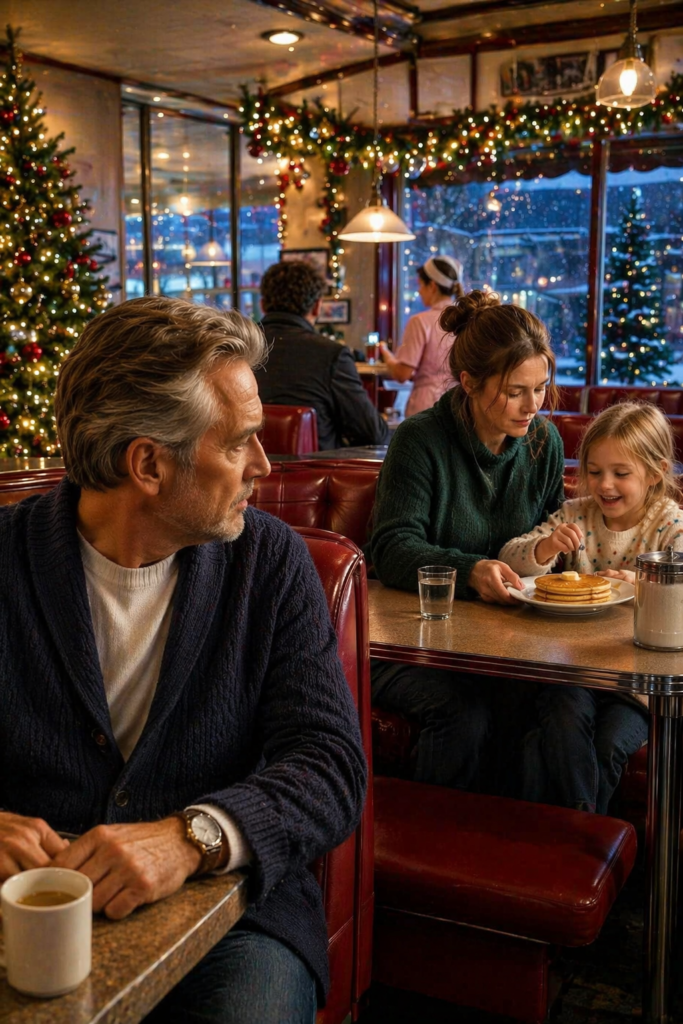
He entered, ordered an American coffee, and sat in a corner.
From afar, anyone would have thought he was an important man.
Cashmere coat, Swiss watch, immaculate shoes.
Up close, he was just a rich old man who didn’t know where to return.
The café was almost empty.
A driver ate chilaquiles.
A woman watched a soap opera without sound.
A young man waited for his takeout.
Then the little bell at the door rang.
A young woman entered with a girl.
The woman looked to be in her early thirties. She wore a worn gray sweater, a thin jacket, and wet shoes at the tips.
Her dark hair was tied up haphazardly, as if she had to choose between combing her hair or not crying.
The girl, about seven years old, wore a pink scarf, a purple backpack, and old boots.
She looked at the plastic Christmas tree by the register as if she had just seen something magical.
The woman didn’t walk like a customer.
She walked like someone who asked for permission to exist.
Doña Meche, the waitress, smiled at them.
—Come in, dear. We don’t charge for sitting.
They sat two tables away from Eugenio.
He tried not to look.
But the woman took out a small bag of coins.
She counted them.
Then counted them again.
The girl remained quiet, with that educated sadness of children who have learned that being hungry can also be shameful.
Doña Meche arrived with the menu.
The woman pointed to the cheapest option.
—One order of pancakes and one glass of milk, please.
—And what will you have for dinner, dear?
The woman smiled quickly.
—Nothing, thanks. I’ve already eaten.
Eugenio felt that lie squeeze his chest.
He had heard lies from partners, lawyers, and officials.
But this one was different.
It was a mother’s lie.
When the plate arrived, the woman cut the pancakes into small pieces, barely added syrup, and pushed it all toward the girl.
—Eat, Sofi. Before it gets cold.
The girl picked up the fork but stopped.
—And you, Mom?
—I’ve already eaten, my love.
The girl began to eat slowly.
Then with desperation.
Too hungry to hide it.
Eugenio called Doña Meche.
—Bring that lady a full dinner. The best you have. Turkey, soup, bread, whatever. Charge it to me.
—Should I tell them it was you?
—No.
Doña Meche looked at him with those eyes of a woman who had seen more sadness than news.
—Of course I’ll tell them.
And before Eugenio could stop her, she placed in front of the woman a huge plate of turkey, hot soup, rice, salad, and sweet bread.
The woman was startled.
—No, sorry, this isn’t ours. I can’t pay for it.
Doña Meche pointed at Eugenio.
—The gentleman has already paid. And today, on my shift, no one leaves hungry.
The woman slowly turned.
Her eyes met Eugenio’s.
She tried to smile to thank him, but her mouth broke.
She lowered her head and cried silently, while her daughter looked at the plate as if a miracle had just occurred.
Eugenio thought that was where it would all end.
Until the girl stood up, walked to his table, and asked with an innocence that shattered the soul:
—Sir, why are you eating alone if today is Christmas?
PART 2
The mother stood up abruptly, her face flushed with embarrassment.
—Sofía! I’m sorry, sir. I really apologize. My daughter didn’t mean to bother you.
Eugenio looked at the girl.
She had wide, transparent eyes, filled with a curiosity that sought no harm.
There was no mockery.
Just truth.
And truth, when it comes from a child’s mouth, doesn’t ask for permission.
—You didn’t bother me —Eugenio replied—. She’s right. I’m alone.
Sofía squeezed her backpack against her chest.
—My mom says no one should eat alone on Christmas.
The woman closed her eyes, as if that phrase had left her naked in front of everyone.
—Let’s go, daughter.
But Eugenio spoke before they could walk away.
—Where are you going to go?
The woman froze.
The question fell on her back like a cold hand.
—We’re fine.
Eugenio recognized that lie.
It wasn’t meant to deceive.
It was meant to hold on.
—Ma’am —he said calmly—, I don’t want to offend you. It’s cold, it’s late, and your daughter is tired. If you need help, I can give it to you without asking for anything in return.
She looked at him harshly.
—I don’t need pity.
—And I don’t need to feel like a saint for paying for dinner.
Her response disarmed her a little.
Doña Meche pretended to clean the counter, though she listened to everything.
The woman looked at Sofía, then at the door, then at the untouched plate in front of her.
Outside, the city continued with its noise of cars, stalls closing, and people rushing to dinners where they were indeed awaited.
—I’m Valeria Morales —she finally said—. This is Sofía.
—Eugenio Alarcón.
Valeria blinked.
She knew that last name.
Alarcón Technology Clinical appeared in private hospitals, business conferences, and economic news.
It was one of those names that ordinary people hear as if it belonged to another planet.
—My husband died 11 months ago —Valeria said, lowering her voice—. His name was Andrés. He was a maintenance technician at a hospital in Satélite. They asked him to cover an extra shift because a colleague was absent. He left the house and never returned.
Sofía looked down.
Eugenio felt a silent blow.
—I’m very sorry.
Valeria tightened the napkin.
—After that, everything fell apart. The rent, the school, the bills. I did designs for small businesses and cleaned apartments in Roma, but it wasn’t enough. Andrés’s mother started saying he had killed himself working because of me.
Her voice cracked, but she continued.
—Three weeks ago, she kicked us out of the room where we lived. She said the house belonged to her son, not to me. She took his tools, his laptop, papers from the insurance, and even a box where I kept Sofi’s documents.
—And your family? —Eugenio asked.
Valeria let out a humorless laugh.
—My mom died. My dad has another family in Toluca. My sister told me that if I wanted to be a mom so much, then I should try harder.
Sofía, without lifting her face, murmured:
—We slept in the car for five nights.
Valeria covered her mouth.
—Sofi, don’t say that.
—But it’s true, Mom.
The word hung in the air.
Truth.
Eugenio thought of the seven empty bedrooms in his house, the heating turned on for no one, the refrigerator full of food that would probably end up thrown away.
And in front of him was a mother who had bought one plate with her last coins.
—You are not a bad mother —Eugenio said firmly—. A bad mother would eat first and leave her daughter watching. You are doing the impossible.
Valeria let out a broken laugh.
—The impossible doesn’t pay rent.
—Tonight it does.
Eugenio took out his phone.
—Ramiro, sorry for calling you on Christmas Eve. I need one room at the Hotel Reforma Imperial under Valeria Morales’s name. Yes, now. Charge it to my personal account. Also, send clean clothes for a seven-year-old girl and her mom. Not tomorrow. Today.
Valeria looked at him as if he had just spoken in Chinese.
—I can’t accept this.
—You can argue with me tomorrow. Today your daughter needs to bathe in hot water and sleep in a bed.
—Why would you do this for us?
Eugenio looked at his cold coffee.
He could say it was because he had money.
He could say it was because it was Christmas.
But he chose the heavier truth.
—Because my wife and I wanted to adopt. I always thought there would be time. Then she died. Since then, I have a house full of empty rooms and no one to ask me if I’ve had dinner yet. Today, I saw you lie so your daughter could eat without guilt. And I understood that I wasn’t alone due to bad luck. I was alone because I left what was important for later.
Valeria cried silently.
Sofía watched him seriously.
—Is your wife in heaven with my dad?
Eugenio swallowed hard.
—I hope so.
—Then maybe they’re friends now.
For the first time all night, Eugenio smiled.
Half an hour later, a driver arrived. Valeria walked towards the car with the distrust of someone who has learned that favors almost always come with a price.
Eugenio noticed it.
—Valeria, this doesn’t obligate you to anything.
She stopped.
—People with money always say that. Then they charge with interest.
The phrase could have offended him.
But it didn’t.
It was fair.
—Then let’s set some rules —he said—. You decide what to accept. You decide for your daughter. And if one day you want me to disappear, I will disappear.
Valeria looked at him for a long time.
—Okay. But don’t treat me like a poor thing.
—Deal.
When they arrived at the hotel, Sofía stood at the entrance of the room.
There were two huge beds, white towels, heating, and a basket of fruit.
—Mom… can we touch the beds?
Valeria broke down.
She knelt and hugged her daughter so tightly that Eugenio had to look out the window to not invade that pain.
That night, Sofía bathed in hot water, had sweet bread for dinner in a hotel robe, and fell asleep hugging a pillow almost bigger than she was.
Valeria couldn’t sleep.
At 2:40 AM, she went to the small living room and found Eugenio looking at the city lights.
—I don’t want to owe you my life —she said.
—You don’t owe me.
—Then help me get it back. Not replace it.
Eugenio understood something at that moment.
Valeria didn’t need a savior.
She needed solid ground.
On December 27, a trusted lawyer of Eugenio reviewed the documents that Valeria still had in her email.
There appeared the first blow.
Andrés had indeed left insurance.
It wasn’t a fortune, but it was enough to pay debts, rent for a year, and Sofía’s school.
The problem was that the mother-in-law, Doña Griselda, had hidden the notification and was trying to collect it with an old letter where she appeared as the provisional beneficiary.
Valeria went cold.
—She knew Sofía was sleeping in a car.
Eugenio’s face hardened.
—Then this is no longer poverty. It’s abuse.
The lawyer requested a meeting.
Doña Griselda arrived with her daughter Brenda, both very dressed up, very perfumed, and with that cruel assurance of someone who believes shame always falls on the weakest.
—Look at you, Valeria —Brenda said as soon as she saw her—. You found someone to keep you. How quickly your tears dried up for my brother.
Valeria went pale.
Eugenio was about to speak, but she raised her hand.
—No. This time I’ll answer.
Doña Griselda let out a dry laugh.
—You? You couldn’t even feed my granddaughter.
Valeria trembled.
But she didn’t bend.
—That’s exactly why I came. So a judge can hear how you hid Andrés’s insurance while your granddaughter was sleeping in a car.
The mother-in-law lost color.
Brenda tried to laugh it off.
—Oh please, what a cheap novel.
Then the lawyer put copies of emails, calls to the insurance company, and a recording where Griselda said:
—Don’t tell Valeria anything. That girl is going to waste the money. I’ll handle it better.
The silence became unbearable.
Sofía wasn’t there.
Thank God.
Because the truth was crueler than hunger.
Doña Griselda had not only hidden the insurance. She had also sold Andrés’s tools and withdrawn money from an account where Valeria kept savings for her daughter’s school.
—It was my son’s money —Griselda spat.
—It was your granddaughter’s future —Valeria replied.
The complaint progressed.
Griselda had to return part of the money, hand over documents, and sign an agreement to not approach Valeria or Sofía without authorization.
When they left the office, Valeria didn’t celebrate.
She cried.
Not for the money.
She cried because she understood that the people who should have supported her had pushed her deeper.
Eugenio walked beside her without saying anything.
—Don’t say something nice —she asked—. I can’t today.
—I wasn’t going to say anything.
—Thank you.
In January, Valeria got a job at the Alarcón Foundation.
Not because Eugenio hired her out of pity.
She got in because she presented a portfolio of community campaigns, school designs, videos for small businesses, and proposals that left the entire table silent.
She was interviewed by Jimena, the Human Resources director, a woman who wasn’t impressed even by wealthy last names.
—You have talent —she told her—. And you have street smarts. That’s what we need here.
Valeria accepted with one condition.
—I don’t want anyone to see me as the lady that Don Eugenio rescued.
Jimena smiled.
—Then work so well that they stop being nosy.
And that’s what she did.
Valeria arrived early, learned quickly, and began designing campaigns for single mothers, children’s scholarships, and emergency support for employees in crisis.
Eugenio watched her from afar.
He didn’t show her off.
He didn’t protect her from everything.
He learned to respect her process, even though it cost him at times.
Sofía entered a primary school near the small apartment that Valeria rented with the recovered money and a temporary support that she accepted only for three months.
On the first morning, before entering, the girl asked:
—Can Don Eugenio come to pick me up one day?
Valeria fell silent.
Eugenio, who had accompanied them to the door, knelt in front of the girl.
—Only if your mom says yes.
Sofía smiled.
—My mom is in charge.
—That’s already clear to me, shorty.
As the months passed, Eugenio stopped being “the man from the café.”
He went to the Mother’s Day festival.
He clapped too much.
He learned to make crooked ponytails.
He discovered that second-grade homework could defeat any businessman.
One day, Sofía gave him a drawing.
It was El Farolito.
At one table sat her mom.
At another sat him.
Outside were Christmas lights.
Above, in crooked letters, it read:
“THE NIGHT WE FOUND DON EUGENIO.”
He framed the drawing and hung it in his office, next to international awards.
A company advisor saw it and asked:
—What’s that?
Eugenio replied:
—The most important contract of my life.
No one understood.
He didn’t care.
A year passed.
The next Christmas Eve, they returned to El Farolito. Doña Meche greeted them with hugs and coffee, as if they had always been family.
Valeria no longer entered measuring whether she had the right to sit.
Sofía wore a red coat and talked nonstop.
Eugenio ordered American coffee, just like that first night.
—Do you remember? —Sofía asked—. You were alone.
—I remember.
—And my mom said she had already eaten, but it was a lie.
Valeria lowered her gaze, between shame and tenderness.
Eugenio took her hand on the table.
—that lie saved me.
She looked at him confused.
—No. You saved us.
—No, Valeria. I had a house, money, a driver, a business. But I had no one to come home to. You taught me that a life full of things can also be empty.
Sofía, who understood more than adults imagined, asked:
—So we all saved each other?
Eugenio smiled with wet eyes.
—Yes, my girl. All of us.
Years later, when Valeria and Eugenio married in a small ceremony, no one spoke of a fairy tale.
Because it wasn’t.
It was a story of hunger, mourning, family abuse, wounded pride, and difficult choices.
Sofía carried a locket with Andrés’s photo because Valeria never allowed a new love to erase the father who had left.
After the wedding, Eugenio knelt before the girl.
—I want to ask you something. Not to replace your dad. He will always be your dad. But if one day you want, it would give me great pride to adopt you too.
Sofía cried before answering.
—I want to. Because my dad is in heaven… but you come when there are school meetings.
Everyone laughed while crying.
Even Doña Meche, the guest of honor, wiped her eyes with a napkin and said:
—Oh come on, you ruined my mascara.
Since then, every Christmas Eve they returned to the same café.
Not to take photos.
Not to show off kindness.
Not for people to say “how nice.”
They returned to remember that family doesn’t always come with blood, last names, or perfect plans.
Sometimes it comes with one plate of pancakes.
With a mother lying so her daughter doesn’t feel guilt.
With a girl asking why a man eats alone.
And with a man who had millions but needed to lose almost everything inside to understand that true luxury isn’t a mansion full of decorations.
It’s having someone save you a seat at the table.