PART 1
The sound of water hit the ground long before Julián crossed the gate of the family home in Cuernavaca.
It wasn’t the gentle sound of someone watering bougainvilleas.
It was a sharp, violent thud against the patio floor.
Julián had come from Mexico City, his shirt wrinkled, a suitcase in one hand and a black folder under his arm. He had advanced his return by two days without notifying anyone.
And then he saw her.
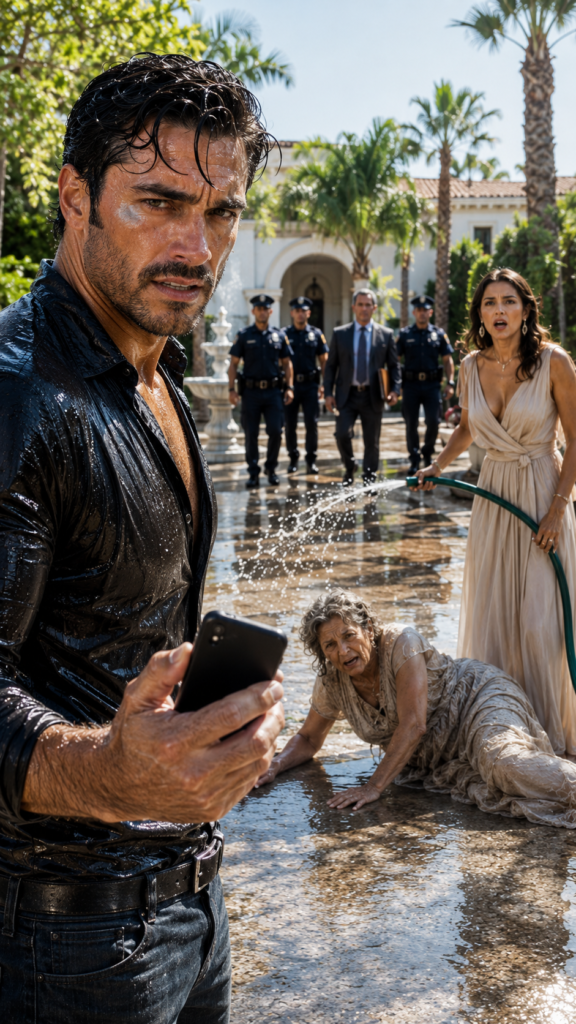
His mother, Doña Teresa, lay sprawled on the wet tiles, her nightgown clinging to her body, her hair soaked, hands trembling in the mud.
Since the stroke a year ago, she hadn’t been able to move her legs.
Before her stood Marcela, the woman who had been his father's mistress, wielding a green hose like a punishment.
—Come on, move it, you useless old woman! —Marcela shouted—. I’m fed up with your martyr act.
Doña Teresa tried to lift her head.
Her eyes found Julián’s.
She didn’t ask for help. She didn’t scream. She just looked at him with a shame that shattered his soul.
—Son… —she whispered.
Marcela turned slowly.
Upon seeing him, she didn’t turn off the hose.
On the contrary, she smiled with that venomous confidence she had been wielding for months inside that house.
—Look who’s back —she said—. The big-shot lawyer has returned. What happened, Julián? Did you get bored playing successful in the capital?
Julián set the suitcase down next to the empty fountain.
He didn’t run. He didn’t scream.
He just stared at his mother soaked on the floor.
His father, Don Arturo, had died four months earlier. Before he died, Marcela moved into the house, claiming she had rights, papers, and promises.
She insisted Arturo had left her the property.
She said Teresa was a burden.
She said Julián didn’t have the guts to throw her out.
For months, he had listened in silence.
Marcela thought that silence was fear.
How wrong she was.
—Turn off the water —Julián said.
Marcela laughed.
—And if I don’t? Are you going to report me? What proof do you have, dumbass?
Julián looked up at the ceiling of the corridor.
A tiny black camera blinked, hidden among the wooden beams.
Marcela didn’t even notice it.
She never saw what mattered.
Julián pulled out his phone and pressed a single button.
—I don’t need new evidence —he replied—. I just needed you to keep talking.
Marcela's smile froze.
At that moment, the electric gate began to open.
The metallic noise filled the patio like a sentence.
Marcela furrowed her brow.
—Who did you call?
Julián knelt next to his mother, brushed the wet hair from her face, and draped his jacket over her shoulders.
—All the people who’ve been waiting for you to make a mistake in front of a camera for weeks.
Marcela lowered the hose.
But the water kept flowing.
And it was too late.
PART 2
First, two paramedics entered.
Then a woman in a dark suit, her hair pulled back, and a serious expression appeared. She was Licenciada Araceli Mendoza, a Public Prosecutor specializing in domestic violence.
Behind her came two investigative officers and a notary public with a brown briefcase.
Marcela stepped back a step.
Just one.
Then she lifted her chin, as if the house still obeyed her.
—This is illegal —she spat—. You’re entering my property.
The notary opened the briefcase slowly.
—that’s still up for clarification, Mrs. Marcela Ríos.
She glared at Julián with hatred.
—Your father left me this house. I have a signed will.
Julián helped the paramedics carefully lift Doña Teresa. They wrapped her in a thermal blanket and seated her in a special chair.
Doña Teresa wouldn’t stop shaking.
Not from the cold.
From humiliation.
Marcela had done this countless times, but never in front of witnesses.
Or so she thought.
—Of course you have a will —Julián said—. I saw it myself.
Marcela smiled just a little, as if she had regained control.
—Then get this crowd out of my house. And take your mother to a nursing home, where she should have been from the start.
The patio fell silent.
Even the paramedics stood still.
Doña Teresa lowered her gaze.
Julián clenched his jaw.
—Don’t ever talk about my mother like that again.
Marcela approached slowly, soaking her heels.
—Oh, please. Your mom has been pathetic for years. Your father didn’t want her anymore. He chose me.
Licenciada Araceli lifted a tablet.
—Mrs. Marcela Ríos, we have seven weeks of recordings showing abuse, threats, isolation, medical neglect, and possible improper administration of medication against Mrs. Teresa Salgado.
Marcela laughed, but her laughter came out broken.
—Recordings? From whom? That woman can't even hold a spoon.
—Not her —Julián said—. But I was able to install cameras when I came to check on the roof’s humidity.
Marcela looked up at the beams.
For the first time, she understood.
Her eyes swept the corridor, the flower pots, the fountain, the kitchen entrance.
The house she had used as her kingdom had become a witness.
—You were spying on me —she said.
—I was letting you talk —Julián replied—. And boy, did you overshare.
Licenciada Araceli swiped her finger across the tablet.
—We also have audio where you say that Mrs. Teresa “wouldn’t last long” if her medications were reduced.
Doña Teresa closed her eyes.
It hurt Julián to see her like this, but he wouldn’t allow himself to break.
The worst was yet to come.
Marcela pointed at the notary.
—He can’t do anything. Arturo signed. The house is mine.
The notary pulled out several stamped pages.
—The document you presented has alterations.
Marcela paled.
—That’s a lie.
Julián opened the black folder.
Inside were certified copies, bank statements, fake receipts, and printed messages.
He had spent months gathering it all.
While Marcela mocked him for “being busy in the capital,” Julián had worked with banks, doctors, lawyers, and neighbors.
He learned to swallow his rage to turn it into a file.
—My father didn’t leave you the house —Julián said—. He left you a monthly pension conditional on your respecting and caring for my mother.
Marcela shook her head.
—No.
—Yes —the notary said—. The property was placed under the administration of Mr. Julián Ortega, with a life estate for Mrs. Teresa Salgado. Anyone who engaged in abuse, coercion, or negligence against her would lose all benefits.
Marcela opened her mouth, but no words came out.
The hose lay discarded on the floor.
Water trickled between her expensive shoes.
Julián pulled out another page.
—Besides, you forged a clause. You fired the nurse. You changed the locks. You blocked my calls to the landline. And you moved money from my mother’s medical account to yours.
—You can’t prove that.
Licenciada Araceli lifted some screenshots.
—The bank provided the transactions this morning. We also have messages from you to a friend bragging that “the cripple costs more alive than dead.”
Marcela's face crumbled.
Doña Teresa clutched her chest.
—Oh my God...
Julián leaned toward her.
—It’s over, Mom. She can’t hurt you anymore.
But Marcela wasn’t ready to fall.
She fixed her wet hair and smiled desperately.
—You all think Arturo was a saint. But he begged me to stay. He said Teresa disgusted him.
Doña Teresa opened her eyes.
This time, there was no shame.
Only pain.
An old pain.
One Julián didn’t know.
—You’re lying —he said.
Marcela looked at him maliciously.
—Didn’t you know? Your dad was going to leave you out too. He said you were too soft to handle money. That you would spend it all taking care of this woman who was half dead already.
The blow was low.
And still, Julián didn’t move.
Then Doña Teresa spoke.
Her voice came out weak but clear.
—Arturo didn’t love you, Marcela.
The mistress turned towards her in rage.
—Shut up.
—He was afraid of you —Teresa continued—. And guilty. Because you threatened to destroy his reputation if he didn’t let you into this house.
Marcela gritted her teeth.
—Old fool.
Julián raised his hand.
—Don’t talk to her like that.
Doña Teresa took a deep breath.
—Your father called me three days before he died. He cried. He apologized. He said he had signed papers under pressure. He said Marcela had recordings of him, of his mistakes, of his shames.
Julián froze.
That part wasn’t in the file.
Marcela swallowed hard.
The notary looked at Julián.
—That explains why Mr. Arturo requested a review of all documents shortly before passing away.
Licenciada Araceli moved in closer.
—Mrs. Marcela, would you like to explain those threats?
Marcela let out a dry laugh.
—Now you believe a cripple?
That was the moment everything changed.
Not because of the evidence.
Not because of the cameras.
But by the way Doña Teresa lifted her face.
For months, Marcela had treated her like furniture, like a nuisance, like garbage.
But that afternoon, in front of everyone, Teresa stopped hiding.
—I can’t walk —she said—. But I heard everything. I kept it all right here.
With trembling hands, she pointed to her chest.
Then she looked at Julián.
—And I also kept this.
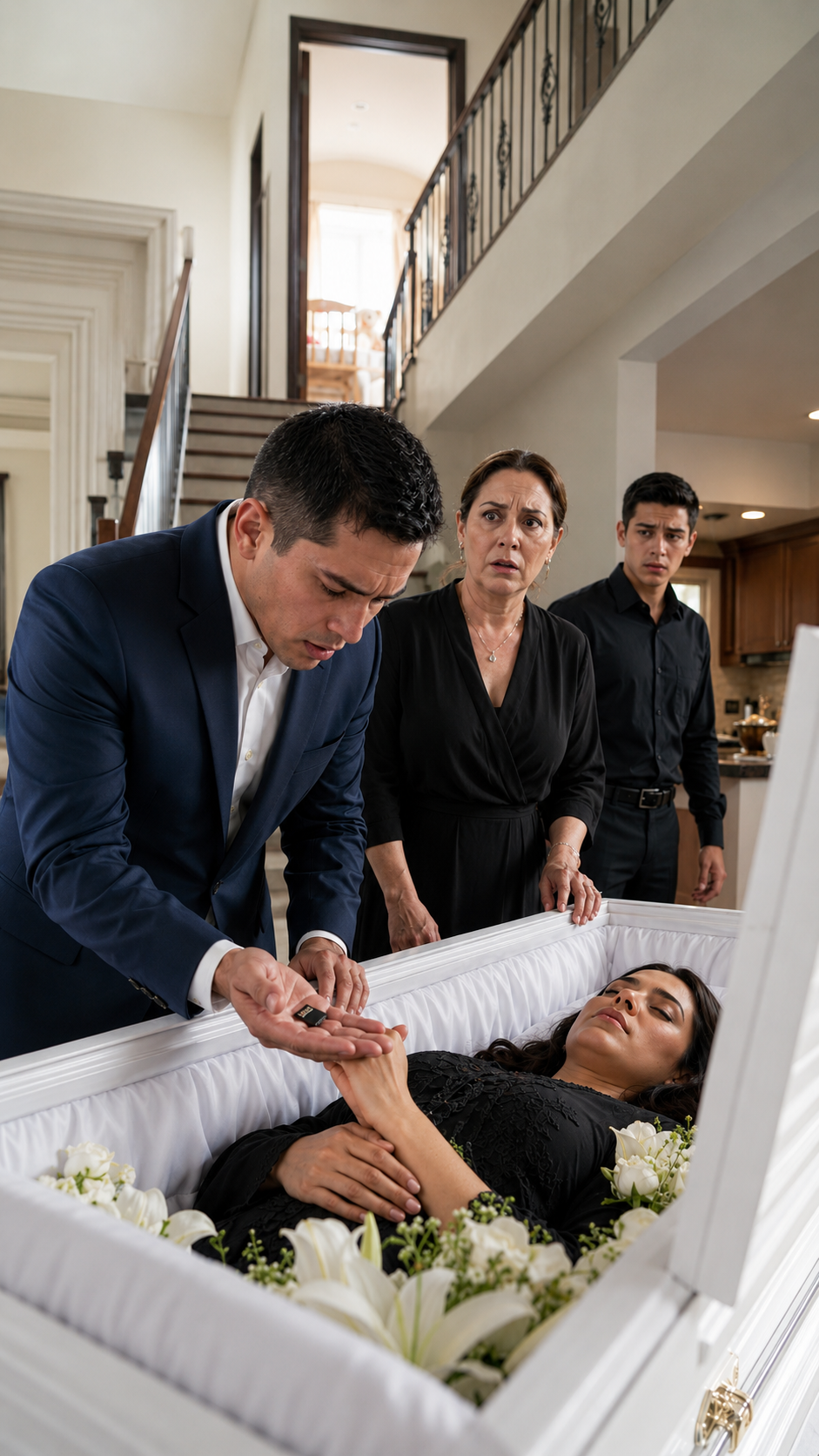
From beneath the blanket, she pulled out a small black device.
A digital recorder.
Julián's eyes widened.
—Mom...
—Your father gave it to me before he died —Teresa said—. He asked me to record anything strange. I didn’t know how to hand it to you. Marcela searched my room, my phone, my drawers.
Marcela lunged at her.
—Give me that!
The movement was so fast that the police barely had time to react.
Marcela shoved Julián with her shoulder and reached for the recorder.
She didn’t get to touch it.
An officer grabbed her by the arm.
The camera in the corridor captured everything.
Licenciada Araceli spoke with a sharp calm.
—Thank you, Mrs. Ríos. You just added one more assault in front of witnesses.
Marcela struggled.
—I’m being set up!
—No —Julián said—. You dug the hole yourself.
The notary asked for permission to play the recorder.
Doña Teresa nodded.
The first audio filled the patio.
Marcela's voice sounded clear, arrogant, cruel.
“If your son gets involved, I’ll tell everyone that Arturo left me the house. No one will believe an old sick woman. You just stay quiet and don’t get in the way.”
A heavy silence followed.
Then another audio.
The voice of Don Arturo, tired and broken, came through the static.
“Teresa, forgive me. I was wrong. Julián must know the truth. Marcela can’t keep anything. Protect those papers. Protect the house. And please, don’t let our son carry my cowardice.”
Julián closed his eyes.
For months, he had silently hated his father.
He believed him weak.
He believed him complicit.
And yes, he had been cowardly.
But in the end, he had tried to make it right.
Doña Teresa began to cry.
—He asked me for forgiveness —she whispered—. But I couldn’t talk to you, son. She was always watching.
Julián took her hand.
—Not anymore.
Licenciada Araceli signaled.
—Marcela Ríos, you are arrested for alleged domestic violence, fraud, forgery of documents, breach of trust, threats, and attempted dispossession.
Marcela screamed.
She screamed that they were all sellouts.
She screamed that Arturo had loved her.
She screamed that Julián was ungrateful.
But as the police placed the cuffs on her, her voice no longer sounded powerful.
It sounded like what it had always been: fear disguised as arrogance.
As she passed by Doña Teresa, Marcela still tried to spit venom.
—Without me, this house rots.
Doña Teresa looked her straight in the eye.
—No, Marcela. This house began to rot when you entered.
The neighbors were already at the gate.
Mrs. Lupita, from the house next door, covered her mouth. Don Chema was filming from his cellphone. The news would spread throughout the neighborhood before nightfall.
Marcela, who enjoyed humiliating in private, came out exposed before everyone.
Soaked.
Handcuffed.
With the same water she had used to punish a defenseless woman running down her legs.
Julián didn’t smile.
He thought he would.
He thought he would feel victorious.
But seeing his mother wrapped in a blanket, her lips purple and her eyes filled with lost years, he understood that justice doesn’t always taste sweet.
Sometimes it just tastes like late.
Very late.
The following months were tough.
Doña Teresa had to testify. Julián had to listen to recordings he never wanted to hear. More fake accounts, more changed medications, more canceled visits with lies came to light.
It was also discovered that Marcela had sold family jewelry at a pawn shop in Jiutepec.
Among them, Teresa’s wedding ring.
That detail hurt the most.
Not for the money.
For the contempt.
In the trial, Marcela tried to cry.
She said she was in love.
She said Arturo had promised her a life.
She said Teresa provoked her with her silence.
No one believed her.
The judge ordered preventive detention while the process advanced and froze her accounts.
The supposed inheritance was annulled.
The pension disappeared.
The contacts who used to invite her to lunches and events stopped responding.
In Mexico, people can forget many things.
But they don’t easily forgive someone who mistreats a sick mother.
Six months later, the house in Cuernavaca smelled again of coffee, sweet bread, and wet earth.
The bougainvilleas grew over the wall.
The fountain started working again.
Doña Teresa received therapy every morning under the shade of a lemon tree. She didn’t walk again, but she laughed once more.
And that, for Julián, was greater than any sentence.
One afternoon, as the sun fell orange over the patio, Teresa asked to be taken to the exact spot where Marcela had thrown her.
Julián hesitated.
—Mom, you don’t have to go back there.
She smiled wearily.
—Of course I do. A house can’t hold fear forever.
He pushed the chair to the center of the patio.
Doña Teresa looked at the new tiles.
Then she looked at the coiled hose next to the plants.
—Your father made mistakes —she said—. Many. But you don’t have to live hating him.
Julián swallowed.
—I don’t know if I can forgive him.
—Don’t forgive him for him —she replied—. Do it for you.
Julián kept staring at the garden.
Right there, he had felt a rage capable of breaking everything.
Now he only felt tired.
And a small but real peace.
—Do you think he would be proud? —he asked.
Doña Teresa squeezed his hand.
—No. I think he would be embarrassed… and grateful.
Julián let out a sad laugh.
She did too.
That afternoon they didn’t talk about Marcela anymore.
It wasn’t necessary.
The house no longer belonged to fear.
It belonged to a woman who survived when everyone thought she was weak.
It belonged to a son who understood that patience is not cowardice when used to seek justice.
And it belonged to an uncomfortable truth that many prefer not to see:
Sometimes the monster doesn’t come crashing through the door.
Sometimes it arrives smiling, saying “I love him,” and waits for the family to be too tired to defend itself.