PART 1
—If that man takes those pills tomorrow, he’ll die just like his father.
The words floated out from the service hallway of Santa Esperanza Hospital, in the Doctores neighborhood, just as a 7-year-old girl reached into a black bag searching for plastic bottles.
Her name was Camila Torres.
She wore torn sneakers, an oversized sweatshirt, and a poorly tied braid that her mother had made with cold hands. Her mother, Elena, had been an elementary school teacher in Iztapalapa, until her husband died in an ambulance during a supposed accident.
Then came the debts, the eviction, and a life nobody would brag about: sleeping on an old mattress, heating beans on a borrowed grill, and going out at night to collect PET to sell by the kilo.
—We’re almost done, my love —Elena whispered—. Just fill half a sack more.
Camila nodded, but then she heard another voice.
—The dosage has been changed. Tomorrow at 9, Salvatierra arrives. He takes it in front of Arroyo, and in three days it looks like a heart attack.
The girl’s heart began to pound in her chest.
—Just like his father? —asked another man.
—Exactly the same. No one suspected eight years ago; no one will suspect now.
Camila dropped a bottle.
The sound was small, but on that wet night, it thundered.
She couldn’t see their faces well. Only white coats, a golden watch, and a small vial hidden in a transparent bag.
—Doctor Arroyo has signed everything —one said—. When the son falls, the port route is clear.
The two men walked away, laughing quietly.
Camila didn’t understand everything, but she understood one thing: someone was going to die.
The next morning, at 8:56, a black truck stopped at the hospital’s private entrance.
Iván Salvatierra stepped out.
In the city, they called him The Wolf of the North. To some, he was a businessman in security, transportation, and hotels. To others, he was the man no one should look in the eye for too long.
He was 39 years old, dressed in a dark suit, with a scar near his lip and three bodyguards following him like shadows.
His father, Don Aurelio Salvatierra, had died eight years earlier in that same hospital from a “sudden cardiac failure.”
Iván went every three months for check-ups with Doctor Ernesto Arroyo, the family’s trusted physician.
Camila stood by the gate with her sack of bottles.
When she saw the black suit, the bodyguards, and the time, she froze.
“The man arrives tomorrow at 9…”
Her mother took her hand.
—Don’t look, daughter. Let’s go.
But Camila pulled away.
She ran towards Iván and tugged at his jacket sleeve.
One of the bodyguards shoved her on the shoulder.
—Get lost, kid!
Iván raised his hand.
—Let her be.
Camila looked up at him, her eyes filled with fear.
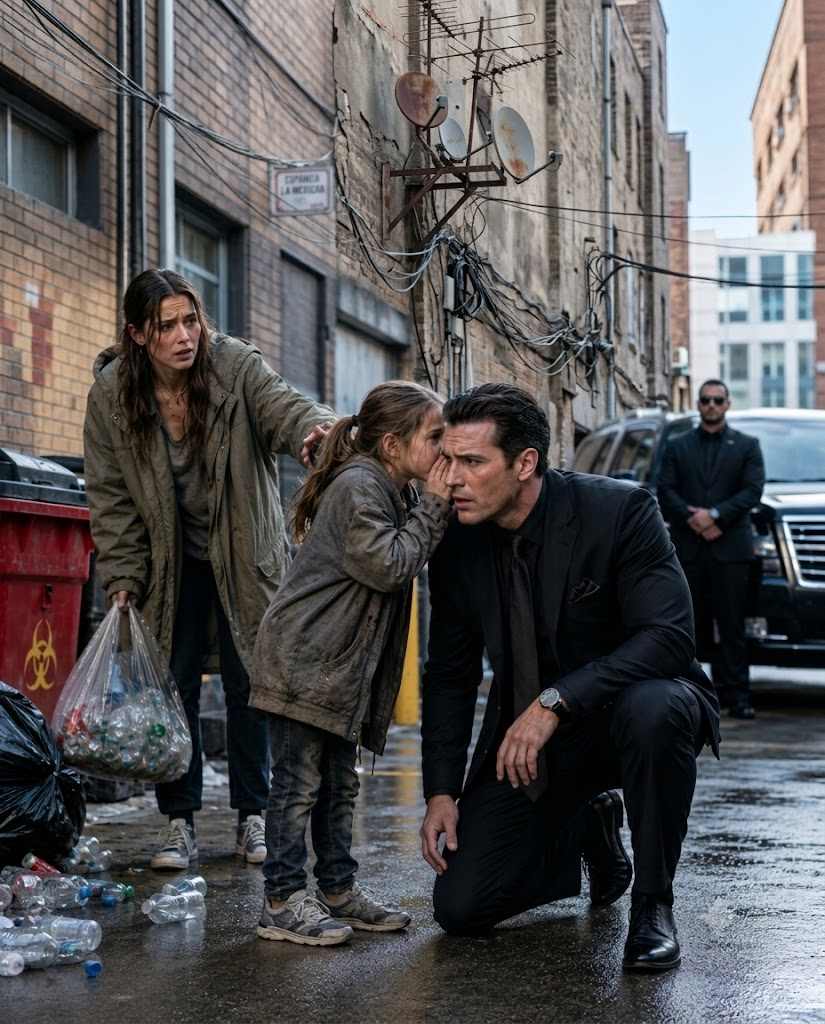
—Sir… please don’t take your medicine today.
Elena turned pale.
—I’m sorry, sir. She’s just a child; she doesn’t know what she’s saying.
Iván didn’t take his eyes off Camila.
—What did you hear?
—Last night, behind the hospital. They said they changed your pills. That you were going to die just like your father.
The bodyguards stood still.
Elena wanted to cover her daughter’s mouth, but it was too late.
Iván crouched down in front of the girl.
—Who said it?
—I didn’t see their faces. I only saw white coats. One had a golden watch. And they said the name Arroyo.
Iván’s jaw tightened.
For eight years, he had tried to forget his father’s last words.
“Don’t trust Arroyo…”
He thought it was delirium.
Now, a poor girl with scraped knees and a garbage sack in hand had just repeated the same ghost.
—Memo —Iván ordered his bodyguard—. Cancel the appointment. Call Doctor Julia Ríos. Have her analyze my medications today.
—Boss, for a kid?
Iván looked at him coldly.
—For a girl who might have just saved my life.
Then he opened the truck door.
—You’re coming with me.
Elena stepped back.
—No, sir. We don’t want any trouble.
Iván glanced toward the third floor of the hospital.
Behind a curtain, a man in a white coat was watching them with a shocked expression.
—Ma’am —Iván said—, the problems have already seen your face.
Camila went up first, hugging her sack as if it were a treasure.
Elena followed, trembling.
And when the truck started, Doctor Ernesto Arroyo took out his cellphone and dialed a number.
—Beltrán… the girl heard everything.
PART 2
Iván Salvatierra’s house was in a gated community in Santa Fe, behind high walls, cameras, and gates that looked like an elegant prison.
Elena got out of the truck feeling out of place. Her clothes smelled of dampness, her shoes were worn, and her daughter still had dirt on her hands.
Inside, everything shone.
Marble, tall glass, huge paintings, expensive silence.
A butler named Don Jacinto offered them water, sweet bread, and a blanket. Camila looked at the living room with her mouth agape.
—Mom, this house looks like a movie palace.
Iván heard from the hallway.
It had been years since anyone had said something innocent inside that house.
Doctor Julia Ríos arrived 40 minutes later. She was a toxicologist, serious, one of those women who aren’t scared by heavy names.
Iván handed her the pills the hospital had sent him the night before.
—Analyze them.
—What are your suspicions?
Iván glanced at Camila, who was slowly nibbling on a concha, as if someone would take it from her.
—I suspect a girl told me the truth before all my men.
While they waited, Don Jacinto served chicken broth, red rice, and freshly made tortillas. Camila ate hungrily but shyly. Elena barely touched anything. She coughed into a napkin, trying to hide it.
Iván noticed.
He was used to detecting betrayals, weapons, lies.
He wasn’t used to recognizing hunger.
—Why were you in the hospital’s trash? —he asked, without harshness.
Elena looked down.
—Because rent doesn’t get paid with pride, sir.
Camila squeezed her mother’s hand.
—My dad was a paramedic. He died working. Since then, my mom does what she can.
Iván stood still.
—What was your father’s name?
—Mateo Torres.
Doctor Julia entered before Iván could respond.
Her face said it all.
—These are not normal medications. They contain concentrated digitalis with another compound that alters the heart rhythm. If you took them, you would die in 3 to 5 days. It would look like a natural failure.
Silence fell heavily.
Iván closed his eyes.
He remembered his father sweating on a hospital bed, gripping his wrist and saying:
—Arroyo… no…
For eight years, he thought his father had died confused.
For eight years, he had continued to shake hands with the man who killed him.
That night, Memo arrived with a folder.
—I reviewed old files. The dosage changes for your dad were signed by Arroyo. But there’s something worse.
Iván opened the folder.
Rogelio Beltrán.
The old enemy of his family.
Don Aurelio Salvatierra had refused to let Beltrán use his trucks to move women and children through the port routes of Veracruz. Three months later, he died.
—And there’s another name —Memo said, quieter—. Mateo Torres.
Elena raised her head.
—What did you say?
Memo swallowed hard.
—The girl’s father didn’t die in a normal accident. His ambulance was carrying documents. He was going to report that several patients were dying from altered medicines.
Camila didn’t understand everything, but she understood her mother’s face.
Elena put a hand to her chest.
—Did Mateo know?
Iván looked at the papers.
—Your husband tried to do what no one else did. That’s why they silenced him.
Elena broke down.
She didn’t scream. She didn’t insult. She just sat on the floor, as if her bones had been taken from her.
Camila ran to hug her.
—Mommy, did my dad not die by accident?
Elena cried against her hair.
—No, my love. Your dad was brave.
From that night on, the house became a fortress.
Iván set up Elena and Camila in a secure room. He provided them clean clothes, food, doctors, and protection.
Without intending to, Camila began to change the house.
She named the fish in the pond, taught Iván’s old dog, a German shepherd named Bruno, to shake paws, and one morning, she brought Iván a burned pancake.
—You have to eat this to get that angry look off your face.
Elena wanted to apologize.
But Iván tasted it.
—It’s great.
And for the first time in years, he laughed.
But the peace didn’t last long.
On the third day, Memo received an intercepted call.
The voice was Doctor Arroyo’s.
—Beltrán, Salvatierra didn’t take the pills. The girl warned him.
On the other end, a hoarse voice replied:
—Then bring me the girl. Alive if possible. Dead if she’s a problem.
Iván listened to the recording without blinking.
Then he did something that shook everyone.
He died.
At 11:01 PM, a black truck exploded in a parking lot in Polanco. News outlets announced that Iván Salvatierra had perished in the blaze.
Arroyo saw the news in his office and smiled for the first time in days.
—He’s down —he said on the phone—. Now all that’s left is the girl.
What he didn’t know was that Iván was alive, listening to him from an unmarked truck two streets away from the hospital.
He had used a double, a prepared vehicle, and a controlled explosion to make Beltrán believe the path was clear.
The trap closed nine days later.
Beltrán sent five men to the Santa Fe house. They broke in through the backyard, shattering glass and shouting orders.
Elena managed to grab Camila.
Don Jacinto opened a hidden panel behind the kitchen.
—To the safe room, quick!
Bruno followed them, barking.
Camila was crying.
—Is Iván going to come back?
Elena kissed her forehead.
—Yes, my love. He always keeps his promises.
Elsewhere in the city, Memo received the alert.
—Boss, they’ve entered the house.
For the first time in years, Iván felt fear.
Not of dying.
He had rehearsed that too much.
He felt fear that a 7-year-old girl, who once searched for bottles in the trash, was hiding under his kitchen waiting for him to return.
—Let’s go —he ordered.
When he arrived, his men had already taken down three attackers. One tried to flee through the garden.
Iván caught up to him.
The man fell to his knees upon seeing him.
—You were dead...
Iván leaned in.
—And you’re going to talk.
The man confessed in under two minutes.
Beltrán had ordered to take Camila because she could recognize Arroyo's golden watch. He also confirmed that Mateo Torres, the girl’s father, had been eliminated for uncovering the network of medical murders.
That same night, Arroyo was arrested as he left the hospital.
There were no blows. No blood.
Just a white room, a recording device, and one question.
—Start with my father —Iván said.
Arroyo looked like he had aged twenty years.
—Beltrán bought my debts —he whispered—. He forced me to alter medicines. First it was businessmen. Then officials. Then your father.
—And Mateo Torres?
Arroyo cried.
—He found the files. He was going to report me. Beltrán ordered the ambulance crash.
The confession lasted 58 minutes.
He gave names, accounts, clandestine laboratories, and a list of 17 deaths disguised as heart attacks.
Iván handed everything over to prosecutor Mariana Cárdenas, a woman who had been trying for years to bring down Beltrán without a clean piece of evidence.
—With this, he goes down —she said—. But you’re also going to have to answer for your own, Salvatierra.
Iván left another folder on the table.
—That’s why I came. I’m going to close everything illegal. I want to clean my businesses and open a foundation in my father’s name and Mateo Torres’s.
The prosecutor looked at him skeptically.
—Did the Wolf of the North find his conscience?
Iván thought about Camila telling him that everyone deserved to go home.
—No —he replied—. I found a reason.
The trial was national news.
Rogelio Beltrán received life imprisonment. Arroyo too. Families came to light that had buried their dead for years thinking God had taken them, when in reality, they had been sold for money.
Elena testified for Mateo.
She didn’t tremble.
—My husband didn’t die in an accident. He was killed for telling the truth. And my daughter, a poor girl that many didn’t even look at, did what cowardly adults didn’t do.
Camila didn’t enter the courtroom.
Iván said a girl shouldn’t have to look at all the monsters he helped uncover.
A year later, the Santa Fe house no longer looked like a museum.
There were laughs, toys, flowers, the smell of soup, and Bruno sleeping wherever he wanted.
Elena returned to teaching. Camila entered a school in Coyoacán and said she wanted to be a doctor when she grew up, but “a good one.”
The Aurelio and Mateo Foundation opened its doors to help children who had lost their parents to violence, corruption, or abandonment.
On the day of the inauguration, Iván spoke before cameras.
—A girl who searched for bottles in the trash saved my life. But she did more than that. She forced me to see what kind of man I had become.
Elena looked at him with tears.
Camila took his hand.
—Are you not going to be bad anymore?
Iván crouched in front of her.
—I’ll try every day.
Camila hugged him.
—Then you can come home.
That night, Iván hung three photos in the main hallway.
Don Aurelio Salvatierra.
Mateo Torres in paramedic uniform.
And a new one: Elena, Camila, Iván, and Bruno under the sun in the garden.
Before going to sleep, Camila stopped in front of the photos.
—Goodnight, Grandpa Aurelio. Goodnight, Dad Mateo.
Then she looked at Iván.
—Goodnight, Dad Iván.
He couldn’t respond.
He just crouched down and hugged her so tightly that Camila protested with laughter.
—You’re squeezing me, dude!
Iván laughed with tears in his eyes.
Because he understood that justice doesn’t always come with sirens, judges, or punishment.
Sometimes it comes with a 7-year-old girl, worn-out shoes, and a truth overheard behind a hospital.
And sometimes, that truth not only saves a life.
It also returns a heart to the man everyone thought was lost.