PART 1
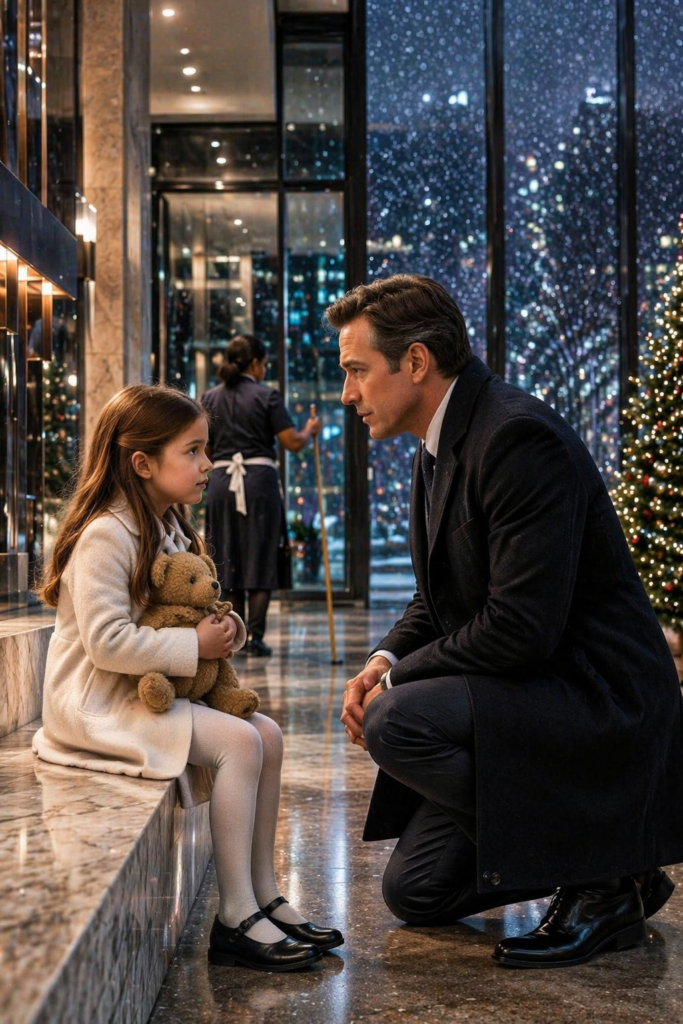
At 11:38 PM, in the marble lobby of a corporate building on Paseo de la Reforma, a 6-year-old girl clutched a purple backpack like it was a lifeline.
Her sweater was soaked from the rain, her sneakers caked with mud, and her wide-open eyes held the kind of expectation that had learned to wait without complaint.
The guard had seen her sitting there for a while but figured her mom would come down soon.
In expensive buildings, the cleaning staff always came down last.
Alejandro Robles stepped out of the elevator with his jacket in hand and his tie loosened. He was the CEO of Robles Capital, a 42-year-old man known for never smiling, forgiving mistakes, or sticking around after midnight without a good reason.
That night, he couldn’t sleep in his office.
He had closed a million-dollar deal, but something had been squeezing his chest since the afternoon. Maybe it was the rain. Maybe it was the anniversary of his mother Carmen's death, a woman who cleaned offices at night and died sprawled next to a mop because no one believed her pain was urgent.
Alejandro saw her.
The girl was alone.
“What are you doing here so late, little one?” he asked, crouching down to meet her gaze.
She clutched her backpack tighter.
“I’m waiting for my mom.”
“Does your mom work here?”
The girl nodded.
“She cleans upstairs. Her name is Marisol Hernández.”
Alejandro didn’t know that name, and it embarrassed him.
He knew balance sheets, investments, client numbers, partner surnames. But he didn’t know the name of the woman who cleaned the bathrooms where his executives left crumpled napkins, coffee cups, and scraps of expensive food.
“And why aren’t you at home?”
The girl lowered her voice.
“Because my mom is sick, but she keeps working.”
Alejandro felt the lobby sway.
“Sick how?”
The girl looked at the guard, then at the elevators, as if revealing that would betray someone.
“Her stomach hurts. Sometimes she shakes. Sometimes she sits on the toilet for a long time. But she told me not to tell anyone because if she misses work, they’ll fire her. And if they fire her, we can’t buy medicine.”
Alejandro stopped breathing for one second.
In his memory, Carmen appeared saying, “It’s nothing, son,” while gripping the sink in a school bathroom.
He had thought it was nothing too.
Until it was too late.
“What’s your name?” he asked.
“Sofía.”
“Sofía, do you know what floor your mom is on?”
“Sometimes on the 12th. Sometimes on the 16th. Today she said she had to go all the way up because the supervisor got mad.”
Alejandro shot up.
“Luis,” he said to the guard. “Find the assignment for Marisol Hernández. Now.”
The guard straightened.
“Yes, sir.”
Sofía looked at him with fear.
“Is my mom going to be mad at me?”
Alejandro felt a lump in his throat.
“No, sweetheart. No one is going to be mad at you for telling the truth.”
Luis checked the system.
“18th floor, west zone. Executive offices and bathrooms.”
Alejandro frowned.
“That floor wasn’t supposed to be cleaned today. We closed that area since 8 PM.”
Luis went pale.
“The supervisor Patricia changed the route this afternoon.”
Alejandro requested the camera feed.
On the screen, Marisol appeared.
Thin, hair tied back, navy blue uniform, a bucket beside her. She walked slowly, too slowly, one hand on her abdomen and the other pushing the mop.
Sofía moved closer to the monitor.
“That’s how she walks when it hurts a lot.”
Alejandro didn’t wait any longer.
“Call the service elevator.”
But before Luis could move, the image showed Marisol doubling over.
The mop fell.
The bucket spilled.
And Sofía’s mom lay motionless on the shiny floor as a woman’s voice crackled over the radio.
“Don’t call an ambulance yet. If there’s a scene, we’ll all be in trouble.”
PART 2
Alejandro snatched the radio from the desk.
“This is Alejandro Robles. Call emergency services right now. If anyone says not to call an ambulance again, they’ll be detained as a witness with me.”
The lobby froze.
Sofía didn’t understand everything, but she understood enough. Her face crumbled.
“Did my mom die?”
Alejandro knelt in front of her.
“No. Your mom is in danger, but she’s not alone. You’re not alone either.”
The girl launched herself at him as if those words were the only solid thing in the world.
Alejandro carried her to the elevator, but Luis stopped him.
“Sir, the girl can’t go up. It’s protocol…”
Alejandro looked at him with a coldness that left no room for discussion.
“The protocol has already failed. Now we’re going to do what’s right.”
They ascended to the 18th floor.
Marisol was pale, sweating cold, her lips almost white. She was breathing, but barely. Beside her, the water from the bucket spread like a dirty mirror under the corridor lights.
Sofía tried to run to her.
“Mommy!”
Alejandro held her gently.
“Let them work, my love. Let them help her.”
The paramedics arrived 9 minutes later. To Alejandro, it felt like 9 years.
When they brought Marisol down on a stretcher, Supervisor Patricia appeared next to the elevator with a folder under her arm.
“Sir, this shouldn’t have happened. She never reported being sick. Also, she’s subcontracted staff, not direct employees of the company.”
Alejandro didn’t even look at her.
“Not now.”
“I’m just saying that legally we’re not responsible.”
Then Sofía, her face wet with tears, spoke softly:
“My mom did tell you. I heard when Ms. Patricia told her that if she missed work again, she would replace her.”
The silence was brutal.
Patricia swallowed hard.
“The girl is scared. She probably misunderstood.”
Alejandro finally turned around.
“Better hope what you just said is true.”
At the hospital, Marisol disappeared behind some white doors. Sofía remained in the waiting room, clutching her backpack, trembling even though Alejandro had draped his jacket over her.
He didn’t sit down.
He paced back and forth, his phone glued to his hand, making calls that didn’t sound like favors, but orders.
He requested Marisol’s files from human resources.
He asked legal to review the cleaning company’s contract.
He demanded the complete recordings from the 18th floor.
And he asked for something more:
“Look for any medical requests, permissions, complaints, or reports made by Marisol Hernández in the last six months.”
At 2:17 AM, the first truth arrived.
Marisol hadn’t hidden everything.
She had requested 3 shift changes. She had submitted 2 prescriptions. She had asked for permission for blood tests.
Everything was marked as “improper” by Patricia Salgado.
The last note read:
“Conflictive employee. Uses illness as an excuse. Recommend termination if she insists.”
Alejandro closed his eyes.
Carmen’s memory returned.
Only this time it wasn’t a memory.
It was a living woman, behind a door, paying with her body for others’ indifference.
The doctor emerged just before dawn.
“Marisol Hernández is stable, but critical. She has severe anemia, dehydration, and clear signs of lupus with a strong flare-up. She should have been in treatment and resting. Continuing to work like this could have killed her.”
Sofía jolted awake.
“Does my mom live?”
Alejandro crouched down.
“Yes. She lives.”
Sofía began to cry silently.
She didn’t cry like a spoiled child.
She cried like someone who had been holding the world with hands too small.
At noon, a man appeared in the waiting room. Fitted shirt, strong perfume, expensive phone. He was accompanied by a woman with a designer bag and a judging expression.
“Where is my daughter?” he demanded.
Sofía hid behind Alejandro.
Alejandro sized him up.
“Who are you?”
“Ricardo Méndez. Her father.”
The woman lifted her chin.
“And I’m her grandmother. We’re here for the girl. We already knew Marisol wasn’t fit to take care of her.”
Sofía tightened her grip on Alejandro’s hand.
“He never comes for me,” she whispered.
Ricardo heard her.
“Don’t start with your nonsense, Sofía. Your mom filled your head.”
Alejandro stepped forward.
“Don’t talk to her like that.”
Ricardo let out a mocking laugh.
“And you? The savior boss? The new boyfriend? Because if Marisol is hospitalized, the girl is coming with me. I have a home.”
The grandmother added:
“A sick, poor, and alone woman shouldn’t be raising a girl. Everyone knows that.”
Alejandro’s jaw tightened.
That was the kind of phrase people said as if it were common sense, when in reality it was cruelty cloaked in perfume.
“You need to speak with social services and present documents,” Alejandro said. “You’re not taking Sofía like that.”
Ricardo smiled.
“I have documents.”
He pulled out a folded sheet.
It was an emergency custody request prepared with today’s date.
Alejandro understood the blow.
Ricardo hadn’t come for love. He had come because someone tipped him off that Marisol was vulnerable.
And the person who tipped him off didn’t take long to appear in the call records.
Patricia Salgado.
The supervisor.
The twist was worse when legal found messages between Patricia and Ricardo.
“If she goes to the hospital, it’s your chance.”
“I can declare that she leaves the girl alone in the lobby.”
“We’ll figure out my part later.”
Alejandro read those messages with a calm that was frightening.
Marisol wasn’t just sick.
She was being used.
Ricardo wanted to take Sofía away to punish her for not returning to him. Patricia wanted to get rid of an employee who claimed rights. And the subcontracted company wanted to pretend it was all a “careless mother’s” fault.
When Marisol woke up 2 days later, the first thing she did was search for her daughter.
“Sofía…”
“She’s fine,” Alejandro said from a chair by the window. “She’s with Ms. Lupita, your neighbor. She came with sandwiches, blankets, and half the building.”
Marisol tried to sit up, but the pain overwhelmed her.
“I shouldn’t be here.”
“You should be alive,” he replied.
She looked at him with distrust.
“I don’t need pity.”
“I didn’t come to give you pity.”
“Then what do you want?”
Alejandro took a deep breath.
“To ask for your permission.”
Marisol blinked.
That wasn’t what she expected.
“Permission for what?”
“To help you without deciding for you. To cover your salary while you recover, activate a medical fund, put a family lawyer if you agree, and report those who used your illness to try to take your daughter.”
Marisol turned her face away.
Shame burned more than the fever.
“I don’t want Sofía to see me as a burden.”
Alejandro fell silent for a moment.
“My mom thought that too.”
Marisol looked at him again.
He spoke plainly.
He told her that Carmen cleaned offices. That she hid her pains. That she died during a night shift because no one wanted to interrupt a meeting to ask for help. That he arrived too late and since then had become a rich man with the soul of a waiting room.
Marisol listened with tears caught in her throat.
“I studied medicine,” she confessed later. “I was in my 4th semester. I got pregnant, Ricardo left, my mom told me I had ruined my life. I dropped out to pay rent. Then I got sick. And every time I asked for help, someone reminded me that a real mother endures.”
Her voice broke.
“I didn’t want Sofía to learn to depend on anyone.”
Alejandro replied softly:
“Maybe Sofía doesn’t need to learn that her mom endures until she collapses. Maybe she needs to learn that asking for help in time is also bravery.”
Marisol then cried.
Not dramatically.
With exhaustion.
With rage.
With years of pretending she could do it all alone.
When Sofía entered the room, she slowly ran to the bed.
“Mommy, you promised you’d always come down.”
Marisol hugged her with the arm she had free.
“Forgive me, my darling.”
“I don’t want you to work if it hurts.”
Marisol closed her eyes.
That phrase hurt more than any diagnosis.
Because it came from a girl who didn’t ask for toys, trips, or parties.
She asked for her mom not to die working.
Justice didn’t arrive like in the movies, but it came.
Patricia was fired and investigated for falsifying reports and sharing personal data. The cleaning company lost the contract. Ricardo didn’t get emergency custody because the messages proved his intent, and because Sofía testified, accompanied by a psychologist, that her mom never abandoned her.
Marisol accepted medical support with one condition:
“No hidden charity. If you’re going to help me, then something has to change for others too.”
Alejandro agreed.
Three months later, Robles Capital created a real program for night staff, including cleaning, security, cafeteria, and messaging. Not just suited employees. Also those who opened doors, cleaned bathrooms, and held the building up when executives were already home.
Marisol, already in treatment, started working part-time in that program.
She didn’t return to the mop.
She returned to using her medical knowledge, her experience, and that dignity she never lost, even though many tried to trample it.
Alejandro didn’t become a hero overnight.
He was still serious, awkward at talking about feelings, and terrible at making soup. Sofía said his soup tasted “like sad water,” and Marisol laughed until her ribs hurt.
Over time, Alejandro started visiting less out of guilt and more out of affection.
Marisol noticed.
She also noticed that he always asked before making decisions.
That, to her, was worth more than any check.
A year later, at a forum for cleaning workers in Mexico City, Marisol stepped onto a small stage. Sofía sat in the front row in a yellow dress. Alejandro stood back, unobtrusive.
Marisol took the microphone.
“For a long time, I believed that being strong meant not needing anyone. I thought that if my daughter saw me accept help, she would think her mom was weak.”
The room fell silent.
“I was wrong. My daughter didn’t need to see me fall alone. She needed to see me live. She needed to learn that dignity isn’t lost when someone lends you a hand. It’s lost when a society forces you to faint on the floor to make your pain real.”
Several women cried.
Others applauded with rage.
Sofía stood up from her chair and shouted:
“That’s my mom!”
Marisol smiled with tears in her eyes.
Alejandro looked down.
For the first time in 20 years, he thought of Carmen without just feeling guilt.
Outside, the rain fell gently over Reforma.
Sofía walked between the two, holding hands with her mom and Alejandro, jumping over puddles as if the world were finally a safe place.
Later, people told the story wrong.
They said that a rich director saved a sick employee.
They said Marisol was lucky.
They said Sofía found a miracle in a lobby.
But the truth was different.
Sofía didn’t save her mom by speaking up.
She only said what the adults refused to see.
Marisol didn’t become valuable when someone helped her. She was already valuable, cleaning floors, raising her child alone, hiding her pain, studying at night the symptoms she feared she had.
And Alejandro wasn’t good because he had money.
He began to heal when he stopped using his guilt as a tomb and turned it into action before another woman ended up like his mother.
Sometimes family isn’t born of blood.
Sometimes it’s born the moment someone looks at a girl waiting alone and says:
“You don’t have to wait alone anymore.”