PART 1
Mariana entered the supermarket in the Narvarte neighborhood with a tense face and her cellphone glued to her hand.
It was payday Friday.
She had left the office in Santa Fe late, had driven for almost 2 hours through traffic, honking horns, and desperate people, and all she wanted was to buy bread, milk, rice, tomatoes, and something quick for dinner.
Nothing more.
But the supermarket was packed.
Carts stuck, kids begging for chips, women fighting over sales, and people glancing at their watches as if everyone were about to miss a flight.
Mariana was in a hurry too.
And had little patience.
Just before entering, she had sent a message to the family group:
"Mom called me 3 times again. Seriously, someone else answer her. I can't handle everything."
Her sister only replied:
"That's why I say we should find her a care home."
Mariana didn’t respond.
But she didn’t defend her mother either.
She put her phone away and walked into the first aisle.
There she saw her.
A very thin elderly woman, wearing a beige sweater, long skirt, and comfortable shoes, stood in front of the cookies as if she were deciding something extremely important.
Her hands trembled.
She picked up a package, looked at it, then set it down.
Then she picked up another.
And then back to the first.
Next to her was a man about 38, dark-skinned, wearing a simple jacket and worn sneakers, with a calm expression.
He didn’t seem to have money.
He didn’t seem to be in a rush.
That was what irritated Mariana the most.
She stood behind them, with her basket in hand.
She sighed.
Not loudly.
But enough to be noticed.
The man turned his head slightly.
He didn’t complain.
He didn’t scowl.
He simply gave a small smile, as if apologizing for taking up space in a world where everyone was rushing.
Then he looked at the elderly woman.
"Mom, those are too hard. You like the butter ones, remember?"
The woman blinked, confused.
"Oh, yes… the butter ones."
He picked the right package and placed it in the cart carefully.
Mariana passed by them and thought something horrible.
She thought that if she knew her mother took so long, she could do the shopping online.
Or leave her at home.
Or come alone.
She thought it.
And kept walking.
A few minutes later, she found them in the fruit section.
The elderly woman held a small apple between her fingers.
"Your dad always picked the small ones," she said.
The man smiled.
"Yeah, Mom."
"He said the big ones just showed off but didn’t taste like anything."
He let out a soft laugh.
Not a fake laugh.
A son’s laugh that had heard that phrase 100 times but still received it as if it were new.
"Then we’ll take only the small ones," he replied.
Mariana pretended to look at the tomatoes.
But she was watching them.
There was something strange about that man.
He didn’t rush her.
He didn’t correct her.
He didn’t treat her like a burden.
In dairy, the elderly woman asked 3 times which yogurt they always bought.
And 3 times he answered the same:
"The plain one, Mom. The one that doesn’t upset your stomach."
She looked down.
"I repeat things too much, don’t I, Diego?"
That’s when Mariana learned his name.
Diego.
He rested a hand on the cart.
"You don’t repeat. You just make sure."
Mariana stood still.
That phrase hit her like a stone.
Because her own mother also asked a lot.
If she had eaten.
If she arrived safely.
If she was tired.
And Mariana almost always replied:
"I already told you, Mom."
In the bakery, the elderly woman wanted to grab a bag of bread by herself.
It fell to the floor.
Mariana thought Diego would grow impatient.
But he bent down and said:
"I drop everything too, Mom."
The elderly woman smiled.
"Don’t be a liar."
"A little, but yes."
Then she murmured:
"I’m a bother to you, son."
Diego looked at her with a tenderness that almost hurt.
"Mom, you tied my shoes for years. And I was a really annoying kid. This is not a bother."
Mariana swallowed hard.
Then her phone rang.
The screen read: "Mom."
Mariana pressed decline.
At the same time, the elderly woman looked at her with tired eyes and said softly:
"When a mother calls a lot, it’s almost always because she misses you, not because she wants to bother you."
Mariana froze.
And the phone rang again.
PART 2
Mariana looked at the screen as if it were burning.
Once again it said, "Mom."
The supermarket remained crowded.
People kept pushing carts, searching for deals, making annoyed faces.
But for Mariana, everything fell into silence.
The elderly woman didn’t say anything else.
Diego didn’t either.
They just kept moving toward the register, slowly, with a calmness that felt like a slap to all those rushing about.
Mariana didn’t answer.
She tucked her phone away in her bag.
As if hiding it could also hide her guilt.
They reached the register right in front of her.
And of course, it took time.
The elderly woman pulled out the cookies.
Then the yogurt.
Then the small apples.
Diego handed her things, but he didn’t do everything for her.
He let her participate.
He gave her time.
That made Mariana more uncomfortable than any reprimand.
Because helping like that required love.
Not just strength.
Behind Mariana, a man murmured:
"Seriously, some people should come at times when they don’t get in the way."
The elderly woman heard.
Her hands trembled more.
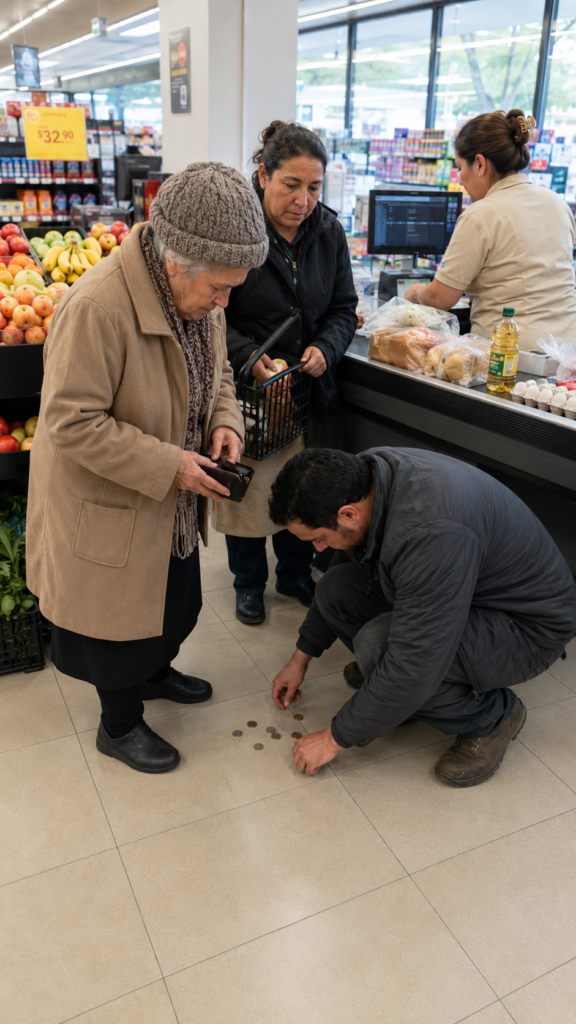
A coin fell.
Then another.
Then another.
Diego bent down slowly.
Mariana bent down too.
She picked up 2 coins and handed them to her.
The elderly woman looked at her with shining eyes.
"Thank you, dear."
Only those 2 words.
But something broke inside Mariana.
Dear.
That’s what her mother called her when she wanted to soften anything.
"Dear, did you eat?"
"Dear, did you make it?"
"Dear, I just wanted to hear you."
The cashier finished ringing everything up.
The elderly woman searched for her glasses.
Then her wallet.
Then forgot that the wallet was already in her hand.
The man behind them huffed again.
"Take your time, Mom," Diego said. "We’re not in a hurry."
"People are waiting," she whispered.
Diego didn’t look back.
He didn’t apologize for her.
He didn’t rush her.
"Then let them wait a little."
The cashier smiled faintly.
Mariana looked down.
Because minutes earlier she would have thought the same as the man behind them.
Maybe she wouldn’t have said it.
But she would have thought it.
And sometimes what one thinks also reveals who they are.
Diego paid for what was left with an old card.
He made no comment.
He didn’t say, "You’re short."
He didn’t say, "Again."
He just paid.
Then he packed everything into reusable bags.
He put the rice at the bottom.
The tomatoes on top.
The cookies separately, as if they were something fragile.
Then he helped his mother adjust her sweater.
He arranged her collar.
He kissed her forehead.
Right there.
In front of everyone.
Without shame.
As if loving a mother were the most normal thing in the world.
And it should be.
But many forget.
When they went outside, Diego received a call.
He didn’t realize his phone was on speaker.
A woman’s voice sounded annoyed.
"Are you still with my mom at the supermarket? Diego, please. I’ve told you to put her in a home. We can’t live like this."
Diego clenched his jaw.
"Veronica, don’t talk like that. She’s here."
"Let her hear. It’s the truth. You have no life because you’re taking care of her."
The elderly woman froze.
Her eyes searched for her son’s.
"Am I a burden?" she asked.
Diego hung up immediately.
"No, Mom. Don’t listen to her."
But the phrase had already entered.
And it wasn’t going to leave easily.
Mariana felt her chest tighten.
Because that call resembled too closely the chat of her own family.
It changed the name.
It changed the voice.
But the message was the same.
"We can’t do this anymore."
"Let someone else handle it."
"Don’t bother."
"Don’t get in the way."
Diego took a deep breath.
He leaned a bit toward his mother.
"Look at me, Mom. You’re not a burden. You’re my home."
The elderly woman cried silently.
Her lips trembled.
"But Veronica says you left your job for me."
Diego stood still.
That silence said it all.
Mariana understood before he responded.
He wasn’t a man without urgency because he had nothing to do.
He was a man who had decided to change his pace for her.
"I didn’t leave it for you," Diego finally said. "I left it because my boss didn’t understand that a sick mother isn’t kept in a drawer from 9 to 6."
The elderly woman looked at him as if she had just discovered a hidden wound.
"Why didn’t you tell me?"
"Because you’ve already carried too much, Mom."
Diego tried to smile.
But his face broke.
"Besides, at night I drive for an app. We manage to keep things going."
Mariana felt shame.
She had seen his worn sneakers.
His old jacket.
His exhaustion.
And yet thought he wasn’t someone important.
How easy it was to measure people by what they wore.
How difficult to see what they were holding inside.
The elderly woman clutched the cookies against her chest.
"I don’t want to take your life, son."
Diego took her hands.
"You gave me mine."
The phrase floated outside the supermarket, amidst taxis, tamale stands, sweet bread aromas, and the city’s noise.
Mariana couldn’t move.
Then her phone vibrated.
It was a message from her mother’s neighbor.
"Mariana, sorry to intrude. Your mom is still sitting outside the clinic. She says she doesn’t want to bother you, but I think she forgot the bus schedule. Were you going to pick her up?"
Mariana felt the blood drain from her.
The clinic.
The appointment.
The results.
She had forgotten.
Her mother had called her 3 times.
Not to bother.
Not to repeat.
Not to take her time.
She had called because she was alone outside an IMSS clinic, with a bag of papers in hand, waiting for her daughter to remember.
Mariana covered her mouth with her hand.
Now she answered the next call.
"Mom?"
On the other end, Rosa’s voice sounded soft.
Not angry.
That was the worst part.
"Dear, don’t worry. I already told Lupita to keep me company for a bit. You’re probably busy."
Mariana closed her eyes.
"Mom, I’m sorry. I’m sorry, I forgot."
"It’s nothing, dear."
It was something.
Of course, it was something.
But mothers often say it’s nothing to avoid weighing you down.
To not inconvenience you.
To not become a problem.
Mariana looked at Diego and the elderly woman.
They were still there, half-embraced, as if the world could break apart, but not if they were together.
"I’m on my way," Mariana said.
"Don’t rush, dear," Rosa replied. "I’ll be here waiting."
That phrase broke her completely.
"I’ll be here waiting."
How many times does a mother wait?
Waits at school.
Waits at the door.
Waits awake.
Waits for calls.
Waits for visits.
Waits for her children to have time.
Even waits when she already knows they’re not coming.
Mariana left the supermarket almost empty-handed.
But before she approached Diego, she said:
"I’m sorry," she said.
He looked at her confused.
"Why?"
Mariana took a deep breath.
"Because earlier I was frustrated with you both. Because I thought ugly things. Because I’m also failing with my mom."
Diego didn’t judge her.
That hurt more.
He just said:
"You still have her, right?"
Mariana nodded, tears in her eyes.
"Then you can still make it."
The elderly woman extended a hand and touched her arm.
"Bring her sweet bread," she said. "Moms’ hearts soften with bread and a visit."
Mariana let out a sad laugh.
"Yes, ma’am."
"Carmen," the elderly woman corrected. "My name is Carmen."
"Thank you, Mrs. Carmen."
Diego lifted the bag of small apples.
"And don’t drive while crying, okay? Breathe first."
Mariana nodded.
She bought a concha, 2 cuernitos, and a café de olla at the bakery outside.
Then she drove to the clinic with her heart in a knot.
When she arrived, she saw her mother sitting on a metal bench.
Rosa was 69 years old.
She wasn’t that elderly.
She wasn’t that sick.
She didn’t walk that slowly yet.
But she was already starting to repeat questions.
She was already forgetting some things.
She was already calling more.
And Mariana, instead of getting closer, had started to pull away.
Rosa saw her and smiled as if she hadn’t been waiting for 2 hours.
"Oh, dear, I’m so glad you came. I didn’t want to worry you."
Mariana knelt in front of her.
The people around looked.
She didn’t care.
"Mom, forgive me."
Rosa got scared.
"What happened?"
"What happened is that I’ve treated you like an interruption. And you’re not."
Rosa didn’t know what to say.
Mariana took her hands.
They were cold.
Hands that bathed her as a child.
Hands that braided her hair.
Hands that washed uniforms.
Hands that applauded when she took her first steps.
Hands that now trembled slightly holding some medical papers.
"I don’t want you to learn not to bother me," Mariana said. "I want you to call me. Even if it’s 3 times. Even if it’s 10. Even if it’s to tell me the same thing."
Rosa cried.
But smiled.
"It’s just that sometimes I feel I’m bothering you already."
Mariana shook her head firmly.
"No, Mom. I’m the one who got lost."
That night there was no quick dinner.
No pending tasks.
No computer.
Mariana took Rosa to her house, heated coffee, and split the sweet bread on an old plate.
Her mother talked about the neighbor.
About the doctor.
About a plant that was drying up.
About a mole recipe she wanted to make on Sunday.
Mariana listened.
Without looking at her phone.
Without saying, "You’ve already told me."
Without rushing her.
Later, the family group chimed again.
Her sister wrote:
"So, what are we going to do about Mom? We can’t all be babysitters."
Mariana looked at Rosa, who had fallen asleep on the couch with a blanket over her legs.
She replied:
"Mom is not a package. She’s not a problem. She’s not a burden. She’s our mother. We’ll talk tomorrow, but with respect."
Her brother wrote:
"How intense."
Mariana replied:
"No. Late, but I’ve understood."
Nobody replied for several minutes.
Sometimes the truth is more uncomfortable than a scream.
From that day on, Mariana changed some things.
She didn’t become perfect.
Sometimes she got tired.
Sometimes she grew impatient.
Sometimes life caught up with her again with tasks, traffic, and pressure.
But she no longer rejected her mother’s calls as if they were garbage on the screen.
When Rosa asked the same thing 3 times, Mariana breathed and answered 3 times.
When they walked to the store and her mother stopped to look at flowers, Mariana stopped too.
When Rosa took time to pay, Mariana didn’t take the wallet from her.
She just waited.
Like Diego.
Like Mrs. Carmen.
Like she should have waited from the start.
A week later, Mariana returned to the same supermarket.
She wasn’t looking for them.
But she found them in the fruit section.
Mrs. Carmen had a small apple in her hand.
Diego listened to her as if the memory of his father were new again.
Mariana approached with Rosa on her arm.
The 2 mothers greeted each other as if they had known each other their whole lives.
Mrs. Carmen looked at Rosa and said:
"It’s great that your daughter walks with you."
Rosa smiled.
"She’s learning."
Mariana felt a lump in her throat.
Diego looked at her and winked.
No further words were needed.
Because some lessons aren’t explained.
They’re walked.
Slowly.
Next to those who once walked more slowly to never let go of our hands.