PART 1
The armored truck rolled into Mendoza's Garage seven minutes before closing, steam billowing from the hood as if the engine were begging for help.
Julián Mendoza looked up from his workbench, wiped his hands on a red rag, and listened to the sound.
A real mechanic knew how to listen.
A loose belt shrieked. A damaged bearing growled. An overheated engine sounded like a tired man who could no longer pretend.
That truck sounded desperate.
The garage was on the outskirts of Tepatitlán, Jalisco, next to a parts store, a taco stand with old tin, and a street where dust clung to everything.
Julián was 38, a widower, the father of a nine-year-old girl, and the owner of a shop that survived more on trust than on money.
His only employee, Memo, was already lowering the curtain when the truck's door opened.
A woman stepped out in fine heels, immaculate white pants, dark glasses, and a bag that likely cost more than all the tools in the shop.
She looked at the oil-stained floor as if she had landed on another planet.
—Do you still take customers? —she asked.
Julián glanced at the clock.
—That depends on how serious the problem is.
The woman didn’t smile.
—My truck overheated on the highway. My assistant called every agency in Guadalajara, and no one could take it today. A policeman told me this was the closest garage.
Julián opened the hood. The smell hit him hard.
Burnt antifreeze. Blown hose. Stuck thermostat. Reservoir nearly dry.
If that woman had driven ten more kilometers, the repair wouldn’t have been cheap; it would have been a mechanical tragedy.
—You were lucky —he said.
She lowered her glasses slightly.
—I don’t believe in luck. I believe in quick solutions.
Julián took a deep breath.
—I can change the hose, the thermostat, refill and purge the system. If nothing else turns up, you’ll be driving it in two hours.
—How much?
—Approximately $1,999, including antifreeze and labor.
She looked at him as if he had just asked her for a house in Las Lomas.
—For a hose?
—For the hose, the thermostat, the fluid, the inspection, and for staying after hours.
—Fine. Do it.
She didn’t say it as permission.
She said it as an order.
Julián accepted because he needed the money. The rent for the garage was overdue, the electricity bill was about to expire, and Sofía, his daughter, had a school trip he still didn’t know how to pay for.
Memo stayed too, even though Julián told him twice to leave.
At 7:18, the truck started up again evenly, no jumping, no overheating, no complaints.
Julián printed the bill.
Total: $1,999.
The woman took the paper with two fingers.
Then she let out a dry laugh.
—This is ridiculous.
The garage went still.
Doña Lupita, who had come for her Tsuru, stopped searching for coins in her purse. A tortilla delivery man turned from the entrance. Memo tightened the wrench in silence.
—Ma’am, you authorized the price —Julián said.
—I authorized a reasonable repair. Not an abuse.
—The work is done, and the old parts are in that box.
She lifted her chin.
—I’m not paying this.
—Then I can’t release the truck.
The woman smiled coldly.
—Of course you can. I’m Valeria Monteverde.
The name fell like a stone.
Everyone knew Grupo Monteverde. Factories, developments, foundations, interviews in business magazines. Valeria was the CEO, the brilliant daughter of the region's most powerful businessman.
But Julián only saw a client who wanted to leave without paying.
—with all due respect, Mrs. Monteverde, the bill remains $1,999.
She stepped closer to the counter.
—You don’t understand who you’re talking to.
—I understand that your truck arrived broken and is leaving fixed.
Valeria threw the bill on the counter.
—Send it to my office. They will decide if it’s worth paying you.
She grabbed the keys.
Julián didn’t touch her. He wasn’t going to make a scene in front of customers. He wasn’t going to give anyone a dirty story that could one day reach Sofía’s ears.
Valeria paused at the door.
—Be careful, Mr. Mendoza. Workshops like this live on their reputation.
Julián looked at her steadily.
—And people like you do too.
For the first time, Valeria’s face shifted.
But she got in the truck and drove off, leaving the unpaid bill on the counter.
That night, as Julián opened a letter from the bank at home and Sofía left him a note written in purple marker that said, “Dad, everything will get better,” in a mansion in Zapopan, Valeria recounted the story, laughing.
And her father, Don Ernesto Monteverde, set his fork down on the plate, looked at her in silence, and asked:
—How much did you pay the mechanic?
PART 2
Valeria gulped her wine as if that could erase the question.
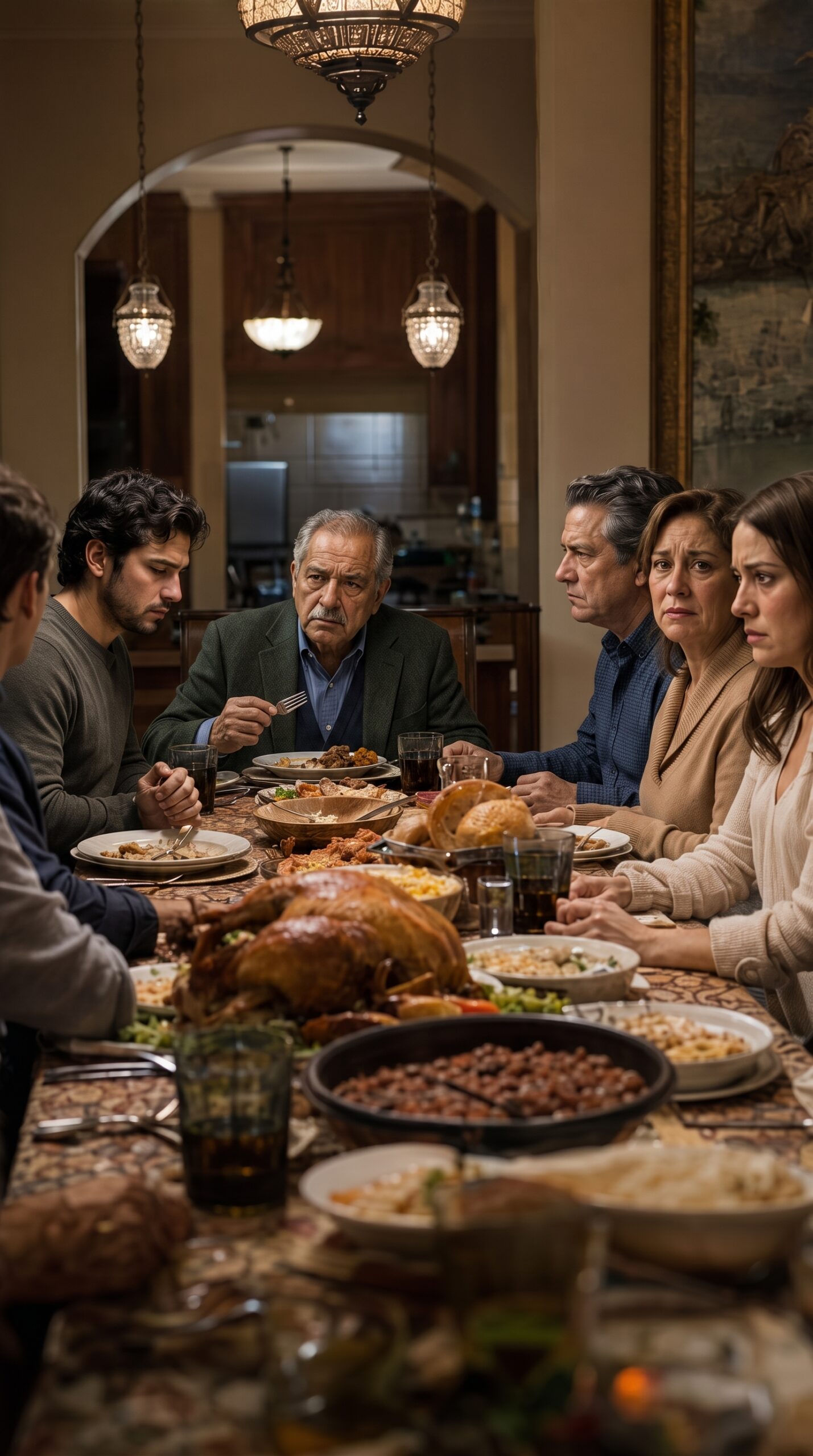
The dining room of the Monteverde house was longer than all of Julián’s garage. There were expensive paintings, Italian lamps, fresh flowers, and employees who knew how to disappear when the atmosphere turned heavy.
Don Ernesto Monteverde was not a loud man.
At 72, he spoke softly, walked slowly, and wore simple sweaters over fine shirts. In his office, he kept, inside a display case, his first lunchbox as a worker.
Before owning factories, he had carried sacks.
Before appearing in magazines, he had eaten cold beans on a sidewalk.
So, when his daughter said, “A town mechanic tried to take advantage of me,” something shifted in his eyes.
—I asked you how much you paid —he repeated.
Valeria gripped the napkin tightly.
—Not yet. I told him to send the bill.
—Did he give you an estimate beforehand?
—Yes.
—How much?
—$1,999.
—Did he fix the truck?
—Yes, but Dad…
—Does the truck work?
Valeria fell silent.
Don Ernesto looked at her for several seconds, no visible anger. That made her more uncomfortable than any scolding.
—Why didn’t you pay?
—Because men like that see someone like me and think they can charge whatever they want.
Don Ernesto tilted his head.
—Men like that?
Valeria knew she had said too much.
—I didn’t mean to say…
—Yes, you did.
The silence grew heavy.
Don Ernesto stood up.
—Excuse me.
—Dad, really, you’re exaggerating.
He stopped at the door.
—No, Valeria. What you did was small. And that’s worse, because people show who they are in the small things.
He locked himself in his study and made four calls.
The first was to his driver, who confirmed the truck had already been overheating before reaching the garage.
The second was to a former judge from the area who knew half of Jalisco.
The third was to the principal of the elementary school where Sofía Mendoza studied.
The fourth was to Doña Lupita, widow of an old Monteverde worker, who had known Julián for years.
At midnight, Don Ernesto had a notebook full of notes.
Julián had fixed the church van for free when the youth couldn’t pay.
He had kept Doña Lupita’s car running through her chemotherapy without charging her interest.
He had changed a battery in pouring rain for a retired teacher, telling him, “You can pay me when you can, professor.”
He had bought two pairs of soccer shoes for kids at the elementary school without putting his name on it.
He had gone at midnight for a single mother stranded on the highway, with a sick child in the back.
No one boasted about it.
Not him, least of all.
Don Ernesto closed the notebook and looked at his old lunchbox.
He remembered his father coming home with torn hands and intact pride. He remembered the foreman who once called him a “dirty boy” in front of everyone. He remembered the rage he felt when he discovered that poverty didn’t hurt as much as contempt.
At 6:20 in the morning, he was already dressed.
At 8:05, a black sedan parked in front of Mendoza's Garage.
Julián was trying to revive the coffee maker when Memo whistled.
—Boss… I think now we’re really in trouble with the tax office.
Julián stepped outside.
He recognized the man immediately. Don Ernesto Monteverde appeared in newspapers alongside words like investment, employment, exportation, and foundation.
The businessman extended his hand.
—Mr. Mendoza.
—Don Ernesto.
The handshake was firm. Not one of those seeking to prove strength, but one that recognizes another worker.
—I owe you an apology —the businessman said.
Julián didn’t know what to respond.
—For my daughter.
—She was upset.
—She was wrong.
Those two words cleansed something Julián didn’t know he had stuck in him since the previous afternoon.
Don Ernesto looked towards the office.
—Can we talk?
Inside, Julián moved overdue bills, receipts, and a pink backpack of Sofía that he had forgotten on a chair.
He felt embarrassed by the oil-stained floor, the peeling wall, the parts store calendars, and the fan that made more noise than air.
Don Ernesto noticed everything.
But he stared longer at the photo of Sofía taped next to the computer.
—Your daughter?
—Sofía. She’s 9.
—I had a daughter of 9 —Don Ernesto said—. I should have corrected many things since then.
He pulled out a thick envelope and placed it on the desk.
Julián raised his hand.
—If it’s about the bill, it was $1,999.
—I know.
—I don’t want problems.
—That’s why I came personally.
Don Ernesto pulled out a cashier's check.
$19,990.
Julián’s eyes widened.
—That’s too much.
—It’s the bill multiplied by ten, for the lack of respect and the time wasted.
—I can’t accept that.
—You can accept only what you decide. But I didn’t come just for that.
He pulled out another document.
It was a contract on Monteverde Foundation letterhead. It had seals, attachments, lawyer signatures, and several pages that Julián could barely follow.
Until he saw the number.
$19,000,000.
He felt the ground shift beneath him.
He pushed the papers back.
—No.
Don Ernesto didn’t smile.
—Yes.
—No, sir. You don’t know me.
—I know enough to start. And I know how to investigate what matters.
Julián breathed quickly.
—I fix cars.
—And people trust you for more than just cars.
Don Ernesto explained the project.
The Monteverde Foundation had been searching for two years where to open a trades center for underprivileged youth, single mothers, veterans, adults wanting to restart, and kids who couldn’t afford university.
They had looked at fancy buildings in Guadalajara, agreements with expensive schools, proposals with too much photo and little reality.
Nothing convinced them.
Until Valeria refused to pay a bill of $1,999.
—The money would buy the abandoned warehouse behind your garage —Don Ernesto said—. It would pay off your debts, expand the business, buy equipment, hire instructors, cover scholarships, and leave a reserve for ten years. You would still own Mendoza's Garage. If you accept, you would also be the director of the Sofía Mendoza Trades Center.
Julián shot his gaze up.
—Sofía?
—If you authorize it. Sometimes our children remind us who it’s worth building for.
Julián was left speechless.
He thought of his wife Mariana, who died three years earlier from an infection that advanced too quickly. He thought of the mornings combing Sofía’s hair poorly before school. He thought of the scrambled eggs when he couldn’t afford meat. He thought of the purple note he carried in his wallet.
He took it out without knowing why.
He placed it on the desk.
“Dad, everything will get better.”
Don Ernesto read the note.
His mouth trembled slightly.
—Smart girl.
—She is a girl —Julián said, his voice breaking.
—That’s why she still speaks the truth without fear.
At 9:30, half the neighborhood knew something unusual was happening.
No one knew what.
They just saw Don Ernesto’s black sedan parked outside and, shortly after, Valeria Monteverde’s truck entering the garage again.
This time, Valeria didn’t wear dark glasses.
She stepped down wearing a simple blouse, dark pants, and a face paler than the day before.
Her father waited for her alongside Julián.
Memo was in bay 1 pretending to check a tire. Doña Lupita appeared with coffee. The tortilla delivery man stood next to his moto.
In Mexico, no invitation is needed when justice is in the air.
Valeria first looked at her father.
Then at Julián.
—Mr. Mendoza —she said.
He didn’t respond.
—I owe you an apology.
The words came out harsh, as if they weren’t used to passing through her throat.
—I approved your estimate. You did the work. I refused to pay because I judged your garage and you by how you looked, not by what you were worth. I treated you with contempt. And I threatened your reputation when the one who should have protected it was me.
The garage fell silent.
Valeria opened her bag and took out an envelope.
—Here’s the original payment and compensation.
Julián looked at the envelope.
Then at Don Ernesto.
The businessman didn’t give any sign.
That was important.
Julián looked back at Valeria.
—I accept $1,999.
She blinked.
—but my dad said that…
—I accept what I earned.
Valeria looked down.
She took out two $1,000 bills and placed them on the counter.
Julián opened the cash register, took out $1 in change, and left it next to her hand.
That peso did more than any speech.
Valeria looked at him as if for the first time she understood that paying wasn’t about giving charity.
It was about acknowledging.
—Would you like a receipt? —Julián asked.
—Yes, please.
He printed it out.
She took it carefully.
No longer with two fingers.
Before leaving, Valeria turned to the people in the garage.
—I also owe you all an apology.
She didn’t say it loudly.
But everyone heard.
Doña Lupita nodded slightly. Memo crossed his arms. The delivery man murmured, “Wow.”
Valeria left alone.
Her father didn’t follow her immediately.
He stayed with Julián, looking at the garage.
—We’re going to have to buy a decent coffee maker —he said.
Julián let out a laugh he hadn’t felt for weeks.
—That would be an urgent investment.
The following months didn’t turn Julián into another man.
That’s what many misunderstood when the story became famous.
The money changed his circumstances.
It didn’t change his habits.
He continued opening early. He continued notifying when a repair could wait. He continued telling the truth even if it meant earning less. He continued keeping candy on the counter for the kids.
But the fear changed.
The bank letters no longer felt like a hand tightening around his neck.
The rent was paid.
The electricity was paid.
The parts supplier, who already called three times a week, received a check and then an awkward hug.
Memo received such a big raise that he looked at his paycheck and said:
—Boss, I think the printer is drunk.
The abandoned warehouse behind the garage transformed into something Tepatitlán had never seen.
New windows. Clean floors. Good tools. Practical classrooms. A simple sign:
SOFÍA MENDOZA TRADES CENTER
Below it read:
Honest work also deserves a future.
The first group had 12 students.
4 recent high school graduates. 2 single mothers. 3 older men who lost their jobs. 1 ex-soldier. 2 girls whom other garages had told that “that wasn’t for women.”
One of them, Brenda, ended up diagnosing electrical faults better than Memo.
Memo complained for two days.
Then he hired her proudly.
Valeria also paid her part.
Don Ernesto didn’t disinherit her because he didn’t believe that humiliation taught. He believed responsibility taught more.
He removed her from the foundation's board for one year and forced her to attend the center every month.
Not as director.
Not as a special guest.
As an observer.
The first month she arrived stiff, with an expensive notebook and a face like she was fulfilling punishment.
She listened to students talk about bus fare, daycare, expensive tools, sick parents, debts, shame, and that horrible fear of starting late.
The second month she took real notes.
The fourth she stopped wearing expensive suits to come.
The sixth she helped create a paid internship program at Grupo Monteverde, with one condition that Julián set before signing:
—No photos while people work.
Valeria almost responded like before.
But she breathed.
—I’m learning.
A year later, the center celebrated its first graduation in the municipal auditorium.
The place was packed.
Mechanics, teachers, merchants, church ladies, students, whole families, and curious onlookers who came for gossip and ended up crying.
Julián wore a gray jacket that Sofía picked out.
He felt strange, as if he were going to testify before a judge.
Sofía was in the front row with a camera hanging around her neck, smiling as if she had financed everything by selling bracelets.
Don Ernesto sat next to her.
Valeria was on the other side.
When Julián stepped up to the microphone, the applause was so loud he had to look at the floor.
He had buried his wife. He had raised a girl alone. He had worked sick. He had endured rude customers. He had felt that a bill of $1,999 could sink him.
But seeing so many people applauding him almost broke him.
—I’m not good at speeches —he said.
Someone shouted from the back:
—We already know that!
Everyone laughed.
Julián smiled.
—Then I’ll be clear. This place wasn’t born because a rich man felt pity. It was born because a town remembered that work is valuable. That whoever fixes, cleans, carries, drives, teaches, cooks, or supports a family deserves respect before someone with money decides to overlook them.
The auditorium calmed.
Julián looked at the graduates.
—Every person receiving a diploma today was already valuable before entering here. We didn’t give them worth. We gave them tools, time, and an open door.
Then he pulled out the purple note from his wallet.
—My daughter wrote this one night when I thought I was failing.
The paper was worn at the folds.
—“Dad, everything will get better.”
Sofía covered her face with the camera.
Julián swallowed hard.
—I don’t know if everything gets better on its own. I think people make it better. With one honest job. With one bill paid. With one apology. With one second chance. With one person choosing not to treat another as if they were invisible.
In the front row, Valeria looked down.
Not out of shame.
But to understand.
When Brenda crossed for her diploma, her 6-year-old son climbed onto the chair and shouted:
—That’s my mom!
Half the auditorium cried.
Memo said it was allergies.
Don Ernesto didn’t even try to pretend.
Years later, people still told the story of the bill for $1,999 and the decision for $19,000,000.
They told it at the taco stand, at church, in the market, on Facebook, every time someone felt too important to respect the person in front of them.
Julián never framed the check.
He never hung the newspaper clippings.
The only thing he framed was Sofía’s note.
It hung by the entrance of the garage, a bit crooked even though Memo straightened it every week.
Below it, Julián placed a small plaque:
Things do not improve on their own.
They improve when someone decides to do the right thing.