PART 1
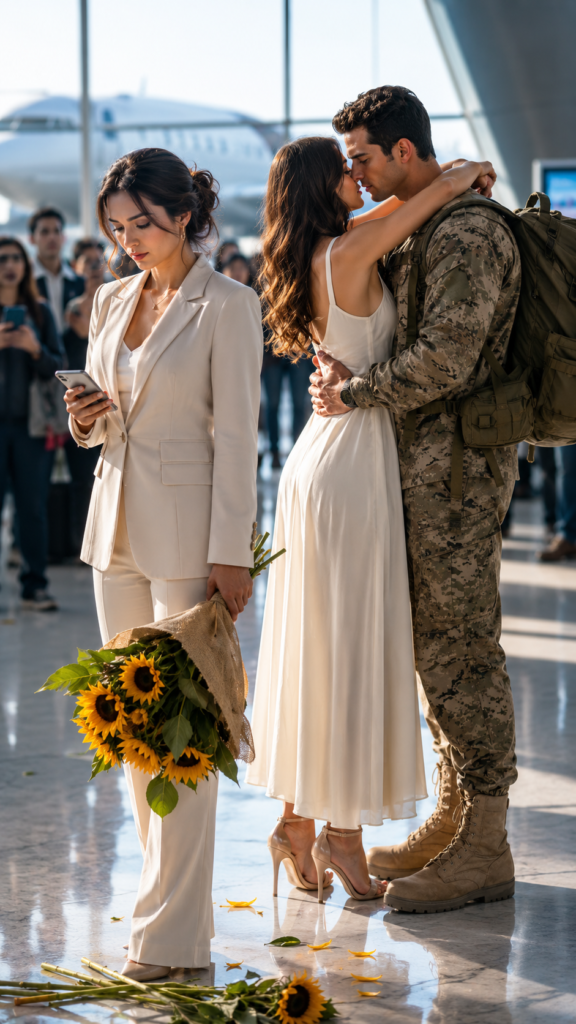
Camila Aranda arrived at Guadalajara International Airport with a bouquet of sunflowers pressed against her chest.
She had spent five years imagining this moment.
She wore the blue dress Mateo Robles had given her before he left as a military doctor on a mission abroad.
She had styled her hair in soft waves, just as he liked.
Mateo had promised to return.
He had sworn, in front of the Basilica of Zapopan, that when he came back, they would marry, buy a quiet house, and leave behind so many years of waiting.
—Just hold on a little, Cami. When I come back, we’ll finally start our lives.
She believed him.
And while he was away, Camila did much more than wait.
She took care of Don Aurelio, Mateo’s father, when he suffered that stroke that almost robbed him of speech.
She accompanied Doña Graciela Robles to doctor appointments, prayers, family meals, and funerals where everyone treated her like an unwelcome guest.
And above all, she saved Constructora Robles from disaster.
But Doña Graciela never accepted her.
—A woman too smart scares men away, my dear —she would say with a venomous smile—. Mateo needs a wife, not a boss.
Camila stayed silent.
Not because she was weak.
But out of love.
Later, she would lock herself in the office until dawn, reviewing contracts, renegotiating debts, and speaking with banks that no longer wanted to lend them a single peso.
No one in the Robles family knew that the money didn’t come from miracles.
It came from Fondo Aranda del Pacífico, her grandfather’s financial group.
No one knew either that Camila wasn’t just a grateful girl for marrying into a “well-known family.”
She was an heiress to one of the most discreet fortunes in Jalisco.
When the arrival doors opened, Camila felt her legs tremble.
Mateo appeared in olive green uniform, backpack slung over his shoulder, and a weary gaze.
She smiled.
Took a step.
But before she could call out to him, a woman in a beige dress rushed through the crowd.
—Mateo!
It was Renata Cárdenas.
The childhood friend.
The “almost sister.”
The woman Mateo spoke of with too much nostalgia, even though Camila always preferred not to ask questions.
Renata threw herself into his arms.
Mateo received her.
Not like a friend should be received.
He hugged her by the waist, closed his eyes, and buried his face in her hair.
Camila stood frozen.
A sunflower bent between her fingers.
She waited for him to pull away.
Waited for him to call her name.
But Mateo merely whispered something in Renata’s ear, and she cried against his chest as though she had also been waiting for five years.
Then Mateo turned.
He saw her.
—Cami… I swear, let me explain.
Camila glanced down at his hand, still resting firmly on Renata's back.
She didn’t scream.
Didn’t create a scene.
Her voice didn’t crack.
She walked to a trash can and dropped the sunflowers.
Then she pulled out her cellphone.
—Mr. Becerra —she said with a calmness that was frightening—. Cancel the financial guarantee for the Puerta Andares project for Constructora Robles immediately.
Mateo turned pale.
—What are you doing?
Camila didn’t look at him.
—Also withdraw the backing for the development in Valle Real and freeze any line related to Robles companies.
There was silence on the other end.
—Miss Aranda, without that backing, the construction company won’t make it to Friday.
Camila watched Mateo next to Renata.
And replied:
—Then let them finally know how much it costs to humiliate the woman who was holding their house together.
She hung up.
Mateo tried to approach.
—Camila, please…
She raised her hand.
—No. If you came back looking for other arms, stay there. I already understand.
That night, a black truck took her to a residence in Colinas de San Javier.
At the entrance, Don Julián Aranda, her grandfather, was waiting.
—Finally got tired, huh?
Camila placed the little box with the promise ring on a table.
—An Aranda returned, Grandpa.
And no one in the Robles family imagined that before dawn, the surname they flaunted in magazines would begin to crumble like adobe under the rain.
PART 2
Doña Graciela Robles received the first call at 7:12 in the morning.
It was from the bank.
Then another call came.
Then another.
In less than an hour, her living room in Providencia was filled with papers, lawyers, and long faces.
Don Aurelio, still struggling to move one hand, listened from his armchair.
—What do you mean the guarantee was withdrawn? —Doña Graciela asked, tightening her glasses against her chest—. That cannot just happen.
The accountant, a short man who had been covering holes with excuses for years, swallowed hard.
—It can happen, ma’am. The guarantee didn’t belong to any bank friendly to the family. It belonged to Fondo Aranda del Pacífico.
Doña Graciela frowned.
—Aranda?
The accountant couldn’t hold her gaze.
—Camila Aranda is the direct beneficiary of the trust that backed your loans. She also privately signed guarantees for payroll, suppliers, and construction advances.
Don Aurelio closed his eyes.
—Are you saying that Camila kept us alive?
—Not just alive, Don Aurelio —said the accountant—. She gave you oxygen when no one else wanted to come near.
Doña Graciela fell into a chair.
For five years, she had sent Camila for medicine, for bills, for flowers for the Virgin, for gifts for her friends.
She had seated her far from the main table at Christmas.
She had introduced her as “Mateo’s girl,” never as her future daughter-in-law.
And now she discovered that the same girl was the reason she was still drinking coffee in a house with Italian marble.
Mateo arrived shortly after.
Renata followed behind, with a washed face and swollen eyes.
Doña Graciela threw a folder at her son’s chest.
—Look what you did.
Mateo read it.
The color drained from his face.
—I didn’t know…
—Well, you should have known! —his mother shouted—. Or did you think the company would be saved with prayers and your letters from abroad?
Renata tried to speak.
—Ma’am, I didn’t know Camila was…
—You shut up —Doña Graciela cut her off—. You didn’t wait five years, doing the math, paying debts, and enduring scorn.
Renata lowered her gaze.
Mateo said nothing.
Because guilt began to settle where pride used to be.
He remembered Camila at the airport.
Her blue dress.
The sunflowers.
The way she threw the bouquet away without crumbling.
That hit him harder than any accusation.
Camila didn’t leave crying.
She left like someone signing a sentence.
That afternoon, Mateo went to find her in Colinas de San Javier.
The black gate opened after checking his ID.
Two guards accompanied him to a huge room, with windows overlooking a garden full of bougainvillea.
Camila stood, reviewing documents.
She wasn’t wearing the blue dress.
She wore a cream suit, low heels, and her hair tied up.
She looked calm.
And that destroyed him.
—You have ten minutes —she said.
—Cami…
—Camila —she corrected—. Nicknames are earned, Mateo.
He took a deep breath.
—What happened with Renata isn’t what you think.
Camila slowly closed the folder.
—And what do I think?
—She… she was with me in the toughest months. She wrote to me. She understood me. I was far away, confused.
Camila let out a brief laugh.
No joy.
—What a convenient word: confused. Men use it when they want to keep two doors open.
Mateo clenched his jaw.
—I never stopped loving you.
—But you did stop choosing me.
He fell silent.
—I took care of your dad —she continued—. I accompanied your mom when she fractured her hip. I saved contracts. Paid salaries. Endured being called interested at meals where I had put up the money for dessert.
Her voice barely trembled.
—And you came back hugging another woman as if I were just a pit stop.
Mateo took a step.
A guard moved.
Camila didn’t even blink.
—Don’t come closer.
—I made a mistake.
—No, Mateo. A mistake is forgetting your keys. What you did was cultivate another story while a woman was holding your life.
At that moment, Don Julián Aranda entered.
He was 80 years old, with a fine wooden cane and a gaze that didn’t need to shout.
—Young Robles, my granddaughter has heard enough.
Mateo straightened.
—Don Julián, I love Camila.
The old man observed him with a hard sadness.
—No, boy. You love that my granddaughter put out your fires.
He left another folder on the table.
Mateo opened it.
His hands trembled.
—The 51%?
Camila nodded.
—The expired guarantees are now enforceable. Fondo Aranda will take control of the construction company.
—That will destroy my family.
—Your family started to be destroyed when they confused my patience with need.
Mateo felt he couldn’t breathe.
—Is there no other way out?
Camila looked at him for the first time with pain.
—There was. It was at the airport. I had sunflowers.
The next day, news spread across Guadalajara.
Constructora Robles was losing operational control.
Banks froze lines.
Suppliers demanded payments.
Investors called for urgent meetings.
The same businessmen who had once greeted Doña Graciela at the club now replied with terse messages.
“I’ll get back to you.”
“I’m out of the country.”
“What a shame, comadre.”
The fall of the Robles surname made no loud explosive noise.
It made the sound of phones that stopped ringing.
Doña Graciela held out for three days.
On the fourth, she went to see Camila.
She arrived dressed in black, without makeup, with her pride broken in her bag.
The guards took her to the garden.
Camila was sitting in front of a cup of coffee.
—Camila —said Doña Graciela.
—Mrs. Robles.
That formal address broke her.
—I came to ask for your forgiveness.
Camila didn’t respond.
—I was cruel to you. I judged you without knowing you. I treated you as if you were worth less.
—You called me a gold digger —Camila remembered—. You told me Mateo came from a good family and that I should be grateful. You asked me not to appear in the anniversary photos because I was still “nobody.”
Doña Graciela lowered her head.
—I know.
—You also asked me for money for your sister's surgery and then said at the rosary that St. Jude had performed the miracle.
The woman closed her eyes.
—I have no defense.
—Then don’t make one up.
Doña Graciela began to cry.
—Please, don’t take everything from us. Aurelio won’t survive it. Mateo just returned. We can fix this.
Camila looked at her with a serenity that hurt more than anger.
—For five years, I thought the same. That a humiliation could be fixed. That a lie could be forgiven. That a disdain could be forgotten. But no, ma’am. One doesn’t break all at once. They break you little by little, until one day there’s nothing left to save.
Doña Graciela knelt.
—I beg you.
Camila stood up.
—Don’t kneel to me. Kneel to the construction workers you left without pay. To the secretaries who cried because they couldn’t pay rent. To the suppliers you brought around while spending on dinners in Andares.
Doña Graciela cried without being able to speak.
—I am not destroying the Robles —Camila said—. I am preventing you from continuing to destroy others.
The takeover occurred one week later.
Camila entered the boardroom without cameras, without the press, and without the desire to show off.
She arrived with lawyers, an external auditor, and a list of decisions.
The financial director was removed for embezzlement.
A cousin of Mateo was fired for collecting without showing up.
A partner was denounced for inflating budgets for affordable housing.
When Mateo entered, everyone fell silent.
Camila looked up.
—Dr. Robles. Have a seat.
The title pierced him.
He was no longer “my love.”
No longer “Mateo.”
He was a man sitting in front of the woman he had lost.
—I want to resign —he said.
Camila reviewed a document.
—You have no executive position.
Some lowered their gaze.
—Then I want to give up my shares.
—They are pledged against family debt. You can’t move them without authorization.
Mateo remained standing.
—Then tell me what you want from me.
Camila closed the folder.
—Nothing.
The word fell clean.
Cold.
Final.
—That’s what you don’t understand, Mateo. I no longer want anything from you.
Renata tried to see him several times afterward.
She sent messages.
Left him voice notes.
Even went to the military hospital.
Mateo didn’t receive her.
Not because he had become a saint.
But because he understood something that embarrassed him to accept: Renata didn’t destroy his relationship.
He had used her to not feel alone.
And had used Camila to avoid responsibility.
One night he found a box in his room.
Inside were Camila’s letters.
One for each month of absence.
Some spoke of her father.
Others about the company.
Others about how much she missed him.
The last one, written four days before his return, said:
“When you come back, I don’t want to keep being strong every day. I want to rest with you.”
Mateo cried.
Not as a soldier.
Not as a doctor.
He cried as a man who understood too late that the woman asking for rest had carried everything.
Meanwhile, Camila rebuilt what remained.
She paid overdue payrolls.
Rehired workers wrongfully dismissed.
Canceled dirty contracts.
Renamed projects.
And six months later, Constructora Robles ceased to exist as the family knew it.
Raíz Viva Desarrollo was born, a company focused on dignified housing, rural clinics, and technical schools for communities in Jalisco, Puebla, and Oaxaca.
The Robles retained a minimal part.
Enough to avoid living on the street.
Insufficient to regain control.
Doña Graciela stopped attending social dinners.
Don Aurelio never spoke ill of Camila again.
And Mateo requested a transfer to a rural clinic in the Sierra Norte of Oaxaca.
Before leaving, he left a letter at the reception of Camila's office.
She read it one rainy afternoon.
Not because she wanted to go back.
But because she was no longer afraid to read his name.
“Camila:
I’m not writing to ask for another chance.
I’ve already understood that there are doors one locks themselves.
I’m sorry for leaving you alone with my family.
I’m sorry for allowing you to be humiliated.
I’m sorry for coming back and not running first towards the woman who held me up when I wasn’t there.
I said I served others, but you served everyone I abandoned.
I don’t deserve your love.
I hope one day I deserve your peace.”
Camila folded the letter.
She didn’t cry.
And that time it wasn’t out of pride.
It was because it no longer hurt the same way.
One year later, she inaugurated the first community clinic financed with resources recovered from the old Robles projects.
The building was on the outskirts of Puebla.
White.
Bright.
Filled with doctors, nurses, children, and families who could never afford private care.
Don Julián arrived in a wheelchair.
He took her hand.
—Your grandmother would be proud, dear.
Camila smiled.
—Do you think I did well?
The old man looked at the clinic.
—Anger brought you here. But this is no longer anger. This is legacy.
When Camila cut the ribbon, a little girl approached and handed her a sunflower.
Camila stood still.
For a second, she was back at the airport.
At the trash can.
With that bouquet that fell as if her life was falling too.
But this time, she took the flower.
Held it against her chest.
And smiled.
Because she understood that the sunflowers had never belonged to Mateo.
They were hers.
They were proof that even after waiting for someone who didn’t know how to return, a woman can still look towards the light.
At the entrance of the clinic, there was a plaque made from the melted gold of the promise ring.
It read:
“For the women who waited too long for someone who never truly arrived. May this door remind them that they can always return to themselves.”
Far from there, in a clinic in Oaxaca, Mateo watched the inauguration on television.
The camera focused on Camila.
Serene.
Elegant.
Free.
He didn’t change the channel.
He simply lowered his gaze and accepted that some women do not get lost.
They free themselves.
And Camila Aranda didn’t sink a family out of spite.
She sank a lie.
And on its ruins, built something that no one would ever take from her.