PART 1
Elena Morales never imagined that bringing her daughter to the office would end up reopening a wound that one of Mexico's most powerful families had been trying to hide for three long years.
That morning, Doña Lupita, the neighbor who took care of Sofía, slipped on the stairs of her building in the Narvarte neighborhood and injured her knee.
Elena had no family nearby, nor the money for an emergency daycare. Missing work meant losing her monthly bonus and, perhaps, her job altogether.
So, she made a desperate decision.
She stuffed toys, cookies, and a little blanket into a backpack and took Sofía to the offices of Grupo Valdés in Santa Fe.
Her plan was to hide her for a few hours in the break room.
But Sofía, barely two years old, started crying just as Elena was cleaning the executive floor.
The sound traveled all the way to Alejandro Valdés’s office.
Everyone at the company feared him.
Not because he shouted, but because he didn’t need to. He owned an investment empire, spoke little, and could end a career with just one sentence.
Elena dashed to his office, convinced her career was over.
She opened the door and froze.
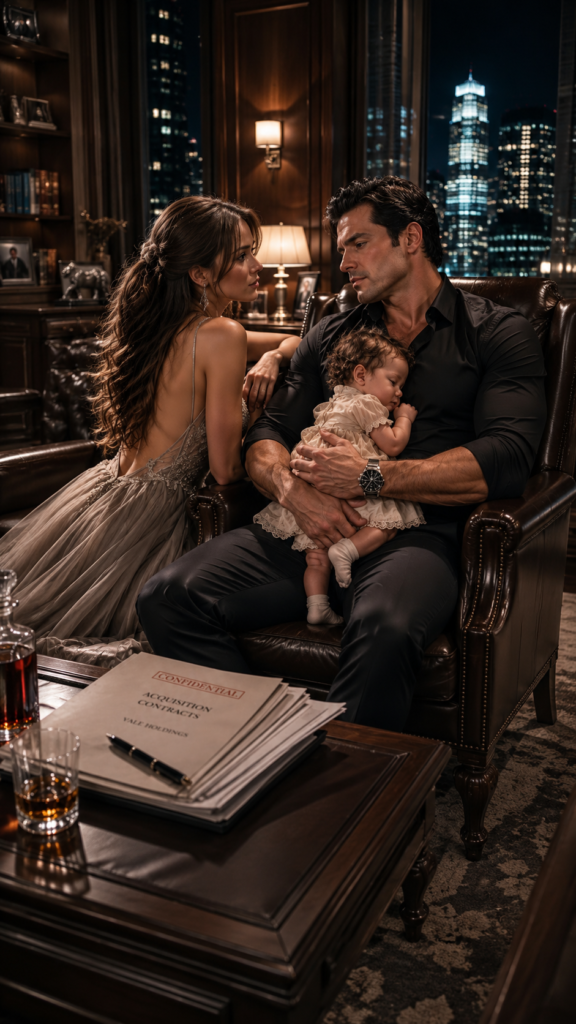
Alejandro was asleep on a leather couch.
Sofía was curled up against his chest, wrapped in the millionaire’s gray coat. One of her tiny hands gripped his shirt while he held his palm against her back, as if even in sleep he wanted to protect her.
Elena had never seen tenderness on that face.
When Alejandro opened his eyes, she began to apologize.
—Mr. Valdés, I’m so sorry. I’ll leave right away. I swear, it won’t happen again.
—No —he replied.
He pointed to the couch.
—Sit.
Elena obeyed, her legs shaking.
Alejandro looked at Sofía before speaking.
—She was cold. She stopped crying when I held her.
—I know I broke the rules.
—Rules don’t take care of children.
The phrase threw her off.
He called his assistant, requested that Sofía’s backpack be brought up, and ordered that no one disturb them for 30 minutes.
—When she wakes up, feed her and finish your shift.
Elena looked at him in disbelief.
—You’re not going to fire me?
—You need the salary.
—I also need to know if I’ll still have a job tomorrow.
—You will.
For the first time, his voice didn’t sound cold.
After a silence, Alejandro asked about Sofía’s father.
Elena pressed her lips together.
—He left before she was born.
She didn’t mention that the man was named Mateo Cruz.
She didn’t mention that he worked in a workshop in Coyoacán, that he loved overly sweet coffee, or that he had cried tears of joy upon learning about the pregnancy.
Nor did she say he had disappeared two weeks later, leaving without taking his clothes and without saying goodbye.
Alejandro observed Sofía’s tiny clenched fist.
—My younger brother used to sleep like that —he murmured—. As if even his dreams were secrets.
Elena felt a chill.
—What was his name?
—Mateo.
The air grew heavy.
—Mateo what? —she asked.
Alejandro lifted his gaze.
—Mateo Valdés.
Elena fumbled with her phone, clumsily showing him the only photograph she had of her daughter’s father.
Alejandro lost all color.
It was his brother.
Then he looked at Sofía’s dark curls, the shape of her mouth, and a small mark next to her ear.
The same birthmark Mateo had since childhood.
—How old is she? —he asked.
—Two years.
Alejandro did the math and hugged the girl tighter.
At that moment, Sofía opened her eyes, touched his face, and innocently said:
—Uncle Mateo.
Alejandro stopped breathing.
Because no one had taught her that name.
PART 2
Elena picked up Sofía in her arms.
—Who taught you to say that?
The girl pointed to the phone.
—Daddy.
Alejandro played a video that Elena hadn't seen in months. Mateo appeared, laughing while assembling a crib. In the background, a male voice said, “Hurry up, dude, you’re going to be a dad.”
The voice belonged to Alejandro.
The video had been recorded at a family gathering that Elena never attended. Mateo must have shown it to Sofía before he vanished, or someone had continued teaching her those images.
Alejandro immediately called Daniel Reyes, head of the family security.
In less than an hour, Daniel confirmed something worse: Mateo Cruz did not exist legally. The workshop, the lease, and even his bank account were registered with fake documents.
However, a camera from Elena’s building had captured a man resembling Mateo three months prior, watching from across the street.
Elena felt anger burning in her chest.
—He was close and didn’t come up.
—Maybe he couldn’t —Alejandro said.
—Everyone can knock on a door.
Alejandro didn’t reply.
That afternoon, while Doña Lupita was treated in a hospital, she confessed that Mateo had visited her six weeks after Sofía was born.
He had asked if Elena and the baby were safe. He also handed her a chain with an old key, marked with the initials E.V.
—He begged me not to say anything —the woman explained—. He assured me that if he returned, the people who were looking for him would come for them.
Alejandro recognized the key.
It had belonged to his mother, Emilia Valdés, who died in an accident when he was 13.
Daniel discovered that the key corresponded to a hidden compartment in the family’s old house in Las Lomas, a property that everyone believed had been sold.
The records told another story.
The house belonged to a secret trust whose beneficiary had been changed three months prior.
The new name was Sofía Elena Morales.
Someone alive, with legal access to Emilia’s documents, was still watching over the girl.
That same night, they went to the house.
The place had been closed for years but was not abandoned. There was recent food, footprints in the dust, and children’s drawings stuck in one room.
In one, there were two children, one tall man, and another wearing a cap.
Above the figures was written: “Noah, Sofía, dad and uncle Mateo.”
—Who is Noah? —Elena asked.
Daniel opened a hidden filing cabinet.
Inside were medical records, photographs, and an unfinished DNA test. Noah Bell, 7 years old, was the son of Mariana Bell, an event organizer Alejandro had met during a conference in Valle de Bravo.
Alejandro recalled a blurry night, months after his father’s death, when he drank too much and worked without sleeping.
—Are you telling me I have a son?
Daniel didn’t have time to respond.
A voice came from the hallway.
—Yes.
Mateo appeared with a beard, thinner and with a scar on his eyebrow.
Elena slapped him before he could get closer.
—Don’t look at me like you’re the victim.
Mateo lowered his head.
—I’m not.
Sofía watched him from Alejandro’s arms. Then she hid her face, unable to recognize the man from the videos.
That destroyed Mateo more than the slap.
He explained that Mariana had sought out the Valdés family to inform them that Noah was Alejandro’s son. Before she could do so, someone had entered his apartment and stolen copies of his medical records.
Days later, he died when his car lost its brakes.
Mateo investigated and discovered that the accident was related to Arturo Salgado, a longtime partner of both their father.
Salgado had been siphoning money for decades through shell companies. Emilia discovered it and decided to report him but died before handing over the evidence.
Alejandro’s father, fearing a scandal that could destroy the company, hid part of the truth and allowed Salgado to remain close.
Years later, Mateo found his mother’s documents.
He also discovered that Salgado knew about Noah’s existence.
The boy could inherit shares protected by Emilia’s trust. Sofía, as Mateo’s daughter, also had rights.
The two children were obstacles.
—That’s why you used another last name —Alejandro said.
—And that’s why I left Elena —Mateo replied—. Salgado already knew where I worked. They followed me to the workshop. I thought distancing myself would protect them.
Elena let out a bitter laugh.
—Protect us? Sofía had a fever, and I had no money for a taxi. I worked until the day of the delivery. She asked about her dad in front of a screen. Don’t call your silence protection.
Mateo absorbed every word without defending himself.
—You’re right.
That acknowledgment didn’t erase anything, but it prevented Elena from easily hating him.
Alejandro asked where Noah was.
Mateo revealed he lived with Ruth, Mariana’s sister, in Querétaro. He had remained hidden because Salgado paid people within the company, the police, and the family’s legal firms.
—And why come out now? —Daniel asked.
Mateo showed a folder.
—Because Salgado discovered the trust. Tomorrow he plans to transfer the shares and sell the company to a foreign fund. After that, the children will no longer be useful to him.
The statement froze the room.
Among the documents were accounts, emails, recordings, and payment orders related to Emilia and Mariana’s accidents.
But one piece was missing: the original ledger signed by Salgado.
Emilia’s key opened a compartment behind a mirror.
There lay the book.
Also, a letter addressed to Alejandro.
His mother explained that she had created the trust to protect any future grandchild from the decisions of adults. She asked him not to confuse the last name with family nor control with love.
Alejandro read the last line in silence:
“When the time comes, protect the children, even if to do so you must destroy what you inherited.”
The next morning, Salgado entered the boardroom convinced he would win.
Alejandro let him speak for 20 minutes.
Then he projected the bank transfers, played a recording, and announced that the Prosecutor’s Office already had certified copies of everything.
Salgado smiled.
—Without the original book, this proves nothing.
Mateo entered the room and placed it on the table.
The smile vanished.
Salgado was arrested along with two lawyers and a former commander who had manipulated the accident reports.
The subsequent investigation confirmed that the brakes of both vehicles had been tampered with. It also showed that several executives had hidden money and threatened witnesses for years.
Alejandro was able to save the company by blaming only Salgado.
He didn’t.
He published the documents, temporarily resigned from the presidency, and allowed a complete audit. Millions were lost on the stock market, but the families of affected employees received compensation, and those responsible were prosecuted.
Noah arrived in Mexico City a week later.
The DNA test confirmed he was Alejandro’s son.
The first meeting was awkward.
Noah didn’t run to him or call him dad. He stayed behind his aunt Ruth and asked if he could continue living with her.
Alejandro swallowed hard.
—Of course. No one will tear you away from the person who took care of you.
For the first time, he did something that couldn’t be bought or ordered: he waited.
With Mateo, something different happened.
Elena allowed him to see Sofía, but under clear rules and supervision. There was no romantic reconciliation or instant forgiveness.
—Disappearing could have saved our lives —she told him—, but it also broke us. You’ll have to accept both things.
Mateo began therapy, testified before the Prosecutor’s Office, and found work under his real name. Every Sunday he arrived on time, although Sofía barely looked at him at first.
Months later, during a meal, the girl offered him half a sweet bread.
To anyone else, it would have been a small gesture.
To Mateo, it was the first open door.
Alejandro created a daycare and emergency support program for all employees of the group. Elena was promoted to the labor welfare area because no one understood better what it meant to choose between a child and a salary.
She refused personal gifts.
She accepted opportunities.
A year later, Noah could spend whole afternoons with Alejandro without hiding behind Ruth. Sofía called him cousin and they argued over toys as if they had always known each other.
Mateo still carried guilt.
Alejandro still woke some nights believing he could control the past.
Elena still distrusted men who promised to protect her without asking what she needed.
But the three learned something uncomfortable: loving a family doesn’t mean deciding for it, but telling the truth, staying, and accepting the consequences.
The photo that ended up in Alejandro’s office didn’t show a perfect family.
It showed Noah making a face, Sofía with chocolate on her face, Mateo a step back, and Elena holding onto her daughter’s hand.
Alejandro was at the center, not as the owner of anything, but as someone who finally understood that blood can reveal kinship.
But only actions decide who deserves to stay.