PART 1
—If you were so hungry, we left you the heads. The meat was for the real family.
That’s what Lupita said, a can of beer in hand, as Fernanda stepped into her mother-in-law’s house and saw two cold lobster heads mockingly arranged on a ceramic plate.
The living room smelled of butter, dried chili, lime, and cynicism.
Shells were strewn across the tablecloth, dirty napkins littered the floor, empty cans lay beside the couch, and plates were smeared as if a family dinner had been replaced by a riotous looting.
Fernanda entered, her hair damp from the drizzle of Guadalajara. Her white blouse clung to her shoulders, and she still held the car keys in her hand.
Mauricio, her husband, closed the door slowly.
He said nothing.
That was what terrified Fernanda the most. Mauricio didn’t shout, didn’t demand, didn’t ask questions. He just looked at the table, then at their six-year-old son, Emiliano, standing by the hallway with red eyes.
An hour earlier, that same house had felt different.
Fernanda had arrived early with eight enormous lobsters bought from the Zapopan seafood market. They were no ordinary lobsters. They had cost a fortune, but she insisted.
She wanted to prepare one last dinner to reconcile with Mauricio’s family.
Doña Raquel, her mother-in-law, had been saying for months that Fernanda thought too highly of herself ever since her event decoration business began to flourish. That she no longer knew how to socialize. That she looked down on everyone.
Lupita, her sister-in-law, echoed the same with a venomous smile.
—Ever since she started bringing clients from Andares, she thinks she’s all that.
Fernanda swallowed hard and remained silent.
That wasn’t who she was.
She had paid for don Gilberto’s medications, Mauricio’s father. She had lent money for Lupita’s children’s tuition. She had bought groceries, fixed the refrigerator, and even covered overdue electricity bills.
But in that house, every favor was forgotten quickly.
And every boundary turned into an offense.
So that afternoon, while carefully washing the lobsters, she told Mauricio:
—I just want us to sit together. No fights. No jabs. For Emiliano’s sake, too.
Mauricio looked at her sadly.
—Fer, you don’t have to prove your worth to them.
—I don’t want to prove anything —she replied—. I just want to stop feeling like we come to a war every Sunday.
He agreed to help her.
They prepared garlic, butter, guajillo chili, lime, red rice, and salad. Emiliano entered the kitchen excitedly, wearing his dinosaur shirt.
—Am I getting a big claw?
Fernanda smiled.
—The biggest one will be for you.
Then Mauricio’s phone rang.
It was Iván, his partner in the auto parts shop. He spoke quickly, nervously. There were strange movements in a secondary account of Fernanda’s business: small, repeated transfers at odd hours.
Mauricio grew serious.
They had to leave.
Before heading out, Fernanda looked at Doña Raquel.
—Please wait for us. We’ll be back soon. Emiliano wants to have dinner with us.
Doña Raquel didn’t even look up from her phone.
—Oh, sure, honey. The food won’t run away.
Lupita glanced at the steamer and let out a giggle.
—Just don’t take too long, because it tastes better hot.
Fernanda felt something twist in her stomach, but she kissed Emiliano on the forehead and left with Mauricio.
When they returned, the silence was worse than a scream.
Emiliano emerged from the hallway with a swollen face from crying.
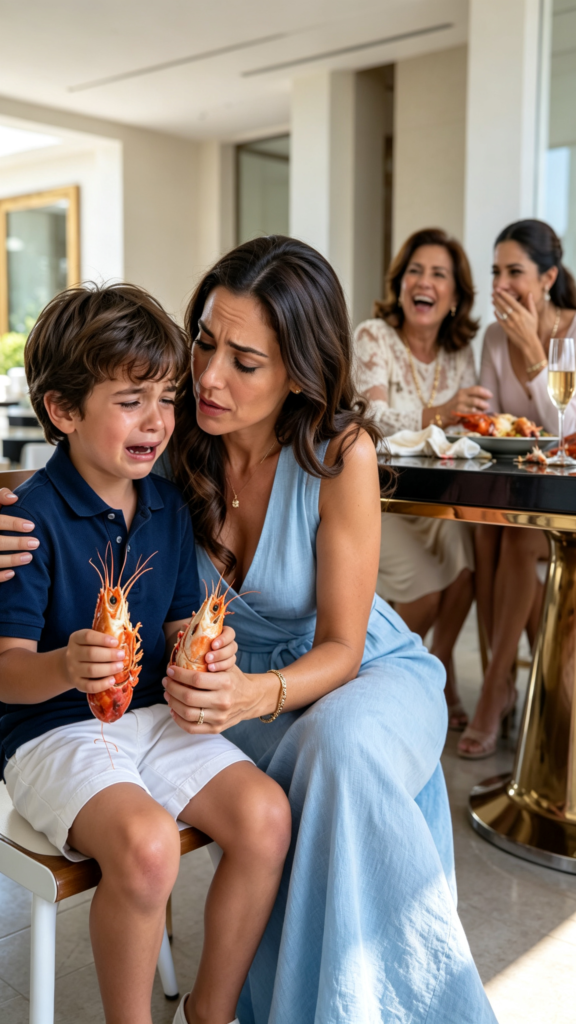
—Mom… my grandma said that kids waste expensive food. And my aunt said you guys could eat the heads because that’s why you work so hard.
Fernanda froze.
Mauricio walked to the table. He lifted a lobster head, stared at it for a few seconds, and then dropped it back onto the plate.
Then he let out a low, dry, unfamiliar laugh.
—Good to know you had such a nice dinner.
Doña Raquel frowned.
—Don’t start, Mauricio. Don’t make a scene over food.
Lupita shrugged.
—Seriously, you look like poor people fighting over seafood.
Mauricio took out his phone and set it beside the cold heads.
—This isn’t about the food.
Everyone froze.
He looked at his mother, then at his sister.
—This dinner was paid for with the same 200,000 pesos you all have been stealing from Fernanda’s account.
Doña Raquel’s smile vanished.
And Fernanda understood, her heart tightening, that the lobsters were just the beginning.
PART 2
—Stealing? —Doña Raquel spat, rising so fast that her chair scraped against the floor—. Be careful what you say, Mauricio. I’m your mother.
Mauricio didn’t move.
His voice came out calm, but firm.
—And Fernanda is my wife. Emiliano is my son. The business is hers. None of you had the right to interfere.
Lupita let out a nervous laugh.
—Oh, please. It was probably a bank error. Or that accountant Fernanda hired. Don’t come here playing theater just because you lost some money.
Fernanda stared at her.
Lupita didn’t ask how much was missing. She didn’t ask what account they were talking about. She didn’t ask when it happened.
She just shook her head.
Too quickly.
Rubén, Lupita’s husband, set his can down on the table and wiped his mouth with the back of his hand.
—Alright, calm down. In a family, things are discussed, not thrown around like this.
Mauricio looked at him.
—That’s what Fernanda wanted. To talk. That’s why she bought this dinner. That’s why she prepared everything early. You all couldn’t wait even an hour before tearing into the meal.
Doña Raquel crossed her arms.
—Don’t compare a dinner to accusing your family of being thieves.
Mauricio unlocked his phone.
—I’m not accusing you without proof.
He tapped the screen.
First, there was kitchen noise. Then Lupita’s voice, clear and mocking.
—Mom, send me another 4,000. Fernanda doesn’t check that account daily. If we take little by little, she won’t even notice. That woman just pretends to suffer.
Fernanda felt her legs weaken.
Lupita opened her mouth, but no sound came out.
Mauricio paused the audio.
—There’s more. One where Rubén asks if the motorcycle money has come through. Another where you, Mom, say that money “comes from the family anyway.”
Don Gilberto, who until then had been staring at the floor, placed a hand on his chest.
—Son, take it down a notch. Emiliano is listening.
Mauricio turned to the boy, who was clinging to Fernanda’s skirt.
—Precisely because of him, Dad. Because today my son learned that in this house even food is used to humiliate.
Fernanda felt a burning in her eyes.
She didn’t cry for the lobsters.
She cried for all the times she swallowed comments to avoid discomfort. For every loan that was never returned. For every “don’t be dramatic” when she asked for respect. For every Sunday she sat at that table pretending it didn’t hurt.
Lupita started to cry.
—I just borrowed it. I was going to return it. It’s not stealing if we’re family.
Fernanda stepped forward.
—Borrowed? In the middle of the night? Without asking permission? While you were calling me spoiled for keeping track of my accounts?
Lupita raised her face in anger.
—Oh, Fernanda, don’t play the martyr. You earn well. Mauricio does too. What’s 200,000 pesos for you?
Rubén pulled her by the arm.
—Shut up, Lupita.
But it was too late.
Doña Raquel, cornered, changed her tone. She no longer shouted. Now she spoke as if giving an order.
—Yes, I told her to take money out. So what? Mauricio is my eldest son. He used to help without anyone asking. Since he’s been with you, Fernanda, he’s become cold with his blood.
Mauricio shut his eyes for a second.
When he opened them, his expression had changed. It was no longer anger. It was disappointment.
—I learned about the transfers four days ago.
Fernanda looked at him, surprised.
—What?
Mauricio continued speaking without breaking eye contact with his mother.
—I didn’t want to believe it was you. That’s why I didn’t block the account immediately. That’s why I asked Iván to call me right when dinner was ready. I wanted to see what you would do if Fernanda and I went out.
Doña Raquel fell silent.
Lupita stopped crying.
Fernanda felt a chill run down her spine.
Mauricio hadn’t been acting strange because of the shop. He had been waiting for confirmation of something he already suspected.
—Tonight was a test —he said—. And you all failed miserably. You didn’t just take money. You also devoured everything Fernanda prepared to make amends and left Emiliano with the scraps as if he were less.
The boy lowered his head.
That broke something in Mauricio.
He pulled a folded folder from his jacket and laid it on the table.
—And now comes what you weren’t expecting.
Doña Raquel looked at the papers as if they were a living threat.
—What is that?
—Account statements, transfer captures, device records, and a letter from the lawyer.
Rubén turned pale.
—No way, Mauricio...
—Tomorrow at 10 a.m. you have two options —he continued—. Sign an agreement to return every peso, with guarantees and clear dates, or we file a complaint.
Lupita covered her mouth.
—You can’t do this to me. I’m your sister.
—That’s why you have until tomorrow. If you were strangers, the police would already be here.
Doña Raquel slammed her palm on the table.
—All because of this woman! She’s filling your head. She never wanted to be part of this family.
Fernanda took a deep breath.
For years, that phrase would have made her apologize.
That night, she wouldn’t.
—I did want to be part of it —she said, her voice trembling but firm—. That’s why I paid for medications. That’s why I lent money. That’s why I came even when you made me feel uncomfortable. That’s why I prepared this dinner. But you didn’t want family. You wanted access.
The living room fell silent.
Don Gilberto stood up slowly.
—Fernanda, dear, your mother-in-law was wrong. So was Lupita. But if you file a complaint, this will destroy us.
Fernanda looked at him sadly.
—No, Don Gilberto. This didn’t start when Mauricio put evidence on the table. It began every time you called “help” what took from me. Every time you allowed me to be humiliated. Every time you watched Emiliano cry and no one served him a plate.
Doña Raquel pressed her lips together.
—Oh, come on. It was lobster, not life.
Mauricio let out a bitter laugh.
—It wasn’t lobster, Mom. It was Fernanda’s last attempt to believe in you. And you devoured it.
No one responded.
Lupita approached Fernanda with trembling hands.
—Forgive me. I was desperate. Rubén owed money. My kids needed things. Mom said you had plenty, that it was fair.
Fernanda observed her.
For a moment, she recalled the Lupita from years ago, the one who asked for help to pay for a school uniform. The one who cried saying she didn’t have money for her son’s checkup. The one who promised to return 3,000 pesos and never brought it up again.
Before, that would have softened her.
Now she saw something else: a woman who didn’t ask for help but for permission to abuse.
—Don’t ask me for forgiveness because you were caught —Fernanda said—. Ask yourself for forgiveness for learning to take and calling it need.
Lupita broke down in tears.
Rubén, sweating, spoke for the first time without acting offended.
—I’ll sell the motorcycle. I can get part of it this week. But don’t get us into legal trouble. I have work, clients, reputation.
Mauricio looked at him coldly.
—Your reputation was lost when you bought a motorcycle with someone else’s money.
Rubén lowered his head.
Then Doña Raquel looked at Emiliano.
—My boy, tell your parents not to leave. Tell them your grandma loves you very much.
The boy hid behind Fernanda.
—But you didn’t give me dinner —he murmured—. You said I was going to waste the meat.
Doña Raquel’s face crumbled.
That was the hit no one expected.
It didn’t come from the audios, nor the papers, nor Mauricio. It came from a boy who didn’t understand banks or lawyers but understood when someone made him feel small.
Mauricio put the folder away.
—I don’t want calls. I don’t want threats. I don’t want anyone looking for Fernanda to blame her. Everything will be in writing with the lawyer.
Doña Raquel stepped toward him.
—This is also your home.
Mauricio looked at the dirty table, the cans, the shells, and the two cold heads.
—No. This stopped being my home today.
They left with Emiliano’s backpack, Fernanda’s bag, and the folder of documents. The rain continued to fall softly on the street. Emiliano fell asleep in the car before they reached the avenue.
Fernanda gazed out the window.
She didn’t feel triumph.
She felt pain, anger, and a strange calm, like finally closing a door she had been banging on for years.
Mauricio drove silently to a small hotel near the shop.
Then he said:
—I rented an apartment a week ago.
Fernanda looked at him.
—Were you already planning to leave?
—I was planning to protect you. But I needed you to see what I could no longer justify.
Fernanda hurt at the thought that he had planned everything without telling her. But she also understood something that weighed even more: she had spent years looking for excuses not to break the peace.
And that peace had never been peace.
The next day, the lawyer sent the agreement. Lupita sent 21 audio messages crying. Rubén offered to sell the motorcycle. Don Gilberto asked to talk “like men.” Doña Raquel didn’t respond until night.
Three days later, they signed.
They returned part immediately. Rubén sold the motorcycle. Lupita pawned jewelry. Doña Raquel had to return the gold she had bought with the money taken from the account. The rest remained in monthly payments, with signed documents.
Mauricio didn’t expose them on social media.
He didn’t seek revenge.
But he never sat at that table again.
That was what hurt them the most.
Because for years they believed they could do anything and then cover it with the word “family.” They believed a mother could demand without respect. That a sister could take without asking. That a daughter-in-law should endure to be accepted.
They were wrong.
Two weeks later, Fernanda, Mauricio, and Emiliano moved to a small apartment in Chapalita. It had a simple kitchen, a living room with a gray couch, and a window where the afternoon sun came in.
It wasn’t luxurious.
But it was theirs.
No one entered without knocking. No one rummaged through drawers. No one commented on what they ate. No one called Fernanda selfish for caring for what she had built.
Emiliano took time to understand.
Sometimes he asked if his grandma was still angry. Fernanda didn’t speak ill of her. She just told him that loving someone didn’t mean allowing them to hurt you.
One afternoon, Mauricio came home with a bag of seafood.
Fernanda froze when she saw it.
—Lobster?
He smiled sadly.
—Yes. But this time it’s not to convince anyone. It’s for us.
The smell of garlic, butter, and lime filled the kitchen once more.
Fernanda felt a lump in her throat. She remembered the shells, the empty cans, the laughter, and the two cold heads on a plate.
Mauricio took her hand.
—We don’t have to keep living in that night.
Emiliano rushed in.
—Do I finally get a big claw now?
Fernanda knelt in front of him and smiled.
—Now you get the biggest one.
They sat together at the small table. Mauricio placed the best part on the boy’s plate, then served Fernanda, and finally himself.
No one mentioned how much it cost.
No one made hurtful comments.
No one had to earn their place.
They simply dined in peace.
Later, Emiliano looked at the lobster head on the serving plate and asked:
—Mom, can you eat that too?
Fernanda took a deep breath.
—Sometimes yes —she replied—. But it should never be the only thing someone leaves you to make you feel less.
The boy didn’t fully understand, but he continued eating happily.
Fernanda understood.
Those two cold heads, which one night seemed like the cruelest humiliation, ended up being the end of years of silence. They were the painful proof, but also the one that opened their eyes.
Months later, Doña Raquel sent her a message.
“I didn’t know it hurt you so much.”
Fernanda read it several times.
Before, she would have written a long response, carefully choosing each word to avoid seeming like a bad daughter-in-law.
This time she simply replied:
“Yes, I knew. You just thought I would never leave.”
Doña Raquel didn’t respond.
And that was fine.
Because there are silences that no longer hurt. There are small families that heal better when they stop inviting those who come only hungry to take advantage. And there are simple tables, with three plates and respect, that are worth more than any expensive dinner served among people who never knew how to love without demanding.