PART 1
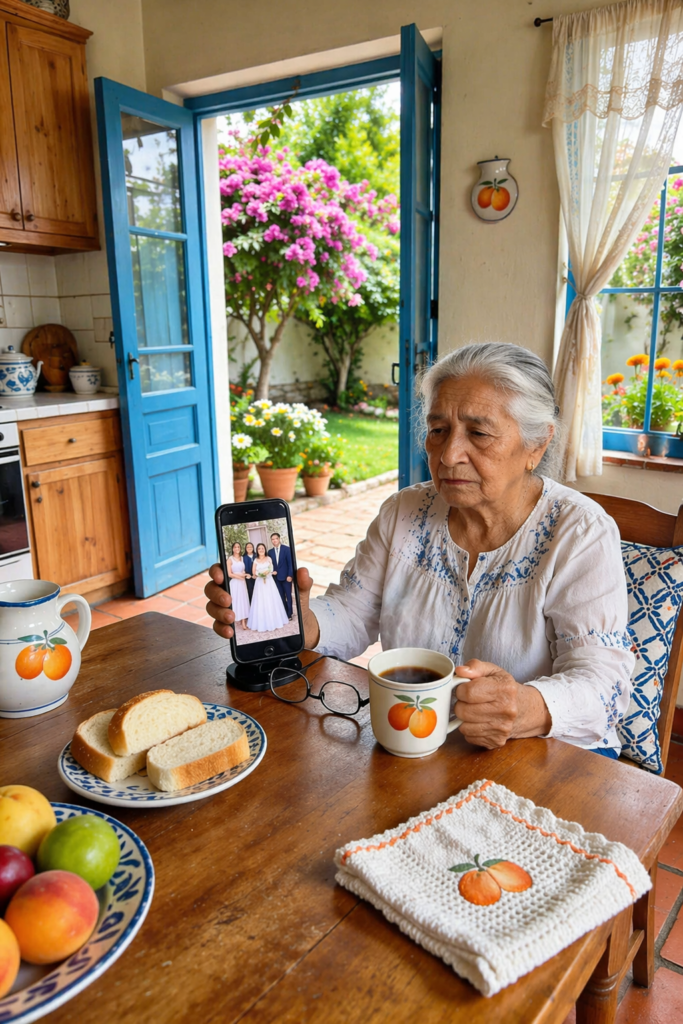
Doña Mercedes opened Facebook while her coffee cooled on the kitchen table in her small house in the Oblatos neighborhood of Guadalajara.
She did it every morning.
She scrolled through photos of her nephews, recipes, saints, memes from other older ladies, and occasionally a post from family that still hurt to see.
That Monday, she found a new album.
"Wedding of Camila and Andrés."
Her granddaughter.
Doña Mercedes felt a clumsy joy at first, the kind that arrives before the mind processes the blow. She tapped the photo with her finger.
Camila was dressed in white, beautiful, with a huge smile in front of a terrace full of bougainvillea. There were balloons, mariachi, a candy table, cousins, uncles, neighbors, people Mercedes had known for years.
40 photos.
In none of them was she.
She went through them one by one, slowly, with dry eyes and a tight chest. In one image, up front, next to the flower aisle, there was an empty chair. A little white card hung from its back, but she couldn’t read the name from her cellphone.
Doña Mercedes lived 40 minutes away by bus.
Not in another country.
Not sick in bed.
Not missing.
40 minutes.
She was 74 years old and her name was Mercedes Rivas.
Since her son Rodrigo divorced Lucía 12 years ago, she had chosen to side with him. He was her son. A mother, she thought, does not abandon her blood.
Camila went with her mom. At first, she called, sent messages, congratulated on birthdays. Then everything turned cold.
Rodrigo told her every Sunday:
—Don’t beg, Mom. The girl has already taken her mom’s side.
Mercedes believed him.
Who else would she believe?
Rodrigo was the one who called regularly. He asked if she had eaten, if she had taken her blood pressure pill, if she needed him to bring her water.
Four years ago, he also helped her with the bank.
—Send something to Camila for college, Mom. Even if it’s little. I’ll give you the account. She won’t thank you, but you do your part as a grandmother.
And Mercedes complied.
Every month she transferred money to the account Rodrigo had jotted down on a piece of paper.
On Tuesday, Rodrigo called as always.
—Did you see the photos? —he asked, his voice strange.
—Yes —she replied—. Why didn’t anyone tell me?
He sighed.
—It was Camila’s decision. She didn’t want any fights. She said better without you.
Mercedes swallowed hard.
—How many people came?
—About 80.
80 guests.
And her grandmother, alive, nearby, waiting.
That same day, she went to the bank and canceled the transfer. Then she went to the notary and removed Camila from the will: her savings, her gold earrings, and the porcelain display case that had belonged to her mother.
She didn’t cry.
She felt ashamed for not crying.
Three weeks later, the phone rang.
It was Camila.
—Grandma... did you cancel a transfer?
Mercedes tightened her grip on the cellphone.
—Yes. The one I sent you every month.
There was a long silence.
—Grandma... I never received any money from you. Never. Not a single peso.
PART 2
Doña Mercedes stood frozen in the kitchen, her hand trembling, the refrigerator humming behind her.
For a moment, she thought she had misheard.
—What do you mean you never got it? —she asked, her voice dry—. Your dad gave me your account. I’ve been depositing every month for 4 years.
Camila breathed heavily on the other end.
—My dad told me you didn’t want to know anything about me. That you said I was no longer your granddaughter because I went with my mom.
Mercedes had to lean on the table.
The coffee was cold again.
She went to the drawer where she kept receipts, medical prescriptions, old warranties, and bank papers. She pulled out the folded sheet where Rodrigo had written the account number.
She read it over the phone, digit by digit.
At first, Camila said nothing.
Then she spoke softly, as if she too were seeing a ghost.
—Grandma... that’s not my account.
Mercedes felt something collapse inside her.
Camila kept talking.
She told her that yes, she had invited her to the wedding. That she had given an envelope to Rodrigo to take personally. That he came back saying that Mercedes had refused to go.
—He said you replied: "No way am I going to that wedding" —Camila whispered—. But I didn’t fully believe him. That’s why I saved you a spot.
Mercedes closed her eyes.
The empty chair.
The little white card.
—What did the card say? —she asked, although she already knew the answer would tear her soul apart.
Camila cried for the first time.
—It said "Grandma Meche." It was up front. During the whole ceremony, I watched the door.
Doña Mercedes didn’t cry.
Not yet.
She hung up with Camila promising to see her soon, but first she made a call to the bank. She asked to confirm whose name the account was that she had sent money to for 4 years.
The girl took a few minutes.
—Ma’am, the account is under the name of Rodrigo Salazar Rivas.
Mercedes didn’t answer.
Rodrigo.
Her son.
The same boy she had carried one rainy dawn at the Civil Hospital. The same one she made soup for when he was sick. The same one who every Sunday asked her about her pills.
That son had taken her money.
And worse: had robbed Camila of 12 years of being a grandmother.
Mercedes grabbed her purse and left without changing her shoes. She took the bus with anger embedded in her bones. During the ride, she looked out the window at the streets of Guadalajara as if she had never seen them before.
She was going to confront him.
She was going to ask him what kind of son does that to his mother.
Rodrigo rented an apartment near López Mateos Avenue, in an old building with dry planters on the stairs. Mercedes knocked once. Then again, harder.
No one opened.
A neighbor came out of the apartment across the hall. She was an older lady in a blue robe, with a face that didn’t want to get involved in any problems.
—Are you looking for Rodrigo?
—I’m his mother.
The neighbor froze.
—Oh, ma’am... I thought you knew.
Mercedes felt a strange chill in her back.
—Knew what?
The woman lowered her voice.
—Your son is hardly ever here. He spends more time at the IMSS. He’s been in and out for over a year. He’s very sick.
Mercedes dropped her purse.
—No.
—I once helped him up. He came in pale, sweating. He told me not to tell anyone. That his mom would worry.
Mercedes’s rage didn’t disappear.
It turned into something else.
Heavier.
More confusing.
She remembered Sunday calls where Rodrigo sounded hoarse.
—It’s just a cold, Mom.
She remembered his birthday, 5 months ago, when he hardly ate any birria.
—I had a late lunch.
She remembered seeing his skinny hands, his deep dark circles, but thought they were work problems. She even teased him.
—You look like a coat rack, son. Eat well.
He laughed.
Now that laugh hurt.
Mercedes returned home without going to the hospital. Not because she didn’t want to know, but because her body couldn’t handle it. She sat in the backyard under an old vine and let the afternoon turn to night.
She couldn’t piece together the puzzle.
Rodrigo had lied. He had stolen. He had separated a grandmother from her granddaughter. That couldn’t be erased just because he was sick.
But if he was dying, why didn’t he ask for help?
Mercedes would have given him everything.
The house, her savings, the wedding ring she had kept since becoming a widow.
She would have wiped his forehead, fed him by mouth, sung "Las Mañanitas" softly if he had asked her.
Why did he prefer to become the villain?
At 6 in the morning, she took the first bus to the IMSS.
She found him in a bed, connected to IV, a gray blanket up to his chest. At first, she didn’t recognize him.
Rodrigo no longer looked like the man in the wedding photo, the one in a dark suit raising a glass.
He looked like an old child.
When he saw her, he wanted to cover himself.
—Mom... I told you not to come.
Mercedes walked to the foot of the bed.
—You never told me anything, Rodrigo.
He closed his eyes.
She didn’t scream. That was the hardest part.
She told him she knew about the account. That she knew Camila had indeed invited her. That she knew he had lied to both of them for 12 years.
Rodrigo didn’t deny anything.
—Why? —Mercedes asked—. I would have given you the money if you had asked me. But the thing with Camila… that was cruel.
Rodrigo swallowed hard.
—If you talked, everything would fall apart.
—What would fall apart?
He gestured minimally at his body.
—This.
Mercedes pressed her lips together.
—I’m your mother.
—That’s why —he said, with his eyes full—. Because you’re my mother. A mom shouldn’t have to see her son die.
Mercedes felt the hospital floor shift beneath her.
Rodrigo explained between pauses.
At first, it was something treatable. Then came tests, medications, chemotherapies that the insurance didn’t cover completely, private consultations, transfers, debts.
He didn’t want to sell the house to Mercedes.
He didn’t want to ask her for money.
He didn’t want her to stop eating well to pay for medications.
So he used the account.
—I thought it was a little, Mom. I thought you wouldn’t need it that much. And I told myself I’d pay it back later.
Mercedes looked at him without blinking.
—And my granddaughter? Did you also think you could pay back 12 years?
Rodrigo cried silently.
—I didn’t know how to stop. At first, I told one lie so you wouldn’t fight. Then another so you wouldn’t look for each other. When I got sick, I didn’t want anyone to see me like this. Not you. Not her.
—Camila needed you.
—I know.
—I needed you.
Rodrigo closed his eyes.
—I know that too.
Mercedes wanted to hate him with all her might, but the bed was full of wires, and her son's voice could hardly reach to ask for forgiveness.
—Why didn’t you let me go to the wedding? —she asked.
Rodrigo took his time.
When he spoke, his voice broke.
—Because that day was the last day I could stand straight. I took pills to hold on. I wanted Camila to have a nice picture with me. If you came in and saw me well, I would crumble. And I didn’t want to fall in front of my daughter dressed up.
Mercedes remembered the photo.
The raised glass.
The fake smile.
The empty chair.
He wasn’t a happy father showing off.
He was a sick man holding on with pride to give his daughter a clean memory.
Mercedes approached and kissed his forehead.
It was cold.
—I have to bring Camila —she said.
Rodrigo opened his eyes, frightened.
—No.
—Yes.
—She’s going to hate me.
Mercedes looked at him with fierce sadness.
—She has the right.
She went out to the hallway and called Camila. She told her everything with a broken voice: the illness, the account, the lies, the wedding, Rodrigo’s absurd fear of being seen as weak.
Camila couldn’t speak for several seconds.
Then she said:
—I’m on my way.
Mercedes hung up and went back inside.
Rodrigo was sleeping.
For 2 hours, she sat by his side. She tucked the blanket over him, moistened his lips with a gauze, stroked his hair like when he was a child.
At times she looked at him and wanted to forgive him.
At times she remembered Camila watching a door that never opened, and the anger hurt her again.
Life didn’t give her time to choose orderly.
At 10:20 in the morning, Rodrigo woke up.
—Did she come? —he asked.
Mercedes understood.
—She’s on her way.
He barely moved his head.
—Tell her I was happy at her wedding.
—You’re going to tell her yourself.
Rodrigo tried to smile.
—You’ve always been so bossy, Mom.
Mercedes let out a small laugh that broke into tears.
Camila arrived 18 minutes later.
She burst in, still with wet hair and no makeup. She stopped when she saw him. All the fury she had brought with her melted away at the door.
—Dad...
Rodrigo opened his eyes.
Mercedes stood up to leave them alone, but Camila took her hand.
—No, grandma. You stay.
And there they were, the three of them.
The wounded daughter.
The betrayed mother.
The man who wanted to protect them by causing harm.
Rodrigo asked for forgiveness. Not with pretty speeches but as best he could, between short breaths. He admitted every lie. He said he was cowardly. He said he confused caring with controlling.
Camila cried, but she didn’t immediately rush to hug him.
—You took my grandmother from me —she told him—. You made me believe she didn’t care.
Rodrigo nodded.
—I have no way to pay you back for that.
—No —she replied—. You don’t.
That was the most honest blow.
Mercedes felt pride for her granddaughter. Not for being tough, but for not pretending that love automatically erases everything, like in novels.
Rodrigo extended his hand.
Camila took her time but finally took it.
—I love you, Dad —she said—. But I’m angry.
Rodrigo wept.
—That’s good. That means you’re still here.
That night, Rodrigo worsened.
Mercedes and Camila didn’t leave the hospital. They took turns getting coffee from the machine, praying softly, and notifying Lucía, Camila’s mom, who arrived without asking questions, without complaining, without adding more poison.
At 3:40 in the morning, Rodrigo died.
There was no music.
No perfect phrase.
Just a machine shutting down, a daughter bent over the bed, and a mother repeating, "my boy, my boy" as if she could still bring him back to the world.
Later, a nurse handed them his belongings in a transparent bag: wallet, cellphone, watch, keys, and the gray jacket from the wedding.
Camila recognized it immediately.
—That’s the one he wore that day.
Mercedes reached into the inside pocket.
There was a sealed envelope.
On the front, it read, in neat handwriting:
"For my Grandma Meche."
Camila covered her mouth.
It was the invitation.
The one Rodrigo never delivered.
On the back, in shaky handwriting, he had written one line:
"If I see her walk through that door, I won’t be able to stay standing."
Mercedes didn’t open the envelope.
It wasn’t necessary.
Everything was there: the lie, the fear, the twisted love, the cowardice, the desperate attempt to appear strong when he was already crumbling inside.
Camila hugged her grandmother in the IMSS hallway.
They didn’t embrace as a perfect family.
They embraced as two survivors of the same lie.
Weeks later, Mercedes returned to the notary and put Camila back in the will. Not as a prize or an apology, but because the truth had returned to its place.
She also went to the bank.
She requested account statements, reviewed every transfer, and understood that almost everything had gone to hospitals, medicines, and medical debts. She didn’t justify it. She just understood it.
Because understanding doesn’t always mean completely forgiving.
Sometimes it means letting go of the wrong questions.
Camila began visiting her on Sundays.
She arrived with sweet bread, flowers, or simply with time. They sat in the kitchen, looked at old photos, and talked about what Rodrigo had taken from them, but also about what they could still rebuild.
At first, they cried a lot.
Then they began to laugh.
One Sunday, Camila brought the photo from the wedding where the empty chair appeared.
Now Mercedes could read the sign:
"Grandma Meche."
She touched it with her finger.
—I did want to go, my girl.
Camila squeezed her hand.
—I did wait for you.
They didn’t need to say more.
Since then, Mercedes keeps the envelope in the kitchen drawer, next to old receipts and medical prescriptions. She never opened it.
Every morning she takes it out, runs her finger over its name, and then puts it back.
Sometimes she gets angry with Rodrigo.
Sometimes she misses him so much it takes her breath away.
Sometimes she thinks it was unfair, noble, cowardly, and loving all at once. Because there are people who don’t know how to love without causing harm, and yet they leave a huge void when they are gone.
Camila learned something similar.
That not every family secret is born from hate.
Some are born from fear.
But fear also destroys.
That’s why, every time someone in the family says, "better not tell her so she doesn’t suffer," Mercedes slams her palm on the table and replies:
—No. The truth hurts, but the lie steals years.
And she knows it better than anyone.
Because for 12 years, she had a living granddaughter sitting on the other side of a lie.
And for 4 years, she had a son dying every Sunday over the phone, asking if she had taken her pill yet, while he swallowed the illness, pride, and guilt all alone.
Now the coffee cools just like that morning on Facebook.
But she is no longer alone.
Every Sunday, when Camila knocks on the door, Mercedes opens quickly, as if she could still make up for all the times she didn’t arrive in time.
And in the kitchen, between two cups, one sealed envelope, and a chair that never stays empty again, the two women continue learning something Rodrigo understood too late:
Loving someone isn’t hiding the pain.
Loving someone is letting them in before the door closes forever.