PART 1
For eight months, Mariana avoided opening the left side of the closet.
There lay Julián's shirts, his dusty boots, and three sweaters that still held a hint of his scent. Every time she tried to pull something out, she ended up slamming the doors shut and fleeing the room.
But that Tuesday, while the garbage truck rumbled through the streets of Querétaro, she decided it was time.
Julián had died of cancer in her arms. She had fed him, bathed him, and stayed by his side until his last breath, even though for a long time she believed he had stopped loving her long before he got sick.
Mariana began to empty drawers.
Behind a pile of blankets, she found a burgundy folder she had never seen in thirteen years of marriage. She sat on the floor, opened it, and felt something constrict her chest.
The first page was a medical diagnosis.
The date was written eleven months before the night Julián had taken his pillow and gone to sleep on the couch.
Mariana remembered that time perfectly.
First came the silences. Then, the calls he answered from afar. Then came the supposed work trips to León, Guadalajara, and San Luis Potosí.
Finally, one early morning, she searched for a charger in Julián's jacket and found a red lipstick next to a sample of women's perfume.
She didn’t make a scene.
She left the lipstick on the table and the next day brought him the divorce papers.
—Is that what you want? —Julián asked.
—I don’t want to keep embarrassing myself.
He didn’t defend himself. He didn’t explain anything. He didn’t ask for another chance.
He signed.
—Alright, Mariana.
Those three words shattered her more than any confession. She left believing another woman had erased thirteen years of their life together.
One month later, her sister Rebeca called her crying.
—Don’t file those papers. Julián has cancer.
Mariana returned.
During the following months, something unexpected happened: they reconnected. She shaved her head when he lost his hair, took him to Veracruz to see the ocean again, and slept beside his bed every night.
Before he died, Julián squeezed her hand.
—I loved you my whole life.
Mariana decided to forgive him for that supposed infidelity. She thought, at least, they had managed to say goodbye with love.
Until that Tuesday.
Beneath the diagnosis were dozens of chemotherapy receipts. The dates matched all his “work trips.”
Julián had never left with another woman.
He had gone alone to receive treatment.
Mariana kept searching and found a receipt: one red lipstick and one cheap perfume, paid with his card.
Then she found a folded sheet of paper.
It was a list written in his handwriting:
“Sleep on the couch.”
“Leave the lipstick where she can find it.”
“Don’t stop the divorce, even if it breaks my heart.”
At the top, underlined twice, was a phrase:
“It’s better for her to hate me now than for me to destroy her life taking care of someone who is going to die.”
Mariana could barely breathe.
And at the bottom of the folder, she found a small phone she had never seen before.
She turned it on.
There were months of loving messages sent by “the other woman.”
But all of them came from the same man.
Julián had invented a complete affair.
Then Mariana opened the last message. It wasn’t addressed to her or any woman.
It was addressed to Rebeca, her own sister.
And when she read the first line, she understood that the betrayal hadn’t ended.
It was only beginning.
PART 2
The message had been sent one year before Rebeca revealed the illness.
“When I can no longer hide it, seek her out. Tell her about the cancer, but only at the end. Don’t let her give up her life for me. Just let her say goodbye, that’s all.”
Mariana dialed her sister with numb hands.
Rebeca answered on the first ring.
—You found the folder already —she said.
She didn’t sound surprised. She sounded defeated.
—Since when did you know everything?
There was a heavy silence.
—From the beginning.
Mariana stood up so fast that she knocked a box with her knee.
—You watched me cry for months and didn’t say anything? You let me believe I was worthless?
—I swore to him, Mari.
—You swore to help him destroy me!
Rebeca began to cry.
—I swore I would protect you.
Mariana hung up.
That night, she spread every paper from the folder across her bed. She was no longer looking for proof of infidelity. She sought to understand how the man who had loved her could fabricate such precise cruelty.
She found notes written on napkins, medical prescriptions, and bus tickets.
“Buy a strong-smelling perfume.”
“Stop hugging her so she notices the distance.”
“Don’t change in front of her.”
“Don’t let her see how much weight I’m losing.”
Everything had been calculated.
Julián moved to the couch so Mariana wouldn’t feel his ribs at night. He avoided kissing her to hide the metallic taste left by the medications. He invented trips because he didn’t want her to accompany him to the chemotherapy sessions.
While Mariana sniffed his shirts looking for traces of another woman, he returned dizzy from a clinic, bought a sandwich he could hardly finish, and waited in the car until the color returned to his face.
She remembered the night with the lipstick.
Julián was sitting by the window when Mariana appeared with the object in hand. He looked down and let her insult him.
Mariana had believed it was the shame of an unfaithful man.
Now she understood it was the pain of a man watching his own lie play out.
The next morning, she drove to the neighborhood where Rebeca lived.
Her sister opened the door with swollen eyes. She didn’t try to hug her. She just led her to the kitchen and poured coffee into the chipped cups they had kept since they were young.
Mariana placed the folder on the table.
—Don’t hide anything from me anymore.
Rebeca held the cup with both hands.
—Do you remember Mom?
Mariana felt a shiver.
Of course she remembered.
Their mother had suffered from a degenerative disease for six years. Mariana had quit her job at an insurance company to care for her. She bathed her, changed her diapers, and endured days when her mother no longer recognized her face.
When their mother died, Mariana was 34 and felt like she was 60.
Julián had been there throughout the process. He watched her sleep in a chair, injure her back, and sell her car to pay for medications.
—What does Mom have to do with this? —Mariana asked.
Rebeca pressed her lips together.
—Julián did exactly what you asked him to.
—I never asked him to lie to me.
—No. You asked him to keep his distance if he ever got sick.
Mariana shook her head.
Then Rebeca reminded her of a scene she had buried.
The day of their mother’s funeral, Mariana had crumbled next to a flowerbed in the cemetery. Crying against Julián's chest, she told him she never wanted to become a burden.
“If one day I get something like this, promise me you won’t give up your life for me. I’d rather you abandon me than see you destroyed taking care of me.”
Those had been words spoken from exhaustion, guilt, and grief.
Mariana forgot them the next day.
Julián did not.
He held onto that promise for twelve years.
When he received the diagnosis, he knew Mariana would never abandon him if she knew the truth. He also knew she had already sacrificed six years for her mother and was willing to do it again.
So he decided to force her to leave.
—He said that if he asked you to go, you wouldn’t listen —Rebeca explained—. He knew you would stay, even if it meant losing your job, your money, and your own life.
—It was my decision!
—Yes. And that’s what he took from you.
The phrase left the kitchen in silence.
There lay the part Mariana couldn’t romanticize.
Julián had acted out of love, but he had also decided for her. He made her feel ugly, replaceable, and insignificant. He robbed her of months of peace to spare her other months of pain.
There was no simple villain.
Just three people making terrible decisions while trying to protect themselves.
—Why did you call me one month later? —Mariana asked.
Rebeca wiped her face.
—Because he worsened sooner than expected. The doctor said he might not get to say goodbye. Julián got angry when he found out he had called you.
—But he let me come back.
—Because when he saw you walk in, he no longer had the strength to throw you out again.
Rebeca opened a drawer and took out a white envelope.
—He asked me to give you this when you found out everything.
Mariana didn’t take it.
—Another lie?
—No. I think this time it’s the complete truth.
Inside was a USB drive and a note: “For when you can no longer ask me anything.”
Mariana returned home with the envelope in the passenger seat.
That night she connected the drive to the television.
Julián appeared, sitting in the chair where he pretended to stop loving her. He looked thinner than she remembered and wore a cap to hide his hair loss.
—Mari —he said, looking at the camera—, if you’re watching this, you already know there was never another woman.
Mariana covered her mouth.
Julián explained every part of the plan. He confessed to buying the lipstick, the perfume, and the phone. He admitted he sent himself messages to construct a believable story.
But then he said something she didn’t expect.
—I was also a coward.
Mariana stopped breathing.
—I used your promise as an excuse because I was afraid of seeing you suffer. I convinced myself I was saving you, but I was also running away. I couldn’t bear to imagine your face every time the doctor said I was getting worse.
Julián looked down.
—You didn’t have to forgive me for infidelity. You had to forgive me for not trusting in your strength.
That confession changed the weight of everything.
He wasn’t a perfect martyr. He was a terrified man who mixed love with fear and turned an old promise into a license to manipulate her.
In the video, Julián told her that several nights he almost confessed. Especially when Mariana shaved her head, when she took him to see the ocean, and when she told him again that she loved him.
—Each time I thought: “Tell her the truth, man.” But if I told you, it meant accepting that I hurt you for nothing.
Then he lifted the little phone.
—The fake messages were part of the act. The others weren’t.
Mariana took the device again and reviewed the entire conversation.
Among flirtatious invented phrases were texts written in the early morning:
“She fell asleep holding my hand today.”
“I prayed in the kitchen so she wouldn’t see me.”
“She laughs so I won’t be scared, but later cries in the bathroom.”
Those messages weren’t directed to a mistress.
They were a secret diary about her.
The last had been sent hours before he died:
“She’s here. She came back even though she thought I betrayed her. Maybe I don’t deserve this love, but I’ll leave feeling it. I hope one day she understands that everything came from my fear, not from a lack of love.”
Mariana cried until dawn.
For the first time, she wasn’t crying for the unfaithful husband she had forgiven or the hero who sacrificed himself for her.
She cried for the real man: loving, clumsy, scared, and capable of making a colossal mess trying to fulfill a promise he should have never taken as a sentence.
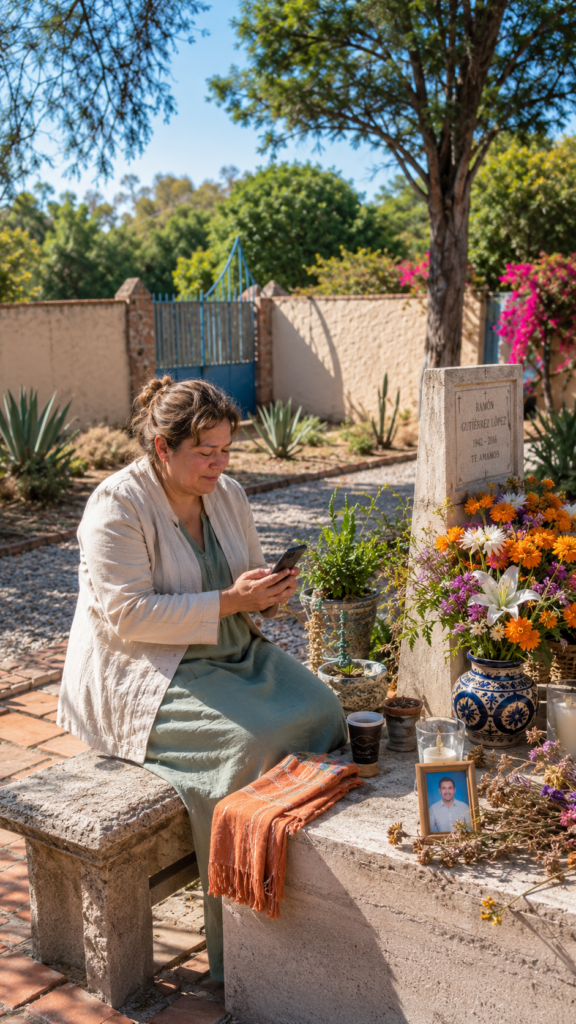
That afternoon, she took the phone to the cemetery.
She sat in front of Julián's grave while the sun dipped behind the trees.
She opened the nonexistent woman’s conversation and wrote:
“I understand now. You didn’t need to save me from loving you. You needed to trust that I could choose.”
She sent the message.
The personal phone she carried in her bag vibrated, because both numbers now belonged to her.
For two seconds, Mariana felt Julián had answered her from some impossible place.
Then she wrote another message:
“I loved you when you were my husband. I loved you when I thought you were a jerk. I loved you while you were leaving. But I’m still angry with you.”
The screen vibrated again.
Mariana let out a broken laugh through her tears.
Since then, she charges that phone’s battery every Sunday. Not because she expects a response, but because that’s where the only words Julián never dared to say to her face are kept.
Some people believe what he did was the greatest proof of love.
Others would say it was an unforgivable betrayal disguised as sacrifice.
Mariana still doesn’t know which side she’s on.
She only knows that loving someone doesn’t give the right to decide how much pain they can endure.
And that sometimes, lies born from love also leave wounds that even death cannot close.