Edward Kellner did not contest the will.
Not because the lawyers couldn't build a case. Not because Victor hadn't pushed. But because the morning after he read the fifty-three letters, he went back through the family's archived files and found the original documents — the ones his parents had drawn up in 1993 when Linh Chen was four months pregnant and twenty-two years old and in no position to know her rights.
He read them once.
He called his solicitors that afternoon and told them to stand down.
Then he called Mai.
She came to the house on a Tuesday morning.
For the first time in two years, the study door was open.
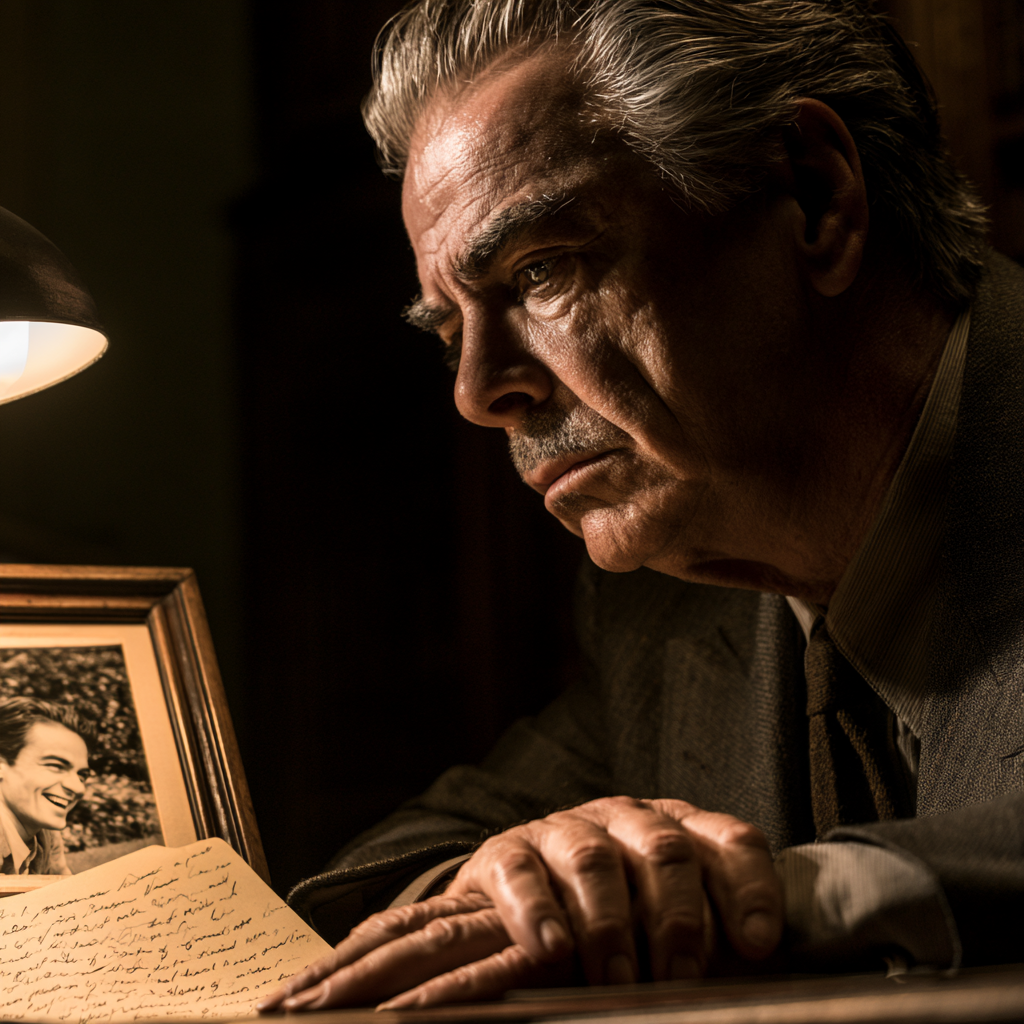
He was standing in the doorway when she arrived. He led her in without preamble. She had walked past this door so many times, heard the faint sounds of work through it, and now she was inside it, and it was just a room: books, a mahogany desk, a lamp, and on the wall, framed photographs.
She stopped in front of one.
A man in a garden. Young. Dark-haired. Laughing at something off-camera, one hand raised to push his hair from his face.
She stood there for a moment without speaking.
"James," Edward said, from behind her. "1990. He was twenty-nine."
She looked at the photograph for a long time.
"I thought I recognized something in this house," she said finally. "From the first week. I could never place it."
Edward came to stand beside her.
"He was five years younger than me," he said. "He was smarter than me, honestly. Kinder. He had this quality of paying full attention when you spoke to him — of making you feel like what you were saying was the most important thing in the room. I've always been better at half-listening." A pause. "I think you have it too. I noticed it. I chose not to think about why."
She turned to look at him.
He was looking at the photograph.
"I want to show you something," he said. He went to the desk. He opened the bottom drawer and took out a folder — not the letters, something older, on thinner paper. "These are from 1993. My parents had them drafted after James died. I found them in the archive two days ago."
He set them on the desk.
She picked up the first document.
A relinquishment of claim. Linh Chen. In exchange for twenty thousand pounds, she agreed to make no further contact with the Kellner family, to assert no claim on the estate, and to make no disclosure to any party of her relationship with the deceased.
She was four months pregnant when she signed this.
"Did she know she could contest it?" Mai asked.
"She was twenty-two. She was on a student visa. My parents had a law firm and she had nothing." He paused. "I'm not defending them. I'm explaining. What they did was not technically illegal. What it was — was a choice. To make a problem disappear."
"And you didn't know."
"I didn't know. I was thirty-one years old and my brother had just died and I told myself that whatever my parents were handling, they were handling." His voice was careful — not defending himself, just stating it, letting it stand or fall on its own weight. "I have spent thirty years not examining that decision."
She set the document down.
"She spent everything she had getting me back from the foster system," Mai said. "My grandmother. She was sixty-one years old when she started the legal process, and she spent five years in court. She never told me why she was so determined. I thought it was just — family. Her daughter's daughter."
"She knew," Edward said. "About James. About the Kellners. She knew who your father was."
"And she couldn't tell me directly without—"
"Without opening everything up. Without exposing Linh's choice. Without giving a name to something that had been nameless for twenty years." He was quiet for a moment. "Your mother was ashamed, I think. That's the most honest reading of it. She was twenty-two and she'd signed the papers and taken the money and she spent the rest of her life with that."
"But she left me a note," Mai said. "Before she died. Through my grandmother. An envelope. She said: there's a name. A good man. Find him if you ever need help. But be careful."
Edward looked at her.
"I assumed she meant you," Mai said. "But she said a good man. She knew you as the man who let his parents handle things."
"James," Edward said. Very quietly.
"She was pointing me toward the part of this family that was worth finding. The part that hadn't made the choice."
The room was very quiet.
"He would have wanted to know," Edward said. "I believe that absolutely. He would have married her." He looked at the photograph. "I should have said things like this out loud more often while he was alive."
A clinic confirmed the DNA four weeks later.
Mai had asked for the test partly for Priya's file and partly because she'd felt she owed it to herself — the certainty of an official result rather than a resemblance and a collection of letters. Edward had offered to submit his own sample without being asked.
She got the results on a Tuesday morning and sat with them for a long time before calling anyone.
Second-degree biological relative. Consistent with niece/uncle relationship.
She called Priya first.
Then she called Edward.
He picked up on the second ring. She heard the sound of his study — the familiar quiet of that room.
"I got the test results," she said.
"And?"
She told him.
He was quiet for a moment. Not a surprised silence. The silence of confirmation.
"All right," he said.
"All right," she said.
There was a pause that felt, for the first time, like the pause between two people who have something real to establish — not a history yet, but the agreement to begin one.
"What do you want to do?" he asked.
"I don't know yet," she said. "I think I need to sit with it."
"Take the time you need," he said. "I've already taken thirty years by accident. I can be patient on purpose."
Victor came to the house that evening.
He arrived in the way he had always arrived — certain, fluid, prepared to be the center of things. He came into the study and he stood in the doorway, and whatever he'd prepared to say appeared to dissolve slightly when he saw the photograph on the desk and the folders and the expression on his father's face.
"I want to be reasonable about this," Victor said.
"I know you do," Edward said. "Sit down."
"If she is who you think she is—"
"The DNA test confirmed it," Edward said. "Four weeks ago. She is James's daughter. Your cousin."
Victor looked at Mai. She said nothing.
"The will is still contestable," Victor said, quieter now. "Even if the parentage is confirmed, that doesn't automatically—"
"Victor." Edward's voice was the same even tone it always was. But underneath it was something that hadn't been there before — a firmness with its own weight to it, like a door being closed gently but completely. "I am not going to contest the will. The bequest to Mai stands. Your mother knew exactly what she was doing. She had been deliberate about it for four years. And if the situation were reversed — if it were my father who had been erased from a family's history at twenty-two years old — I would hope someone would do what your mother did."
"She's a stranger," Victor said. "I know the argument, I know what the papers say, but I don't — we don't know her."
"We've had two years to know her," Edward said. "I spent them not looking."
The silence stretched.
Grace appeared in the doorway behind Victor. She looked at the photograph on the desk. She looked at Mai. Something crossed her face — the watchful, calculating quality giving way, briefly, to something else. Something that might have been the beginning of understanding.
"Victor," she said quietly. "Come with me."
Victor stood for a moment longer.
Then he left.
Mai did not move into the Kellner house.
She was asked. Gently, by Edward, as an offer with no pressure behind it. She thanked him and said no. She had her apartment. She had her work. She had a life she had built with some difficulty and was not interested in exchanging it for one that came pre-loaded with other people's history.
What she agreed to was Sundays.
Sunday mornings in the kitchen — not the formal dining room, but the kitchen where Maria left covered plates and where Mai had sorted the medication bottles in December without making it into a gesture. They sat with coffee and she showed him photographs of her grandmother's house in Ohio, and he showed her more photographs of James: James at the university, James sailing, James at thirty-one laughing with Dorothy at a holiday table with no idea he had less than a year left.
Slowly, over the months, she began to understand the shape of who he had been.
She began to understand, too, the shape of who Edward was — not the man at the door with the mechanical nod, but the version that existed in the kitchen on Sunday mornings: deliberate, a little formal, genuinely trying. Not a natural father figure. Not a replacement for anything. Just a man who owed her something and was choosing, late, to pay it.
Victor was harder. They were in the same room at Christmas, and then again at Easter, and they were polite in the way of people who have agreed not to be enemies. Grace was warmer than expected — she had her own history with families that managed things, Mai gathered, and she recognized the damage differently than Victor did.
It was not a family yet. It was the beginning of the conversation that makes a family possible.
In May she met with Priya about the bequest.
"The fifteen percent is upheld," Priya said. "Edward withdrew the objection. Victor's separate contest was dismissed for lack of grounds."
"All right," Mai said.
"That's — a significant amount of money."
"I know."
"Do you know what you want to do with it?"
Mai looked out the window at the canal. She thought about letter thirty-five. She thought about a twenty-two-year-old woman being handed papers she didn't fully understand, with a law firm on one side and nothing on the other.
"I want to set up a legal support fund," she said. "For people in the foster system. For birth parents who sign things without understanding what they're signing. For children who have people looking for them but can't get through the legal maze." She paused. "There are a lot of people in the position my mother was in. And in the position I was in. And the only difference between them and me is that my grandmother didn't give up."
Priya looked at her for a moment.
"Your mother could have used that," she said.
"Yes," Mai said. "She could have."
It was September when she went to the graves.
The botanical garden was on the way — she drove past the hothouse where she and Dorothy had walked in February, the last good month, and she let herself feel it. The loss. The particular shape of it. Two years of Tuesday and Friday drives, of waiting rooms and blankets and low radio on the long way home. It was real and it was hers and she was not going to pretend it was simple.
Dorothy's grave was in the west section, where the Kellner family had plots. Simple stone. Dorothy Kellner, née Worthing. 1965–2026. Beloved Wife. And below that, in smaller letters that Edward had added after reading the letters: Who tried, in the end, to do right.
Mai put tulips on the grave. Dorothy had never mentioned caring about flowers in particular, but the gesture felt right — something from her grandmother's world brought into Dorothy's, a small acknowledgment that the two women had been connected through her without ever meeting.
She walked further along the path.
James Edward Kellner. 1961–1993. Beloved Son and Brother.
She had one tulip left.
She stood there for a while.
She thought about a twenty-two-year-old woman being handed papers and a sum of money that must have felt enormous and a clear signal from a powerful family about what her life was and was not allowed to contain. She thought about her grandmother at sixty-one years old beginning the legal process to reclaim a granddaughter she had never met. She thought about Dorothy sitting at her desk writing letters she knew she might never be able to say out loud.
Three women, across thirty years, all trying to do the same thing. All taking too long about it. All running out of time before they could say it plainly.
She thought about her grandmother's envelope. A good man. Find him if you ever need help. Be careful.
She thought: you were pointing me here. Not at the family. At the gap in it. At the person who should have been here.
She put the tulip on the grave.
She said his name, quietly, so that the name was in the air.
James.
She stood for a moment longer.
Then she walked back to her car.
She had a Sunday morning to get to — coffee, kitchen, photographs, the slow work of learning the shape of something new. She had a legal fund to set up. She had a solicitor to call and a grant application to write and a woman in Birmingham whose foster care case had been referred to her by a legal aid charity, a woman who had been trying for six years to find her daughter and who had, that week, found someone willing to help.
She started the car. She drove home.
She was not done yet.