PART 1
On the morning Camila Ríos stepped into Café Jacaranda with her four-year-old daughter, she only wanted to buy her a chocolate concha and forget about the overdue rent for a while.
Outside, rain poured down on the Veracruz boardwalk.
Inside, the air was thick with the smell of coffee, freshly baked bread, and cinnamon. For Sofía, her daughter, the place was a castle. For Camila, it was the only small luxury she could afford since leaving Mexico City and starting from scratch as a teacher at a public elementary school.
Sofía wore a yellow raincoat and red boots splashed with water. She bounced along happily, unaware that her mother had been hiding from a surname too powerful for four long years.
"Can you buy me that one, Mommy?" she asked, pointing to the biggest concha in the display.
Camila smiled, although her mind raced with calculations.
"Of course, my love."
She had learned to say yes to little joys. After the divorce, sleepless nights, diapers bought with spare change, and soft lies about a dad who "would understand one day," a chocolate concha felt like a small victory.
The line moved slowly.
Then Sofía tugged at her hand.
"Mommy…"
"What is it?"
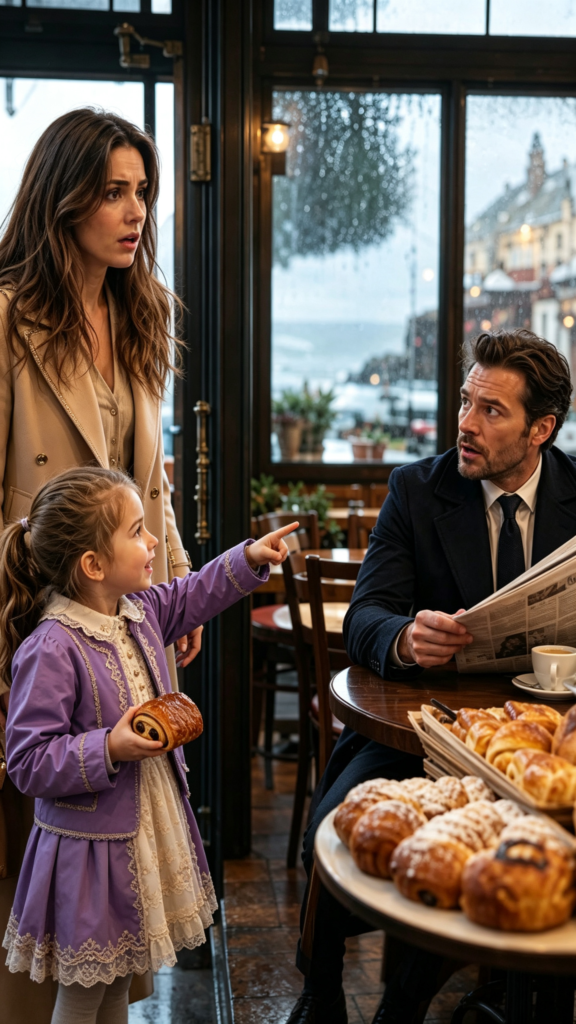
"That man is looking at us a lot."
Camila turned her head.
And felt her heart drop to the floor.
At the corner table, behind a folded newspaper, sat Santiago Echeverría.
Her ex-husband.
The tech mogul who had graced magazine covers, international forums, and financial scandals. The man Camila had loved until she uncovered shady contracts, hidden accounts, and a coldness that made her feel lonelier in a penthouse than in any rented room.
She hadn't seen him in four years.
Since the day she signed the divorce papers, her hands shaking, with a pregnancy test hidden in her bag.
Santiago lowered the newspaper.
His eyes locked onto Camila.
Then they dropped to Sofía.
And something in his face shattered.
The girl had his eyes. The same way of crinkling her nose. The same stubborn chin that Camila remembered all too well.
Santiago slowly stood, as if the world had just shifted beneath him.
"Camila…"
She tightened her grip on her daughter's hand.
"Sofía, go pick a table by the window."
"With a view of the boats?"
"Yes, my love."
The girl obeyed but didn’t stop looking at the stranger.
Once Sofía was away, Santiago stepped closer to Camila.
"Who is she?"
Camila felt her throat tighten.
"My daughter."
"Your daughter?"
Santiago's voice cracked.
"Camila… how old is she?"
She didn’t answer.
It wasn’t necessary.
He was too smart not to understand. Dates. Divorce. Silence. Four years. A girl with his eyes sitting by the window.
"You hid my daughter from me," he murmured.
"Don’t make a scene."
"A scene?" Santiago let out a dry, wounded laugh. "I just found out I have a daughter in a café, man… and you ask me to stay calm?"
Camila glanced at Sofía, who played with a napkin, unaware that her life had just been split in two.
Then the little girl raised her hand and asked innocently:
"Mommy, is that man my dad?"
PART 2
The question hung in the air amidst the noise of the espresso machine, the rain hitting the windows, and the conversations around them that continued as if nothing had just happened.
Camila felt every eye on her, though no one truly understood what had just transpired.
Santiago stood frozen.
For the first time since she met him, the man who always had the perfect answer was left speechless.
Sofía climbed down from her chair and walked towards them, her concha still intact on the plate.
"Is he?" she insisted.
Camila knelt before her and tucked a wet curl behind her ear.
"He’s someone Mommy knew a long time ago."
Sofía looked at Santiago.
"And why is he crying?"
Camila raised her gaze.
Santiago's eyes were filled with tears.
That detail disarmed her more than any shout. She had seen that man negotiate with bankers, face lawsuits, fire partners, and close million-dollar deals without batting an eye. But she had never seen him tremble in front of a four-year-old.
"I’m Santiago," he said softly. "And yes… I’ve known your mommy for a long time."
Sofía studied him with a seriousness that didn’t match her age.
"Do you live here?"
"I’m fixing a house near the old lighthouse."
"A lighthouse? That sounds like a story."
Santiago tried to smile.
"Something like that."
Camila interrupted before the conversation turned dangerous.
"Sofía, please finish your bread. Santiago and I will talk later."
"Later when?"
"When you’re asleep."
The little girl scrunched her nose.
"I always get put to sleep when interesting things happen."
Santiago let out a brief, broken laugh.
And that laugh was worse. Because for a second, Camila remembered the man he once was. Not the arrogant businessman. Not the husband who belittled her. But the young man who one night bought her tacos in Roma, spilled salsa on his expensive shirt, and said that life felt more real with her.
Camila paid quickly and left the café with Sofía.
Santiago didn’t follow them.
That surprised her.
The Santiago of before would have sent chauffeurs, lawyers, investigators—anything to regain control. But he stayed under the café's roof, watching them leave into the rain as if four years of life had just been ripped from him.
That night, Camila left Sofía with Doña Meche, the neighbor who had been helping her since she arrived at the port.
At nine, she walked to Zamora Park.
Santiago was waiting for her by a wet bench. He wore jeans, a dark jacket, and his hair was disheveled from the humidity. Without a suit, without bodyguards, without that shine of money that always surrounded him, he seemed less invincible.
"Explain it to me," he said.
Camila crossed her arms.
"Do you want the pretty version or the truth?"
"The truth."
"I left because you scared me."
Santiago closed his eyes.
"I would never have hurt you."
"Do you really think it’s only physical pain that hurts?" Camila swallowed hard. "I confronted you about the ghost companies, the contracts with politicians, the accounts in Panama. And you told me I was an naive teacher who didn’t understand how the world worked."
He looked down.
"I said unforgivable things."
"Yes. And then I found out I was pregnant."
The rain began to pour harder.
Camila continued:
"I wanted to call you. Several times. But every time I saw your name in the news, every time you were surrounded by powerful people, I thought Sofía would grow up in a war. Lawyers, press, bodyguards, your dad weighing in, your partners meddling. I didn't want my daughter to be just another accessory in the Echeverría family."
Santiago clenched his fists.
"My mom died without knowing she had a granddaughter."
Camila paled.
She knew that Doña Teresa, Santiago's mother, had died of cancer two years ago. That woman had been the only one in that family who treated her with kindness, who brought her tea when she saw her crying silently during dinners full of false businessmen.
"I didn’t know how to tell her," Camila whispered.
"She asked about you until the last month," Santiago said. "She told me to find you. She said I had lost more than a wife."
Camila felt a blow to her chest.
"I’m sorry."
"That’s not enough."
"I know."
He took a deep breath.
"I also have to tell you something."
Camila looked at him with distrust.
"What?"
"I didn’t come to Veracruz by chance."
The park seemed to run out of air.
"What do you mean?"
"After my mom died, I hired someone to find out if you were okay."
Camila took a step back.
"You had me investigated?"
"Yes."
"You’re sick, Santiago."
"I know. Or I know now." He didn’t try to get closer. "They told me you had been living here for six months. That you worked at an elementary school. That you seemed fine. They didn’t mention anything about a girl."
"And you bought the lighthouse house?"
"Yes."
Camila let out a bitter laugh.
"Why? To show up like a ghost in my life?"
"To ask for forgiveness one day. I thought if I searched for you directly, you would run. I hoped that maybe, if fate brought us together…"
"That wasn’t fate. That was manipulation."
"Yes."
The simple answer left her speechless.
The old Santiago would have defended his actions with ten arguments. This one stayed there, accepting blame as if he no longer had the strength to disguise it.
"I didn’t know about Sofía," he said. "I swear on my mother I didn’t know. If I had known, Camila, I would have come the same day."
"With lawyers?"
"No. On my knees."
She didn’t want to believe him.
But something in his voice sounded too broken to be a strategy.
For two weeks, Camila didn’t allow Santiago to approach Sofía.
He didn’t protest.
He just sent short messages. Asking if he could know what the girl liked. He didn’t ask for photos. He didn’t demand visits. He didn’t threaten.
Camila replied minimally.
"She likes mermaids, marine animals, and quesadillas without cheese because that’s what they call them."
Santiago responded:
"I’ll study."
She almost smiled but forced herself not to.
The first meeting happened on a Saturday at Villa del Mar beach.
Camila arrived with Sofía and a pink bucket. Santiago was already there, standing several meters away, carrying a backpack filled with sand toys, sunscreen, water, and hot chocolate.
Sofía recognized him.
"The lighthouse man!"
Santiago squatted down.
"Hello, Sofía."
"Do you know how to look for seashells?"
"Not yet. I came for you to teach me."
The girl took his hand without fear.
Camila felt a knot in her stomach.
She wanted to stop her.
Wanted to lift her and run.
But Sofía happily walked toward the shore, explaining to Santiago that broken shells weren’t trash, but "little pieces of stories." And he listened to her with such complete attention that he never once pulled out his phone.
Not once.
For an hour, Santiago dug tunnels, let Sofía fill his shoes with sand, and accepted wearing a crown made of seaweed because she declared him "king of the sea."
At sunset, the girl sat between the two and asked:
"Santiago, do you have children?"
Camila felt the world freeze.
Santiago looked at Camila, silently asking for permission.
She barely nodded.
He leaned toward Sofía.
"Yes, I have a daughter. But I’m just getting to know her."
"Who is she?"
"You."
Sofía's eyes widened.
"Am I your daughter?"
"Yes, my girl."
"Then are you my dad?"
Santiago cried without trying to hide it.
"Yes. I am your dad. And I’m so sorry for not being there before."
Sofía looked at Camila.
"Why didn’t you tell me?"
Camila took her little hands.
"Because mommy was scared. Because she thought she was protecting you. But you deserve to know the truth."
The girl fell silent.
Then looked at Santiago.
"My mom says that when someone says sorry, they also have to show it."
Santiago let out a laugh through tears.
"Your mom is right."
"Then you have to come to my school festival. I’m going to be a jellyfish."
"I’ll be in the front row."
"And you have to learn the names of the shells."
"All of them."
"And you can’t disappear."
At that, Santiago stopped smiling.
"Never again."
The following months were not a perfect novel.
They were awkward, slow, and filled with difficult questions.
Camila set clear rules. No expensive gifts. No chauffeurs to impress. No showing up unannounced. No speaking ill of her in front of Sofía. No using money to buy trust.
Santiago accepted every rule.
He arrived at the festival twenty minutes early and cheered wildly when Sofía came out dressed as a jellyfish with strips of cellophane. He attended school meetings. Learned to do twisted braids. Discovered that Sofía hated broccoli but would eat it if called "underwater trees."
One afternoon, when the girl had a fever, Santiago sat on the floor of Camila’s apartment and read stories for three hours while she spoke with the doctor.
He didn’t ask if he could take them to a private hospital.
He didn’t flaunt his connections.
He was just there.
That was what began to change something in Camila.
Not his donations. Not the articles about his "more ethical" company. Not the speeches.
His presence.
The way he learned to respect boundaries without feeling humiliated.
The old lighthouse also changed.
Santiago restored it with local workers and turned the ground floor into a free children’s library. He set up small tables, chairs, shelves full of stories, and a huge window overlooking the sea.
"Veracruz gave them a refuge," he told Camila. "I don’t want to buy forgiveness. I want to give something back."
Camila didn’t respond.
But that night, when Sofía drew three figures in front of the lighthouse and wrote in crooked letters "my almost complete family," Camila cried in the bathroom so no one could hear her.
On the day of the inauguration, half the neighborhood showed up.
Doña Meche brought tamales. The principal from the elementary school brought her students. The children ran between books and cushions. Sofía proudly shouted:
"This is my dad’s library!"
Camila watched Santiago kneel to help a child choose a story.
And for the first time in four years, she didn’t see the man from the penthouse or the name that scared her.
She saw a dad learning.
That night, the three of them climbed to the top of the lighthouse.
The sea crashed against the rocks. The lights of the boardwalk shone in the distance. Sofía pressed her face to the glass.
"It looks like the world is all sea."
Santiago smiled.
"A little bit, yes."
Camila stayed next to him, the wind blowing her hair.
"It still hurts that you investigated me," she said.
"I know."
"And it still weighs on me that I hid Sofía from you."
Santiago looked at her.
"I won’t use that against you."
"You should be angry."
"I am sometimes. But I also understand that fear makes horrible decisions when it masquerades as love."
Camila felt tears welling up.
"I thought protecting her meant hiding her."
"Maybe at that moment it was all you could do."
"No. It was all I knew how to do."
Santiago fell silent.
The old Santiago would have tried to win the conversation. This one just listened.
"I don’t know if I can get back with you," Camila said.
"I don’t want to go back to what we were."
She looked at him.
"I want something better," he said. "Without secrets. Without power looming above. Without closed doors."
"That takes time."
"I have time."
Sofía turned from the window.
"Mommy! Daddy! Come see a boat!"
Daddy.
The word still hurt a little.
But it no longer hurt like a lie.
One year after that rainy café, Camila walked into the lighthouse library holding Sofía’s hand.
Santiago was reading a story to a group of children. Sofía ran over and sat on his lap as if that place had been hers forever.
He made space for her without stopping his reading.
Camila stood at the entrance, watching.
The man who once measured his life in meetings, investments, and scandals was now spending Saturdays making octopus and shark voices for kids who didn’t even know how much money he had.
When he finished, Santiago approached with a small envelope.
"It’s not an expensive gift," he said quickly, almost nervously.
Camila opened it.
Inside was a key.
"To the lighthouse?"
"To any door that’s mine," he said. "Not to pressure you. Not to ask you to forget. Just so you know I don’t want to close anything with you again."
Camila grasped the key tightly.
"Santiago…"
"I love you," he said quietly. "But I’ve understood that loving means nothing if you don’t change what you do. So I’m going to keep proving it. For Sofía. For you. For what someday we might be."
Camila looked at her daughter.
Sofía had purple crayon on her cheek and was laughing with Doña Meche while organizing books.
Then she looked at the lighthouse.
It was no longer a property bought out of guilt.
It was a place filled with children, sweet bread, stories, sea breeze, and second chances that hadn’t arrived clean but earned.
Camila put the key in her bag.
"I don’t promise forever today."
Santiago nodded, his eyes shining.
"I know."
"But I promise I won’t run away anymore."
He exhaled as if he had waited years for that phrase.
"That’s enough for me."
Sofía ran to them with a drawing.
It depicted three figures holding hands in front of the lighthouse.
Above it read: "My complete family."
Camila read those words and understood something that many mothers learn late and with pain: protecting a child doesn’t always mean hiding the truth.
Sometimes it means telling it carefully.
Sometimes it means accepting that one was wrong out of love.
And sometimes it means allowing someone who failed to pay not with money, but with presence, patience, and actions.
Because forgiveness doesn’t erase what happened.
But when someone proves, day after day, that they are no longer the same person, maybe life does deserve another page.
And it all began with a four-year-old girl, a chocolate concha, and an innocent question that shook two adults:
"Mommy, is that man my dad?"