PART 1
The first day Sofia Rangel crossed the gate of the Mancini residence in Lomas de Chapultepec, she understood that luxury could also smell like confinement.
The house looked like it had been pulled from an upscale magazine: white walls, stone fountains, perfect bougainvilleas, and armored SUVs parked as if they were planters. But behind every window, there was a man watching, and behind every silence was something old, heavy, rotten.
Sofia was 31 years old, worked as a palliative care nurse, and had just come off two consecutive shifts at a private hospital in Mexico City. Her eyes were tired, her hair pulled back without grace, and she carried a backpack filled with gauze, gloves, medications, and a debt that wouldn't let her sleep.
The rich did not impress her.
She had seen businessmen die with watches worth 500,000 pesos and construction workers with hands full of cement. In the end, all of them asked for water the same way. All trembled the same. All wanted someone to tell them they were not alone.
At the entrance, Leonardo Mancini awaited her.
He was the visible head of a family that no one mentioned openly, but that everyone greeted with excessive courtesy in certain restaurants in Polanco. Tall, serious, dark suit, cold gaze. He didn’t need to shout for the guards to obey.
—You are Sofia Rangel —he said.
—And you are the son who thinks paying a lot buys absolute obedience.
A guard barely moved his head, surprised.
Leonardo looked at her as if he didn’t know whether to throw her out or offer her a better contract.
—My father is not an ordinary patient.
—In my shift, he is. If he breathes, eats, dehydrates, and refuses medication, he is my patient.
Leonardo took three seconds to respond.
—You’ve dismissed four nurses in ten days.
—Then they weren’t nurses. They were prudent people.
He didn’t smile.
He led her down a long hallway filled with Italian paintings, gilded saints, and family photos where nobody seemed happy. Sofia noticed five cameras, three reinforced doors, and seven armed men pretending not to look at her.
At the end was the room of Don Vittorio Mancini.
The old man was 82 years old and hadn’t spoken in three years after a stroke. Doctors said he could, but he simply refused. As if silence were the last throne he had left.
When Leonardo opened the door, Sofia felt a strange coldness.
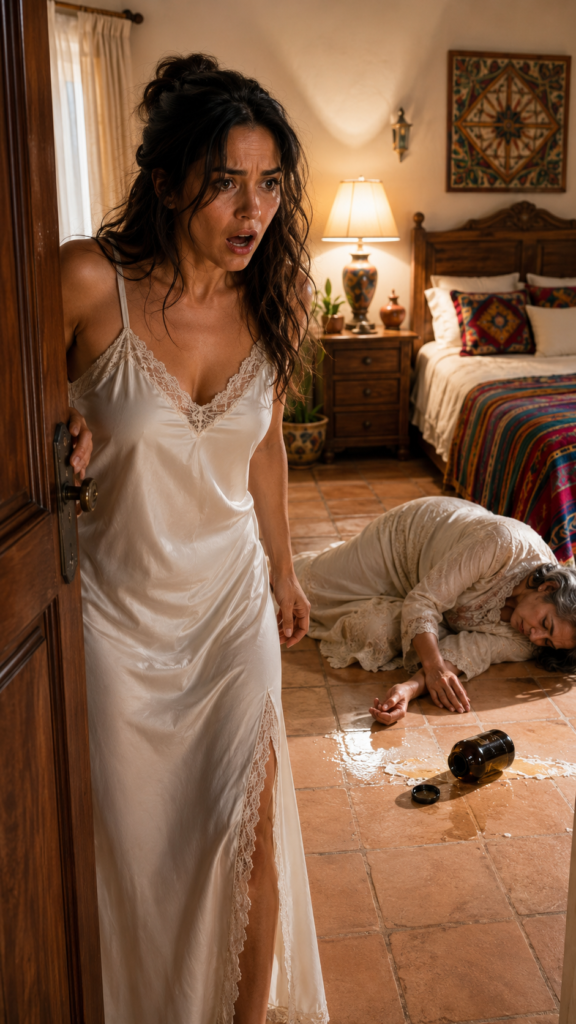
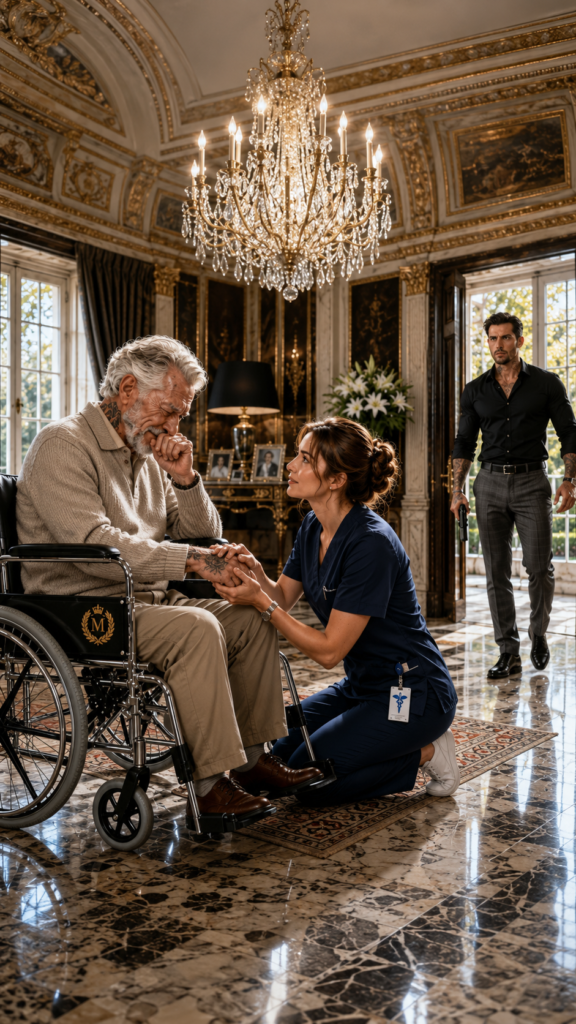
The room was dark, with thick curtains and the smell of old medicine. Don Vittorio sat by the window, covered with a gray blanket. He was thin, pale, almost paper-like. But his eyes were still alive.
Black.
Hard.
Violent.
Sofia placed her backpack on a chair.
—Good morning, Don Vittorio. I’m Sofia. I’m going to open the curtains because this looks like a wake in the countryside, but with marble.
No one breathed.
Leonardo took a step.
—He doesn’t allow...
Sofia had already pulled the curtain.
The light burst in, white, clear, brutal. Don Vittorio closed his eyes and clenched his jaw as if he had been insulted in front of his entire family.
—The light doesn’t kill —she said—. Pride does, but we’ll see that later.
For two days, the old man tried to break her without saying a word.
He spit out the medication.
He shut his mouth against the broth.
He threw the glass of water to the floor.
He looked at her hands, her neck, her back, as if remembering every place a body could ache.
On the third day, when Sofia attempted to place an IV because he was dehydrated, Don Vittorio grabbed her wrist.
It was quick.
Too strong for such a sick old man.
His bony fingers dug into her skin, leaving red marks. Leonardo, who had been standing at the door, stepped forward with a distorted expression.
—Dad, let her go.
Sofia raised her other hand.
—Don’t interfere.
The fourth froze.
She leaned toward the old man. She no longer saw the capo everyone feared. She saw a terrified man inside a body that no longer obeyed. A king without a kingdom. A father who preferred to destroy himself rather than accept help.
Then Sofia spoke softly, with a word her Italian grandmother used when the world became unbearable.
—Enough.
Don Vittorio remained motionless.
Sofia held his gaze.
—Enough, signore. The war is over. You don’t have to beat me.
The old man’s fingers trembled.
Then they opened.
Sofia calmly placed the IV, though her wrist hurt. Leonardo looked at her as if he had seen a tomb open.
—No one talks to my father like that —he murmured.
Sofia cleaned up the needle.
—Well, someone had to do it.
Then, from the chair, a broken, rusty voice, buried for three years, emerged.
—I am not dead.
Leonardo turned pale.
Don Vittorio barely turned his head toward his son and repeated, in Spanish, with anger and sadness:
—I am not dead.
PART 2
After those three words, the Mancini mansion stopped breathing the same way.
The guards looked at each other in the hallways as if they had heard a miracle or a sentence. The cooks crossed themselves when Sofia passed. Leonardo couldn’t take his eyes off her, but not with distrust anymore. Now he watched her like someone who has just moved a stone that nobody could lift for years.
Sofia, on the other hand, just wanted to finish her shift and go back to her apartment in Narvarte.
She had clothes to wash, overdue bills, and an old cat named Canela who hated being left alone.
But Don Vittorio didn’t fall silent again.
He spoke little, in short phrases, as if each word cost him blood.
—Water —he asked the next day.
Sofia handed him the glass without dramatizing it.
—Look at this, Don Vittorio. 82 years old and discovering that hydrating doesn’t destroy his reputation.
The old man looked at her with tired hatred.
—Impertinent.
—Alive, thank God.
Leonardo let out a minimal laugh from the door. His father immediately looked at him, and the laugh died on his face.
—You don’t laugh —Don Vittorio said—. You made this house sadder than a grave.
Leonardo clenched his jaw.
—I kept it standing.
—You filled it with fear.
The phrase fell like glass.
Sofia pretended to check the IV, but she heard everything.
For years, Leonardo had ruled the Mancini family with military discipline. Nothing moved without his permission. Nothing was said without measuring consequences. His father, before the stroke, had been worse: crueler, more elegant, quieter. But the illness had left the son with a poisoned inheritance.
Power.
Enemies.
And a house where everyone obeyed, but no one loved.
That night, before leaving, Leonardo stopped her next to the fountain in the courtyard.
—I want you to stay permanently.
—No.
—I’ll pay you four times more.
—No.
—you’ll have a private room, a driver, security.
—Mr. Mancini, I don’t know how to tell you this without hurting your ego: your house looks like a luxury hotel, but it feels like a kidnapping.
Leonardo pressed his lips together.
—My father responded to you.
—Because I’m not afraid of him.
—That’s exactly what worries me.
Sofia shouldered her backpack.
—Good night.
She didn’t reach the gate.
A loud crash shook the street.
First came the dry thud. Then the screams. After that, the gunfire.
The guards rushed toward the entrance. The armored trucks turned on their lights. Sofia crouched behind a column while Leonardo yanked her arm and pulled her back into the house.
—Up! —he ordered—. With my father!
—What’s happening?
—The Rosales.
The name was enough to pale two employees.
The Rosales were the rival family that had waited years to see the Mancinis fall. And now everyone knew Don Vittorio wasn’t dead but weak. Worse still, they knew a nurse had made him speak.
Sofia ran upstairs.
Don Vittorio’s room was illuminated only by a lamp. The old man didn’t seem surprised. He looked tired of being right.
—they’re coming for me —he said.
—Well, today I’m not in the mood for you to die —Sofia replied, closing the door.
Don Vittorio looked at her.
—they won’t enter through the front door. My son thinks like a bull. They think like rats.
Sofia felt a chill.
Then she heard a noise behind the wardrobe.
It wasn’t outside.
It was inside.
A section of the wall opened with a faint creak. Sofia barely caught a glimpse of the hidden passage when two men entered with short weapons.
She didn’t scream.
She grabbed the lamp and threw it at the first one. The bulb exploded. Don Vittorio, with an unexpected strength, shoved his medical table against the legs of the second.
The shot went off toward the ceiling.
Sofia lunged at the old man and threw him to the floor just as another bullet shattered the window glass.
Leonardo entered four seconds later with three men.
Everything was smoke, blows, and terse commands.
When it ended, one of the attackers was alive, bleeding on the carpet. Sofia had a cut on her eyebrow. Don Vittorio was breathing heavily but still conscious.
Leonardo knelt before her.
—Are you hurt?
—Your house has secret passageways, dude. Seriously, does no one check that?
One of the guards looked down.
Leonardo didn’t laugh.
He looked at the injured attacker and asked who had let him in.
The man smiled, his teeth full of blood.
—Ask your family.
The silence became more dangerous than the gunfire.
The next morning, the truth began to emerge like pus from a old wound.
They hadn’t entered by chance.
Someone inside the house had given them blueprints, schedules, and codes.
The betrayal came from within.
And not from a guard.
It came from Alessandra, Leonardo's younger sister.
The perfect woman of the family. The one who organized charity dinners, prayed at the noon mass, and spoke of honor with a pearl necklace. She had negotiated with the Rosales because she was tired of living in her brother's shadow and taking care of a father who never chose her to lead.
—Leonardo inherited everything —Alessandra said when confronted in the library—. I inherited fake smiles and silence.
Don Vittorio, sitting in his chair, looked at her as if she had been slowly stabbed.
—Daughter...
—Don’t call me daughter now —she spat—. When I could serve you, I was decoration. When he took command, I was a nuisance. And now you cry because I sought my place?
Leonardo stepped closer, furious.
—You sold Dad.
—I sold a corpse that refused to die.
Sofia felt nauseous.
Don Vittorio closed his eyes.
There was the true rotten heart of the Mancini house. It wasn’t just the enemies, nor the weapons, nor the dirty money. It was an entire family raised to obey, compete, and swallow affection until it turned into poison.
Leonardo wanted to call his men, but Don Vittorio raised his hand.
—No.
Everyone stood still.
The old man looked at his daughter.
—I did this.
Alessandra blinked.
—What?
—I made them fight for crumbs. I taught them that love was earned through obedience. I gave them fear when I should have given them a father.
For the first time, Leonardo lowered his gaze.
Sofia saw that this dangerous man’s jaw trembled like a scolded child.
Don Vittorio breathed heavily.
—But betraying to kill is not pain. It’s a decision.
Alessandra began to cry, but not from remorse. She cried from rage.
—you will always choose him.
—No —Don Vittorio said—. Today I choose for this house to stop rotting.
Leonardo called the police.
No one expected it.
Neither the guards.
Nor Alessandra.
Nor Sofia.
For years, the Mancinis had resolved everything in silence. Money, threats, disappearances. But this time, Leonardo turned in his own sister for attempted murder, conspiracy, and leaking information. He also turned in the live attacker, the cell phones, the cameras, and the access logs.
It was the first clean act in a house full of shadows.
Alessandra, handcuffed, glared at Sofia with hatred.
—you don’t know where you got yourself, nurse.
Sofia, with a bandaged eyebrow and her wrist still bruised, replied:
—I do. That’s why I’m leaving.
Leonardo turned to her.
—Sofia...
—No. I came to care for a patient, not to save a criminal dynasty.
—I can protect you.
—that’s the problem. Here, everyone calls protection locking people up.
Don Vittorio let out a bitter cough.
—She’s right.
Leonardo remained still.
The old man looked at his son with a sadness that no longer seemed like theater.
—If you want her close, let her go.
The phrase hit harder than any bullet.
Sofia didn’t ask what it meant. She didn’t want to know at that moment. She grabbed her backpack, asked for Canela to be brought to her, because yes, in the chaos, Leonardo had sent for the cat without consulting her, and left the mansion with discreet escort, not as a prisoner, but as a protected witness.
Five months passed.
Alessandra's case exploded on social media, although no one mentioned all the names. The neighbors of Lomas talked. The journalists smelled blood. The Mancini family had to break pacts, sell properties, and surrender businesses that had operated under the table for decades.
Leonardo didn’t become a saint.
No one changes just because a nurse shouts truths at them.
But something changed.
He opened a palliative care foundation in Iztapalapa, with audited money and external management. He didn’t put his last name on the facade. Sofia accepted to work there only under three conditions: total autonomy, no armed men inside, and no Mancinis giving medical orders.
The clinic was named Casa Alba.
Don Vittorio was transferred there when his health worsened. He was no longer in a dark room. He had an open window, clean sheets, the smell of coffee, and a low radio where Italian music sometimes played.
Sofia cared for him until the end.
Not because she forgave him.
But because that was her way of not resembling them.
One rainy afternoon, Don Vittorio asked to see Leonardo.
The son arrived without a jacket, with a tired face and less hard eyes.
—I’m sorry —the old man said.
Leonardo didn’t respond immediately.
For years, he had awaited that word. When it finally arrived, it no longer repaired childhood, nor nights of fear, nor the house full of closed doors.
But something softened.
—I don’t know if I can forgive you —Leonardo said.
Don Vittorio nodded.
—Then don’t lie. That’s already better than me.
Sofia was by the window, checking the IV. Don Vittorio beckoned her with a gesture.
—Enough —he whispered, trying to smile.
She understood.
She took his hand.
—Yes, Don Vittorio. Enough now.
The old man closed his eyes and died without speeches, without grandeur, without movie music. He died as everyone dies when the body surrenders: small, fragile, human.
Leonardo cried silently.
Sofia didn’t hug him immediately. She waited. Because even pain needs permission.
When he extended his hand, she took it.
A year later, Casa Alba attended to patients who couldn’t pay. Canela slept in the reception like the absolute owner of the place. Leonardo came some Thursdays with coffee, legal donations, and a patience he hadn’t had before.
One afternoon, he said to Sofia:
—I still don’t know how to be good.
She looked at him from the clinic door.
—Then start by not being cruel today. We’ll see about tomorrow.
Leonardo smiled slightly, like someone learning a new language.
The story of the Mancinis continued to divide opinions. Some said no one with so much blood behind them deserved redemption. Others swore that turning in his own sister was justice. Many debated whether Sofia had been brave or reckless.
But she never wanted to be a heroine.
She was just a nurse who entered a house full of fear, opened the curtains, and said a word no one dared to pronounce.
Enough.
And sometimes, for an entire family to begin to fall or to heal, all it takes is that:
A person who isn’t afraid to say it’s been enough.