PART 1
"Don’t make a scene, Emiliano. It was just a fall." Ofelia Barragán uttered those words outside the intensive care unit while her five brothers filled the waiting room as if they were at a barbecue.
One was telling a joke.
Another laughed with his mouth full of chips.
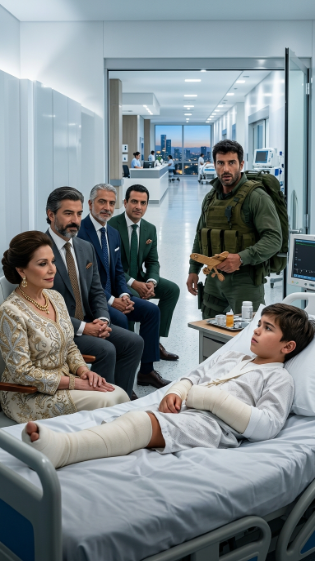
Fifteen meters away, Gael, seven years old, breathed through a machine.
Emiliano Córdova had just returned to Mexico after 91 days working as a rescue technician on an oil platform in the Gulf.
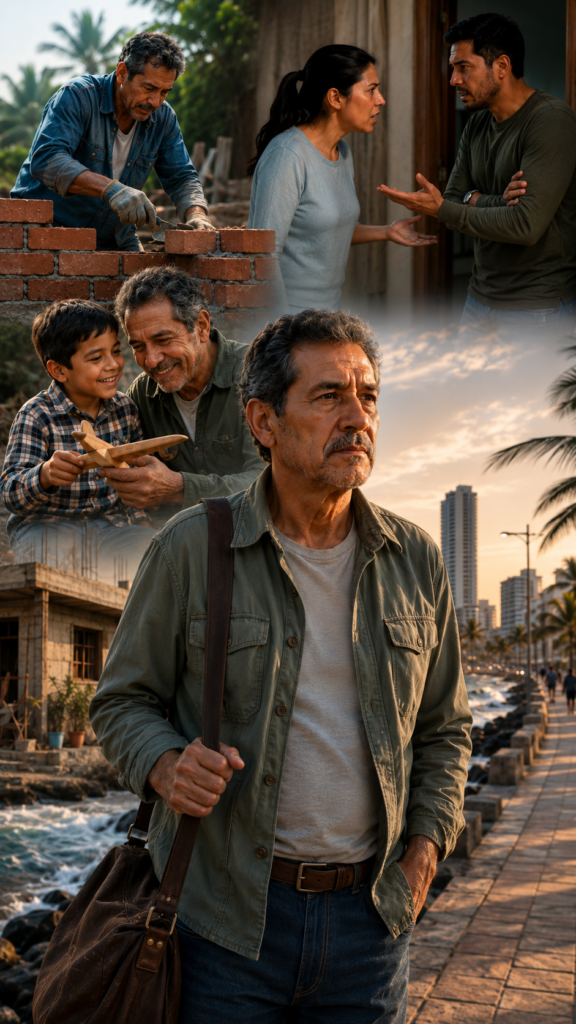
He still wore the company jacket, a backpack over his shoulder, and a small wooden locomotive he had carved for his son.
During the drive from Ciudad del Carmen to Puebla, he imagined Gael running towards him.
But upon arriving home, he found the door ajar, the room empty, and the drawings ripped from the refrigerator.
The neighbor, Doña Chelo, barely managed to look him in the eye.
"He’s at the Poblano Children’s Hospital," she murmured. "And don’t believe a word they say."
Eighteen minutes later, Emiliano stood before Doctor Elisa Montaño.
She closed the consulting room door and laid out several X-rays on a lit table.
"Your son has 42 fractures," she said. "Some are recent. Others have been healing poorly for months. There are ribs, wrists, a collarbone, a femur, and old injuries on his back."
Emiliano didn’t ask if Gael would live.
Not because he didn’t care.
But because he feared the answer would kill him before he could help.
The doctor showed photographs of small round burns on the child's arms.
"This wasn’t a fall, either."
Emiliano squeezed the locomotive until the wood dug into his palm.
He remembered the last video call. Gael wore a sweatshirt despite the heat, and Ofelia wouldn’t let him get close to the camera.
"Who brought him here?"
"His grandmother. She said he fell down the basement stairs."
Emiliano stepped into the hallway.
Ofelia rose with a rehearsed expression of sadness. Behind her were her brothers: Ramiro, owner of junkyards; Saúl, manager of a pawnshop; Bruno, bar operator; Efraín, city hall manager; and Nico, the youngest, who lowered his gaze upon seeing him.
"Son, you know Gael has always been restless," Ofelia said. "Don’t lose your mind over this."
"Forty-two," Emiliano replied.
Laughter died.
Ramiro adjusted his watch and smiled weakly.
"Watch your accusations, dude. You were gone for three months. We were here."
A prosecutor, Darío Luján, asked to speak with Emiliano privately.
"The DIF received five reports about that house over two years," he confessed. "All of them disappeared. The Barragán family has judges, police, and officials eating out of their hands. If you get violent, they’ll paint you as a dangerous father and take your child away."
Emiliano watched Ofelia signing documents next to a social worker.
"Why can she sign?"
Darío hesitated.
"Because she has a temporary guardianship."
The world froze.
"I never authorized that."
"A judge granted it eight days after you left the country."
Emiliano returned to Gael’s room, placed the locomotive by the bed, and stored copies of each X-ray.
He didn’t scream.
He didn’t threaten.
He just called someone and said:
"I need you to help me take down a family without touching any of them."
While he spoke, Ofelia appeared at the door with another document.
It was a request to make the guardianship permanent.
And it had a signature claiming that Emiliano had voluntarily given up his son.
PART 2
Emiliano didn’t take his eyes off the document.
The signature resembled his, but had one impossible detail: the initial of the second surname was traced backward.
His wife, Lucía, had died two years earlier. Since then, Ofelia had repeated that Gael was "the only thing she had left of her daughter."
Emiliano had confused that attachment with love.
Now he understood it was possession.
Doctor Montaño managed to transfer Gael to a specialized hospital in Querétaro before dawn.
She justified the move due to multiple trauma and the risk of family interference.
Ofelia arrived just as the ambulance was pulling away.
"I am his guardian!" she screamed.
Emiliano looked at her from inside.
"For a few more hours."
In Querétaro, he sought out Mariela Tovar, a lawyer known for confronting corrupt officials.
Her office was above a stationery store, devoid of fancy furniture or photos with politicians.
Mariela reviewed the guardianship.
The file claimed that Emiliano had abandoned Gael, suffered violent episodes, and posed a risk.
It included a psychological evaluation signed by a doctor who had never seen him.
It also contained three statements from neighbors.
Doña Chelo appeared among them.
The woman confessed that Efraín had forced her to sign blank sheets after threatening to shut down her husband’s workshop.
"I heard the boy crying," she said. "I reported several times. Then police came and told me to stop making up stories. I’m sorry."
Emiliano didn’t blame her.
He needed proof, not easy scapegoats.
His call was to Iván Salcedo, an old colleague from civil protection and now a federal financial analyst.
Iván didn’t investigate assaults; he traced the money that made them possible.
In 31 hours, he uncovered a network.
The Barragán family controlled four junkyards, two pawnshops, several bars, and an organization called Hands of Light, which received donations for children with disabilities.
Gael had been listed as a beneficiary for nine months.
They had billed for nonexistent therapies, orthopedic devices, and support for injuries that no one reported to Emiliano.
The fractures hadn’t just been hidden.
They had been billed.
"Man, they turned your son’s pain into receipts," Iván said.
That phrase made Emiliano punch the bathroom wall.
Just once.
Then he washed his knuckles and returned to Gael.
On the third day, Mariela received a message:
"There are more children. Look for Abril."
Abril Barragán was 16 and had lived with Ofelia since she was 11.
In documents, she was listed as a protected niece.
In reality, she hadn’t attended school for eight months.
Nico, the youngest of the five brothers, agreed to talk in the hospital parking lot.
"Abril is locked in the service room," he confessed. "She took care of Gael. She hid food and recorded what was happening."
"Who hurt my son?"
Nico started to cry.
Ofelia punished Gael when he refused to pose for medical photos.
Ramiro hit him if he ruined documents with tears.
Bruno used a hot tool to force him to repeat that he had fallen.
The others knew.
So did Nico.
"I never touched him," he defended himself.
"But you left him there," Emiliano replied.
That night, a federal unit and child protection personnel entered the house with a warrant related to Abril’s school disappearance.
They found her behind a door locked from the outside, barefoot and malnourished.
Inside her jacket, she had sewn a second phone.
There were videos.
Ofelia giving instructions.
Ramiro calculating how much they would pay for a fabricated surgery.
Bruno threatening Gael.
Efraín celebrating that another DIF report had disappeared.
In one recording, Ofelia spoke with a judge:
"When the guardianship is permanent, the father won’t be able to review accounts. The boy can still produce for several years."
But Abril had recorded something worse.
Ofelia confessed that Lucía discovered the fraud before she died and planned to report her uncles.
Her death had been recorded as a car accident.
The audio didn’t prove murder.
However, it revealed that Efraín paid to repair the vehicle two days before the crash, and the shop belonged to Ramiro.
Emiliano felt the ground vanish beneath him.
For two years, he believed Lucía died from rain and bad luck.
Now he didn’t know if they had also turned her into a business.
The Federal Prosecutor’s Office opened another investigation.
Mariela asked him not to confront the Barragán family.
It wasn’t necessary.
They came for him.
On the highway between Puebla and Querétaro, the brake pedal of his truck fell to the floor.
Emiliano slowed down, brushed the vehicle against the barrier, and managed to stop inches from a trailer.
The mechanic found a loose connection with a tool.
Emiliano accepted protection, not out of fear of dying, but because Gael couldn’t lose another father.
The damaged truck allowed for expanded warrants, intercepted communications, and protection for Abril and Nico as witnesses.
The guardianship hearing was set for twelve days later.
Ofelia arrived dressed in black, with a rosary and local cameras waiting for her.
She declared that an absent father was trying to take away the grandson she had "saved."
"That man returns, believing he’s a hero," she said. "Gael needs stability."
Emiliano didn’t respond.
The Barragán family needed to see him furious.
He denied them even that.
The hearing was moved to Querétaro due to a conflict of interest.
The judge listened to Doctor Montaño.
On the screen appeared the 42 fractures, the burns, the malnutrition, and the injuries from different dates.
Then Mariela spoke.
She proved that Emiliano’s signature had been copied from an employment contract.
The expert pointed out the inverted initial.
The supposed psychologist admitted he received money from Hands of Light.
Doña Chelo recounted the threats.
Nico explained who gave the orders.
Abril entered at the end.
Ofelia stopped crying.
"That girl is ungrateful. We picked her up from the street."
Abril looked at her without lowering her head.
"You didn’t pick me up. You locked me up."
The videos were played privately.
Seven minutes was all it took.
When the judge returned, Ofelia no longer seemed like a grieving grandmother.
She looked like a woman doing the math and discovering that all the sums equaled zero.
The temporary guardianship was annulled.
The permanent request was denied.
Full custody returned to Emiliano.
Outside, federal agents secured the junkyards, pawnshops, bars, and Hands of Light.
They froze accounts and found files on 13 minors used to claim support, insurance, and donations.
Ramiro was arrested trying to escape through the kitchen of a restaurant.
Bruno fled towards Veracruz, but was captured at a toll booth.
Saúl surrendered passwords.
Efraín blamed the judge.
Nico testified against everyone.
The five brothers who had laughed in the hospital ended up accusing each other.
Ofelia was arrested for fraud, forgery, domestic violence, and crimes against minors.
As she was handcuffed, she searched for Emiliano.
"I lost my daughter!" she screamed. "Gael belonged to me!"
He stopped.
"That’s why you never loved him. Because a child doesn’t belong to anyone."
Gael woke up two nights later.
His eyes were swollen and his voice tiny.
"Dad, can I go home with you now?"
Emiliano rested his forehead against his bandaged hand.
"Yes. But first, we need to teach your body that it’s safe now."
The recovery lasted months.
Gael feared stairs, closed doors, and the sound of keys.
Some nights, he hid bread under his pillow.
Other nights, he woke up apologizing without knowing why.
Abril also had to learn normal things: to sleep without shoes, serve herself another tortilla, and say "no" without expecting a hit.
She was sent to a protection home near Querétaro.
Emiliano and Gael visited her every week.
Later, when evaluations allowed, Emiliano started the process to receive her as a foster child.
He didn’t call her daughter.
He gave her something more urgent: time to choose.
One Sunday, Gael sat in the yard with the repaired locomotive.
He had painted two additional cars.
"This is for Abril," he explained. "This is where the unheard children go."
"And who drives?" Emiliano asked.
Gael pointed to a small figure in the cabin.
"Me. But you watch the road."
The Barragán case appeared on national news.
They talked about corruption, fake organizations, suspended officials, and a new investigation into Lucía’s death.
Emiliano declined interviews.
He knew that justice wasn’t in the cameras or in seeing Ofelia in handcuffs.
It was in Gael learning to stop hiding food.
In Abril returning to school.
In a child capable of sleeping without asking for permission.
The Barragáns mistook Emiliano’s silence for fear.
They expected an enraged father they could provoke, record, and destroy.
Instead, they found a patient father who kept 42 X-rays, followed every signature, and let their secrets do the rest.
Because there are families that use the word love to justify control, abuse, and silence.
And there are those who believe that sharing blood obligates forgiveness of the unforgivable.
Gael’s story left a question that divided everyone:
Does family deserve another chance just for being family?
Emiliano already had his answer.
Blood may explain where someone comes from.
But it never gives the right to break a child.