PART 1
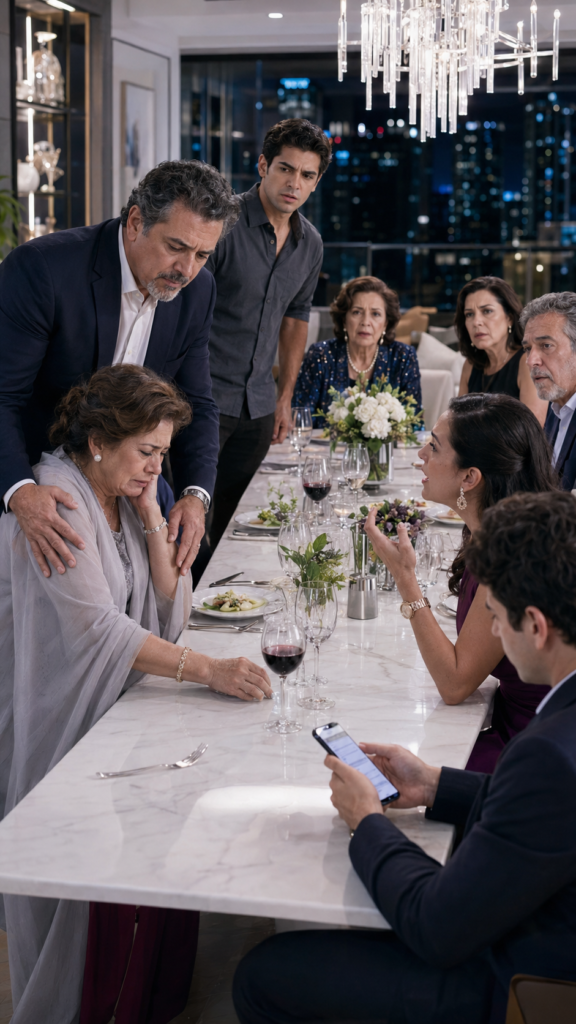
Doña Refugio's 70th birthday was celebrated at an elegant restaurant in Polanco, one of those places where the waiters speak softly, the glasses shine more than the smiles, and the food looks more like decoration than dinner.
The whole maternal family was there.
At the head of the table, doña Refugio received hugs like a party queen. Next to her was her favorite son, Dr. Arturo Salazar, a famous cardiologist at a private hospital in Santa Fe, expensive suit, shiny watch, and a smile of a man used to being respected by everyone.
But the one who drew the most attention was his wife, Marcela.
She arrived in a wine-colored dress, high heels, gold earrings, and a huge bracelet that jingled every time she moved her hand. She didn’t need to shout to humiliate; a smile was enough.
That night, Laura’s family seemed out of place.
Laura, doña Refugio's youngest daughter, arrived with her husband Martín and their son Diego, a 21-year-old engineering student at the IPN.
Martín was known to everyone as a simple maintenance technician at a parts factory in Ecatepec. Quiet, kind, wearing a plain shirt and old but well-shined shoes.
Laura held in her hands a gift wrapped in blue paper. It was an electric neck and back massager. Not luxurious, but she had chosen it carefully because her mom always complained about neck pain.
As they entered, Marcela looked them up and down.
—Oh, they finally arrived. What happened? Did the minibus get a flat tire?
Some awkward laughter followed.
Laura tried to smile.
—Martín had a problem at work, so we were a little late.
Marcela raised an eyebrow.
—A problem at that little factory? Come on, Lau, really, don’t make things up. How serious can it be to tighten screws?
Martín looked down.
Diego clenched his fists under the table.
It wasn’t the first time. Ever since Arturo started earning a lot of money and Marcela felt herself part of the “upper class,” Laura became the perfect target: the sister who “married poorly,” the one who never traveled to Europe, the one who bought clothes on sale.
Dinner had barely begun when Marcela pointed at the blue package.
—And that’s for your mom?
Laura placed it gently on the table.
—Yes. It’s a massager. My mom always says her neck hurts, so I thought it might help.
Marcela didn’t wait for permission. She yanked the box, ripped the paper, and looked at the gift as if someone had placed garbage in front of her.
—No, Lau… are you serious? An internet massager? How much did it cost? 600 pesos? 800?
Laura went pale.
—It’s not about the price, Marcela. I just thought of something useful.
—Useful would have been contributing something decent — Marcela replied —. My son Emiliano gave his grandmother an envelope with 50,000 pesos. 50,000. That’s how you show love to a mother.
Silence fell over the table.
Doña Refugio tried to intervene.
—Come on, Marcela. Laura doesn’t have as many resources. What matters is the intention.
But that phrase was worse than the insult.
Because it sounded like pity.
Laura lowered her head. Tears filled her eyes.
Marcela smiled, cruelly.
—It’s just that, mother-in-law, one thing is to have little, and another to show up with a trinket on such an important date. If one marries a man without ambition, then you end up with these humiliations.
Diego stood up abruptly.
—Aunt Marcela, that’s enough.
She looked at him as if he were a spoiled child.
—Sit down, Diego. You'd better study hard so you don’t end up like your dad. Because in Mexico, kid, without contacts and without money, just hard work isn’t enough.
Emiliano, his cousin, let out a laugh while looking at his new phone.
—Chill, dude. Don’t get all worked up.
Laura dropped her fork. The sound was dry, terrible.
Tears rolled down her face.
Martín, who had remained silent, lifted his head.
He didn’t shout.
He didn’t insult.
He just looked at Marcela, Arturo, doña Refugio, and all the relatives who pretended to check the menu to avoid defending Laura.
Then he looked at his wife.
Three seconds passed.
Three long, heavy seconds, the kind that change a life.
Martín reached into the pocket of his old jacket and pulled out a black key with a silver emblem.
He placed it next to Laura’s trembling hand.
Marcela frowned.
—And now what? Are you going to impress us with the key to the Tsuru?
Martín didn’t look at her.
He simply told his wife, with a calmness that froze the table:
—Love, this family is no longer a place for us. Let’s go home.
PART 2
Laura looked up, confused, still with tears on her cheeks.
—Martín…
He stood up, took her bag, and carefully pulled out her chair.
—Let’s go, Lau. That’s enough.
Marcela slammed her hand on the table.
—Don’t be ridiculous! Are you seriously going to leave in the middle of your mom’s birthday? Laura, have a little shame.
Martín stopped.
For the first time all night, he looked directly at her.
—I felt shame for many years, Marcela. But today it’s over.
Arturo stood up, nervous.
—Martín, calm down. Don’t make a scene.
Martín let out a sad smile.
—The scene was watching how they tore my wife apart while all of you ate peacefully.
Emiliano, who had searched something online, paled.
—Dad… that key looks like it’s from a Mercedes Maybach.
Marcela let out a fake laugh.
—Oh, please. That man doesn’t even buy a new shirt.
Martín explained nothing.
He took Laura’s hand, looked at Diego, and said:
—Son, let’s go.
They left the restaurant under everyone’s gaze.
In the parking lot, Martín pressed the key button.
A few meters away, a black Mercedes Maybach truck lit up its lights.
Laura stood frozen.
Diego opened his mouth, unable to speak.
Martín opened the passenger door.
—Get in, love.
Nobody said a word during the drive.
But the strangest part was that they didn’t head to the modest apartment in Iztapalapa where Laura had lived for years.
The truck entered a gated community in Interlomas, with security, illuminated gardens, and huge houses.
It stopped in front of a white residence, with tall windows and a wooden door.
Laura covered her mouth.
—Martín… what is this?
He turned off the engine.
His voice came out low.
—Our house.
Inside, everything was spacious, elegant, but not excessive. There was no ostentation. There was silence, light, order. As if a whole life had been hidden behind a door.
Laura stood at the entrance.
—I want the truth. Now.
Martín placed the keys on the table.
—The factory where I work… it’s not just where I work.
Laura blinked.
—What do you mean?
—Autopartes del Valle is mine.
The phrase landed like a blow.
Diego felt the ground shift beneath him.
Laura stepped back.
—Yours?
Martín nodded.
—Twelve years ago, the company was about to go bankrupt. The owner was going to sell the machines. I knew the contracts, the suppliers, the processes. I used my savings, sold the land my dad left me in Toluca, and bought the main operation.
Laura looked at him as if she didn’t recognize the man she had slept with for so many years.
—And why did you hide it from me?
Martín closed his eyes.
—Because I was scared. Scared that money would change our home. Scared that Diego would grow up thinking he was better than others. Scared of losing the simplicity we had.
Laura let out a broken laugh.
—Protect us? Martín, you watched me get humiliated for years.
—I know.
—You saw how my brother treated me like I was worth less.
—I know.
—You saw your son being compared, trampled, called a failure.
—I know.
Each “I know” weighed on her like a stone.
Laura slammed her palm on the table.
—Then it’s not enough to just say sorry.
Martín took a black folder from a drawer and placed it in front of her.
—I’m not asking for you to forgive me today. Here are the company documents. Tomorrow, 40% of my shares will be in your name. This house too. The accounts, the investments, everything. Not because I want to buy you, but because you built this with me, even though I was cowardly enough to hide it from you.
Laura didn’t touch the folder.
—Money doesn’t erase the shame.
—No. But the truth gives you back the right to decide.
At that moment, Martín’s phone rang.
It was Arturo.
Martín answered on speaker.
—Martín, please. I admit Marcela went too far. But we are family. Come back, let’s talk it over.
Martín replied coldly:
—Family doesn’t stay silent while a woman is torn apart in front of everyone.
Arturo sighed.
—Don’t exaggerate.
—When Marcela called my wife cheap, where were you?
Silence.
—When she called me mediocre, where were you?
More silence.
—When they made fun of my son, where were you?
Arturo didn’t respond.
Martín said:
—You were busy cutting your meat.
On the other end, there was only breathing.
—Also — Martín continued —, tomorrow Autopartes del Valle will suspend the negotiation with the firm where Emiliano works. We’ll also review the payments from the last three years.
Arturo almost shouted.
—You can’t do that! That project is key for my son.
—Did you think about Diego’s future when you allowed them to humiliate him?
Then Marcela’s voice was heard in the background.
—What company? Is Martín the owner of Autopartes del Valle?
Martín hung up.
That night, no one slept.
At 2 AM, the camera at the gate showed Arturo, Marcela, Emiliano, and doña Refugio standing outside.
Marcela no longer looked like the powerful woman at the restaurant. Her makeup was smudged, her hair disheveled, and her voice trembled.
—Laura, open up. I came to apologize.
Laura stood up impulsively.
Martín touched her shoulder.
—You don’t have to go out if you don’t want to.
That phrase made her breathe differently.
Diego went to the gate with his father.
Arturo opened his arms.
—Diego, your dad is angry. But this was a misunderstanding.
Diego looked at him fixedly.
—Was it a misunderstanding when my aunt tore up my mom’s gift?
Arturo looked down.
Marcela tried to speak.
—I said horrible things, yes, but I was upset.
—No — Diego replied —. You said what you thought. You just got scared when you discovered my dad wasn’t poor.
Emiliano murmured:
—I had nothing to do with it, dude.
Diego confronted him.
—You laughed.
Emiliano fell silent.
Doña Refugio struck the floor with her cane.
—Diego, I’m your grandmother. It was my birthday. You embarrassed the family.
Martín stepped forward.
—Doña Refugio, Laura is also your daughter.
The elderly woman stood still.
—You worried about the embarrassment at the restaurant. Did you worry about the humiliation Laura felt when everyone looked at her like she was nothing?
Doña Refugio opened her mouth but said nothing.
Laura appeared behind them.
Marcela joined her hands.
—Lau, forgive me. I was a fool. I swear I didn’t think.
Laura looked at her without hatred, but without bowing her head.
—If Martín were still just a factory technician, would you be here?
Marcela paled.
—Laura…
—If we had taken the bus, would you apologize?
Silence answered for her.
Laura nodded slowly.
—Then you didn’t regret it. You were scared.
Marcela started to cry.
Laura looked at her mother.
—Mom, I brought a gift thinking of your pain. You looked at the price. I looked at your neck, your complaints, your sleepless nights.
Doña Refugio tightened her grip on the cane.
—Daughter…
—I need time, Mom. And this time, I won’t rush to fix what you broke.
Then she went into the house.
Martín and Diego followed her.
The gate closed.
In the following days, everything came to light.
The review of the contract uncovered hidden commissions, crossed favors, and documents signed to the advantage of the firm where Emiliano worked. The project was canceled.
Emiliano lost his main position.
Arturo lost influence.
Marcela disappeared from the family chats.
Several relatives called Laura with the same phrase:
—Family is family.
She would respond:
—And when I cried at that table, where was the family?
No one knew what to say.
But the deepest change occurred within the house.
Martín stopped hiding behind humility. He began to repair what his silence had destroyed.
Not with absurd luxuries.
With presence.
He accompanied Laura to the doctor for her neck pain. He took her to breakfast at the Coyoacán market. He bought her a simple, beautiful white car, not to show off, but so she wouldn’t depend on anyone.
When Laura received the key, she ran her fingers over the steering wheel like someone touching a newfound freedom.
—Now, you can go wherever you want — Martín told her —. Without asking for permission.
She smiled.
Diego had never seen his mother smile like that.
A month later, doña Refugio arrived alone.
She brought the massager Marcela had despised. The box was taped shut.
She placed it on the table.
—I used it — she said, her voice broken —. It does help.
Laura stared at the box.
Doña Refugio took out a handwritten letter.
“Forgive me, daughter. I treated you as if your kindness were an obligation. I let them humiliate you because I thought you would always endure.”
Laura read silently.
She didn’t say “it’s okay,” because it wasn’t.
But she went to the kitchen, poured a glass of water, and placed it in front of her mother.
—Sit down. I’ll make coffee.
Doña Refugio cried.
Laura entered the kitchen with her back straight.
From then on, nothing was the same.
They didn’t attend the next family dinner. They had their own at home, with pozole, tostadas, punch, and a cake bought from the corner bakery.
There were no comparisons.
There were no envelopes of money.
There was no one measuring love by the price of a gift.
Martín raised his glass.
—From today on, we won’t pretend to be poor.
Diego burst out laughing.
Laura did too.
Martín continued:
—But we also won’t pretend to be better than anyone. We will just live with dignity.
That night, Laura looked at her family and understood that the true victory wasn’t the truck, or the house, or the money.
The true victory was never again shrinking in front of anyone.
It was knowing that a simple gift can carry more love than 50,000 pesos.
It was understanding that family isn’t the one that demands you endure humiliations for sharing the same blood.
True family is the one that takes your hand when everyone tries to make you feel less and says:
—Let’s go home. You weren’t born to be humiliated.