PART 1
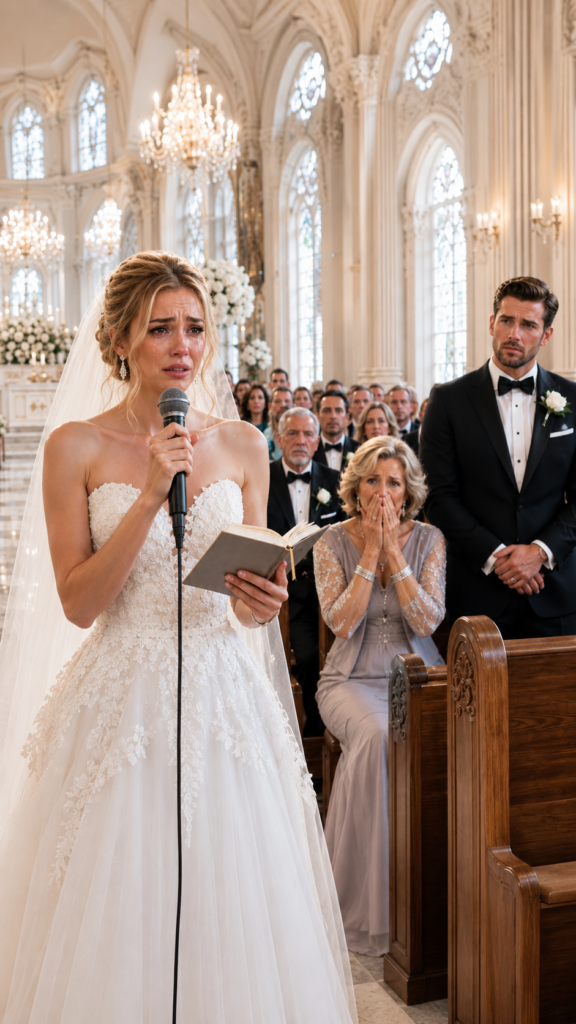
On the morning Lucía Robles got married, there was no kiss, no dance, and certainly no love.
Just a private chapel in Las Lomas, arrangements of white calla lilies, expensive perfume hanging in the air, and a groom who hadn’t opened his eyes in nine months.
Alejandro Santillán, heir to the Santillán Group, sat in a wheelchair beside the altar. His dark hair was neatly styled, his tailored black suit fitted just right, and a luxury watch strapped to his wrist.
But he didn’t move.
He didn’t look.
He didn’t say anything.
A nurse stood behind him, monitoring every breath as if even living required permission.
Lucía, in a borrowed white dress from a cousin, clenched the bouquet to keep from trembling.
Beside her, her father Ernesto whispered:
—Say it already, mija. Don’t make this any harder.
Lucía felt her throat close up.
—I do.
The word didn’t sound like a promise.
It sounded like a sentence.
The priest smiled too quickly. The guests applauded with that false politeness of the wealthy. And just like that, in under twenty minutes, Lucía became Mrs. Santillán.
No one kissed the groom.
No one could.
When it was over, they took Alejandro away through a side hallway. Lucía remained under the stained glass, feeling as if her life had just been signed away like a contract, with white lace and elegant witnesses.
Outside, Ernesto approached with eyes filled with relief.
—You did the right thing.
Lucía let out a bitter laugh.
—Marrying a man who couldn’t even say yes?
He lowered his voice.
—This saves us.
“Us.”
That word always came up when Ernesto needed his daughter to pay for his mistakes.
Three weeks earlier, in their rented house in Iztapalapa, he had explained the deal. The Santillán family needed Alejandro married before he turned thirty-five to retain control of the company.
If Lucía accepted, the debts would disappear.
The loans.
The threats.
The overdue bills.
Everything.
—You want to sell me to a stranger in a coma? —she had asked him that night.
—I want to stop seeing you suffer because of me —Ernesto replied, crying.
Lucía wanted to believe him.
But now, in front of the Santillán mansion, with its black gates, Italian marble, and guards on every corner, she no longer knew if she could believe anyone.
The first man to greet her was Mauricio Santillán, Alejandro’s cousin.
He leaned against a column, wearing a smile that didn’t reach his eyes.
—So you’re the bride.
His gaze roamed her from head to toe, slow and uncomfortable, as if he were appraising a purchase.
Before Lucía could respond, a cold voice sliced through the air.
—If you’re done looking at her, get out of the way.
Doña Mercedes Santillán descended the stairs with the poise of an old queen.
Elegant.
Hard.
Dangerous.
Alejandro’s grandmother scrutinized her for a few seconds and said:
—You’ll do.
Lucía didn’t know if that was approval or insult.
Then she was led to Alejandro’s room.
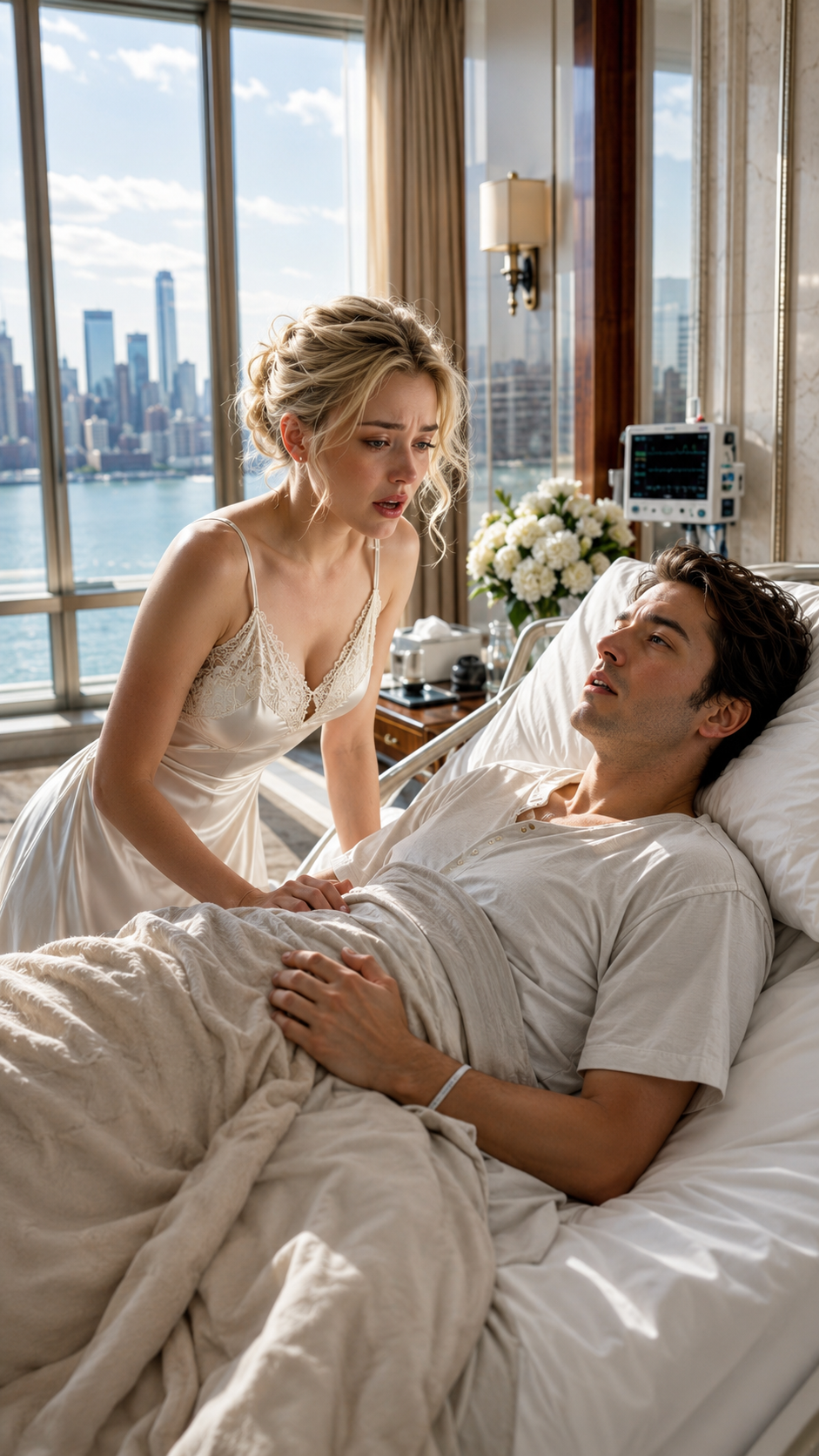
Lucía expected machines, darkness, and the smell of a hospital. But she found huge windows, fresh flowers, soft music, and white light streaming in from the garden.
The room felt alive.
Only Alejandro did not.
He lay between white pillows, pale, motionless, too beautiful to seem real.
Doña Mercedes looked at him dryly.
—You have a wife now. Don’t embarrass us.
There was no response.
When the grandmother left, Lucía was alone with him.
The silence weighed heavily.
After several minutes, she approached the bed.
—Well… technically only one of us isn’t moving.
Nothing.
Lucía smiled sadly.
—I don’t know if you can hear me.
The machine continued to mark a steady rhythm.
She sat by his side.
For the first time all day, she stopped pretending to be strong.
—My mom died two years ago —she whispered—. And honestly, I think she would have hated seeing me here.
Her voice broke.
—I didn’t want this marriage. But I didn’t know how to save my dad.
A tear fell onto the sheet.
Then she felt it.
A tiny movement.
Almost impossible.
Lucía froze.
She looked at Alejandro’s hand.
His index finger had moved.
Her heart stopped.
Before she could scream, Alejandro’s eyelids fluttered.
And for the first time in nine months, they began to open.
Lucía covered her mouth with one hand.
But before she could call for help, he barely moved his lips and uttered a phrase that drained the blood from her face.
—Don’t trust Mauricio.
PART 2
Lucía felt the floor drop out from under her.
Alejandro’s voice had been so weak that for one second she thought fear had conjured it.
—Alejandro? —she whispered.
His eyes were barely open, dark, lost, but alive.
Alive.
Lucía reached for the emergency button beside the bed, but his hand moved again.
Not much.
Just two fingers curling around the sheet.
No.
Lucía froze her hand.
—You don’t want me to call anyone?
Alejandro blinked once.
Yes.
Goosebumps pricked her skin.
—Why?
He made a brutal effort.
—Camera.
Lucía slowly looked up.
In a corner of the ceiling was a small black sphere. She had mistaken it for regular home security.
But now she understood.
Someone was watching them.
She forced herself to sit as if nothing had happened. As if she were just a newlywed wife crying next to her comatose husband.
Alejandro closed his eyes.
A few seconds later, the door opened without a knock.
Mauricio entered with a smile.
—Are you getting used to married life?
Lucía quickly wiped her tears.
—I was just talking to him.
—People do that with comatose patients —he said, stepping closer—. I guess it helps to feel like they aren’t so dead.
—He’s not dead.
Mauricio smiled wider.
—Not yet.
The phrase landed like ice.
He leaned toward her.
—You were brought here for something very simple, Lucía. Smile when you’re asked, sign when you’re told, and don’t get attached to him.
—And if I don’t?
Mauricio looked at her with a cruel calm.
—Sentimental people make mistakes.
The door opened again.
Doña Mercedes appeared in the frame.
—Mauricio, I don’t recall inviting you.
He straightened up.
—I was just welcoming her.
—This house has already welcomed her. Leave.
The tension between them was old, sharp, almost familial.
Mauricio left without losing his smile.
When he was gone, Doña Mercedes turned to Lucía.
—Did he threaten you?
Lucía didn’t answer.
She only looked at the camera.
The elderly woman followed her gaze and, for the first time, her face showed anger.
—Come with me.
She led her to a small office behind a bookcase. She closed the door and pressed a hidden button beneath a stone figure.
There was a click.
—There are no cameras here —she said.
Lucía could barely breathe.
—Alejandro spoke.
Doña Mercedes lost color.
—What did he say?
—That I shouldn’t trust Mauricio.
The grandmother stood still.
Then she poured coffee with steady hands, as if she needed to cling to the ritual to keep from breaking.
—Nine months ago, Alejandro’s car went off the road to Valle de Bravo. They said it was rain, speeding, bad luck.
—But you don’t believe that.
—In this family, convenient misfortunes are never a coincidence.
Lucía swallowed hard.
—Did Mauricio do it?
—I haven’t been able to prove it.
Then Doña Mercedes revealed the hardest truth.
She hadn’t chosen Lucía for being pretty, or poor, or easy to manipulate.
She chose her for her voice.
Months earlier, at a gala for Hospital ABC, Lucía had sung to raise money for her mother’s treatment. Someone recorded that performance. During a neurological test, Alejandro reacted only to that recording.
He didn’t respond to doctors.
He didn’t respond to classical music.
He didn’t respond to his grandmother.
Only to her.
Lucía understood everything with a blow to the chest.
—You didn’t need a wife —she said—. You needed bait.
Doña Mercedes didn’t deny it.
—I needed to bring my grandson back.
—And my dad?
The elderly woman looked down.
—Your dad needed money.
Lucía felt disgust.
They hadn’t just married her.
They had used her as human medicine.
That night, she returned to Alejandro’s room. She waited for Nurse Nora to leave and for the mansion to fall silent.
She approached his bed.
—I’m Lucía. If you can hear me, squeeze my hand once.
Several seconds passed.
Then he squeezed.
Weak.
But real.
Lucía cried silently.
—One squeeze yes. Two squeezes no. Did Mauricio cause your accident?
One squeeze.
—Do you have proof?
One squeeze.
—Where?
Alejandro moved his lips.
—Picture… mom.
Then he became exhausted.
The next morning, at breakfast, Lucía found Ernesto sitting next to Mauricio.
Her dad couldn’t look at her.
On the table was a folder.
—These are simple documents —Mauricio said—. Marital consent. If Alejandro remains incapacitated, you authorize his business votes to pass to a family representative.
Lucía read the name.
Mauricio Santillán.
Her fingers froze.
It was all a lie.
They didn’t want to protect Alejandro from Mauricio.
They wanted to use her to hand over the empire.
—Sign today —Mauricio said— and your dad gets the second part of the payment.
The second part.
Lucía looked at Ernesto.
—How much was I worth?
He broke into tears.
—Mija, I was going to explain...
—How much?
Mauricio answered for him.
—Fifteen million pesos.
Lucía felt something inside her turn off.
—You sold me.
Ernesto tried to take her hand.
She recoiled.
—You sold me twice, dad.
That afternoon, with a key that Doña Mercedes gave her without asking questions, Lucía entered the forbidden study.
The portrait of Alejandro’s mother hung over the fireplace.
An elegant woman, with sad eyes, her hand painted over a pearl necklace.
Lucía observed the painting.
The finger didn’t point at the pearls.
It pointed at the frame.
When she touched it, a compartment opened.
Behind it was a safe.
She tried obvious dates.
Nothing.
Then she remembered the gala where she had sung.
She typed in the date.
The safe opened.
Inside she found a USB drive, medical records, and a black notebook.
The first page had Alejandro’s handwriting:
“If I don’t wake up, Mauricio wins.”
Lucía felt a shiver.
The following pages contained names, payments, plates, security reports, and transfers. A missing mechanic. A bought doctor. A guard fired after changing cameras.
And then a name that took her breath away.
Ernesto Robles.
Fifteen million pesos.
He wasn’t just a desperate father.
He had been part of the plan from the start.
The door creaked.
Nora, the nurse, was there.
She no longer smiled.
In her hand was a syringe.
—You shouldn’t have gotten involved where you weren’t wanted.
Lucía tucked the notebook and USB under her sweater and ran.
Nora lunged after her.
Lucía knocked over a chair, dashed through a service hallway, and ended up in the greenhouse, slipping on the rain-slicked marble.
Doña Mercedes appeared in the distance.
—What happened?
—Nora works for Mauricio.
The nurse arrived behind her, syringe raised.
Then Mauricio appeared.
Clapping slowly.
—Bravo, Lucía. The little girl from Iztapalapa turned out to be smarter than she looked.
Doña Mercedes stood in front of her.
—You won’t touch her.
Mauricio laughed.
—You’re old. Alejandro is half dead. And she is nobody.
Lucía felt rage, but also fear.
Then, from upstairs, an alarm sounded.
Alejandro’s room.
Lucía ran.
When she arrived, the machines were screaming. Alejandro had his eyes open, breathing heavily. A doctor was trying to pull her away.
—Get her out!
But Alejandro violently moved his hand.
Once.
Yes.
He wanted to see her.
Lucía leaned close to his ear.
—I found everything. The notebook. The USB. I know about Mauricio. I know about my dad.
Alejandro cried silently.
Then he moved his lips.
—Sing.
Lucía didn’t understand.
—What?
—Sing.
Mauricio entered behind her.
—Give me what you stole.
Lucía took Alejandro’s hand and began to sing the same song from the gala.
Her voice came out trembling, broken, but she continued.
And something changed.
The monitors lowered.
Alejandro’s breathing steadied.
His hand squeezed hers.
Then he turned his head, just a few inches, but enough to look directly at Mauricio.
In a rough, almost broken voice, he said:
—You should have killed me when you could.
No one moved.
Doña Mercedes already had her phone in hand.
—The police are coming in through the front door.
Mauricio reacted like a cornered animal.
The lights went out.
There were screams, crashes, footsteps. Someone grabbed Lucía from behind. A sweet-smelling rag covered her mouth.
Before she blacked out, she saw Ernesto crying in the doorway.
He didn’t save her.
He just watched.
When Lucía woke up, she was inside a van.
Her hands were tied.
The rain pounded against the windows. Ernesto sat next to her, pale, shattered.
—I’m sorry —he murmured.
Lucía looked at him with a pain that no longer felt like love.
—Don’t ask for forgiveness while you’re still sitting with them.
In the front seat, Mauricio held up the black notebook.
—This ends today.
The van took the old road to Valle de Bravo.
The same one where Alejandro had fallen.
Mauricio smiled.
—Poetic, isn’t it?
Then lights appeared behind them.
A black Suburban sped up to them.
Mauricio yelled at the driver to speed up.
But the Suburban closed in before the curve.
The van skidded and crashed against the barrier.
It narrowly avoided falling into the ravine.
The doors flew open.
Doña Mercedes’s guards, ministerial police, and paramedics surrounded the vehicle.
And there was Alejandro.
Not driving.
Not as an invincible hero.
He was on a stretcher, connected to oxygen, wearing a hospital gown under a black coat.
But awake.
With his eyes fixed on Lucía.
—She’s untouchable —he said.
Mauricio tried to run.
He didn’t make it five steps.
They threw him to the ground and took the notebook from him.
Nora was arrested that same night. The doctor confessed to altering medications to keep Alejandro sedated. The hidden cameras, the USB, and the payments proved what the Santillán family had buried for nine months.
Ernesto was arrested too.
When they took him away, Lucía didn’t cry.
He did.
—You were my daughter —he sobbed.
Lucía responded softly:
—No, dad. I was your way out.
Months later, Alejandro testified from a wheelchair before the judge. His voice was still weak, but each word fell like a hammer.
Mauricio lost the company, his freedom, and the surname he had bragged about.
Doña Mercedes created a foundation for comatose patients and forced the Santillán Group to fund real research, not experiments hidden in mansions.
Lucía requested an annulment of the marriage.
Everyone thought Alejandro would be upset.
But he signed first.
—I don’t want you to stay out of obligation —he told her—. If you ever come back, let it be because you want to.
Lucía looked at him for a long time.
The woman who had walked into that house sold by her father no longer existed.
The one who left understood that sometimes family isn’t who gives you life, but who refuses to buy you with it.
And although many said Lucía should forgive Ernesto because “he was her dad,” she never visited him again.
Because some betrayals can’t be mended with tears.
And there are daughters who only begin to live the day they stop paying off others’ debts.