PART 1
The cake fell face down in the yard just as everyone was about to sing "Las Mañanitas."
The vanilla cream splattered on the ground, the strawberries rolled under a chair, and the golden candle with the number 65 lay discarded next to a napkin.
Doña Mercedes Robles didn’t scream.
She didn’t cry.
She simply stared at the disaster before her neighbors, her sister Carmen, and her son Álvaro, who stood by the grill with tongs in hand, red with embarrassment.
The only one smiling was Renata, her daughter-in-law.
She wore oversized dark sunglasses, wine-colored nails, and a Louis Vuitton bag slung over her arm, as if she were in a fancy restaurant in Polanco instead of at a family barbecue in Querétaro.
—Oh, I’m sorry, mother-in-law —she said with a false voice—. My elbow slipped. Oops.
No one believed her.
There was plenty of space to walk behind the table, but Renata walked close to the cake and shoved it with her elbow.
This was no accident.
It was a humiliation.
Since Renata and Álvaro moved into Doña Mercedes' home "for a few months," the lady's life had shrunk more and more.
First, they took the guest room.
Then the master bathroom.
Next, they changed the living room curtains because Renata said those flowers "gave off a sad grandma vibe."
They removed the photos of Don Julián, Mercedes' deceased husband, and shoved them into a dark hallway.
Renata filled the kitchen with supplements, online shopping boxes, and expensive jars.
Álvaro drove his mother’s car as if it were his.
And Doña Mercedes paid for electricity, water, internet, groceries, gas, and even some expenses that “they would pay her back for later.”
They never paid her back.
Even so, Renata complained.
That the food smelled greasy.
That the house looked like a museum.
That Mercedes talked too much with the neighbors.
That she walked slowly.
That because of her, Álvaro would never mature.
That Sunday, Doña Mercedes only wanted to peacefully celebrate her 65th birthday.
She didn’t want gifts.
She didn’t want a big party.
She just wanted a vanilla cake with strawberries, some quiet laughter, and a little respect in her own home.
But Renata arrived late, flaunting her purse.
—It’s authentic —she said in front of Carmen, even though no one asked—. It cost almost 50,000 pesos. Some tastes are not for everyone, honestly.
When the cake ended up on the ground, something broke inside Doña Mercedes.
It wasn’t anger.
It was exhaustion.
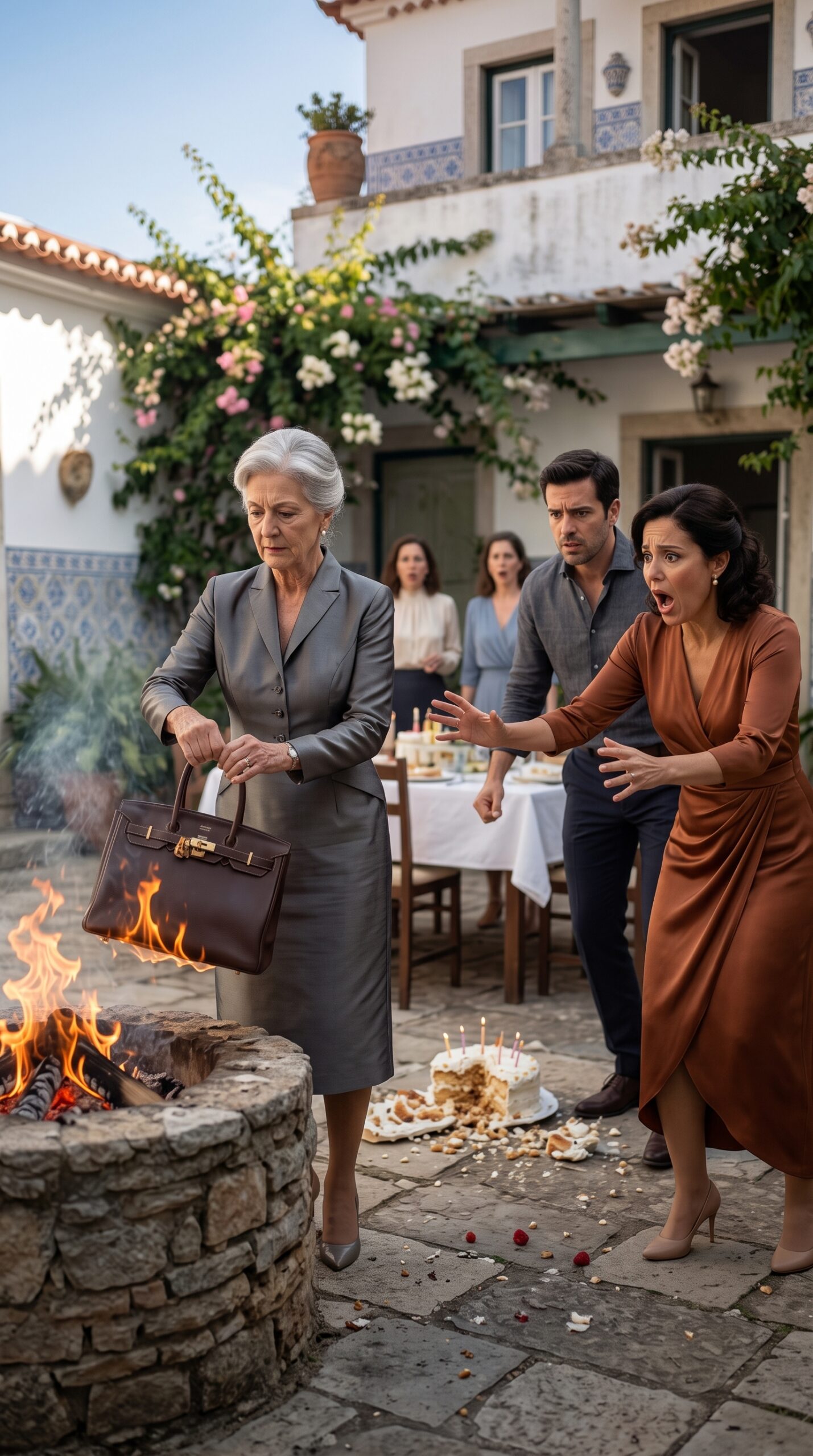
She walked slowly to the chair where Renata had left the bag.
She took it calmly.
She crossed the yard.
And threw it directly onto the burning coals of the grill.
The leather started to smoke immediately.
Renata screamed so loudly that the neighbor’s dog began to bark.
—She’s crazy! My purse! Álvaro, tell your mom something!
Álvaro ran toward Mercedes.
—What did you do, mom? Do you have any idea how much that costs?
Doña Mercedes looked at him without raising her voice.
—Oops.
The yard fell silent.
Renata cried in front of the grill.
Álvaro threatened to make her pay every penny.
But Doña Mercedes, for the first time in a long time, felt her dignity rise back up.
The worst part wasn’t the burned purse.
The worst part came the next day when she checked her bank account and discovered that almost all her money had vanished.
PART 2
The next morning, Álvaro entered the kitchen without knocking.
Doña Mercedes was sipping coffee from her blue cup, the only one Renata hadn’t thrown away because she hid it in her bedroom.
—We need to talk —he said.
Mercedes set the spoon down on the plate.
—Talk.
—Renata didn’t sleep. She’s devastated. You owe her an apology and 50,000 pesos.
The lady looked at him with a calm that hurt more than a scream.
—Your wife threw my cake on the ground on purpose.
—It was just a cake, mom.
Mercedes took a deep breath.
—No, Álvaro. It was my birthday, my house, and my dignity. She thought she could trample all three without consequences.
Álvaro clenched his jaw.
—You’re exaggerating. Renata says you’ve been acting strange lately. That maybe you’re not fit to live alone anymore.
That phrase froze her blood.
Not because it insulted her, but because she finally understood.
Renata had been planting that idea for months.
That Mercedes forgot things.
That she repeated stories.
That she left the stove on, even though that had never happened.
That the house needed "younger management."
Álvaro left for work without saying goodbye.
Doña Mercedes went up to her bedroom and looked at the master bathroom.
There were Renata’s perfumes, her imported creams, her makeup, her brush, and a silk robe hanging behind the door.
That bathroom was Mercedes’.
That bedroom was Mercedes’.
That house was Mercedes’.
She took a cardboard box and packed everything that wasn’t hers.
Perfumes.
Brushes.
Creams.
Clothes.
Makeup.
Then she left the box in front of Álvaro and Renata’s room.
Afterward, she called a locksmith.
Before 4 PM, her bedroom and bathroom had new locks.
That night, Renata tried to get in.
She turned the doorknob three times.
—Álvaro! Your mom locked my things up as if I were a thief!
Mercedes turned up the radio's volume.
The next day she went to the bank.
Years ago, when Don Julián died, she opened a joint account with Álvaro "for emergencies."
The idea was that her son could help her if one day she got sick or needed to pay for a hospital.
Mercedes deposited part of her pension and some savings there.
She never imagined that trust would turn into abuse.
She requested the statements for the last six months.
The manager printed everything.
Expensive restaurants.
Online purchases.
A hotel in San Miguel de Allende.
Shoes.
Spa.
Boutiques.
Almost 380,000 pesos had vanished.
Doña Mercedes felt the floor drop out from under her.
It wasn’t just Renata.
Her own son had allowed it all.
The manager asked if she was okay.
Mercedes said yes, even though inside, something had just shattered.
She closed the joint account.
Transferred what was left to a personal account.
Canceled additional cards.
Changed passwords.
Revoked any banking authorization for Álvaro.
By 2 PM, he called her in a panic.
—Mom, I’m in a restaurant with Renata and some clients. The card was rejected. What did you do?
She was watering the bougainvilleas.
—I closed the account.
—You’re humiliating me!
—No, son. I’m just letting you pay for your own meal.
—Renata is really upset about her purse.
Mercedes looked at the flowers.
—How curious. My cake on the ground didn’t seem so important to you.
And she hung up.
That night, Renata organized a dinner in the living room without asking for permission.
She used Mercedes’ best dishes, opened a bottle of wine that Don Julián had saved for an anniversary, and welcomed three couples as if the house were hers.
Mercedes came down in her robe, turned off the music, and took away the bottle.
—Good evening. The gathering is over.
Renata paled.
—Don’t make a scene.
—A scene was throwing my cake. This is my house, and no one organizes anything without my permission.
The guests stood up awkwardly.
In less than five minutes, the living room was empty.
Renata approached with rage-filled eyes.
—You will regret this. You don’t know who you’re messing with.
Mercedes didn’t respond.
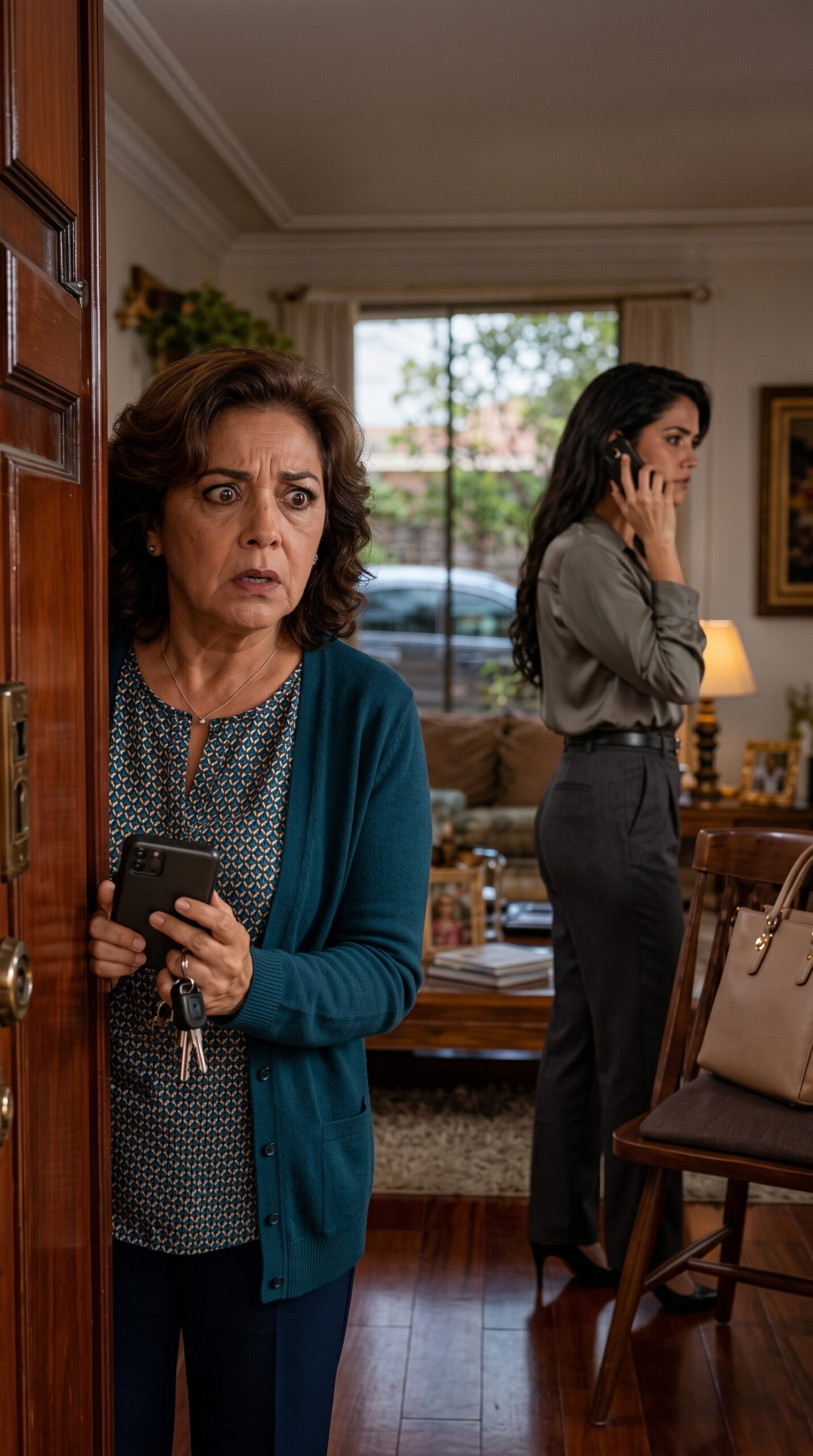
But that morning, as she passed through the hallway, she overheard Renata talking on the phone.
—Don’t worry. If we get her to sign the power of attorney, Álvaro will sell the house, and we’ll put the old lady in a care home. We almost have her.
Mercedes froze.
The woman who threw her cake didn’t just want to humiliate her.
She wanted to take her house.
And the most painful part was that Álvaro already knew.
That night, she didn’t sleep.
She stared at the closet where she still kept Don Julián's shirts.
That house wasn’t just a property.
It was the life she and her husband built, piece by piece.
Don Julián was a primary school teacher for over 30 years.
Mercedes sold food on order and later opened a small stationery store near a school.
First, they bought the land.
Then they built two rooms.
Later, they raised the second floor.
Finally, they fixed the patio.
In that kitchen, Álvaro took his first steps.
In that living room, his sister Daniela cried over her first heartbreak.
In that dining room, Don Julián danced with Mercedes when they finished paying off the mortgage.
At 7 AM, Mercedes dressed in beige pants, a white blouse, and comfortable shoes.
She didn’t prepare breakfast for anyone.
She took the deeds, account statements, and important documents.
Then she went to see lawyer Raúl Castañeda, a lawyer recommended by her neighbor Lupita.
She told him everything.
The drained account.
The abuses.
The threat to declare her incapable.
The plan to get her to sign a power of attorney.
The intention to sell the house.
The lawyer listened without interrupting.
—Doña Mercedes, the first thing is to protect your property. Is the house solely in your name?
—Yes. My husband left everything in order.
—Then no one can sell it without your signature. But if they’re pressuring you, we need to act today.
That same day they did three things.
Revoked any old authorizations for Álvaro.
Prepared a notice for him and Renata to vacate the house.
And registered the bank movements for possible financial abuse.
When the lawyer asked if she was willing to sue her son, Mercedes didn’t respond immediately.
Because one thing was to set boundaries.
Another was to accept that the child she raised with love had treated her like an ATM.
She returned home before noon.
Renata was in the kitchen preparing green juice.
—Good thing you arrived —she said without greeting—. Álvaro and I need you to sign some documents. It’s for your own good.
Mercedes set her bag on the table.
—What a coincidence. I also have documents.
Renata frowned.
—What documents?
—Mine.
She didn’t say more.
That afternoon, Mercedes took her car to Lupita’s house.
It was hers, but Álvaro had been using it for months without paying for gas, insurance, or maintenance.
The next day, he stormed in, furious.
—Where’s the car?
Mercedes was spreading butter on a bolillo.
—Put away.
—I need it. Renata has an appointment.
—The bus passes three blocks away. Taxis are also available.
—Mom, don’t be ridiculous.
She looked up.
—Ridiculous is being 36 years old, with a stable salary, and living like an adolescent supported by your widowed mother.
Álvaro fell silent.
Renata shouted from the stairs:
—This is psychological abuse!
Mercedes continued breakfasting.
Sometimes calm infuriates more than screams.
That night, Daniela, the other daughter, arrived.
She came from León with a small suitcase and the face of a judge.
Surely Álvaro had told her that their mom was "out of control."
Daniela entered without hugging her.
—Mom, this has gotten out of hand. Álvaro says you burned a very expensive bag, closed accounts, took the car, and now you want to kick them out.
Mercedes looked at her.
—How quickly you summarized everything, except for the cake, the stolen money, and the plan to sell my house.
Daniela sighed.
—Renata can be difficult, but you’re not helping either. At your age, you should be seeking peace.
Then she lowered her voice.
—Besides, I wanted to ask you for something. Pablo's business is struggling. You could advance us part of the inheritance. About 400,000 pesos.
Mercedes let out a dry laugh.
It wasn’t joy.
It was the sound of a mother understanding that her children weren’t coming to care for her, but to divide what she still needed to live.
—There’s no such thing as an advanced inheritance, Daniela. There’s a living mother who needs her money to age with dignity.
—Don’t be dramatic.
—Dramatic is coming to ask me for money while your brother is trying to take my house.
Daniela cried.
She called her selfish.
Said that she was also her daughter.
Before, those tears would have broken Mercedes.
That night only confirmed that her children knew how to press where it hurt the most.
The next day, when Álvaro and Renata left, Mercedes reclaimed the guest room.
Renata had turned it into a closet.
There were clothes, shoes, bags, and boxes everywhere.
Mercedes didn’t break anything.
She didn’t throw anything away.
She only packed everything into boxes and left them in the couple’s room.
Then she cleaned, opened the windows, and set up a table with paints and brushes.
Before getting married, Mercedes used to paint bougainvilleas, markets, and wet streets.
That day she reclaimed more than a room.
She reclaimed a part of herself.
When Renata saw her things piled up, she screamed as if she had been hit.
Álvaro came running down.
—What did you do, mom?
Mercedes was painting a red vase.
—I reclaimed my guest room.
Renata trembled with rage.
—You’ve hated me since day one.
Mercedes put down the brush.
—No, Renata. I welcomed you. I cooked for you. I lent you my bathroom, my car, my money, and my patience. You confused education with weakness.
—Álvaro, say something.
He looked at his mother.
For a second, Mercedes thought he would tell the truth.
But he only murmured:
—Mom, you’re destroying my marriage.
Sadness pierced her chest.
But she didn’t back down.
—No, son. I’m just withdrawing the house, the money, and the comforts. If your marriage falls apart because of that, it wasn’t a marriage. It was sponsorship.
Two days later, lawyer Castañeda arrived at the house at 6 PM.
Mercedes scheduled him for that time because she knew everyone would be there.
The lawyer read the notice.
Álvaro and Renata had 60 days to vacate the house.
They were prohibited from using Mercedes’ accounts, documents, or properties.
Any attempt to pressure her into signing powers would be registered as financial abuse.
Álvaro turned pale.
—Mom, you can’t do this.
—Yes, I can.
—I’m your son.
—And I’m your mother, not your property.
Renata let out a nervous laugh.
—Álvaro has rights. He’s lived here for a year.
The lawyer looked at her calmly.
—Living for free in someone else’s house does not generate ownership.
Daniela stood up.
—This has crossed the line.
Mercedes turned to her.
—It crossed the line when I saw hotels and spas paid with my emergency account. It crossed the line when I heard you wanted to put me in a care home. It crossed the line when my cake ended up on the ground, and my son defended a purse more than his mother.
Álvaro lowered his gaze.
Renata did not.
—You will end up alone.
That threat would have destroyed Mercedes months ago.
Not that night.
—Better alone than accompanied by those who rob me of my peace.
Daniela left the next day, offended because she didn’t receive any money.
Before leaving, she said:
—You’ve changed, mom.
Mercedes nodded.
—Yes. Finally.
Renata held out for one more week.
Without the car, without an account, without dinners served, without a huge closet, and with a legal deadline hanging over her, her love for Álvaro began to fade.
One night she came down with two suitcases.
Mercedes was cutting sweet bread in the kitchen.
—Congratulations, Mercedes. You won.
—It wasn’t a competition.
—You destroyed your son’s marriage.
Mercedes looked at her calmly.
—No. I just removed the stage where you pretended to be adults.
Renata left without saying goodbye.
Álvaro ran after her.
Mercedes heard Renata’s voice from the door:
—Without a house, without a car, and without money, what can you offer me?
The silence that followed was louder than any scream.
Álvaro returned to the kitchen with wet eyes.
—Mom…
Mercedes didn’t hug him immediately.
Not for lack of love.
But because she understood that comforting him quickly would save him again from the consequences.
Weeks later, Álvaro began washing dishes, sweeping the patio, and speaking to her with respect.
One afternoon he found her painting bougainvilleas.
—Mom, I know I messed up. Renata blinded me.
Mercedes lowered the brush.
—Renata didn’t spend that money alone. She didn’t call me exaggerated with your voice. She didn’t defend a purse while my cake was on the ground using your mouth.
Álvaro cried.
—Forgive me.
It hurt Mercedes to see him like that.
But forgiveness didn’t mean opening the same doors.
—I accept your apologies, son. But you’re moving out when the deadline is over.
He raised his gaze.
—But Renata is already gone.
—The problem was never just her. The problem was that you thought my life existed to support yours. I love you, but I’m not going to raise you again.
When the day came, Álvaro loaded his boxes into a rented truck.
He found a small apartment near work.
Simple.
Without luxuries.
Without a car waiting.
But his.
Before leaving, he handed over the keys.
—I don’t know if you’ll ever trust me again.
Mercedes took them.
—Trust isn’t demanded. It’s rebuilt.
He hugged her.
She hugged him back.
Not like before.
But like a woman who loves without losing herself again.
When the truck drove away, Mercedes closed the door.
The house was silent.
But it wasn’t a sad silence.
It was a clean silence.
That night, Lupita brought a small vanilla cake with strawberries.
Mercedes lit one candle.
Not to celebrate a birthday.
But to celebrate that she had stopped being afraid.
Because many women were taught that love means enduring.
But love isn’t being humiliated.
Love isn’t maintaining abuses.
Love isn’t disappearing so others can live comfortably.
Sometimes setting boundaries shatters the fantasy of a perfect family.
But it also reveals the truth.
Who truly loves you.
And who just wants you available.
Doña Mercedes didn’t lose her family for defending herself.
She lost the fear of being alone.
And when a woman loses that fear, she regains everything: her voice, her house, her table, and even the piece of cake that no one will ever throw on the ground again.