PART 1
—Then it’s clear: you’re going to take care of the kids.
Doña Elvira’s voice sounded like she was dishing out plates, not deciding her daughter’s life.
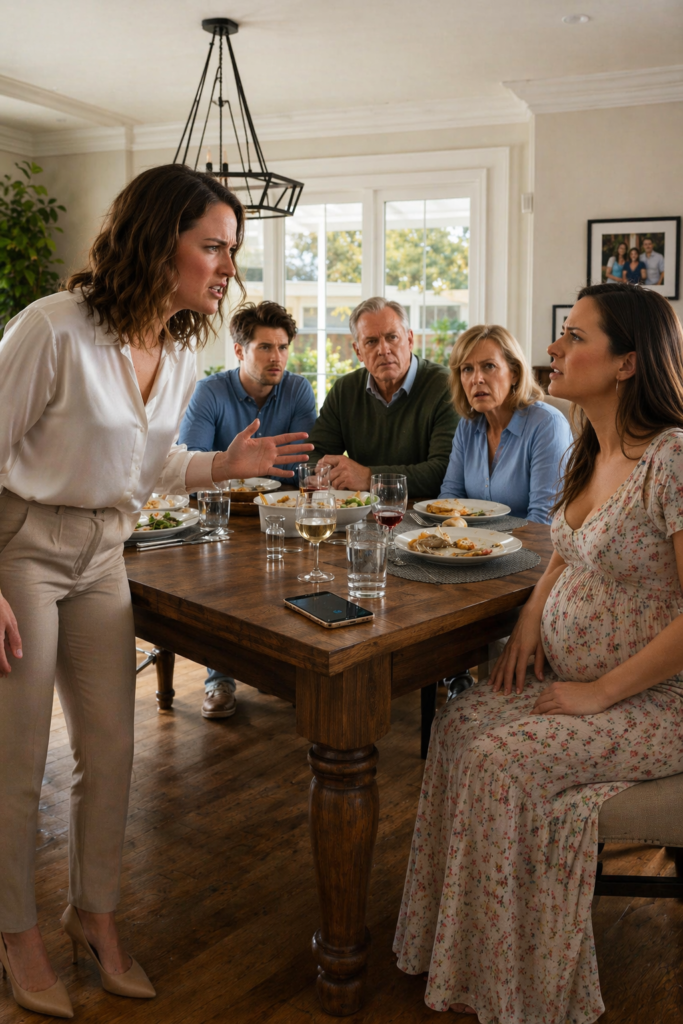
The family meal was at a house in the Jardines de la Hacienda neighborhood in Querétaro. There was barbacoa, rice, salsa verde, freshly heated tortillas, and four kids running between the living room and the patio as if the house were a public park.
Sofía Méndez, 33 years old, sat at the end of the table.
She worked as an administrator at a dental clinic, lived alone, and for years her family had decided that meant one thing: her time wasn’t worth anything.
Her brother Raúl arrived late with his wife, Brenda, wearing a smile that suggested he owned the world.
—Family, we have news —he said, raising his soda glass—. Brenda is pregnant again.
Doña Elvira screamed with excitement.
Don Jacinto clapped.
The four kids jumped around the table, not quite understanding, but caught up in the commotion.
—Baby number 5! —Brenda said, proudly touching her belly.
Everyone celebrated.
Everyone except Sofía.
She watched Mateo spill juice on the couch, Camila pulling her younger sister’s hair, and the three-year-old trying to open the front door.
Raúl didn’t get up.
Brenda didn’t either.
As always, Doña Elvira turned to Sofía.
—Now you really have to help more.
Sofía placed her fork down on her plate.
—No.
Silence fell like a hammer.
Raúl's face tightened.
—Don’t start with your nonsense.
—It’s not nonsense —Sofía replied—. It’s my life.
Brenda let out a dry laugh.
—Oh, please. What life? You don’t even have a husband.
The words stung, but Sofía didn’t look away.
For years, she had picked up kids from school, bought medicine, paid for “forgotten” supplies, canceled appointments, sacrificed weekends, and even requested leave at work because Brenda “couldn’t handle it anymore.”
All for free.
All without thanks.
All because “family is family.”
Doña Elvira grew serious.
—You don’t have kids, Sofía. You don’t know how heavy it is. That’s why you have to help.
—I don’t have to do anything I haven’t agreed to.
Raúl slammed his palm on the table.
—They’re your nephews.
—And they’re your children.
Brenda stood up, red with anger.
—Look how selfish you are. Seriously, Sofía, this would be good practice for you. Let’s see if you ever have a real family.
Don Jacinto stared at his plate.
Doña Elvira said nothing.
Raúl smiled as if Brenda had won.
Sofía felt something inside her break, but she didn’t cry.
She stood up, grabbed her bag, and said:
—You’re right about one thing. I don’t have a real family here.
Doña Elvira followed her to the door.
—Tomorrow you’ll get over your tantrum.
Sofía barely turned.
—No, Mom. Tomorrow it starts.
She left.
That night, in her apartment, she cried in rage until she fell asleep on the couch.
At 7:42 in the morning, her phone rang.
It was an unknown number.
—Hello?
—Good morning. Am I speaking with Miss Sofía Méndez? I’m Officer Ramírez from the Municipal Police.
Sofía sat up abruptly.
—Yes. Did something happen?
—We need you to come in to give a statement.
—About what?
There was a heavy pause.
—Your brother and sister-in-law registered you as responsible for four minors. The children were found alone in the house. One of them was outside, barefoot, near the avenue.
Sofía felt the air choke in her throat.
Because she understood that her “no” hadn’t mattered.
And they had just used her name to cover up an unforgivable madness.
PART 2
Sofía arrived at the police station with her hair half up, swollen eyes, and a blue folder clutched to her chest.
She didn’t know if that folder would be of any use, but during the night she had gathered everything she had: screenshots of
“Can you pick them up?”
“Brenda is tired.”
“Raúl had a meeting.”
“It’ll just be one hour.”
But that hour always turned into five.
And when Sofía complained, the answer was always the same:
“Don’t exaggerate.”
Officer Ramírez received her in a small office, with cream-colored walls and an old fan that made more noise than it provided air.
He was a man in his forties, serious but not cruel.
—First of all, the minors are fine —he said—. A neighbor called 911 when she saw the smallest child crying outside, barefoot.
Sofía closed her eyes.
—I wasn’t with them.
—That’s what we need to clarify.
The officer placed a transparent bag on the desk.
Inside was a torn page from a school notebook.
Sofía recognized Brenda’s handwriting instantly.
“Sofía will stay with the kids until 1. She knows. We went to the doctor.”
Sofía felt nauseous.
—That’s a lie.
Ramírez watched her closely.
—Did your brother or sister-in-law formally ask you to take care of the children this morning?
—No.
—Did you agree?
—No.
—Do you have proof?
Sofía opened the folder.
She didn’t do it dramatically. She did it with the calm of someone who could no longer swallow humiliation.
First, she showed a message from Raúl sent on Friday:
“On Sunday we’ll talk. With Brenda’s pregnancy, you’ll have to step up with the kids.”
Then one from Brenda:
“Don’t make plans for Saturdays. We’re already a lot and need support.”
Then an audio from Doña Elvira:
“Daughter, understand. A single woman must help her own. What do you do, anyway?”
The officer said nothing, but his expression changed.
Sofía moved to another screenshot.
It was from the night before, at 10:28.
Brenda had written:
“You’re going to regret making us look ridiculous. No one abandons family and gets away with it.”
Ramírez read the message twice.
—This is important.
Sofía swallowed hard.
—Yesterday I said no in front of everyone. I left before 9. I didn’t speak to them again.
—Where were you afterward?
—In my apartment. The building’s camera recorded me entering at 9:31. I didn’t leave until today.
The officer made a note.
—We will request that video. In the meantime, your statement is recorded. You were not responsible for the minors.
Sofía looked at the page in the bag.
—They’ll say it was a misunderstanding.
Ramírez sighed.
—They already said it.
Sofía let out a small, bitter laugh.
Of course.
When Raúl made a mistake, it was a misunderstanding.
When Brenda insulted, it was stress.
When Doña Elvira manipulated her, it was motherly love.
But when Sofía said “no,” then she was selfish, a bad sister, a bad aunt, a cold woman.
Minutes later, voices echoed in the hallway.
The first was Doña Elvira’s.
—My daughter always makes a scene. She’s been taking care of the kids for years.
Then Raúl:
—This will get resolved quickly. Sofía is upset because we told her the truth yesterday.
And then Brenda, with that sharp tone Sofía knew too well:
—If she had done what she was supposed to, my kids wouldn’t have gone through this.
The officer opened the door.
The four of them came in.
Doña Elvira had teary eyes, but more from anger than sadness. Don Jacinto walked behind her, hunched over as if shame weighed heavily on his shoulders. Raúl had his shirt improperly buttoned and the face of someone who still believed he could order everyone around.
Brenda entered last, one hand on her belly and the other on her designer bag.
—Are you happy? —she said to Sofía as soon as she saw her—. Did you really call the police on a pregnant woman?
Officer Ramírez responded first.
—The call was made by a neighbor, ma’am. Your child was outside the house, crying.
Brenda froze.
Raúl pointed at Sofía.
—She should have been there.
Sofía stood up slowly.
—No. You wanted me to be there. It’s not the same.
Doña Elvira jumped in quickly.
—Officer, my daughter always helps. She got upset yesterday, but we all know how she is. She’ll get over it.
Sofía looked at her.
—This time I won’t.
The officer placed the note on the table.
—I need to know who wrote this.
No one answered.
But Sofía saw how Brenda lowered her eyes.
That gesture was enough for her.
The lie was no longer hidden. It was sitting in front of everyone, trembling.
—Who wrote it? —Ramírez repeated.
Raúl opened his mouth.
—Look, officer, there’s no need to make this a big deal. These are family matters.
Ramírez looked at him seriously.
—Abandonment of minors is not a family matter. It’s a legal matter.
Don Jacinto lifted his head for the first time.
Doña Elvira tightened her bag.
Brenda took a deep breath.
—I wrote it.
Sofía felt her chest burn.
Raúl turned to her, furious.
—Brenda…
—Did Miss Sofía agree to take care of the kids? —the officer asked.
Brenda pressed her lips together.
—She always agrees.
—That wasn’t my question.
The silence became unbearable.
Even the fan seemed to have stopped.
—No —Brenda finally said—. She didn’t agree.
Sofía lowered her gaze for a second.
It wasn’t happiness.
It was relief.
A sad, tired relief, like someone who finally puts down a stone after so many years they no longer remembered how it felt to walk without it.
The officer took note.
—So you left a false note attributing responsibility to someone who had not given consent.
Brenda immediately defended herself.
—I thought she would come. She always comes. Always.
There was the complete truth.
They didn’t think Sofía would refuse.
They thought Sofía would obey.
Doña Elvira began to cry.
—Daughter, understand. Brenda had a doctor’s appointment. Your brother was nervous. The kids were asleep. It was just for a little bit.
Sofía looked at her with a calmness that made everyone uncomfortable.
—The three-year-old went out to the street.
Doña Elvira went silent.
—He could have gotten lost —Sofía continued—. A truck could have hit him. Something horrible could have happened. And you’re more worried that I didn’t cover for you.
Raúl exploded.
—They’re your nephews!
—And you’re their father.
The words hit harder than a scream.
Don Jacinto covered his face with one hand.
For years, he had been the quiet man of the family. He never insulted Sofía, never directly forced her, never raised his voice. But he never defended her either.
And sometimes silence is also a form of abandonment.
—I’m sorry —he murmured.
Sofía looked at him.
—Why?
Don Jacinto swallowed hard.
—For staying silent. For letting them use you. For believing that since you had no husband or children, your time was available.
Doña Elvira cried louder.
—I just wanted the family to be united.
Sofía shook her head slowly.
—No, Mom. You wanted me to keep the peace even if I was breaking inside.
No one answered.
The process didn’t unfold like a movie.
There were no handcuffs in front of everyone or a dramatic scene with patrols taking Raúl and Brenda away amidst screams.
It was worse because it was real.
The DIF opened a family review. The neighbor testified she had seen the child leave through the front door while the other three cried inside. The police report stated that Sofía had never agreed to care for the minors.
Raúl and Brenda received a formal warning, were summoned for interviews, and had to present a real childcare plan, with names, schedules, and verifiable phone numbers.
For the first time, someone asked them to take responsibility for the children they had chosen to have.
But the hardest blow came later.
It came when Doña Elvira had to hire a nanny by the hour and discovered that taking care of four children wasn’t just a “little favor.”
It came when Brenda could no longer say in gatherings that Sofía was exaggerating, because everyone knew she had forged a note.
It came when Raúl understood that saying “family” didn’t erase a signature, or a lie, or a barefoot child on the street.
That night, Sofía returned to her apartment.
She left the folder on the table and stared at the white wall without turning on the TV.
Her phone vibrated.
Message from Raúl:
“Enough. Don’t make this bigger. Think of the kids.”
Sofía didn’t reply.
Then came one from Brenda:
“I’m pregnant. I don’t need stress. I hope you’re happy destroying a family.”
She didn’t respond either.
Finally, there was an audio from Doña Elvira.
Sofía looked at it for several seconds.
She didn’t open it.
For a month, she blocked everyone.
At first, it hurt.
On Sundays, she felt a strange emptiness in her chest. Her body was used to running, solving, buying, picking up, carrying backpacks, warming milk, looking for pediatricians, bringing toys, answering calls at any hour.
But little by little, the silence began to resemble peace.
She returned to dance classes on Wednesdays.
She accepted invitations to go out with friends without checking her phone every five minutes.
She slept in on a Saturday for the first time in years.
One day, passing through downtown, she saw a woman with two small children struggling to get into a taxi. Reflexively, Sofía wanted to help.
She took a step.
Then stopped.
Helping wasn’t the problem.
The issue was disappearing so others could live comfortably.
Six months passed.
Baby number five was born.
Sofía found out through a photo Don Jacinto sent her, without pressure, without reproach.
The child was small, wrapped in a blue blanket, with a red face and closed eyes.
Sofía felt tenderness.
Because the kids had never been the enemy.
The problem was the adults who confused love with obligation.
She sent a simple gift: diapers, a white blanket, and a card.
“May he grow healthy, loved, and cared for by those who chose to bring him into the world.”
Nothing more.
Doña Elvira called her days later.
—Your brother says you’re very cold.
Sofía took a deep breath.
—No, Mom. I’m free.
There was silence.
—Are you coming on Sunday? —Doña Elvira asked in a small voice.
—Yes. I’ll come for lunch. Not to take care of kids. If anyone tries to leave me with that responsibility, I’ll leave.
This time, her mother didn’t argue.
On Sunday, Sofía arrived wearing a green blouse, her hair down, and a tranquility no one knew her for.
The kids ran to hug her.
She hugged them tight.
Mateo, the three-year-old, showed her a plastic dinosaur.
—Aunt, look.
Sofía smiled.
—That’s really cool.
Brenda barely greeted her.
Raúl didn’t look at her.
Don Jacinto served her fresh water and said quietly:
—I’m glad you’re here.
Sofía nodded.
Not everything was fixed.
Maybe it never would be.
But something had changed forever.
After lunch, Brenda lifted the baby and looked at Sofía.
—Can you hold him for a bit while I go to the bathroom?
Everyone froze.
Doña Elvira stopped moving her spoon.
Raúl lifted his gaze.
Sofía looked at the baby, then at Brenda.
—Yes —she said—. For a bit.
She held him carefully. She rocked him for a few minutes. She adjusted the blanket.
When Brenda returned, Sofía handed him back.
Then she took her bag.
—I’m leaving.
Doña Elvira jumped up quickly.
—So soon?
Sofía smiled slightly.
—Yes. I work tomorrow. And today I want to rest.
No one dared to stop her.
That night, in her apartment, the phone rang close to midnight.
It was Raúl.
For years, Sofía would have answered with her heart racing, ready to run, ready to solve another emergency that wasn’t hers.
This time, she didn’t.
She let it ring until it turned off.
She flipped her phone face down.
Closed her eyes.
And breathed.
Because some families don’t break when someone says “no.”
They just show how broken they were before.
And Sofía, for the first time in 33 years, understood she didn’t need her family to choose her to be able to choose herself.