PART 1
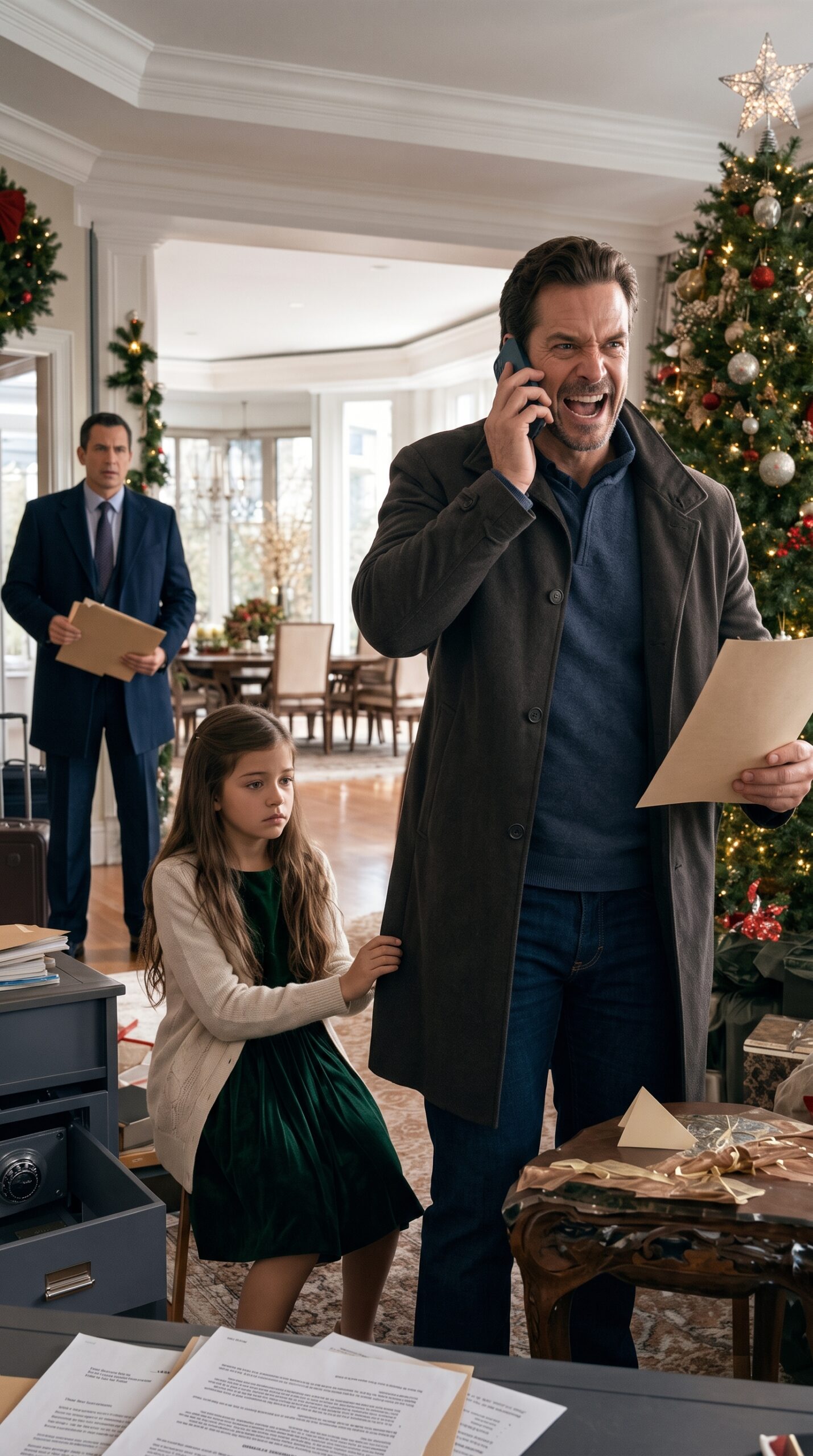
Santiago Robles returned to his home in Lomas de Chapultepec on the night of December 24, his jacket still reeking of airplane and urgency.
He had changed his flight from Monterrey because something, since morning, had been squeezing his chest. His ex-wife, Renata, didn’t answer. His mother-in-law, Doña Patricia, didn’t either. The family group chat was filled only with old photos, clinking glass emojis, and an unsettling silence.
Upon opening the door, the first thing he noticed was the tree lit up.
Perfect. Expensive. Decorated with golden ornaments, red bows, and white lights that looked straight out of a magazine.
But the house didn’t smell like dinner.
No bacalao. No romeritos. No ponche. No laughter, no music, no dirty dishes, no shouts of cousins running through the hallway.
Only Camila, his 10-year-old daughter, sat alone on the floor in front of the tree.
With her legs crossed.
Back straight.
Hands clasped on her lap.
And no gifts around her.
Not a single box.
Not a single bag.
Not even a card with her name on it.
Santiago dropped his suitcase by the entrance, feeling his blood rush to his feet.
—Cami? —he said, trying not to sound scared—. Where is everyone?
The girl lifted her gaze.
She wasn’t crying.
That was the most painful part.
Camila didn’t have red eyes, a broken voice, or the desperation of a child still hoping an adult would make things right.
She looked at him with a rare calmness, a calmness that didn’t belong to a child on Christmas Eve.
—They left —she replied.
Santiago moved slowly.
On the coffee table, there was a white envelope. His name was written in Doña Patricia’s elegant, sharp handwriting, the kind that belonged to a woman who went to noon mass and humiliated waitresses at restaurants.
Camila pointed to the envelope.
—They told me to give it to you if you came back.
Santiago opened it right there.
Inside was a note with a single line.
“We went to celebrate in the Bahamas without her. She’s your burden, Santiago. We’ve done enough.”
No signature.
None was needed.
Santiago felt a surge of rage. He wanted to break something. To scream. To jump in the car and drive straight to the airport. To call Renata and tell her everything he had never said since the divorce.
But Camila was still watching him.
And he understood that if he exploded, she would have to carry that too.
—Did you eat? —he asked.
Camila shrugged.
—Crackers. And a Yakult.
Santiago clenched his jaw.
—Did your mom know they left you alone?
The girl looked down for a moment.
—My grandmother said Mom didn’t want to argue. That it was better this way. That I always ruined family photos because I looked too much like you.
That sentence shattered something inside him.
Camila stood up, walked to her school backpack, and pulled out a blue folder, its corners bent.
—Dad —she said quietly—, while they were packing, I found something in Grandpa Ernesto’s office.
Santiago froze.
Ernesto, Renata’s father, had died eight months ago. He was the only one in that family who treated Camila like a person, not an inconvenience.
—What did you find?
Camila handed him the folder.
—They don’t know I have it.
Santiago spread the papers on the table.
First, he saw a deed.
Then a trust.
Then a modification with crossings out, margin notes, and two signatures from the same man.
The first firm.
The second shaky, like it had been penned by someone sick, sedated, or pressured.
Below were two names that froze his body.
His.
And Camila’s.
Santiago read three more lines.
Then he let out a dry, incredulous laugh, almost dangerous.
Camila didn’t move.
—Is it bad? —she asked.
Santiago pulled out his cell phone.
—No, my love —he said, dialing his lawyer—. It’s worse for them.
And while in the Bahamas they toasted, believing they had left a forgotten child under a tree, in the living room of that house, something had just awakened that none of them would be able to stop.
PART 2
The lawyer answered on the third ring.
He wasn’t just any lawyer. He was Tomás Herrera, a friend of Santiago’s since college, an expert in trusts, inheritances, and wealthy families that pulled dirty tricks with clean papers.
—Santi, it’s Christmas Eve —Tomás said—. This has to be serious.
Santiago glanced at Camila, who had sat back down by the tree, as if waiting for a sentence.
—It is —he replied—. And I need you to listen without interrupting.
He explained everything.
The empty house. The note. The suitcases. The Bahamas. The girl without dinner. The envelope. The blue folder. Ernesto’s signatures.
Tomás was silent for several seconds.
When he spoke, his voice was no longer festive.
—Send me photos of every sheet. Front and back. Don’t tell anyone you have that. And under no circumstances should you call Renata yet.
—They left my daughter alone, Tomás.
—I know. But that paper could prove something bigger than family cruelty.
Santiago placed the documents under the dining room lamp and began photographing them.
Camila watched from the kitchen, clutching her red sweater.
—Am I going to get in trouble for taking it? —she asked.
Santiago set the phone down on the table and approached her.
—You didn’t take anything bad. You saved something they tried to hide.
The girl swallowed hard.
—Grandpa used to tell me to read everything, even the fine print. He said the abusers hid in the fine print.
Santiago closed his eyes for a moment.
Ernesto had always been different. A tough man, yes, but fair. When Camila was born, he was the only one who went to the hospital with a warm smile. He held her, kissed her forehead, and said:
—This girl is going to need a backbone because she was born into a family that confuses money with heart.
At that moment, Santiago didn’t understand.
Now he did.
He prepared quesadillas with the little food left in the fridge. He heated chocolate milk. He sat Camila at the counter, and they ate together while the tree blinked behind them.
It wasn’t a perfect dinner.
But it was the first meal that night where the girl didn’t feel like a burden.
—Did you know they didn’t want me? —Camila suddenly asked.
Santiago set his cup down on the table.
Lying to her would have been easier. But Camila had already lived too many lies tied with a bow.
—I knew they weren’t good to you —he said—. I didn’t know they could go this far.
Camila nodded, as if that answer confirmed something she had been holding inside.
—When you traveled, my grandmother said I was a copy of you. That’s why my mom couldn’t rebuild her life. That if Grandpa loved me, it was because he was old and manipulable.
Santiago felt each word like a stone.
—Did Renata hear that?
Camila looked down.
—Sometimes. Sometimes she went to the bathroom. Sometimes she said, “Enough, Mom, don’t start.” But she never really told them to stop.
That was what hurt the most.
Not Doña Patricia’s malice.
Not Don Gerardo’s ambition, her father-in-law’s.
But Renata’s cowardice.
The mother who preferred to remain seated at the family table rather than stand up for her daughter.
At 1:17 AM, Tomás called again.
—Santiago, this is serious.
—Tell me.
—The original trust left properties, accounts, and shares in Camila’s name, managed by a third party until she turned 25. Your father-in-law wasn’t supposed to touch it. Your ex-wife couldn’t either.
—And the modification?
—The modification registered after Ernesto’s heart attack changes beneficiaries. It gives control to Gerardo and Patricia, with Renata as the secondary beneficiary.
Santiago stared at the paper with the shaky signature.
—They forced him.
—Probably. But what Camila found is something else. It looks like an unregistered addendum, signed before Ernesto died, revoking any changes made under pressure. And there’s a trigger clause.
—What clause?
Tomás took a deep breath.
—If any family member tries to exclude Camila, hide assets, or alter the trust, everything automatically reverts to her and triggers judicial review. Ernesto set a trap for them.
Santiago looked down the hallway.
Camila had fallen asleep on the couch, clutching a blanket, her face finally at peace.
—And they fell into it?
—Up to their necks, man.
Tomás requested certified copies, medical records for Ernesto, notary records, and bank statements. That same night he began mobilizing contacts. In Mexico, many things rest on seals, signatures, and dates. If a date didn’t match up, the whole lie could come crashing down.
And it didn’t match.
By the morning of the 25th, Tomás had already found that the registered modification had been signed when Ernesto was hospitalized in a private Santa Fe clinic, under sedation for cardiac complications.
A power of attorney also surfaced, used two days later.
And a company in Quintana Roo that funneled money into accounts in Nassau.
Bahamas wasn’t a coincidence.
It was a hideout.
While Camila opened the only gift Santiago had brought in his suitcase, a book on astronomy she had asked for months earlier, Tomás called again.
—They’re going to find out today —he said—. We’re filing a preliminary notice, requesting a suspension and reporting possible abuse of power of attorney. We’re also going to ask for protection for Camila due to abandonment and psychological violence.
Santiago closed his eyes.
—Do it.
—When this falls apart, they’re going to rush to find you.
—Let them rush.
He didn’t have to wait long.
At 3:42 PM, Renata called.
Santiago answered on speakerphone, with Tomás recording from another authorized line.
—Where is Camila? —Renata asked, nervous.
—At home. Safe.
—My mom says you’re making a scene.
Santiago glanced at the note on the table.
—Your mom left in writing that our daughter was a burden.
Silence.
Then Renata’s voice lowered.
—Santi, it wasn’t that serious. We thought you were arriving earlier.
—I arrived at the hour I said. And even if I had arrived tomorrow, a 10-year-old girl shouldn’t be left alone on Christmas Eve.
In the background, Doña Patricia’s voice rang out.
—Don’t beg! That man has always wanted to take everything from us!
Santiago smiled without joy.
—Tell your mother to check her email.
Renata didn’t respond.
He heard footsteps, murmurs, a sliding door, the distant sound of resort music.
Then a scream.
Not one of pain.
But of panic.
Tomás had sent the copy of the addendum, the judicial request, and the notice to freeze accounts linked to the trust.
Doña Patricia took the phone.
—What did you do, you fool?
—The right thing.
—That girl stole private documents!
Santiago gripped the phone tightly.
—That girl found the truth you tried to hide.
—You don’t know who you’re messing with.
—I do. I’m messing with a family that left a minor alone, giftless and dinnerless, because she was a burden for their photos on the beach.
Renata came back on the phone. This time she was crying.
—Santi, my dad can go to jail.
—Then you should have thought about that before using the signature of a sick man.
—I didn’t know everything.
Santiago fell silent.
That sentence was almost worse than a confession.
—But you knew enough to leave.
Renata didn’t answer.
On December 27, they returned to Mexico.
They didn’t come back with gifts.
They came back with lawyers.
The black SUV parked in front of the house at 9:06 AM. Santiago was already waiting for them. Tomás was there too, sitting in the living room with a thick folder and a face like thunder.
Camila was upstairs with Santiago’s sister, Aunt Lucía, who had rushed over from Coyoacán as soon as she heard what happened.
Doña Patricia entered first, wearing dark glasses and a designer bag. She looked offended, not remorseful.
Behind her was Renata, pale, with chapped lips from biting them.
Don Gerardo brought up the rear. His smile was that of a businessman used to buying silence.
—Let’s talk like adults —he said.
Santiago pointed to the table.
—Talk.
Don Gerardo dropped an envelope.
—There’s a proposal. Immediate money for Camila. A generous amount. You withdraw the complaints, we correct the trust internally, and avoid damaging the family.
Tomás let out a brief laugh.
—How curious. That sounds like bribery, but with nice paper.
Doña Patricia slammed her hand on the table.
—We will not allow a spoiled girl to destroy the family heritage!
At that moment, Camila appeared on the stairs.
Everyone turned.
The girl descended slowly, wearing a blue hoodie with her hair tied back. Lucía came behind, ready to intervene.
Renata covered her mouth with a hand.
—Cami…
Camila didn’t run toward her.
She didn’t cry.
She just looked at her as one looks at someone who has disappointed them too many times.
—Why did you leave me? —she asked.
The room fell silent.
Renata took a step forward.
—My love, it was a mistake. I thought your dad…
—No —Camila interrupted—. My grandmother said I was her burden. You heard. And you got on the plane.
Renata began to cry.
Doña Patricia clicked her tongue.
—Oh, please. Enough with the theater. You’re a child, you don’t understand legal matters.
Camila turned to her.
—I understood that my name was crossed out.
Don Gerardo stiffened.
—That wasn’t for you to see.
—Well, I saw it —Camila said—. And I also heard when you said Grandpa Ernesto could no longer defend me.
Santiago felt the air shift.
Tomás raised his gaze.
—When did you hear that, Camila?
The girl swallowed hard.
—The day they went to the hospital. My grandmother said to take advantage before Grandpa became lucid again. My mom was there.
Renata covered her face.
Don Gerardo lost color.
Doña Patricia tried to approach Camila, but Santiago stepped in front.
—Not one step closer.
Tomás closed the folder.
—Thank you, Camila. That confirms the pattern of undue pressure.
Don Gerardo raised his voice.
—She’s a manipulated minor!
Santiago stared at him without blinking.
—No. She’s a minor who learned to listen because you forced her to become invisible.
Just then, Tomás’s phone rang.
He answered, listened for 20 seconds, and put it on speaker.
—Attorney Herrera —a formal voice said—, a provisional suspension has been granted. Movements from the trust are frozen, and accounts related must be preserved. A restriction on direct contact with the minor has also been issued for Patricia and Gerardo Salcedo.
Doña Patricia gasped.
—This is outrageous!
Tomás replied calmly.
—No, ma’am. Outrageous was leaving a child alone on Christmas while you toasted in the Bahamas with money that probably doesn’t belong to you.
Renata collapsed into a chair.
—Camila, forgive me —she whispered—. Please.
The girl looked at her for a long time.
Not with hatred.
That would have been easier.
She looked at her with a clean, mature, unfair sadness.
—I don’t know if I can —she said—. But I do know that I no longer want to beg for anyone’s love.
Renata cried harder.
Doña Patricia tried to say something, but for the first time, no one listened to her.
The following months were a slow, public downfall.
The trust was returned to independent administration. The properties Ernesto had reserved for Camila were protected. The overseas accounts were under review. Don Gerardo faced charges for falsification, abuse of power of attorney, and mismanagement of assets.
There was no movie scene with patrols at the door.
It was worse for them.
There were summonses. Hearings. Whispers in private clubs. Partners who stopped answering calls. Invitations that never arrived. People who had once smiled at them now turned away.
Doña Patricia never apologized.
She posted quotes about ingratitude, family, and bad influences. She said Santiago had poisoned the girl. She said Camila didn’t understand. She said many things.
But she could never explain the note.
She could never explain why a girl spent Christmas Eve alone.
Renata requested supervised visits. Camila agreed to see her, but with conditions.
Without grandparents.
Without lies.
Without cruel phrases disguised as concern.
At the first meeting, Renata brought a gift. Camila didn’t open it.
—First tell me the truth —she demanded.
Renata cried.
—Your grandfather wanted to protect you. And I was a coward.
Camila took a deep breath.
—I can believe that.
It wasn’t forgiveness.
It was barely a door left ajar.
The following year, Santiago and Camila made another tree. Simpler. Less perfect. With ornaments bought at a market in Coyoacán and a crooked star that Aunt Lucía insisted on placing at the top.
That Christmas Eve there was dinner.
There was ponche.
There was laughter.
There were gifts with Camila’s name written in big letters, as if each tag also said: you belong here.
After dinner, Santiago found his daughter sitting in front of the tree again.
For a second, his heart froze.
Camila turned and smiled.
—I’m not sad, Dad. I just wanted to see it well.
Santiago sat beside her.
—See what?
She gazed at the lights.
—That this time I’m not waiting for someone to choose me.
Santiago hugged her.
Camila didn’t stiffen.
She didn’t hesitate.
She simply rested her head on his shoulder.
Years later, as a teenager, Camila kept a copy of that addendum in a memory box. Not for the money. Not for revenge.
She kept it because it reminded her of something no cruel adult could take from her:
that sometimes children see everything.
That sometimes they stay silent because no one believes them.
But one day they find the right paper, the right truth, the right moment.
And then those who went to celebrate believing they left behind a burden discover, too late, that the real burden was their own malice waiting to collect the debt.