PART 1
When Captain Emiliano Torres stepped out of the taxi in front of his house in Naucalpan, dust from the barracks still clung to his boots and one thought consumed him: to embrace his mother, sip coffee from a clay pot, and sleep for twelve hours without the drone of radios or orders in his ears.
But before he could ring the bell, he heard his wife Regina’s voice, conversing with the neighbor from apartment 14, as if announcing a medical report.
—Doña Mercedes is no longer right in her head —Regina said, with a perfectly rehearsed sadness—. She hits herself, screams, makes things up. Poor thing, dementia is eating her alive.
Emiliano froze.
Then he heard the thud.
A dry, desperate sound, coming from the second floor.
—Emiliano! —his mother screamed from behind a door—. Son, don’t leave me locked up here!
The neighbor crossed herself. Regina turned quickly, but her smile remained intact.
She wore a beige dress, pearl earrings, and that martyr’s face she used when she wanted everyone to believe her. She walked over to Emiliano, hugged him tightly, and whispered in his ear:
—Don’t panic. Your mom is having a crisis. I locked her up for her safety.
His blood felt like ice.
But he had learned one clear truth in the Army: the one who explodes first loses the advantage.
So he kissed Regina’s forehead and calmly replied:
—Of course, my love. You know what you're doing.
Regina sighed with relief. The neighbor did too. To everyone, Emiliano was the obedient soldier returning tired from a mission at the border, blindly trusting in his wife.
No one remembered that before joining the Army, Emiliano had spent four years investigating property fraud for the Prosecutor's Office.
He waited until the neighbor left. He took his suitcase to the bedroom. Pretended to shower. Then he searched for the key where he knew Regina hid the important things: inside a jewelry box, under a gold rosary.
The door to his mother’s room only opened from the outside.
Inside, there was no light.
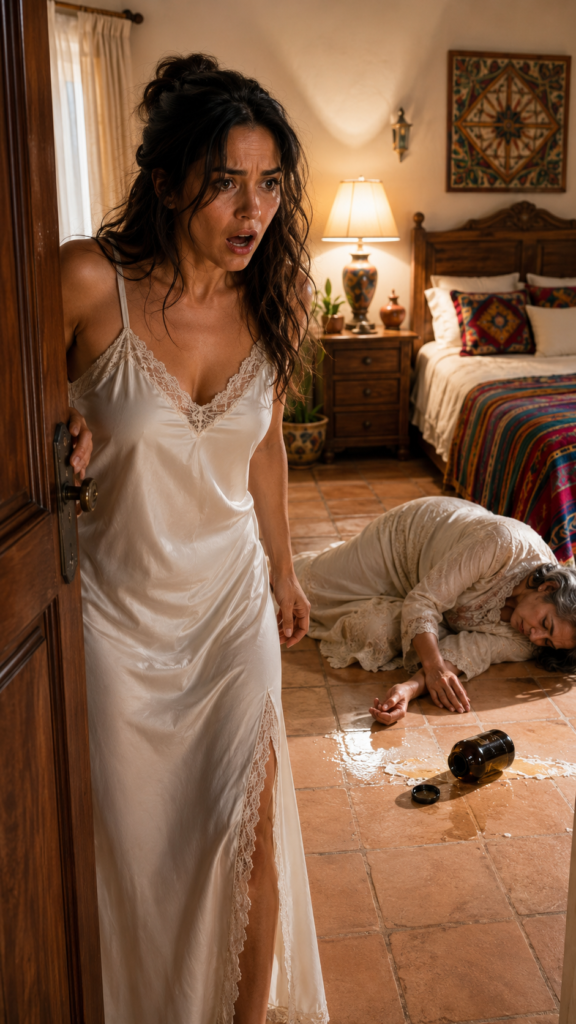
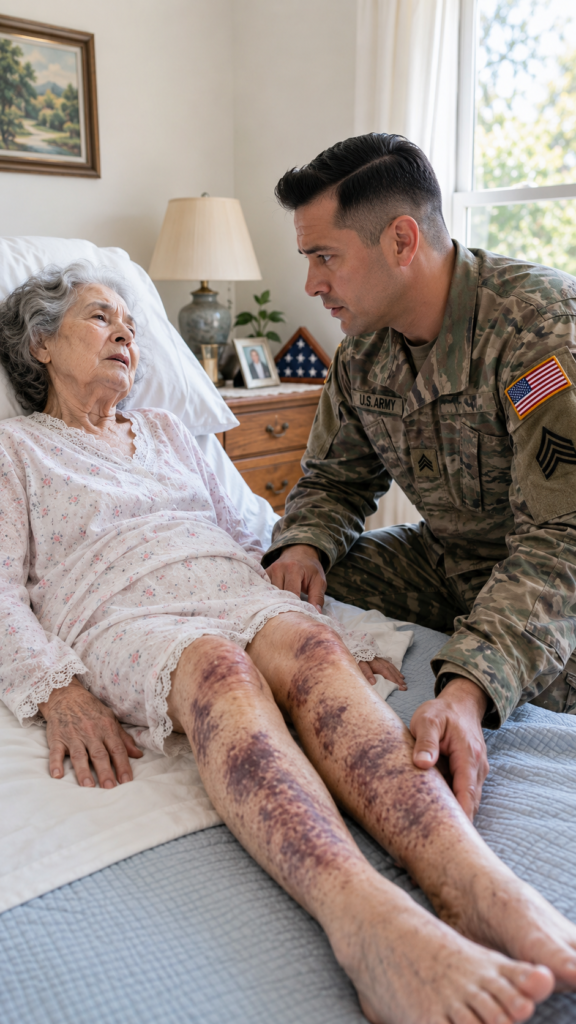
Doña Mercedes sat on the floor, her back against the wall, wearing the same floral blouse he had seen her in during a video call five days earlier. She had no cell phone. No sheets. Just a plastic cup with lukewarm water and a plate with half a stale bolillo.
Her wrists were bruised.
They weren’t bruises from a fall. They were fingerprints.
The elderly woman raised her gaze. Her eyes weren’t lost. They were furious, alive, crystal clear.
—I’m not crazy, Emiliano —she said slowly—. Your wife is robbing me.
He knelt before her.
—I know, Mom.
Doña Mercedes tried to speak, but they both heard footsteps in the hallway. In one second, her face changed. The fury vanished, leaving an empty expression, like that of someone confused.
—Not yet —she whispered—. She checks everything.
Emiliano had to close the door from the outside again. It pained him as if he were betraying himself, but his mother squeezed his hand before the wood separated them.
That night, Regina served Swiss enchiladas and a glass of white wine. She talked about doctor appointments, supposed falls, episodes of aggression, and a scheduled psychiatric evaluation for the following morning.
—If the doctor confirms incapacity, you’ll sign the guardianship —Regina said, pushing a folder toward him—. Then we can sell her house in Coyoacán and pay for a dignified residence.
—My mom’s house has been paid off for years —Emiliano replied.
Regina smiled.
—Exactly.
That “exactly” said it all.
At midnight, Emiliano placed a recorder under the kitchen table. Changed bank passwords. Checked the camera system. Regina had deleted three months of footage, but not the cloud records.
He also found his mother’s bank statements forwarded to Regina’s private email and a pending request for 850,000 pesos.
When he went back upstairs, he barely opened the door.
—Tomorrow I need you to act confused in front of her.
Doña Mercedes looked at her bruised wrists and then at her son.
—How confused do you want me to get, son?
PART 2
The next morning, Doña Mercedes came down to the kitchen wearing a blue robe that Emiliano had tossed through the window before dawn.
She walked slowly, dragging her feet, staring at the toaster as if it were a machine from the future.
—Is this where I buy the ticket to go to Tacubaya? —she asked, her voice trembling.
Regina could hardly hide her satisfaction.
—See, Emiliano? —she said, raising her voice just toward where the recorder was—. I live this every day. She gets lost even inside the house.
Doña Mercedes grabbed the sugar bowl and let it fall to the floor. The noise shattered the morning.
Regina lunged at her and squeezed the elderly woman's wrist so tightly that the skin turned white.
—Enough of making me look bad in front of my husband —she hissed.
Emiliano lowered his gaze to his plate, even though inside he wanted to flip the table.
—Regina, be patient. She’s sick.
She let out a dry laugh.
—Finally, you understand, dude. It was about time.
Later, as Doña Mercedes returned to her room, Regina opened the thick folder on the table.
The evaluation was scheduled for 9:00 with Dr. Alicia Rosales, a private psychiatrist in Polanco. If Doña Mercedes was declared incapable, Emiliano had to sign the guardianship that same day.
—We can’t go on like this —Regina said—. Your mom needs to be committed. And her house, well, it won’t take care of itself.
Emiliano leafed through the papers. There were medical reports with strange phrases, scanned signatures, and notes claiming that his mother “forgot her name” and “exhibited delusions of persecution.”
It was all a lie.
That day, Emiliano moved as if he were on a mission.
First, he called a certified locksmith, who documented that the lock on the room had been modified to open only from the outside.
Then he brought in a trusted military doctor, Dr. Palacios, who photographed Doña Mercedes's wrists and wrote a report: the injuries were consistent with forced restraint, not accidental falls.
Afterward, he spoke with a former colleague from the Prosecutor's Office. She confirmed that the request for the transfer of 850,000 pesos bore a forged signature and that the house in Coyoacán had a notarial alert for attempted irregular sale.
But the piece that changed everything came from Doña Mercedes herself.
—Look in your father’s desk —she told him—. Bottom drawer. He was always paranoid, but blessed paranoia.
Emiliano opened the old wooden drawer and found a small camera hidden inside an antique smoke detector. His father had installed it years ago after a wave of robberies in the neighborhood.
Regina had deleted the modern cameras.
But she never knew about this one.
The memory contained weeks of recordings.
In one, Regina took Doña Mercedes's cell phone.
In another, she pulled her by the arms down the hallway.
In yet another, she practiced in front of the mirror:
—Poor thing, she no longer remembers. Sometimes she hurts herself.
And in the most brutal recording, Regina sat in the kitchen with a man in a gray suit. Emiliano recognized him: Darío Molina, a real estate developer who had been buying up old houses in Coyoacán to build luxury apartments for months.
—When she’s declared incapable, we sell quickly and cheaply —Darío said—. Your husband signs the guardianship and that’s it. No one is going to believe an old lady that everyone thinks is crazy.
Regina leaned in and kissed him.
Emiliano stopped breathing for a second.
The betrayal was no longer just against his mother. It was against everything that remained of his family.
That night, he copied the files onto three flash drives and two clouds. One copy went to Dr. Rosales. Another to the adult protective services unit at the Prosecutor's Office. The third was set to send to Regina's lawyer if she attempted to move a single peso.
At dinner, Regina drank more wine than usual.
—Your mom always hated me —she said—. Now she’s pathetic. She hardly seems human anymore.
—Maybe she’ll recover —Emiliano replied.
Regina burst out laughing.
—From dementia? Don’t be naive.
—I meant her wrists.
Silence fell like a stone.
Regina stared at him intently. For the first time, her smile vanished.
—Listen to me, Emiliano. No one is going to believe that old woman over me. I’ve already told everyone that she screams, lies, falls, and makes things up. Tomorrow a doctor will put it in writing.
The recorder captured every word.
Emiliano raised his glass.
—Then let’s toast to tomorrow.
Regina clinked her glass, unaware that she had just toasted to her own downfall.
At 8:30, they headed to Polanco. Regina looked impeccable, in a white blazer, red lips, and enormous dark sunglasses. She appeared to be a wealthy, worried woman, not someone about to be unmasked.
Doña Mercedes sat quietly in the back, her hands resting on a black bag. Inside was a photo of her deceased husband and the rosary he had given her when they bought the house.
During the drive, Regina gave instructions as if she were training a child.
—Don’t argue with the doctor. If you forget something, don’t make it up. And don’t get aggressive, because that works against you.
Doña Mercedes looked out the window.
—I will do everything I can to remember, Regina.
In the waiting room, Regina handed her fake folder to the receptionist. Emiliano walked straight to Dr. Rosales’s office and handed her another folder.
The doctor opened the first page. Then she saw the photos of the bruises. Afterward, she reviewed the USB drive.
Her face changed completely.
—Please, close the door —she ordered the nurse.
The evaluation lasted 43 minutes.
Doña Mercedes recited the exact date, the name of the president, her CURP, her medications, the account number where she received her pension, and the birthdays of her four grandchildren.
She aced memory tests without fail. She explained how the hidden camera worked. Described each day of confinement with a precision that chilled the blood.
Regina interrupted, screaming:
—She memorized it! My husband trained her!
The doctor stared at her without blinking.
—Mrs. Regina, why was a competent adult locked in a room without a phone or exit?
—It was for her safety.
—And why did the lock open only from the outside?
Regina desperately searched for Emiliano.
—Tell them the truth. I am your wife.
He placed his phone on the desk and pressed play.
“Nobody’s going to believe that old woman over me,” echoed clearly.
Regina turned pale.
Then Darío’s voice sounded, talking about selling the house below market value. After that, the video showed Regina pulling Doña Mercedes by the arms.
Regina lunged for the phone, but the side door opened.
Two agents from the Prosecutor's Office entered.
—Regina Salvatierra —a woman in a government vest said—, you are under arrest for domestic violence, illegal confinement, forgery of documents, and attempted dispossession of property against an elderly person.
—This is a trap! —Regina screamed as they put the handcuffs on her.
Doña Mercedes slowly rose.
—No, daughter. The trap was my locked door.
Regina turned to Emiliano with wild eyes.
—I slept with you! I was your wife!
—And my mother was the victim —he replied—. I only protected the witness.
She broke then.
She began blaming Darío, the stress, the money, the exhaustion, the “manipulative old lady.” Every excuse was recorded by the agents.
At the same time, Darío was arrested at a notary's office in Miguel Ángel de Quevedo, where he was trying to present a fraudulent sale contract. The investigation revealed that he had done the same with two other families, always targeting lonely elderly adults, paid-off houses, and easily manipulable relatives.
Dr. Rosales declared Doña Mercedes fully competent and recommended therapy for trauma. A judge issued protective measures, froze Regina’s accounts, and annulled all documents signed under duress.
The neighbors who had spread the rumor of dementia were the first to knock on the door with flowers, sweet bread, and shame.
Regina ended up pleading guilty when her own lawyer saw the videos. She received prison time, restitution, and a permanent ban from working with or caring for elderly people. Darío received a longer sentence.
Emiliano’s divorce took eleven minutes.
She lost the house, the money, and the mask of the perfect woman she had flaunted.
Eight months later, the room where Doña Mercedes had been locked up was painted light blue, with white curtains and a rocking chair next to the window. On the table was a new cell phone, always charged, and a photo of her husband.
Emiliano returned to service only when she asked him to.
Before he left, he found her in the kitchen making lemon pie.
—Are you still confused, mom? —he asked, smiling.
Doña Mercedes burst into laughter.
—Very much, son. I forget why I was ever afraid of her.
And from the hallway, a new camera blinked silently.
This time, it wasn’t watching a prison.
It was guarding the peace that a cruel woman thought she could steal.