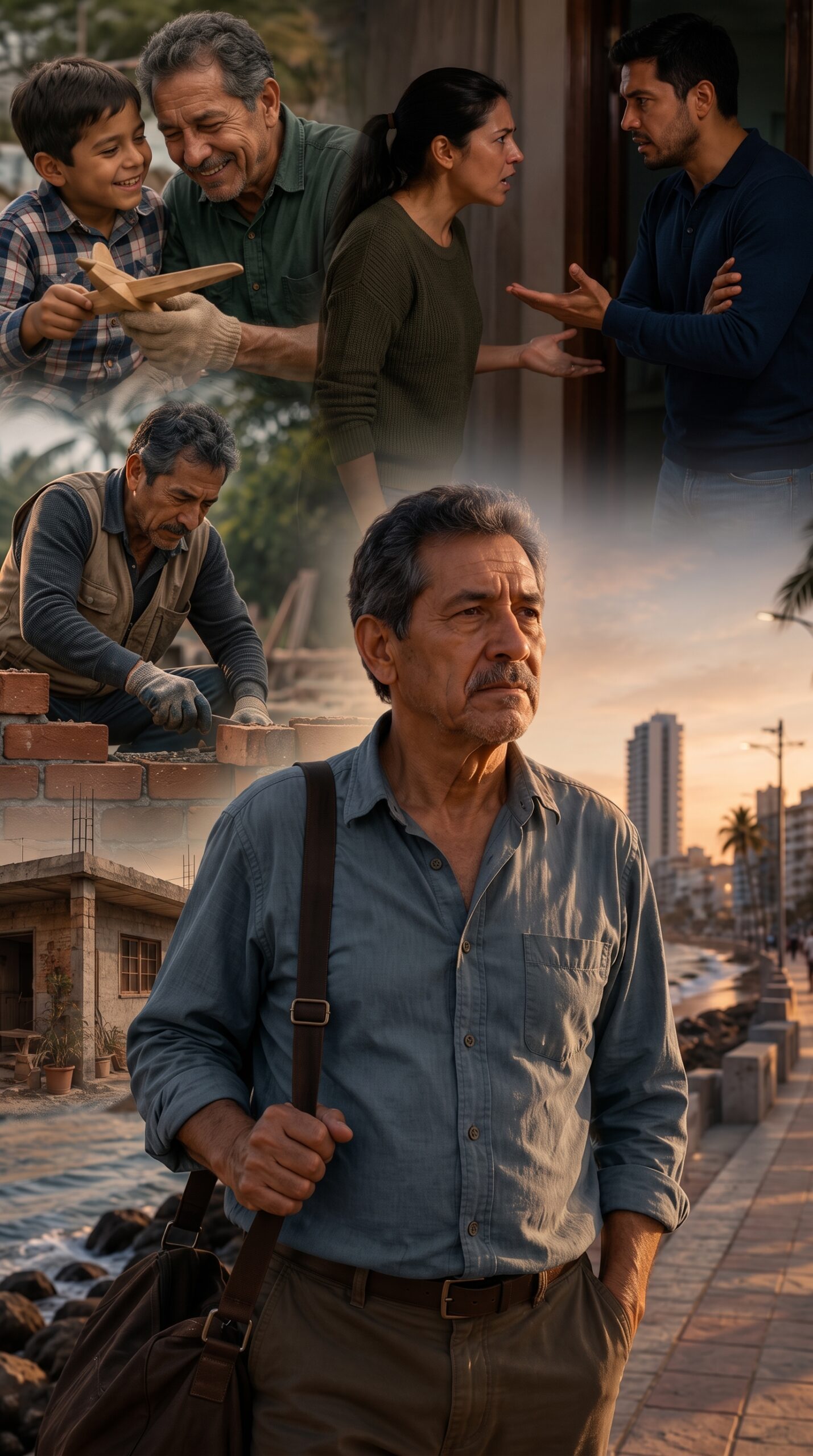
PART 1
The morning Don Héctor Salgado heard his daughter's fiancé say, "After the wedding, Camila will understand who makes the decisions," he felt the steering wheel slip from his grip.
He was driving down Avenida Patria in Guadalajara, with the rain softly tapping against the windshield and the traffic crawling at a snail's pace.
In the backseat, Sebastián Valdés spoke on the phone as if no one existed.
He wore a navy blue suit, an expensive watch, and that smile of a man accustomed to having everyone open doors for him.
Don Héctor said nothing.
He clenched his jaw, eased off the gas, and kept driving.
At 62 years old, with the thick hands of a retired electrician, patience was a lesson life had taught him through hard knocks. For over 40 years, he had fixed houses, workshops, restaurants, and buildings where no one saw the wires, but everyone wanted light.
So he knew something very simple: a faulty connection may take time to fail, but when it blows, it burns everything.
For the past 8 months, he had been working some mornings as an executive driver. He didn’t need the money. His wife, Marta, said he did it because he didn’t know how to stay still.
"You retired, Héctor, they didn’t punish you," she would repeat.
But he missed having a route, a schedule, and people waiting for him to arrive.
Sebastián started as any client: young, elegant, arrogant, one of those who gets in without greeting and gets out without looking the driver in the eye.
Don Héctor wore a black cap, a face mask, and glasses because he had just come from a dental treatment. Besides, passengers rarely looked at the one driving them.
Sebastián? Even less.
The irony was that this man was going to marry Camila, his only daughter, in 4 months.
Camila was 31, worked as a psychologist in a private secondary school, and loved her independence with a beautiful stubbornness. After a horrible relationship at 25, she had learned to tread carefully.
So when she introduced Sebastián, Don Héctor tried to trust.
The kid was nice at family meals. He brought flowers for Marta, talked about plans, stability, about "building a home."
But in the truck, he was different.
He interrupted calls, humiliated waiters, mocked colleagues, and talked about Camila as if she were property up for grabs.
That morning, as the traffic light turned red, Sebastián let out another laugh.
"No, man, you’re exaggerating. Camila asks a lot now because she still feels very free. Once we’re married, with a new house and away from her parents, she'll calm down."
Don Héctor's chest froze.
Camila had never mentioned moving.
She had never said she would leave her job.
She had never accepted that someone would decide for her.
That day, he dropped Sebastián off in front of an office tower in Puerta de Hierro. The young man got out without saying goodbye, with his phone still pressed to his ear.
Don Héctor watched him enter the building.
Then he turned off the truck.
For the first time in a long time, he felt fear of a truth he still couldn’t prove.
That night, Camila sent a photo of the wedding centerpieces to the family chat.
"What do you think?" she wrote happily.
Don Héctor typed: "We need to talk."
Then he deleted the message.
Marta found him in the yard, with a cup of cold coffee in his hands.
"What did you hear?" she asked.
Don Héctor looked at her.
And when he told her everything, Marta didn’t scream, didn’t cry, didn’t curse.
She only said one phrase that left him even more unsettled:
"Then don’t confront him yet. Observe him. If that man is planning to trap her, sooner or later, he will show the key."
PART 2
For the next few weeks, Don Héctor continued to drive Sebastián every Tuesday and Thursday.
Each trip became a silent torture.
At home, Camila excitedly spoke about the wedding, the music, the bridesmaids' dresses, about a honeymoon in Oaxaca that, according to her, they had both chosen.
In the truck, Sebastián talked about another life.
A life Camila didn’t know.
"I’ve already seen 3 houses in Querétaro," he said one morning while checking emails on his laptop. "I like the one in Juriquilla best. It has a study, a garden, and security. It’ll be fine for her, even if she gets dramatic at first."
Don Héctor felt his fingers burning on the steering wheel.
Sebastián heard something on the other end of the call and burst out laughing.
"No, her dad doesn’t count. He’s one of those old men who think that just because they change light bulbs, they understand life. Camila will get mad, but she’ll get over it."
That blow was different.
Not because he insulted him.
But because Sebastián had already thought about how to take away everything that anchored Camila: her job, her family, her city, her choices.
Another day, the young man got in with a brown leather folder. As he sat down, he left several disorganized papers on the seat. Don Héctor caught a glimpse of a printed phrase:
"Separation of assets agreement and waiver of future claims."
Sebastián spoke on the phone with someone named lawyer Ponce.
"I won’t tell her about the housing clause yet," he said. "Let her sign the general one first. Later, with the move looming, she won’t want to fight."
Don Héctor had to take a deep breath.
Camila had never mentioned an agreement.
That same night, at dinner, he tried to be careful.
"Honey, have you and Sebastián talked about money? Accounts, house, that kind of stuff?"
Camila set her fork down on the plate.
"Dad, again?"
Marta looked at him with concern.
"I’m just asking," he said.
"No, you’re not just asking. You’ve been acting strange about him for weeks."
"I want you to be sure."
Camila became serious.
"I’m sure. Sebastián isn’t Daniel. Not all men are going to hurt me."
The name hit the table like a broken glass.
Daniel had been the ex-boyfriend who had made her doubt herself for years. Don Héctor had watched her cry in silence, lose weight, apologize for things that weren’t her fault.
Since then, he promised never to let anyone dim her light again.
But Camila didn’t want a guard.
She wanted a father.
"I’m not saying that," he replied.
"Yes, you are. And it truly hurts me that you don’t trust me."
Camila left early that night.
For 12 days, she barely replied to messages.
Don Héctor drove with a knot in his throat. Sometimes he thought Marta was right. Maybe he was mixing fear with suspicion. Maybe he was hearing threats where there was only clumsiness.
But Sebastián made sure to destroy any doubt.
The ugliest piece appeared on a Thursday.
Sebastián got in in a good mood, smelling of expensive perfume and Starbucks coffee. He called a friend as soon as he closed the door.
"It’s all set for the Club de Industriales," he said. "Big engagement dinner, 120 people. Family, friends, partners. That’s when I’ll announce the move to Querétaro."
Don Héctor almost slammed the brakes.
"No, of course she doesn’t know. That’s the point. If I say it in front of everyone, she won’t throw a fit. Camila cares too much about her image as a reasonable woman."
There was a pause.
Then Sebastián added:
"Social pressure helps, dude. No one wants to look like the problematic bride."
Don Héctor felt like throwing him out in the middle of the avenue.
But he didn’t.
That afternoon, he sought out Julián Robles, an old friend who had been in law enforcement and now worked as a private investigator. They met at a café in the Americana neighborhood.
Don Héctor arrived with tired eyes and the folder of notes he had been gathering.
Julián read everything without interrupting.
"You don’t need to prove that Sebastián is a scoundrel," he said at the end.
"Then what do I need?"
"Prove that Camila is making decisions without information. That changes everything."
From that moment on, Don Héctor stopped acting out of anger and started acting with precision.
He didn’t record private calls. He didn’t steal anything. He didn’t fabricate evidence.
He only kept what Sebastián left in plain sight: printed emails from real estate agents, the reservation for the Club de Industriales, visit schedules for houses in Querétaro, a copy of the prenuptial agreement that Sebastián himself forgot in the truck, and a message mistakenly sent to the shared wedding email.
That message read:
"I confirm the surprise announcement of the move to Querétaro after the toast. Please do not inform Camila to maintain the emotional effect."
Emotional effect.
That’s what they called setting a trap in front of 120 people.
Marta read that phrase and brought a hand to her mouth.
"This isn’t love, Héctor."
"No," he said. "It’s the management of a person."
The night of the dinner arrived with a clear sky and warm air.
The Club de Industriales was decorated with white flowers, tall candles, and cream-colored tablecloths. There was soft music, waiters with trays of wine, and relatives taking selfies next to a golden sign that read "Camila & Sebastián."
Camila appeared in an emerald green dress. She looked beautiful, calm, happy.
When she saw her parents, she ran to hug them.
"Thanks for coming," she said, squeezing Don Héctor tightly.
He could barely respond.
Because he knew that night he was going to break something.
And even if it was to save her, it still hurt.
Sebastián walked through the hall like he owned the place. He greeted businessmen, hugged Camila’s uncles, smiled for photos, and touched his fiancée’s back with a confidence that Don Héctor found possessive.
At 9:10, Sebastián climbed onto the small stage.
He tapped a glass with a spoon.
The hall fell silent.
"Good evening, everyone," he began. "Thank you for joining us in such an important stage. Camila and I are building an incredible future."
Camila smiled, unaware of anything.
Don Héctor felt Marta squeeze his hand under the table.
Sebastián continued:
"And that’s exactly why I want to share some news that will mark our new life. After the wedding, Camila and I will be moving to Querétaro, where I accepted a great professional opportunity."
Some clapped reflexively.
Others turned to look at Camila.
She was no longer smiling.
"What did you say?" she asked.
The microphone picked up her voice.
Sebastián tensed but tried to laugh it off.
"Honey, the opportunity I told you about..."
"You didn’t tell me anything."
The hall went cold.
Sebastián lowered his voice, but the microphone was still close.
"Don’t do this here."
Camila blinked, confused.
"Me?"
That was the moment Don Héctor stood up.
He didn’t shout.
He didn’t slam the table.
He just walked slowly until he stood in front of the stage.
Sebastián looked at him with annoyance at first. Then with doubt. Finally, as if a lamp lit up inside his head, his face drained of color.
He recognized the voice.
The posture.
The name of the executive service app.
"You..." he murmured.
Don Héctor raised his head.
"Yes, Sebastián. I’m Héctor Salgado. Your driver on Tuesdays and Thursdays. And I’m also Camila’s father."
A murmur swept through the hall.
Camila stood frozen.
"Dad, what’s happening?"
Don Héctor didn’t look at the guests. He didn’t look at Sebastián.
He looked at her.
"Honey, when did he tell you he already accepted a job in Querétaro?"
Camila turned to Sebastián.
He didn’t answer.
"When did he tell you he already looked for houses there?"
Silence.
"When did he say he wanted you to leave school because your independence seemed like a problem to him?"
Camila’s face shattered.
Sebastián stepped down from the stage with a hard jaw.
"This is disrespectful. You were eavesdropping on private conversations."
Don Héctor pulled a folder from a black bag.
"You spoke as if the driver were furniture. That was your mistake."
Sebastián tried to snatch the folder, but Camila stepped forward.
"Give it to me," she said.
The tone left no room for argument.
Don Héctor handed it over.
Camila opened the folder right there, under the warm light of the hall. She read the event reservation, the emails from real estate agents, the acceptance letter for the job, the prenuptial agreement, and the message about the "emotional effect."
Each page erased a piece of her illusion.
Sebastián began to speak quickly.
"Camila, you’re misunderstanding everything. I did it for us. You sometimes doubt too much. I just wanted to make things easier for you."
"Easier for me?" she asked.
"Yes. You cling to your school, to your parents, to your routine. But getting married means trusting."
Camila lifted her gaze.
She had tears, but she didn’t look weak.
She looked awake.
"You weren’t asking me for trust, Sebastián. You were asking me for obedience."
He pressed his lips together.
"Don’t be unfair. I love you."
Camila took a deep breath.
"Maybe you do. But you love me like you love a house: wanting to change the doors, the windows, and even the lock."
No one said anything.
Even the waiters stopped moving.
Then came the twist no one expected.
Marta, who had been seated until that moment, stood up with her cellphone in hand.
"Camila, there’s something else."
Sebastián turned abruptly.
"Ma’am, don’t get involved."
Marta ignored him.
"Two days ago, a woman called me. Her name is Rebeca. She said she was Sebastián’s girlfriend in Monterrey three years ago. At first, I thought she was just a bitter ex."
Sebastián turned pale.
"That has nothing to do with anything."
Marta continued:
"She also left her job for him. She also moved. She also signed papers she didn’t fully understand. When she wanted to leave, she found everything was in his name and that she didn’t even have money to return to her family."
An indignant murmur grew among the guests.
Camila looked at Sebastián as if she were seeing him for the first time.
"Is it true?"
"It was a complicated relationship," he said.
"Is it true?" she repeated.
Sebastián fell silent.
And that silence answered for him.
Camila slowly took off the ring.
She didn’t throw it. She didn’t scream. She didn’t make a scene as he had feared.
She simply stepped down from the stage, walked to the main table, and placed the ring inside Sebastián’s glass.
The metallic sound was small.
But in the hall, it echoed like a bell.
"The wedding is canceled," Camila said.
Sebastián tried to grab her arm.
Don Héctor stepped forward.
He didn’t need to say anything.
Several of Camila’s cousins stood up too.
Sebastián immediately released her hand.
"You’re going to regret this," he whispered.
Camila looked at him with a calmness that hurt.
"No. I would have regretted marrying you."
Sebastián left the hall 15 minutes later, accompanied by his mother, who was saying that it was all an exaggeration and that women nowadays couldn’t handle anything.
That phrase ignited more comments than the announcement itself.
An aunt of Camila replied:
"No, ma’am. What they can’t handle anymore is being treated like a borrowed car."
The dinner ended without toasts, without dancing, and without cake.
But it also ended without lies.
Camila cried in the bathroom, holding Marta. Don Héctor stayed outside, his back pressed against the wall, listening to her sobs like one listens to a house that helped to save before the fire.
For weeks, Camila didn’t want to talk much.
She didn’t blame her father, but she couldn’t embrace him yet. It hurt her to have been exposed, it hurt her not to have seen the signs, it hurt her to accept that a part of her had indeed confused control with security.
Don Héctor didn’t insist.
He sent her simple messages.
"There’s soup at home."
"Your mom made rice."
"Cable chewed another sandal."
Cable was a stray dog Camila had rescued months earlier, skinny, hairy, and distrustful. Don Héctor said he resembled the family: half patched up but loyal.
One Sunday, two months later, Camila arrived home with a box of sweet bread.
She sat in the kitchen across from her dad.
"You were unbearable," she said.
Don Héctor looked down.
"Yes."
"Nosy."
"Also."
"Stubborn."
"That runs in the family."
Camila tried not to laugh, but it slipped out.
Then her eyes filled with tears.
"Thank you for not letting them dim my light."
Don Héctor didn’t know what to do with his hands.
In the end, he just hugged her.
A year passed.
Camila continued working at the secondary school. Later, she studied a certification in family therapy and opened a small practice in the afternoons. She bought an apartment near Chapalita, with big windows and a shelf full of plants she almost always forgot to water.
Sebastián moved to Querétaro alone.
He tried to write to her several times. He sent flowers, emails, long apologies, and messages mixing love with reproach.
Camila never returned.
One day, while Don Héctor was installing a lamp in her apartment, he saw a photo on the table: Camila as a child, wearing a yellow helmet, sitting on his shoulders during a construction.
"Do you remember," she said, "that I wanted to tell everyone where to put the wires?"
Don Héctor smiled.
"You always loved to decide."
Camila carefully adjusted the photo.
"And I almost let someone convince me that was a flaw."
He set the screwdriver down on the table.
"Honey, loving someone doesn’t mean handing them the switch to your life."
Camila looked at him in silence.
Outside, the evening fell over Guadalajara, and the new lamp lit up with a clean, warm, steady light.
Don Héctor had been an electrician his entire life.
He knew that some failures aren’t visible from the outside.
But he also knew that if someone manages to cut the power in time, the house doesn’t burn down.
And sometimes, even if it hurts, saving the one you love begins by letting them see the darkness they were about to accept in full light.