PART 1
—After 25 years, enough of the theater: Diego is not your son, Mariana. He’s mine… and Renata’s.
Esteban Valdés's voice cut through the laughter on the terrace of that house in San Ángel like a knife.
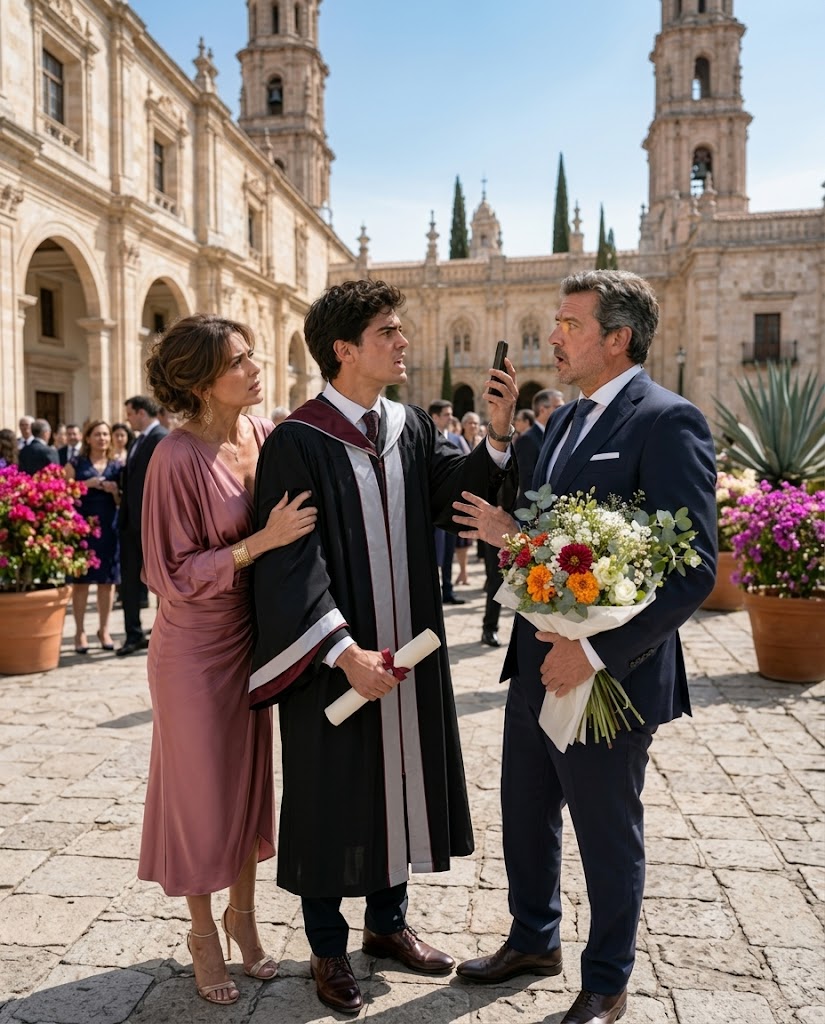
There were 30 people seated among flowers, glasses of wine, mole poblano, and soft music. They were celebrating Diego's return from Spain after finishing a master's in architecture.
Mariana stood by the dining room, wearing a dark green dress and her hair pulled back. She smiled like women do who have learned to hide their exhaustion behind elegance.
For 25 years, she had been Diego’s mother.
The one who left her job at a publishing house when Esteban came home one dawn with a baby wrapped in a gray blanket. The one who believed the story that he had found the child abandoned outside a parish in Coyoacán.
That night, Esteban had said to her:
—God is giving us what the doctor took away. Take care of him, Mariana. I’ll take care of everything else.
And she believed him.
She gave up trips, promotions, and dreams. She traded manuscripts for baby bottles, presentations for school meetings, heels for nights of fever.
While Esteban turned a small construction company into a millionaire enterprise, Mariana raised Diego with a patience that went uncelebrated, yet everyone took advantage of.
So when Esteban raised his glass and asked for silence, several thought he was going to express gratitude.
But then Renata Gálvez appeared.
She strode in from the hallway in a red dress, perfect lips, and a smile that didn’t ask for permission. Esteban took her hand in front of everyone.
—Mariana and I are getting a divorce —he said—. This house is in my name. You have one week to pack your things.
Mariana felt the air leave her lungs.
—Esteban… what are you saying? And Diego?
Renata let out a soft, poisonous laugh.
—Oh, Mariana, don’t play dumb. Thanks for taking care of my son all these years. Honestly, you did pretty well.
A murmur rippled through the terrace.
Mariana took a step back.
—No. You said he was abandoned. You said you didn’t know where he came from.
Esteban calmly set his glass down with cruel precision.
—I told you what you needed to hear. You couldn’t have children, Mariana. You would cling to any baby. You were perfect for raising him without asking.
Mariana’s cheeks burned.
Renata approached and spoke to her as if dismissing an employee.
—Now your part is over. Diego has returned prepared, educated, presentable. He can now be with his real parents.
Mariana searched for Diego with her eyes.
He stood near the entrance, motionless, his face set. He wasn’t crying. He wasn’t yelling. He was just staring at Esteban as if finally seeing a stranger.
—Son —Esteban said, opening his arms—. Come with us. You don’t have to carry a woman who was only useful.
Mariana walked toward Esteban, trembling.
—Useful? I taught him to walk. I was in the hospital when he almost died of pneumonia. I sold my jewelry to pay for classes when you said there was no money.
Esteban shoved her with humiliating force.
Mariana crashed against a chair. A plate shattered beside her hand. No one moved for an eternal second.
Renata smiled.
—Look at that. Even on the ground, she looks like what she always was: a nanny with a last name.
Then Diego set his glass down on the table and walked toward Mariana.
Not toward Esteban.
Not toward Renata.
He knelt before the fallen woman, took her hands, and said in a voice that froze everyone:
—Mom, get up. Because what they don’t know is that I’ve also kept a truth for three years.
PART 2
Diego helped Mariana to her feet with a gentleness that made more than one aunt tear up.
Esteban clenched his jaw.
—Mom? You still call this woman mom after knowing the truth?
Diego placed himself in front of Mariana as if his body was a closed door.
—The truth didn’t start tonight, Esteban. It started three years ago when I heard you talking in your office.
Renata lost her smile.
—What are you talking about, my love?
Diego pulled out his phone.
—Don’t call me my love. You don’t know what it means to love.
He connected the phone to the terrace speaker. No one breathed. Outside, the night in Mexico City remained the same, with distant lights and muted traffic, but inside that house, everything was about to explode.
The recording began.
First, Renata’s voice was heard:
—He's going to Europe. When he comes back, we tell him he’s our son and get Mariana out of the house. I can’t stand her calling him mom.
Then Esteban’s voice appeared, cold and confident.
—Wait. If we had raised him ourselves, who would have stayed up? Who took him to therapy, to school, to the hospital? Mariana was ideal. Since she couldn’t get pregnant, she would cling to the child like an abandoned dog.
Several people screamed at once.
Mariana’s sister stood up furiously.
—You’re a scoundrel!
A cousin of Esteban murmured:
—No way, man… this is too much.
The recording continued.
—When Diego comes back with a degree and contacts —Esteban said—, we’ll tell him everything. Mariana will have done the dirty work. We reclaim the kid, and the company stays clean.
Diego turned off the audio.
Esteban tried to snatch the phone away, but Diego swatted his hand aside.
—For three years, I stayed silent because I needed proof. I wanted to see how far you were capable of going.
Renata pretended to cry.
—Diego, I was young. I was scared. Your dad forced me to leave you.
Diego let out a sad laugh.
—No, Renata. You never left me out of fear. You left because it suited you.
Esteban pointed at Mariana.
—She’s nothing to you!
—She’s the only mother I’ve ever had —Diego replied—. The one who stayed when I was feverishly vomiting. The one who waited up for me when I came home late. The one who cried silently when I went to study so I wouldn’t feel guilty.
Mariana covered her mouth with her hands.
Esteban, desperate, slammed his hand on the table.
—Perfect. Then you both can leave. This house is mine. The construction company is mine. Tomorrow I’ll freeze your accounts, Diego. Let’s see how long your love lasts without money.
—That’s not true either —a voice said from the door.
Everyone turned.
Licenciado Herrera, a gray-haired lawyer who had been a friend of Mariana’s father, entered. He carried a black briefcase and a calm that commanded more respect than any shout.
—Esteban, you forgot a clause.
The lawyer laid several documents on the table.
—The house in San Ángel and the initial capital of the construction company came from the estate of Don Julián Aranda, Mariana’s father. You signed a notarized agreement: if you betrayed Mariana, tried to dispossess her, or used family assets to maintain an extramarital relationship, everything would legally revert to her.
Esteban turned pale.
—That paper is worthless.
—It’s worth enough for a judge to have already frozen three company accounts —the lawyer replied—. We also found transfers to buy Ms. Renata an apartment in Polanco and to pay for luxury treatments at her clinic.
Renata released Esteban’s hand.
—Did you use company money for that?
Esteban glared at her with rage.
—You asked me for it!
The scene turned into a quagmire. The guests were no longer whispering; some were recording, others were shouting insults, and some were hugging Mariana.
Diego took his mother’s hand.
—This is your house, mom. The ones who are leaving are them.
But the hardest blow didn’t come that night.
It came two months later, during the family hearing in a court in Mexico City.
Esteban appeared in a dark suit, wearing a victim’s expression. Renata entered behind him, with enormous glasses and an expensive scarf. Her lawyer tried to paint Mariana as a resentful woman wanting to take someone else's fortune.
—The lady didn’t generate direct economic value —he said—. She was a housewife.
Licenciado Herrera stood up slowly.
—Raising a child, maintaining a home, and allowing a man to build a company also generates value. But today we’re not just coming with arguments. We’re coming with documents.
He presented contracts, account statements, receipts, transfers, and recordings. Each piece of evidence sank Esteban deeper.
Then, cornered, he made his worst mistake.
—I only diverted money because I had to support another child of Renata. It wasn’t for luxuries. It was for my blood.
Renata jumped up.
—Esteban, shut up!
But it was too late.
The lawyer smiled slightly.
—How interesting. Do you have DNA proof of that other child?
Esteban hesitated.
—I don’t need it. He looks like me.
The lawyer requested to call a witness.
A thin man walked in, wearing a simple shirt, accompanied by a 22-year-old. Renata turned as white as a sheet.
—I’m Bruno —the man said—. That boy is my son. Renata made the gentleman Esteban believe he was his to extract money from him for years. I was paid to stay silent.
Esteban lunged at Renata like a wounded animal.
—You played me!
The guards stopped him before he could touch her. Renata cried, but her tears no longer bought compassion.
The judge imposed strict measures. Mariana would keep the house, take control of the construction company, and Esteban would face charges for fraud and embezzlement.
As he was led away in handcuffs, Esteban looked at Mariana.
—Please… for all we lived through.
She looked at him without hate.
—What we lived through died the day you called “useful” the woman who raised your son.
Mariana thought everything had finally ended.
But the truth was just about to reveal its most brutal face.
A week later, already settled in the main office of the construction company, an old accountant named Don Ramiro asked to see her alone. He brought a worn brown notebook, aged by the years.
—Mrs. Mariana, this should have come out 25 years ago. I was cowardly. I can’t carry it anymore.
Inside was a copy of a medical certificate. Male baby. Son of Renata Gálvez. Deceased at three days due to a heart condition.
Mariana felt the blood drain from her body.
The date was the same week Diego arrived at her home.
Beneath it was a handwritten note:
“False proof paid for by Renata. The baby given to Esteban is not his.”
Diego entered at that moment with coffee and sweet bread. Seeing Mariana trembling, he rushed to her.
He read the notebook in silence.
—So… —he murmured— I’m not the son of Esteban or Renata.
Mariana couldn’t speak.
Diego hugged her tightly.
—Mom, listen to me closely. I don’t care about the blood I come from. You saved me. You made me a person. If I don’t carry anyone’s blood in that lie, I carry your love in every part of me.
But Diego needed to know his origin.
They searched for Renata’s mother, an elderly sick woman living in a tenement in Iztapalapa. The woman confessed that Renata had come home that night with a baby that wasn’t hers.
She also kept a wooden bracelet.
It was small, old, with a number engraved: 18122330.
—She said she found him near a private hospital —the old woman whispered—. But I never believed her. She came back scared, as if she had stolen something.
Days later, Renata appeared battered in a hospital. Esteban, from jail, had sent people to collect all her lies. She asked to see Diego before she died.
Mariana wanted to refuse, but Diego needed to hear.
Renata was unrecognizable. Still, her gaze was filled with venom.
—I didn’t find you abandoned —she said, her voice broken—. I stole you.
Mariana felt the room freeze.
Renata confessed that her baby died in a private clinic. Desperate not to lose Esteban or her money, she went out into the hall. In a VIP room, a young mother was suffering from a hemorrhage. Doctors and nurses rushed.
The newborn cried alone, wearing a wooden bracelet on his wrist.
—I hid you under my coat and left —Renata said—. Your mother died without seeing you. Your family has been looking for you for 25 years.
Diego stepped back, devastated.
—You’re a monster.
Renata barely smiled.
—Yes. And yet, no one is going to give you back those years.
The monitor emitted a long beep. Renata died leaving more shadow than regret.
Licenciado Herrera investigated hospitals, complaints, and lost files. He finally found the case: Diego’s mother was named Inés Ibarra, she died from a hemorrhage in a clinic in Santa Fe. Her baby disappeared that same night.
His grandparents, Don Ernesto Ibarra and Doña Mercedes Alcázar, a family from Monterrey, had searched for him for 25 years.
When they arrived in San Ángel, Doña Mercedes could barely walk. Seeing Diego, she placed her hands on her chest.
—He has my daughter’s eyes —she cried—. My God… it’s our boy.
Don Ernesto took out a velvet box. Inside was the other half of a wooden bracelet.
Diego took out his.
The two pieces fit together.
The date and time of his birth.
Mariana stepped back a few paces, believing her place ended there.
But Doña Mercedes approached, took her hands, and cried in front of everyone.
—You didn’t take our grandson from us. You saved him. If Diego is noble, it’s because of you. If my daughter could see you, she would thank you on her knees.
Diego hugged Mariana from behind.
—She is my mom —he said firmly—. Today I found my roots, but my home has always been her.
Don Ernesto nodded through tears.
—Then we’re not just reclaiming a grandson. We’ve gained a daughter too.
Months later, Esteban was convicted. The construction company was left in Mariana’s hands. Diego visited Monterrey, saw photos of his biological parents, and heard stories of the life they took from him.
But he never left Mariana.
One Sunday morning, while they were having chilaquiles on the terrace, Diego placed the wooden bracelet next to his mother’s coffee cup.
—This tells me where I come from —he said—. But you taught me who I am.
Mariana cried without shame.
Because she understood that there are women who give birth with their bodies, and there are women who give birth with their souls.
And when a child was used as a lie, a business, and a sin, the true mother was not the one who showed up in a DNA test.
It was the one who stayed.