PART 1
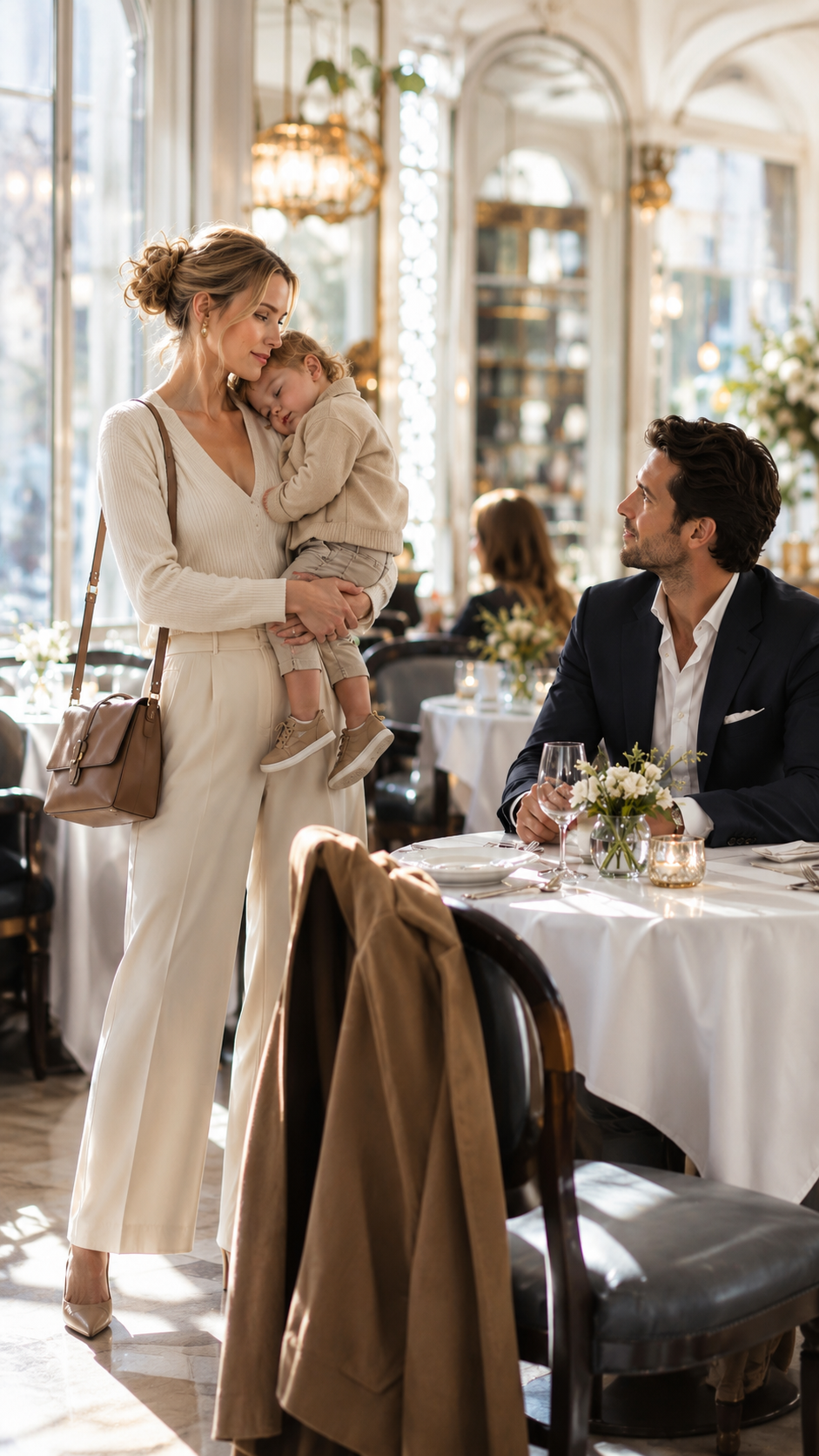
When Valeria arrived 31 minutes late to the restaurant in Roma, her hair was damp from the rain, a diaper bag hung from her shoulder, and a 5-year-old boy was asleep against her chest.
Diego Santillán, owner of a tech company in Santa Fe, saw her cross the door and thought what he had thought many times in his life: this is going to get complicated.
He hated complications.
His friends said Diego was charming, brilliant, and dangerously skilled at disappearing just when a woman started to expect him. He wasn’t cruel. He just always left an exit open.
Valeria approached the table with a shame so clear it was almost painful to watch.
“Sorry,” she whispered. “My neighbor was supposed to watch him, but her mom fell in Iztapalapa and I had to bring him. I understand if you want to leave.”
Diego looked at the child.
He wore dinosaur pajamas under a blue jacket, a cheek squished against Valeria's shoulder, and a green plastic toy tightly gripped in his hand.
“Does he eat dinner too?” Diego asked.
Valeria blinked, surprised.
“He already ate. Well... sort of. He said 3 nuggets were enough to survive.”
Diego smiled despite himself.
The boy opened one eye, looked at Diego's shiny black shoes, and murmured:
“Mr. Money.”
Then he fell back asleep.
Valeria turned beet red.
“Oh, Mateo…”
Diego let out a low laugh.
“I’ve heard worse things in meetings.”
Dinner, which was supposed to be an elegant date, turned into shared tlalpeño soup, used napkins as pillows, and conversations interrupted every 4 minutes because Mateo moved, asked for water, or drowsily wondered if dinosaurs paid rent.
Valeria ordered the cheapest thing on the menu.
Diego noticed.
He also noticed her dark circles, her cracked hands, the way she checked her phone as if expecting an emergency. It wasn’t distraction. It was learned fear.
When they left, the rain had turned the sidewalk into a mirror.
Diego called for a ride-share. Valeria tried to refuse, but Mateo snuggled against her and sighed.
“You don’t have to do this,” she said.
“I know.”
That made her look at him.
For a moment, the city turned down the volume. There were no horns, no waiters, no background music. Just rain, fatigue, and a ruined date that was starting to feel too real.
Mateo moved.
Without opening his eyes, he murmured:
“Mom…”
Valeria froze.
The word crossed her face like an old wound.
Diego saw it before she could hide it.
Then Valeria stroked the boy's hair and replied in a broken voice:
“No, my love. I’m Aunt Vale.”
Mateo fell back asleep instantly.
Diego remained silent.
Aunt.
Not mom.
The whole night crashed into his mind at once: the fatigue, the guilt, the fear, the way Valeria protected the boy even when she smiled.
There was a story there.
A heavy story.
Valeria looked up and said:
“Thank you for not running away.”
Diego wanted to respond with a joke, but he couldn’t.
Because in that moment, he understood something that left him breathless: for the first time in years, he didn’t want to run.
PART 2
Diego told himself he invited her out again because the first date deserved a second chance.
A normal one.
Without a sleeping child, without a diaper bag, without a green dinosaur or a little judge calling him “Mr. Money” in the middle of Roma Norte.
But on the second date, Mateo was there too.
And on the third.
By the fourth, Diego stopped pretending to be surprised.
Valeria always apologized.
“I swear I’m not bringing him as a chaperone,” she said while Mateo chased pigeons in Parque México.
Diego watched him jump over a puddle.
“Honestly, he has better conversation than a lot of adults I know.”
Mateo heard and pointed his dinosaur at him.
“That’s true, Mr. Money.”
“His name is Diego,” Valeria corrected.
“No. He has boss shoes.”
And the nickname stuck.
Their outings stopped feeling like dates and became pieces of real life: coffee in cardboard cups, quesadillas without cheese because Mateo said they were “more mysterious,” visits to bookstores where Valeria did monster voices and Diego looked at her with a tenderness he was afraid to admit.
Valeria worked as a preschool teacher in the morning. In the afternoons, she took care of children at a community daycare. On Saturdays, she cleaned offices with a friend in Del Valle.
Once Diego asked her when she rested.
She smiled.
“Sometimes, at traffic lights.”
He thought she was joking.
Until one afternoon he saw her close her eyes for 6 seconds at a red light, one hand still on the wheel, her face pale from exhaustion.
Still, Valeria never made Mateo feel like a burden.
He was chaos, noise, impossible questions, snot, spilled cereal, and pure love.
Diego began to understand that taking care of someone wasn’t always about saying pretty words. Sometimes it was skipping dinner so a child could eat strawberries. Sometimes it was remembering dinosaur pajama day when rent was already late. Sometimes it was smiling even when you wanted to cry because a child was watching you to know if the world was still safe.
The first time Valeria left Mateo with Diego for 20 minutes, Diego discovered that running a company was easier than caring for a child with imagination.
Mateo invented a game called Dinosaur Hospital.
They used 4 cushions, 2 spoons, an expensive tie, and half a roll of toilet paper.
“Don Chompitas needs surgery,” Mateo announced.
“For what?”
“His teeth.”
“Dinosaurs don’t brush their teeth.”
Mateo looked at him seriously.
“That’s why they went extinct.”
Diego had no arguments.
When Valeria returned, Diego was sitting in the building hallway, outside his own apartment, because Mateo had locked the door with the automatic latch.
Inside, the boy was singing while preparing “cereal soup.”
Valeria looked at Diego.
Then at the door.
Then at the tie hanging from the doorknob.
And she laughed so hard she dropped her keys.
Diego had never been so happy being ridiculous.
From that day on, Mateo stopped being part of Valeria’s complicated life.
He became part of the rhythm.
But not everyone saw him with tenderness.
Diego’s mother, Doña Rebeca Santillán, discovered Valeria through a photo from a children’s reading event. Diego had gone as a donor. Valeria appeared in the background carrying Mateo, wearing a green dress and sneakers because the boy had spilled jamaica water on her shoes.
The next day, Rebeca invited Diego to breakfast in Polanco.
That meant trouble.
“She has a child,” she said before touching her coffee.
“He’s her nephew.”
“And she’s raising him?”
“Yes.”
Rebeca adjusted her pearls, as if they were armor.
“I don’t judge her for not having money.”
Diego set down the cup.
“No one said that.”
“But you thought it, son. And that says quite a bit.”
He fell silent.
His mother lowered her voice.
“I’m worried about her. And I’m worried about you. That girl carries loss, exhaustion, debts, a child who has already lost too much. And you’re too good at wanting hard things from a safe distance.”
Diego was annoyed because it was true.
“This isn’t a project.”
“Then don’t treat it like one.”
Meanwhile, Mateo began saving stories for Diego.
If he built a crooked tower, he asked for a picture for “Mr. Money.” If he learned a new word, he demanded Valeria send it to him by audio. When he discovered that “herbivore” wasn’t an insult, he said Diego needed to know it “in case he lacked culture.”
Diego always responded.
Sometimes with dinosaur facts.
Sometimes with serious messages.
Once he sent an audio saying:
“Tell Professor Mateo that I deeply respect the stegosaurus lifestyle.”
Mateo listened to it 9 times.
Valeria smiled.
And then she felt fear.
Because children don’t get attached carefully.
They dive in whole.
They trust before asking if someone intends to stay.
Mateo had already lost too much to give his heart to a temporary man.
That’s why Valeria began to cancel plans.
First a dinner.
Then another.
Diego noticed, of course. He noticed everything, even when he pretended not to.
One rainy night, while Mateo slept on the couch with one lost sock and Don Chompitas under his chin, Diego and Valeria sat in the small kitchen with 2 cups of tea that no one wanted to drink.
“I’m scared,” she suddenly said.
Diego looked at her.
“Of me?”
She hated that he understood so quickly.
“Of Mateo loving you too much.”
“I love him too.”
“That’s the problem.”
The silence weighed heavily.
Valeria tightened her grip on the cup.
“My sister’s name was Lucía. She was 5 years older. She sang in the supermarket to embarrass me. She was late to everything. She was a beautiful disaster.”
Diego didn’t interrupt.
“She got sick when Mateo was 2 years old. At first, everyone said ‘treatment,’ ‘hope,’ ‘fight.’ Then the words changed: hospital, papers, custody.”
Valeria swallowed hard.
“Before she died, she made me promise that Mateo would never be a case for the DIF. I was 24. I didn’t know what I was getting into. I just knew my sister was dying and I needed to believe her son would be loved.”
Diego said softly:
“And you kept that promise.”
“I’m trying.”
“No. You kept it.”
She cried silently.
Diego reached out his hand over the table, not taking hers, just leaving it close for her to choose.
After a few seconds, Valeria placed her fingers over his.
That night, they almost kissed.
Almost.
Until Mateo appeared in the hallway in his dinosaur pajamas and an empty plate.
“I have a cereal emergency.”
Diego straightened up as if he were in a meeting.
“What kind of emergency?”
“Hunger.”
“Serious type.”
Valeria looked at him with eyes saying “don’t encourage him.”
Mateo sat down.
“Were you doing adult whispers?”
“No,” Valeria said.
“Yes,” Diego said at the same time.
Mateo scrunched his nose.
“Suspicious.”
The moment broke.
Or maybe it was saved.
But when Diego left that night, he stayed in the car for a long time.
On his phone, he had an email he hadn’t told Valeria about.
Monterrey.
A massive expansion.
Investors, new offices, a contract that could change his company forever.
They wanted him to move for at least a year.
Maybe more.
Diego had worked his whole life to open a door like this.
And now that it was open, he couldn’t stop thinking about the little apartment behind him, the exhausted woman who didn’t ask for rescue, and the child who called him Mr. Money as if it were an important title.
A week later, Mateo overheard a call.
Diego was in Valeria’s living room, believing the boy was playing with his dinosaurs.
“Yes, I understand the Monterrey timeline,” he said softly. “I haven’t decided, but if I accept, I would have to move for at least a year.”
The dinosaur fell from Mateo’s hand.
Diego turned.
Too late.
Mateo was staring at him, unblinking.
Valeria came out of the room with a laundry basket.
“What happened?”
Mateo didn’t look at her.
He looked at Diego.
“You’re going far away.”
Diego slowly ended the call.
He found no answer.
Mateo’s voice shrank.
“Like my mom.”
The apartment fell into silence.
One of those silences that enters when something breaks.
For days, no one spoke well of Monterrey.
Diego tried to find the right words.
All of them sounded cowardly.
Valeria found out through an online business magazine before he could tell her fully.
“Capital businessman prepares million-dollar expansion in Monterrey.”
There was a photo of Diego smiling in a dark suit, confident, successful, as if behind that smile, there wasn’t a child with fear.
Valeria read the article 3 times.
It didn’t just hurt that he was leaving.
It hurt to find out as a stranger.
When Diego arrived that night with tacos de arrachera and a guilty look, she was already broken.
“You were going to tell me,” she said, showing him her phone.
He looked down.
“Yes.”
“When?”
The silence answered.
Valeria let out a bitter laugh.
“Wow, how nice. I tried to believe you were different, and you’re planning an exit.”
“This isn’t an exit.”
“For Mateo, a year is an eternity.”
That hit him.
“Do you think I’m running away?”
She looked toward the door of the room where the child slept.
“I think people always leave. Some just take longer.”
Diego took a step toward her.
“I want to be in their lives.”
“We owe you nothing.”
The phrase came out cold.
And as soon as it left, Valeria regretted it.
Because Diego’s face didn’t show anger.
It showed pain.
“That’s the problem,” he said, his voice breaking. “I want to owe you something. I want to choose you. Not out of pity. Not out of obligation. Because you became my home without asking permission.”
Valeria wanted to believe him.
That was the dangerous part.
Wanting to believe.
A few days later, Diego accepted Monterrey.
And Valeria ended what had barely begun.
There were no shouts.
There was no slamming door.
Just an adult sadness, of the kind you carry while preparing lunches, paying bills, and telling a child that everything is okay.
The morning Diego left, it rained as if the city knew.
His truck was loaded. Valeria came down with Mateo, who wore his shoes on the wrong feet and had his hair standing up.
Diego knelt in front of the boy.
“Take care, champ.”
Mateo reached into his pocket.
He pulled out Don Chompitas.
Scraped.
Painted over.
Loved.
He placed it in Diego’s palm.
“Just borrow it.”
Diego felt something close in his throat.
“You’re lending it to me?”
Mateo nodded, trying to be brave.
“Until you come back.”
Diego almost promised.
Almost said what Mateo wanted to hear.
But a child deserved more than promises made with guilt.
So he closed his fingers around the dinosaur as if it were gold.
“Thank you. I’ll take good care of it.”
Mateo hugged him tightly.
Valeria turned her face so no one would see her cry.
Diego left.
But he didn’t disappear.
Every Sunday at 7, without fail, he called via video.
Mateo appeared with crumbs on his shirt and another dinosaur in hand.
“Hello, Mr. Money.”
“It’s Diego.”
“No.”
And that’s how it stayed.
Diego watched the spring festival via video call, even though he was at an airport. He sent medicine when Mateo had a fever. He read stories from a hotel. He didn’t miss Mateo’s 6th birthday and wore a dinosaur hat that Valeria sent by courier.
People said that wasn’t enough.
Maybe it wasn’t.
But it was presence.
And Valeria learned a painful and beautiful difference: a man can leave without disappearing.
During that year, they spoke little at first.
Then carefully.
Then truthfully.
Diego told her that Monterrey had turned out better than expected, but that every achievement felt incomplete if he couldn’t share it with them.
Valeria told him about her bad days, not so he could fix them, but so he would know them.
That’s how they rebuilt something.
Slowly.
Without grand promises.
With small actions.
One Friday afternoon, Valeria’s best friend, Marisol, called her.
“Get ready. I’ll pick you up at 6 at the café where you met Diego.”
“I can’t, Mateo has homework.”
“Mateo is included.”
“Marisol…”
“Put on the green dress. Don’t ask, okay?”
Valeria almost didn’t go.
But at 6:18, she walked into the café.
Late, as always.
Mateo was wearing a red bow tie over a T-Rex shirt and held a folded sheet like an official document.
Marisol was smiling by the entrance with a conspiratorial look.
Then Valeria saw Diego.
Sitting at the same table.
With the same nervous posture.
But he wasn’t the same man.
He stood up when he saw her.
“What is this?” she asked, her voice trembling.
Diego smiled.
“A blind date.”
“With someone I already know?”
“The best ones are like that.”
Mateo sat between them and placed the sheet on the table.
“I’m in charge.”
Diego read the title written in crooked letters:
“Application to date my Aunt Vale.”
The rules were clear.
No disappearing.
No lying.
Watch dinosaur movies.
Go to school festivals.
Don’t make Aunt Vale cry in a bad way.
Valeria couldn’t keep reading.
Diego took a pen.
“I accept.”
Mateo looked at him seriously.
“Also pancakes.”
Valeria checked the sheet.
“That’s not on there.”
“I added it in my heart.”
Diego nodded.
“Valid.”
The dinner was a beautiful mess.
Mateo stole fries from Diego’s plate. Marisol appeared twice to congratulate herself on her excellent emotional manipulation. Valeria laughed like she hadn’t in months.
When they left, the rain had stopped.
Roma glimmered with wet lights, the smell of coffee, and corner tacos.
Mateo ran ahead, raising a dinosaur to the wind.
Diego walked alongside Valeria.
“The first time you arrived 31 minutes late,” he said.
She smiled through her tears.
“I know.”
“All the important things in my life arrived later than I planned.”
Valeria looked at him.
“And was it worth the wait?”
Diego took her hand.
“Yes.”
They didn’t promise it would be easy.
They didn’t pretend the past didn’t hurt.
But that night, there was a man who returned, a woman learning not to run first, and a boy who understood, little by little, that not everyone who leaves disappears.
Sometimes love isn’t a grand phrase.
It’s a Sunday call that never fails.
A birthday seen from another city.
A borrowed dinosaur returned safe and sound.
A man learning that choosing someone means closing off exits.
And a boy brave enough to lend his favorite toy because, somewhere in his heart, he still believed that people could find their way back home.