PART 1
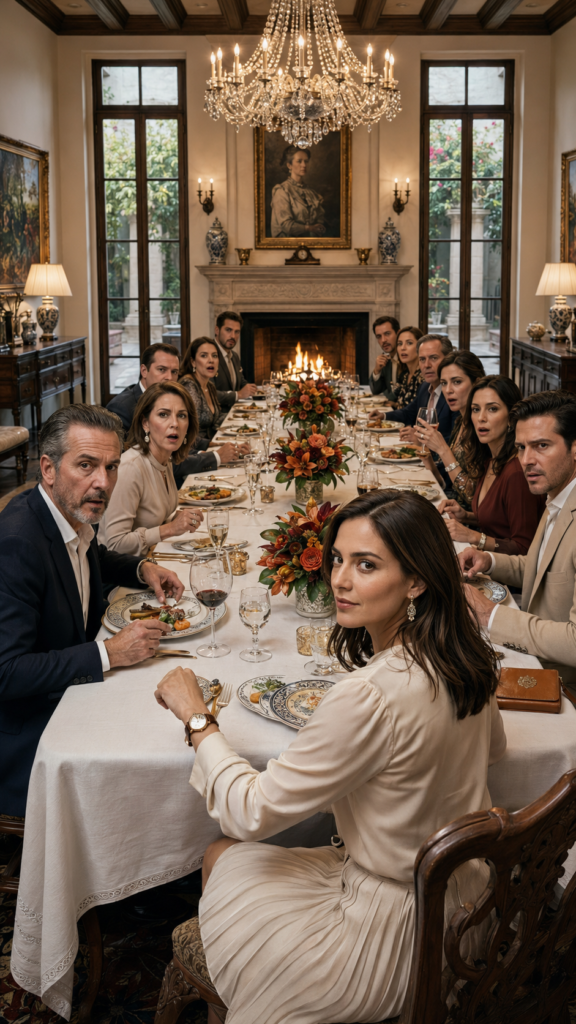
The annual Salazar family dinner always felt more like a runway show than a family gathering.
In the mansion of Las Lomas, with its enormous windows, polished marble, and a dining room for 24, every guest arrived ready to prove that this year had been better than the last.
Cousins parked luxury trucks in front of the entrance as if they were trophies. Aunts talked about renovations, discreet surgeries, and trips to Europe. Uncles whispered about business deals, loud enough for everyone to hear.
Valeria Salazar arrived that night in an Uber.
She wore a simple white blouse, black pants, comfortable shoes, and her hair pulled back. Nothing about her screamed money. Nothing begged for attention.
Because of that, to some, it seemed like she had lost.
Her cousin Rodrigo was the first to notice. Leaning against his new Mercedes, dressed in a navy blazer and a shiny watch that he raised every five minutes for someone to see.
"Didn’t you bring a car, Vale?" he asked with a twisted smile.
"No," she replied. "I came in Uber."
Rodrigo let out a chuckle.
"Well, something is something. I thought you still took the bus."
Valeria looked at him calmly.
"Sometimes I do."
Rodrigo's smile widened as if he had just found the perfect topic for the night.
Inside the house, Doña Elena, Valeria’s mother, greeted her with a kiss on the cheek and a quick glance at her outfit.
"That dress I sent you would have looked beautiful on you."
"This is more comfortable, Mom."
"It’s a family dinner."
"Exactly. I’m family."
Doña Elena pressed her lips together but said no more.
Don Tomás Salazar, her father, appeared from the main room. He was a serious man, the owner of a huge real estate development firm in Monterrey and Mexico City. He had built wealth, prestige, and a reputation that weighed heavily on every chair in that house.
When he saw his daughter, he genuinely smiled.
"There’s my girl."
He hugged her tightly.
"You look tired."
"Quarter-end."
"Everything okay at the company?"
"Fine. Busy, but fine."
Don Tomás nodded. He knew more than the others. He knew Valeria wasn't just pretending to be an entrepreneur. He knew she had turned down a position in his corporation because she wanted to build something with her own name.
But even he didn’t know the whole truth.
Dinner began with soup, expensive wine, and conversations carefully disguised as interest.
Madison talked about her apartment in Polanco. Bruno shared that he was going to open an office in Miami. Aunt Patricia bragged that her daughter had just bought a bulletproof truck.
Rodrigo waited for the perfect moment.
When everyone was served, he leaned toward Valeria and asked loudly:
"Cousin, has your startup taken off yet, or is it still in 'we’ll see' mode?"
A few people let out an awkward laugh.
Valeria left her spoon in the plate.
"It’s going well."
"Well, really, or well as in 'it hasn’t gone bankrupt yet'?"
"Rodrigo," Doña Elena warned.
"What? I’m just asking. We’re all family here."
Uncle Ernesto, Rodrigo’s father, smiled with false understanding.
"Startups are complicated. Not all projects scale. Sometimes the smartest thing is to accept stability."
Valeria knew exactly what he meant.
Four years ago, after finishing her master's in business, her father offered her an executive position at Grupo Salazar. Office, high salary, chauffeur, benefits, and a last name that opened doors before you even knocked.
She said no.
She preferred to move to Mexico City and join a small tech company where the chairs were used, the coffee tasted burnt, and employees slept four hours when there was a launch.
Then she founded K-Datos, a predictive analytics platform for small businesses, pharmacy chains, and logistics companies.
To her family, all of that sounded like smoke and mirrors.
Rodrigo raised his glass.
"I truly admire your humility, cousin. Honestly. With your family’s resources, still taking the bus is almost a philosophical stance."
Some laughed.
Not loud.
That made it worse.
Valeria felt the heat rise in her chest, but she didn’t respond. She had learned that not all offenses warranted an immediate explanation.
Her mentor, Gerardo Klein, had told her many times:
"People who only understand noise don’t deserve you to translate silence for them."
Valeria rested her hand beside the plate.
The sleeve of her blouse barely moved.
Then the watch appeared.
It was discreet, with a worn leather strap, a thin case, and a clean face. It didn’t look ostentatious. It didn’t sparkle under the chandelier. It had no diamonds or large logo.
But Don Tomás saw it.
And he froze.
His face lost color.
Then he slowly lowered his fork.
"Valeria…" he said in a voice that crossed the entire table. "Is that watch what I think it is?"
Laughter died.
Rodrigo turned his head.
"What watch?"
Don Tomás didn’t look at him.
His eyes were fixed on his daughter’s wrist.
"Let me see it, please."
Valeria extended her arm.
Her father leaned in, examining the case, the crown, and a tiny mark almost hidden near the edge.
He took a deep breath.
"It’s an original by Gerardo Klein."
Uncle Ernesto frowned.
"The investor?"
Don Tomás looked up, still in shock.
"Before he was an investor, Gerardo made 50 watches by hand. This isn’t just one of them. This was his."
Rodrigo stopped smiling.
Don Tomás swallowed hard and said the phrase that split dinner in two:
"That watch is worth about $2,000,000."
PART 2
No one touched the food for several seconds.
The entire dining room seemed to run out of air.
Aunt Patricia carefully set her glass down, as if any noise could worsen the moment. Madison lowered her cellphone. Bruno straightened in his chair. Rodrigo looked at the watch, then at Valeria, then at his own pricey new watch, which suddenly seemed like a toy on display.
"$2,000,000?" someone repeated from the back.
Don Tomás continued staring at his daughter’s wrist.
"I saw a photo of Gerardo with that watch at a tech conference years ago. It wasn’t for sale. Collectors offered fortunes for pieces like that, but he never let go of his."
Valeria calmly withdrew her arm.
"He gave it to me."
The sentence fell like another bomb.
Doña Elena blinked.
"Gerardo Klein gave you his watch?"
"Yes."
"Why?"
Rodrigo attempted to regain his mocking tone, but his voice came out lower.
"I mean… did you know him well?"
Valeria looked at him.
"He was my mentor."
The silence shifted. It was no longer just surprise. It was discomfort.
Gerardo Klein wasn’t just any name in Mexico. He had invested in three of the most important tech companies in Latin America. He was famous for rejecting projects with millions behind them and betting on founders nobody saw coming.
Valeria met him when she was working in that small office in Roma Norte, with drywall walls and second-hand desks.
The first time they spoke, she tried to explain why a product had failed.
Gerardo interrupted her after ten minutes.
"That’s not the problem, Valeria. That’s the disaster. Tell me what the client needed that you didn’t understand."
Her pride burned.
But she didn’t cry.
She didn’t defend herself.
She returned to her desk, reviewing interviews, data, complaints, and behaviors throughout the night. The next day, she came back with a notebook full of answers.
Gerardo read in silence.
Then he smiled.
"Now we’re talking. There you are."
From then on, he became her teacher.
He wasn’t an elegant man like Valeria’s uncles. He wore old sweaters, drove a regular car, and carried a patched cloth bag. But when he spoke, even the most arrogant directors listened.
He taught Valeria not to confuse appearance with value.
He taught her that numbers weren’t for boasting but for making better decisions.
And, above all, he taught her that true wealth often walked in silence.
When Valeria founded K-Datos, Gerardo was the first investor. He didn’t ask for control. He didn’t ask for the spotlight. He only set three conditions.
Maintain the majority.
Create something useful.
And open doors for talented people who weren’t born with a last name, contacts, or a served table.
The day Valeria turned 27, Gerardo waited for her in the office after everyone left. He brought a wooden box.
Inside was the watch.
"Don’t wear it to impress," he told her. "Wear it when the world tries to convince you that you’re worth less."
Valeria didn’t want to accept it.
"Gerardo, this is worth too much."
He smiled.
"Not as much as what you’re going to build."
Three months later, Gerardo died unexpectedly.
For weeks, Valeria couldn’t talk about him without her voice breaking. The watch became a way to carry him without having to explain the pain.
She wore it in meetings with investors, during tough negotiations, sleepless nights, and mornings when she had to smile even when she didn’t know if she could pay the payroll.
K-Datos almost went bankrupt twice.
A chain of clients canceled contracts. A fund withdrew a proposal. A technical partner resigned at the worst moment. Valeria sold her car, reduced her salary to almost nothing, and moved to a smaller apartment.
That’s why she took the bus.
Not out of poverty.
Not for show.
Because every peso she didn’t spend on appearances went into surviving.
While her cousins flaunted brunches and trucks, she was building a platform that helped small stores predict demand, reduce waste, and make decisions that only the big chains could afford before.
Then the big contracts came.
National pharmacies.
Private hospitals.
Transport companies.
Supermarkets.
A partnership with a logistics consortium that operated in 18 states.
The latest round had valued K-Datos at $1.8 billion.
And Valeria retained the majority.
The news wasn’t supposed to circulate until the following Monday.
But Madison had already found it.
She was pale in front of her cellphone.
"No way…" she whispered.
Doña Elena looked at her.
"What did you see?"
Madison swallowed hard.
"An investment record. K-Datos closed a round last week."
Rodrigo tensed.
"And?"
Madison raised her eyes to Valeria.
"Valuation of $1.8 billion."
The table froze again.
This time, nobody looked at the watch.
Everyone looked at Valeria.
Uncle Ernesto placed the glass on the tablecloth very carefully.
"Your company is worth that?"
Valeria held his gaze.
"The company, yes."
"And how much do you have?"
Don Tomás reacted before she could.
"Ernesto."
"I’m just asking."
"No. You’re calculating."
Uncle Ernesto fell silent.
Rodrigo's face turned red. Just minutes ago, he had turned the bus into a joke. Now he didn’t know where to hide his hands.
"Cousin… I didn’t know."
Valeria nodded.
"Exactly."
"If I had known…"
"If you had known that my company was worth $1.8 billion, you wouldn’t have mocked me."
He looked down.
"I didn’t mean to…"
"Yes, you did," she said. "You just didn’t expect to be wrong."
Aunt Patricia tried to soften the moment.
"Oh, Vale, don’t take it that way. You know how Rodrigo is. He’s always been a joker."
Valeria looked at her.
"Jokes also teach how a family measures its people."
Doña Elena squeezed the napkin between her hands.
For years, she believed that helping her daughter meant pushing her to look 'more presentable.' She sent her expensive dresses, photos of apartments, contacts for car agencies.
"So you don’t struggle."
"So you look good."
"So people notice you’re a Salazar."
Now she understood that Valeria had never wanted to appear as a Salazar.
She wanted to know who she was without that.
Don Tomás stood up slowly.
The entire dining room looked at him.
"My daughter arrived tonight in an Uber being exactly the same woman she is now that you know the figure," he said. "Ten minutes ago, some of you looked at her with pity. Ten minutes ago, you laughed at how she moved around the city. Nothing about her changed. The only thing that changed was the amount you were able to associate with her."
No one answered.
Rodrigo looked like a chastised child.
But Valeria didn’t enjoy seeing him like that.
For years, she had imagined this moment. She thought she would feel satisfaction, maybe pride, maybe a kind of clean justice.
But the reality was sadder.
Because the respect that came after knowing the price didn’t feel like respect.
It felt like a bill.
"I was the same when I walked through that door," Valeria said. "I was the same when Rodrigo laughed. I was the same when Aunt Patricia offered me 'stability.' I was the same when you thought my life was less valuable because you couldn’t show it off."
Doña Elena began to cry silently.
"Daughter…"
"I’m not saying it to hurt you, Mom. I’m saying it because someone had to say it."
Valeria stood up.
For a moment, everyone thought she would leave.
But no.
She simply walked to the head of the table, where her father was sitting.
"For years, I kept silent because I wanted privacy. But also because I wanted to know if my family could respect a life they didn’t envy."
She looked around.
"Most couldn’t."
The phrase was louder than a scream.
Rodrigo ran a hand across his face.
"I’m sorry, Vale."
She looked at him without anger.
"Why?"
"For the bus. For the startup. For everything."
"If K-Datos were worth $10,000 and I were still working in a borrowed office, would you be apologizing?"
Rodrigo stood still.
That question had no pretty exit.
"I don’t know," he finally admitted.
Valeria nodded.
"That’s the first honest thing you’ve said tonight."
Dinner ended without dessert.
No one felt like having the pecan pie Doña Elena had ordered. The cousins no longer flaunted. The uncles spoke in low voices. Some tried to approach Valeria with questions disguised as interest.
"Are you going public?"
"Looking for strategic partners?"
"Do you need contacts in government?"
"Could we visit your offices?"
Valeria listened, but now understood far too well.
Before, her attention wasn’t worth it.
Now it was worth their convenience.
Later, in the library, Don Tomás found her sitting by a window. Outside, the luxury cars continued parked under warm lights, as if nothing had happened.
"May I sit?" he asked.
Valeria nodded.
He took the chair next to her.
For a while, neither spoke.
"I failed too," he said.
"You didn’t mock."
"It’s not enough just not to mock. I should have stopped them earlier. I should have said something at other dinners."
Valeria looked at her hands.
"Sometimes I wished you would."
Don Tomás closed his eyes.
"I know. Or I should have known."
"I thought respecting my space meant not interfering."
"And I thought my silence was support," he said. "But today I understood that sometimes silent support leaves the person you want to care for feeling alone."
Valeria took a deep breath.
"I didn’t tell you everything either."
"You didn’t have to announce a valuation to deserve respect in your own family."
She lowered her gaze to the watch.
"Gerardo would have hated this dinner."
Don Tomás smiled slightly.
"From what I’ve heard, Gerardo would have arrived on a bus just to annoy Rodrigo."
Valeria let out a small laugh.
It was the first one of the night.
Doña Elena appeared at the door of the library. She didn’t have her perfect posture. Her mascara was slightly smudged, and her expression was one of sincere shame.
"May I?"
Valeria looked at her.
"Yes, Mom."
Doña Elena approached and took her hand.
"I thought I was helping you when I told you to buy a car, to dress better, to accept a nicer apartment."
"I know."
"No. It’s not okay. I wanted people to see you were okay. But you were already okay. I was the one who couldn’t see it."
Valeria didn’t respond immediately.
Her mother cried more.
"I’m sorry for making you feel like your life needed an expensive wrapping to matter to me."
Valeria squeezed her hand.
"That did hurt."
Doña Elena nodded.
"I want to learn to know you without correcting you."
That phrase did break something.
Valeria hugged her.
It wasn’t a perfect reconciliation. Families don’t heal in one night by magic. But it was a crack opened in a wall that had been hardening for years.
Three weeks later, Don Tomás visited K-Datos’ offices in Reforma.
He arrived 15 minutes early, in a dark suit and no tie, because he had decided that was "casual." Valeria introduced him to the engineering, product, sales, and operations teams.
He listened more than he spoke.
That surprised everyone, even Valeria.
In a small room, he met Ximena, a 16-year-old girl from Iztapalapa who was part of the new scholarship program from the Klein Foundation. Ximena had designed a model to map areas where families spent too much time and money just to buy food at a fair price.
"My mom doesn’t decide what to cook just out of craving," Ximena explained. "She decides based on what bus passes, how much it costs to get there, and if there’s enough left to return. That’s data too, but no one takes it seriously."
Don Tomás remained silent.
Not out of disinterest.
But out of shame.
He had built plazas, towers, and shopping centers for years. But he had never listened to a girl explain so clearly that mobility could also decide what a family put on the table.
"Your project can change public policies," he finally said.
Ximena smiled, nervous.
"Really?"
"Really."
That afternoon, Don Tomás wrote to Valeria:
"Ximena is extraordinary. If she accepts me, I want to return on Tuesday."
Then he sent another message:
"I’m proud of you. Not for the company worth $1.8 billion. For what you decided to do with it."
Valeria read the message twice.
That night, even though she had a chauffeur available and her father insisted on taking her, Valeria walked to the subway.
In the car, there was a nurse sleeping with her head against the window. A construction worker held a tool backpack. A lady was selling candy. Two students were sharing headphones. A child watched the tunnel lights in fascination.
Nobody knew who Valeria Salazar was.
Nobody knew she wore a $2,000,000 watch on her wrist.
Nobody knew her company was valued at $1.8 billion.
And that made her smile.
Because she understood that the world always tries to measure people by what it sees first: the car, the clothes, the last name, the address, the cellphone, the seat on the plane, or the way to arrive at a dinner.
But what’s most important is rarely seen upon entry.
Sometimes it’s under a sleeve.
Sometimes it rides the bus.
Sometimes it stays silent for years.
And sometimes, when it finally comes to light, it doesn’t show who became valuable.
It shows who never knew how to look.





