PART 1
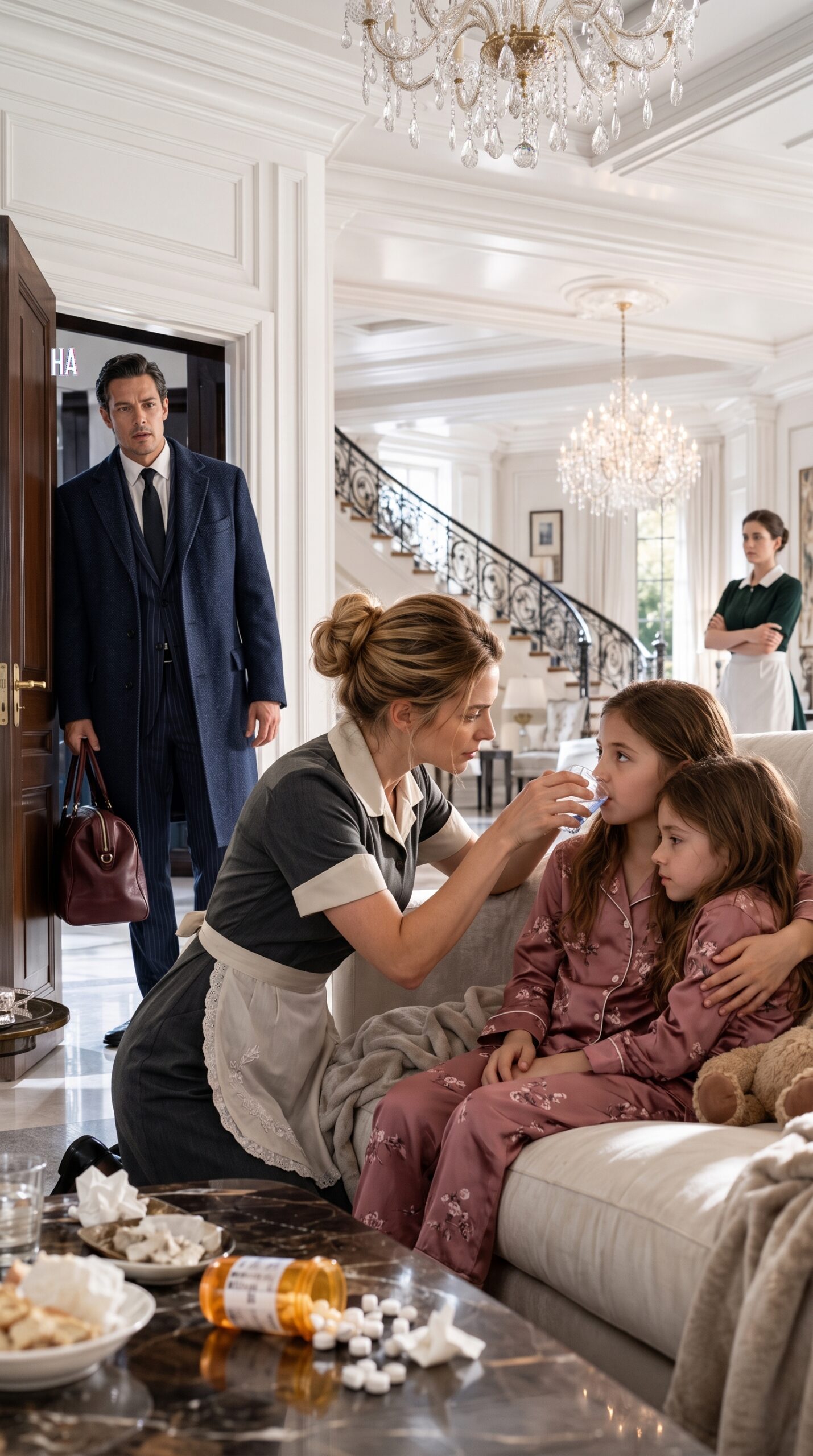
Ricardo Aranda lived in a massive residence in Lomas de Chapultepec, adorned with Italian stained glass, a driver, bodyguards, a cook, a gardener, and construction companies in three states.
In the newspapers, he was called "the businessman who never makes mistakes."
But within his own home, his two daughters were fading away, and he had no idea how to save them.
Sofía was seven. Regina was just five.
Since Inés, their mother, died in a car crash on the Mexico-Cuernavaca highway, the girls had stopped running through the halls. They no longer asked for cake on Sundays. They didn't want anyone closing the door to their room anymore.
Ricardo couldn't stand to see them cry.
So he did what was easiest for a man with money but no words: he hired more help, bought more toys, paid for the best therapy... and threw himself into work.
The only one who seemed to truly understand the girls was Lupita, the housekeeper who had come from Puebla to cook and clean but ended up learning to read silences.
She knew Regina needed to sleep with a little green light by the window.
She knew Sofía hid letters for her mom inside a shoebox.
She knew neither could hear ambulances without covering their ears.
Lupita didn’t invade. She didn’t overstep. She didn’t act important.
She just was.
And that was exactly what Bárbara, Ricardo's girlfriend, could not tolerate.
Bárbara was impeccable, with perfect nails, expensive perfume, and a smile that seemed pretty until you heard what she said.
"That woman is getting too comfortable," she kept repeating to Ricardo. "The girls listen to her more than they do to you. Seriously, that’s not normal."
Ricardo tried not to hear her.
But Bárbara knew how to plant doubts.
One night she left a black folder on his desk.
Inside were printed photos.
Lupita entering the girls' room late at night.
Lupita hugging Regina.
Lupita sitting on the floor while Sofía cried.
Lupita opening a drawer in the private study.
"Look closely," Bárbara said. "First, she wins over your daughters. Then she digs into your stuff. Soon she’ll want to run this house."
Ricardo felt a blow to the chest.
A part of him wanted to defend Lupita.
But another, more cowardly part, preferred to believe the problem was her, not his absence as a father.
So he decided to verify it.
He announced he would travel for three days to Guadalajara to close a land deal. Bárbara sent him off with a cold kiss. Lupita only asked if she should leave noodle soup for the girls.
But Ricardo never made it to the airport.
He hid in an apartment in Polanco, swapped his suit for an old jacket, and returned to the residence through the service entrance, using a key that almost no one remembered.
From the security room, he began to watch the cameras.
At 7:10, Bárbara went down to the dining room with a glass of wine.
At 7:16, she turned off Regina's little green light.
"You’re too big for silly things," she said.
The little girl began to tremble.
At 7:20, Sofía wanted to drink water, but her hands moved abruptly.
Lupita reached the glass before it fell.
Then she knelt in front of Regina and spoke softly:
"Breathe with me, little one. You are safe here. No one is going to disappear tonight."
Ricardo swallowed hard.
He had been signing contracts while that woman held his daughters' world in her hands.
Then Bárbara entered the dining room, looked at Lupita with disgust, and said something that froze Ricardo behind the screen:
"Tomorrow, I’ll throw you out of this house, even if those girls crawl crying for you."
PART 2
Lupita didn’t answer immediately.
Regina was clinging to her skirt, her little face wet, and Sofía stared at Bárbara as if she had just discovered that adults could also be scary.
Bárbara slammed the glass down on the table.
"Don’t look at me like that. You’re paid to clean, not to make yourself indispensable."
Lupita lifted her gaze.
There was no arrogance in her eyes. There was exhaustion. There was dignity. She possessed that tough patience of women who have endured too much because they need to work, yet refuse to allow anyone to hurt a child.
"Miss Bárbara," she said firmly, "if you want to talk about my work, speak with Mr. Ricardo. But don’t threaten the girls to feel like the owner of a house that doesn’t belong to you yet."
Bárbara let out a short laugh.
"And who are you to tell me that?"
"Someone who sees them cry when you slam doors shut," Lupita replied. "Someone who knows they’ve already lost their mother. Don’t use them to win an adult fight."
From the security room, Ricardo hung his head.
Lupita had said in one minute what he had avoided for two years.
Bárbara approached Sofía with a false tenderness.
"My love, you need to understand something. Lupita is not family."
Sofía stepped back.
"Neither are you."
The silence was so loud that even Ricardo stopped breathing.
Bárbara clenched her jaw.
"She taught you that, didn’t she?"
Lupita took a step forward.
"Don’t speak to her like that."
"See?" Bárbara said, pointing toward a camera unknowingly. "This is what I’ll show your father. They’re manipulated."
That night, Ricardo didn’t turn off the screens.
He watched Lupita tuck the girls in. He saw how she searched for the little green light under a dresser, because Bárbara had hidden it. He watched as she told them a story about a turtle finding its way back after a storm.
Later, when everyone was asleep, Lupita went down to the kitchen with a brown notebook.
Ricardo leaned closer.
On the cover it read:
Sofía and Regina. Care Routines.
There were no complaints. No gossip. No plans to "take the house," as Bárbara had said.
There were notes.
"Regina gets agitated if the light is turned off without warning. Responds well to slow breathing."
"Sofía asks if her mom knew she was going to die. Don’t avoid the topic. Just accompany her."
"Bárbara ridicules their routines. After that, both take longer to sleep."
Ricardo felt shame.
That notebook was more love than all the expensive gifts he had bought out of guilt.
The next morning, Lupita entered through the service door and paused when she saw him sitting in the kitchen, without a jacket, without a phone, with swollen eyes.
"Mr. Ricardo... I thought you were in Guadalajara."
"I never left."
Lupita understood immediately.
"So you came to spy on me."
He didn’t try to justify himself.
"I came to see if Bárbara was telling the truth."
"And do you know now?"
Ricardo took a moment to respond.
"I know I was a coward."
Lupita didn’t soften.
"The girls have breakfast at seven. If we’re going to talk, it will be after. Regina can’t start the day hearing another argument."
She didn’t say it as a challenge.
She said it as a priority.
Ricardo nodded.
For almost an hour he watched her do what he had never seen with attention.
She cut the fruit into small pieces because Sofía choked when she was anxious. She placed Regina’s glass far from the edge of the table. She turned on the little green light even though it was daytime, just so the girl could see it from the dining room.
When the girls came down and saw their dad, they froze.
"Didn’t you leave?" Sofía asked.
The question hurt more than any insult.
"No," Ricardo replied. "And I should have stayed many times before."
Regina looked first at Lupita before sitting down.
That small gesture broke him in two.
After breakfast, Lupita accompanied Ricardo to the study.
She stood with her hands clasped, not lowering her gaze.
"Bárbara wants me to leave," she said. "That doesn’t surprise me. What does surprise me is that you needed cameras to find out what’s happening in your own house."
Ricardo closed his eyes.
"You’re right."
"I need this job," Lupita continued. "A lot. But I won’t stay if those girls’ fears are used as punishment. They aren’t anyone's property. Not yours, even if they are your daughters."
Before Ricardo could respond, the door opened.
Bárbara entered with another black folder, walking as if she had already won.
"How nice," she said. "The two of you locked up. No need to pretend anymore."
Ricardo looked at her without emotion.
"Close the door."
Bárbara threw several photos onto the desk.
Lupita hugging Regina.
Lupita arranging flowers next to Inés’s portrait.
Lupita asleep in a chair next to Sofía.
Lupita leaving the study with a little white box.
"This isn’t service," Bárbara said. "It’s invasion. This woman is taking the place of your dead wife."
Lupita pressed her lips together.
That did hurt.
Ricardo picked up one of the photos.
"Do you know what was in that little box?"
Bárbara didn’t respond.
"Sofía’s inhaler. You stored it in my study because you said that 'the girls' shouldn’t touch delicate things."
Bárbara blinked.
Ricardo pulled a tablet from the drawer.
"I also reviewed the full videos. Not your cropped photos."
Bárbara’s face lost color.
On the screen, she appeared entering Regina’s room at 11:04 PM. She turned off the little green light and said:
"If Lupita leaves, you’re going to learn to sleep like a decent girl."
Regina would wake up crying.
Then another video appeared.
Bárbara took a letter from Sofía. On the page were Ricardo, Regina, Sofía, a drawing of Inés as a star, and Lupita by the door of the house.
Bárbara tore off the part where Lupita was.
"So you don’t get confused," she murmured.
Lupita covered her mouth.
Ricardo felt disgust.
Not just for Bárbara.
But for himself, for having given space to that cruelty.
"That’s taken out of context," Bárbara said.
"No," Ricardo replied. "What was out of context were your lies."
At that moment, the door opened just a crack.
Sofía was there, with Regina hiding behind her. Doña Elvira, the cook, was trying to stop them.
"Sorry, sir," Elvira said. "They heard voices."
Regina saw the photos.
Then she looked at Bárbara.
"Are you going to make Lupita leave again?"
No one spoke.
That question sounded too familiar.
Ricardo knelt in front of his daughters.
"No, my love. Lupita isn’t leaving because of anyone."
Sofía crossed her arms.
"You always say you’re going to stay and then you leave."
The entire study was left breathless.
Ricardo had faced corrupt partners, furious banks, and million-dollar lawsuits.
But hearing the truth from a seven-year-old girl left him defenseless.
"You’re right," he said. "I’ve left many times. Even when I was here."
Regina squeezed Lupita’s hand.
Ricardo didn’t try to separate them.
"I thought paying for this house was taking care of them. I thought not talking about Mom would hurt less. I thought if I worked more, someday everything would be okay. But the truth is, I was just running away."
Sofía began to cry.
"I should have known about the little green light," he continued. "I should have known about the letters. I should have known that when they asked about their mom, they didn’t need perfect answers. They needed me not to hide."
Bárbara let out a bitter laugh.
"What a ridiculous scene. All for a servant."
Ricardo stood up.
"Don’t you ever call her that again."
"Then what is she? The new lady of the house?"
Lupita lifted her head.
"No one can replace Mrs. Inés. I’ve never wanted that."
Sofía spoke between sobs:
"Lupita doesn’t want to be my mom. She lets me miss my mom."
Regina nodded.
"You get angry when we cry."
Bárbara opened her mouth but found not a single clean word.
Ricardo looked at her as if he had finally awakened.
"You’re leaving today."
"What?"
"Pack your things. My lawyer will speak with you. You will not approach my daughters again. You will not speak with Lupita again. And you will not disguise your cruelty as concern."
Bárbara gritted her teeth.
"You’ll regret this."
"I’ve already regretted enough," Ricardo said. "Not this."
Bárbara left without shouting.
People like her rarely make a scene when they lose. They prefer to walk with their heels loud, as if the noise were still power.
When the front door closed, no one celebrated.
There was only a strange silence, like after an earthquake, when everyone is still alive, but knows the house needs checking.
That afternoon, Ricardo gathered the staff in the kitchen.
Lupita stood by the sink, uncomfortable. Doña Elvira had red eyes. The driver looked at the floor, ashamed for having repeated rumors.
Ricardo didn’t speak as a generous boss.
He spoke as a man ashamed.
"I allowed suspicion to grow in this house without evidence. That ends today. Guadalupe Morales has my trust and my respect. No one here will be treated as disposable again."
Sofía and Regina listened from the stairs.
Maybe they didn’t understand everything, but they understood something: their dad had said Lupita’s name with respect in front of everyone.
And for two wounded girls, that too was justice.
That night, bedtime was different.
It wasn’t perfect.
Healing never works like a movie ending.
Regina still needed her little green light. Sofía still asked if her mom could hear her when she spoke softly.
Lupita sat on the floor with the turtle story.
But this time, Ricardo didn’t stay standing in the doorway.
He sat down too.
At first, the girls looked at him strangely, as if they didn’t know what to do with a dad who didn’t check his phone.
Then Sofía asked for the song Inés sang when it rained.
Ricardo froze.
For two years, he had avoided that song as if it were a locked room.
Lupita had hummed it some nights because the girls needed it. But now she didn’t rescue him.
She just looked at him, as if to say: it’s your turn.
Ricardo started poorly. His voice cracked. He forgot one line. Lupita whispered it softly.
The girls didn’t laugh.
They listened as if that broken voice was the first proof that their dad was finally there.
In the end, Regina took two fingers from his hand.
Sofía fell asleep looking at him, not at the wall.
In the hallway, Ricardo said to Lupita:
"I don’t know how to fix what I did."
"You don’t fix it with one apology," she replied. "You fix it by being there. Coming back. Following through even when no one applauds."
Since then, Ricardo changed in ways that didn’t make it to magazines.
He canceled trips. Moved meetings. Turned off his phone during dinner. Learned which cup Regina used, what food made Sofía nauseous, and which silences he shouldn’t fill with gifts.
He also changed Lupita’s contract.
Better pay, health insurance, and a dignified position: family care coordinator.
Lupita didn’t become the lady of the house. She didn’t replace Inés. She didn’t accept jewelry or strange favors. She still wore her worn-out sneakers because she said that with small children, one must be ready to run, clean chocolate, or chase a ball.
One Sunday, Ricardo brought down a box that had been sealed for two years.
It was Inés’s box.
There were letters, photos, bracelets, drawings, and a blue scarf that still held a bit of her perfume.
Lupita made hot chocolate and wanted to leave.
"Stay," Regina pleaded.
Lupita froze.
Ricardo looked at her.
"Please."
So she stayed.
They opened the box together.
Sofía cried first.
Regina followed.
Ricardo did too.
Lupita didn’t invade that pain. Nor did she flee.
That was her way of caring: making the room safe so others could feel without fear.
Weeks later, the girls taped a drawing to the refrigerator.
There were four people in front of the house: Ricardo, Sofía, Regina, and Lupita.
Above them, among stars and clouds, was Inés smiling.
"Mom is in heaven," Regina explained.
"And Lupita is in the house," said Sofía. "Because she stays."
Ricardo took a marker and wrote the date.
Below, he wrote five words:
Here, no one lets go again.
There were no applause.
There was no perfect photo.
Just a cold house learning, little by little, to be a home.
Months later, people kept murmuring.
Some said that Ricardo had been manipulated by the maid. Others that the pain had made him weak. Others, with that easy cruelty, said that a humble woman always knows where to cry to gain power.
Ricardo never responded.
He had already answered where it mattered.
At school, when Sofía sang at the festival and found him sitting in the front row.
In the kitchen, when Regina spilled milk and no one scolded her.
At night, when the girls called and he arrived without making them feel like a burden.
Lupita was two seats away during that festival, watching the girls sing with nerves and shine on their faces.
Ricardo glanced at her once.
Not with romance.
Not with possession.
But with respect.
With the painful certainty that the woman he almost cast aside had cared for the most sacred part of his life while he was too broken to see it.
That day he understood that faking that trip didn’t destroy his family.
It destroyed the lie that his family was fine.
And sometimes, only when that lie breaks, can a house begin to breathe again.





