PART 1
—You stay here, Camila. Someone has to clean the house and take care of the cat.
Doña Graciela said it in front of everyone, as if she were giving an order to a servant, not speaking to her son’s wife.
The living room fell silent.
On the table lay the tickets to Paris, three passports, several open suitcases, and a pile of designer bags that Camila had paid for without complaint.
Arturo, her husband, didn’t even lift his gaze from his phone.
—Mom, don’t start —he muttered, but he said it so quietly that it sounded more like a formality than a defense.
Doña Graciela let out a dry chuckle.
—What? Do you want us to take her along to embarrass us? In Paris, not just anyone fits in, darling.
Renata, Arturo’s sister, covered her mouth to feign sympathy, though laughter escaped her.
—Besides, honestly, Camila looks more comfortable here. Cooking, sweeping, taking care of Michi… that’s her thing.
Camila felt her face burn.
The house they stood in didn’t belong to Arturo.
It didn’t belong to Doña Graciela.
Nor to the Robles family, although they flaunted it as if it had been inherited from an esteemed lineage.
Camila had bought it two months earlier in San Ángel, with the money from her surgical supplies company, after working eight years without a vacation, without asking anyone for anything.
She bought it thinking that, at last, her husband’s family would respect her.
How naive.
For years, Doña Graciela had called her “the little girl from the village,” even though Camila was already managing contracts with private hospitals in Monterrey, Guadalajara, and Mexico City.
Renata took dresses from the closet.
Arturo used her cards to “invest” in businesses that always ended up losing money.
And when Camila complained, he responded the same way:
—Don’t exaggerate. My family is like that, but they care about you.
That morning, Camila had prepared coffee, huevos motuleños, fruit, sweet bread, and fresh juice.
Then she saw Doña Graciela handing out the tickets.
One for her.
One for Arturo.
One for Renata.
None for Camila.
—And mine? —she asked in a calm voice.
Doña Graciela looked her up and down.
—Oh, honey, get a grip. We’re going to enjoy the trip. You stay here taking care of the house. And keep it spotless, because when we return, I don’t want to find any dust.
Camila turned to Arturo.
She waited for one word.
One gesture.
One sign that she was still his wife.
But he just said:
—Babe, don’t make a scene. It’s just a few days. Besides, did you authorize the increase on my card’s limit?
Something inside Camila shut down.
She didn’t cry.
She didn’t scream.
She only smiled slowly.
—Sure —she replied—. Have a good trip.
Doña Graciela adjusted her dark glasses.
—That’s how I like it. Obedient.
Camila went up to her bedroom while they continued laughing downstairs.
She closed the door.
She opened the safe.
She took out the deeds, the bank statements, the contracts from her company, and a red folder that Arturo had never seen.
The house was solely in her name.
The additional cards depended on her.
And in that folder lay evidence of something far worse than familial humiliation.
While they boarded the plane, believing they had left her behind, Camila made a call that would change their lives forever.
PART 2
When the truck left for the airport, Doña Graciela still rolled down the window to shout at her:
—Don’t forget to clean the patio! And take good care of the cat, because that’s what you’re good for.
Arturo didn’t even say goodbye.
Renata sent her a mocking kiss from the back seat.
Camila stood at the entrance with Michi in her arms, watching the truck disappear down the cobblestone street of San Ángel.
Then she entered the house.
She didn’t pick up any plates.
She didn’t sweep.
She didn’t wash a single cup.
She dialed Jimena Arriaga, her college friend, now one of the top real estate agents in Mexico City.
—Jimena, I need to sell my house today.
There was silence on the other end.
—Today today?
—Today. Cash. With a notary. Before nightfall.
—Camila, that house is worth a fortune.
—I know. Lower it to what’s necessary. But I want the signature today.
Jimena didn’t ask any more questions.
Three hours later, a couple of entrepreneurs from Querétaro arrived, looking for a spacious property to convert into a luxury private residence for the elderly.
Camila opened the door calmly.
She showed them the large windows, the garden with bougainvilleas, the cantera kitchen, the library, the terrace, and the bedrooms that Doña Graciela had used as if they were her own.
—The house will be handed over empty of people and with fixed furniture —Camila explained—. Personal items will be removed today.
The offer was low, but sufficient.
At six in the evening, the notary was sitting at the same table where Doña Graciela had called her a maid.
Camila signed without trembling.
When the money entered her account, she didn’t feel joy.
She felt relief.
Then the movers arrived.
—Everything belonging to Arturo, Graciela, and Renata goes into boxes —she ordered—. Without separating, without arranging, without special care.
The workers emptied closets, drawers, shoe racks, and dressers.
Doña Graciela’s coats ended up tangled with dirt-covered shoes.
Renata’s bags were crushed between broken suitcases.
Arturo’s suits were folded like old rags.
Camila kept only her things: documents, jewelry, clothes, Michi’s bed, and a small suitcase.
The rest was sent to a cheap warehouse in the Iztapalapa area, hot, dusty, with narrow hallways and the smell of burnt oil.
Before handing over the keys, Camila walked through the house one last time.
She didn’t cry for the walls.
She cried for the woman who had allowed herself to be treated like she was worth nothing in a house paid for with her own effort.
That night, she took a flight to Puerto Vallarta with Michi sleeping in his carrier.
Meanwhile, in Paris, the Robles family strolled through expensive stores as if Camila’s money were family inheritance.
Doña Graciela bought perfumes, scarves, and two coats.
Renata chose shoes that cost more than the monthly rent of many families.
Arturo paid for everything with Camila’s additional card, smiling at the waiters.
Until they entered an elegant restaurant near the Seine.
They ordered wine, meat, seafood, and desserts with names they didn’t even know how to pronounce.
Arturo handed over the golden card.
The waiter returned, uncomfortable.
—Sir, the card was declined.
Arturo frowned.
—Try it again.
They tried three times.
Declined.
Arturo opened the banking app.
The limit showed as zero.
The additional cards were blocked.
The joint account, empty.
Then he received a message from Camila:
“Return to your house. If you still find it.”
Doña Graciela turned pale.
The return was a nightmare.
They had to borrow money from a friend of Arturo’s in Madrid, a guy who charged too much for favors.
They lost their hotel reservation.
They flew with a layover, without complete checked luggage and with humiliation plastered on their faces.
Throughout the journey, Doña Graciela repeated:
—That cat is going to regret this. I’ll kick her out of my house.
Arturo didn’t respond.
He was beginning to understand.
The house never belonged to his mother.
Nor to him.
When the taxi arrived in San Ángel, Doña Graciela got out furious.
But she froze.
The gate was open.
There were construction workers, trucks, boxes, tools, and a huge banner on the facade:
“Santa Lucía Residence — Private Care for Seniors.”
—No! —Doña Graciela screamed—. This is my house!
She ran toward the entrance, but a guard stopped her.
—Ma’am, you can’t enter. Private property.
—Private of whom, you fool! My son lives here!
At that moment, Jimena came out with a folder in her hand.
—The property was sold legally by its sole owner, Mrs. Camila Salcedo.
Doña Graciela nearly ripped the papers from her.
She saw the deed.
She saw the signature.
She saw Camila’s name.
And then she understood that the woman they left to care for the cat had sold the entire palace while they toasted in Paris.
The neighbors began to peek out.
The same ones Doña Graciela had invited to dinners to flaunt “her new house.”
Renata cried next to the suitcases.
Arturo called Camila via video call.
To everyone’s surprise, she answered.
She appeared on a terrace facing the sea, wearing a light dress, dark glasses, and Michi curled up in her lap.
—Hi, Arturo. How’s Paris?
—What did you do? —he shouted—. You sold our house!
Camila caressed the cat.
—It wasn’t ours. It was mine. I bought it, I paid for it, and I sold it.
Doña Graciela stepped in front of the screen.
—Ungrateful! After everything my son did for you!
Camila let out a brief laugh.
—Your son stole from me for six months.
Arturo froze.
Renata stopped crying.
—I have fake invoices, transfers to Renata’s accounts, payments from your cards, loans disguised as suppliers, and personal purchases charged to my company —Camila continued—. My auditors found everything.
—Camila, we can talk —Arturo pleaded.
—Not anymore.
Doña Graciela shouted:
—Where are my things?
—In a warehouse in Iztapalapa. I sent you the address. Since you asked me to clean the house, I left it spotless.
Camila looked into the camera with a calm that hurt.
—And don’t worry about Michi. I’m taking very good care of the cat.
She ended the call.
Then she blocked them.
That afternoon, they went to the warehouse.
The place was an oven.
Doña Graciela opened a box and found her wrinkled coats, spilled perfumes, and her bags crushed under boots.
—This is your fault! —Renata shouted at her—. If you hadn’t treated Camila like trash, we wouldn’t be here.
Doña Graciela raised her hand to hit her, but Renata pushed her.
Arturo tried to separate them.
Then three men dressed in black appeared.
One pulled out a photo of Arturo.
—We finally found you.
They were the collectors for the loan he had taken to get out of Paris.
They searched through the boxes and took watches, bags, jewelry, suitcases, and everything they could sell.
Before leaving, the leader grabbed Arturo by the collar of his shirt.
—This barely covers the interest. We’ll be back in seven days.
That night, they slept in the warehouse.
Without a fan.
Without a bed.
Without pride.
The next day, Arturo traveled to Puerto Vallarta.
He arrived sweaty, with unshaved beard and a wrinkled shirt. At the entrance of Camila’s building, he claimed to be her husband and said he needed to see her.
The guard made a call.
Then he let him in.
Camila received him on the terrace.
She didn’t seem surprised.
She seemed ready.
Arturo fell to his knees.
—Forgive me. I was a coward. My mom manipulated me. I love you, Camila. Please help me with the debt.
She looked at him without hatred.
That was what hurt her the most.
—You don’t love me, Arturo. You need me.
He tried to take her hand, but she stepped back.
Then the elevator opened.
Two detectives and a lawyer entered.
The lawyer handed over a folder.
—Divorce petition and criminal complaint for fraud, breach of trust, and misappropriation of funds.
Arturo gasped.
—Camila, don’t do this…
—You did it —she replied—. I just stopped covering for you.
The handcuffs closed with a dry sound.
The trial was swift.
There were emails, invoices, transfers, messages, and altered documents. Arturo ended up in pretrial detention while the process advanced.
Renata disappeared with what little was left.
Doña Graciela was left alone.
Her friends stopped answering her.
No one wanted to lend her money.
No one wanted to take her back.
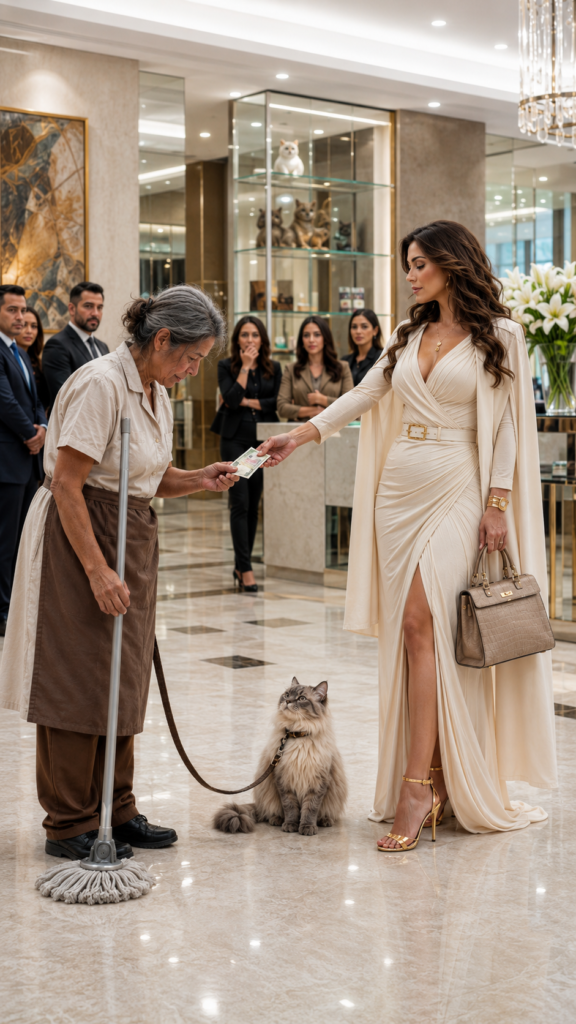
Weeks later, she managed to find a job at a pet grooming salon in Santa Fe.
Not as a manager.
Not as a receptionist.
As a cleaning employee.
She scrubbed floors, picked up fur, disinfected cages, and cleaned litter boxes.
Every time she scooped the litter, she remembered her own phrase:
“Take care of the cat, because that’s what you’re good for.”
One afternoon, the manager announced:
—A VIP client is coming. Everything must be perfect.
Doña Graciela was mopping when the automatic doors opened.
Camila entered.
She wore an elegant coat, dark glasses, and a calm smile.
By her side walked Michi, fat, clean, groomed, with a fine leash.
The manager pointed at Doña Graciela.
—Graciela, help the lady with her cat and load the kibble into her car.
The woman lowered her gaze.
She took the leash with hands dried out from the bleach.
Camila paid at reception.
Then she approached and slipped a 500 peso bill into the pocket of Graciela’s apron.
—Do a good job, Doña Graciela. And take care of the cat.
Doña Graciela lifted her eyes, broken.
Camila took Michi and left without looking back.
When the door closed, the elderly woman fell to her knees on the wet floor.
She didn’t cry for the house.
She didn’t cry for Arturo.
She cried because she understood too late that pride doesn’t place you above anyone.
First, it leaves you alone.
Then it takes everything from you.
And in the end, it seats you exactly where you swore others deserved to be.





