PART 1
For 11 months, 2 weeks, and 4 days, Lena Castillo learned to become invisible inside the Del Valle mansion in Las Lomas.
Every day, she woke up at 5:30, put on simple clothes, tied her hair back clumsily, and walked through the halls as if she weighed nothing.
She didn’t wear perfume.
She didn’t offer opinions.
She didn’t raise her gaze more than necessary.
In that house, powerful people didn’t hurt what they couldn’t see.
Her job was to take care of Doña Isabel Del Valle, a 71-year-old woman with a tired heart, lungs filling with water, and pride harder than the marble at the entrance.
“Don’t hover over me,” Isabel snapped during the first week.
“I’m not hovering.”
“You’re 3 steps away, watching to see if I breathe.”
“I’m making sure you keep doing it.”
Doña Isabel looked at her seriously.
Then she let out a dry laugh.
From that day forward, Lena ceased to be a hired nurse and became the only person the old matriarch allowed close when her body no longer obeyed.
On bad days, Lena took her blood pressure, organized her medications, and helped her walk to the garden.
On good days, she stepped aside so Isabel could pretend she didn’t need anyone.
Lena understood that pride all too well.
Every peso she earned was sent to a rehabilitation clinic in Puebla, where her brother Dany was still trying to move his legs after an accident at a construction site.
Marcos Del Valle barely spoke to her.
At 38, he controlled the family empire with a calmness that was more frightening than any scream.
When he entered a room, the bodyguards lowered their voices.
The lawyers sweated.
The partners smiled with fear.
Lena preferred to stay under his radar.
Until two days before the attack, when Marcos humiliated her in front of everyone.
She was crossing the foyer with Isabel’s medication tray when a file fell to the floor.
“Who authorized this?” Marcos asked, coldly.
Carranza, his head of security, stiffened.
“The girl has been here for almost a year.”
“I know how long she’s been here.”
Lena kept walking.
Then Marcos grabbed her by the collar of her blouse and yanked her back with such force that the pills trembled on the tray.
Everyone froze.
The cooks.
The drivers.
The bodyguards.
“You have debts,” Marcos said, looking at her as if reading her soul. “A brother in rehab. No family worth mentioning. And yet you live under my roof with access to my mother?”
Lena felt the anger rise in her chest.
But she swallowed it down.
“I take care of Doña Isabel.”
“You’re staff,” he replied. “Don’t confuse utility with importance.”
That phrase hit her harder than she wanted to admit.
Lena bent down, picked up the file, and replied without trembling:
“Your mother’s medication is due in 4 minutes. Can I leave?”
Marcos clenched his jaw.
He said nothing.
Three days later, Lena was escorting Doña Isabel to the armored SUV. It was raining as if the sky were shattering over Mexico City.
The black convoy waited with engines running.
The bodyguards scanned the street.
Carranza spoke into the radio.
Then Lena saw it.
A red dot.
Small.
Trembling on Isabel’s white coat.
“DOWN!”
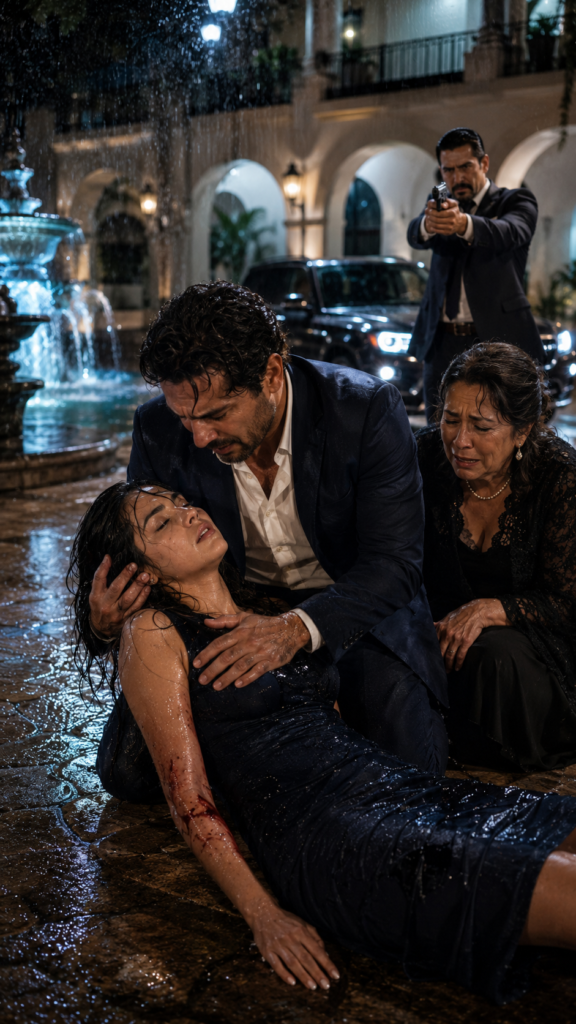
Lena pushed the elderly woman behind a column just as the first shot pierced her shoulder.
The pain shattered her.
The second impact came before she could breathe.
Then the third.
The fourth.
Still, she didn’t fall.
She positioned herself in front of Isabel, body open to the rain and the bullets.
Doña Isabel screamed her name.
The fifth bullet brought her to her knees.
Marcos ran toward her like a wounded animal, knelt on the wet pavement, and pressed his hands against her wounds.
His expensive suit soaked in blood.
“Stay with me,” he ordered, desperate.
Lena wanted to laugh.
Even terrified, Marcos Del Valle was still giving orders.
She barely moved her lips.
“I’m… just staff.”
Marcos’s face cracked.
“No. Don’t say that, Lena. Look at me.”
Behind him, Carranza raised his gun.
But he wasn’t aiming at the attackers.
He was aiming straight at Marcos’s back.
PART 2
The thunder covered the sound of the shot that never came.
One of the bodyguards saw Carranza’s movement and lunged at him. They both fell against one of the SUVs, struggling over the water and the shell casings.
Marcos didn’t move from Lena’s side.
“Ambulance!” he roared. “Now!”
Doña Isabel, pale as a church candle, tried to lift herself behind the column.
“Lena…”
“Don’t move, Mom,” Marcos shouted.
But Isabel didn’t listen.
She crawled to Lena, took her cold hand, and pressed it against her chest.
“Don’t leave me, girl. Not after this.”
Lena didn’t respond anymore.
At the hospital, the doctors rushed her into surgery.
Marcos stayed in the hallway, drenched, with dried blood on his fists and a phrase stuck in his mind:
“I’m just staff.”
Carranza appeared an hour later, with a cut eyebrow and his gun confiscated.
“I wasn’t going to shoot you,” he said.
Marcos stared at him, unblinking.
“Then explain to me why my people had to throw you to the floor.”
“I saw movement behind you. I was going to cover you.”
“How convenient.”
Carranza lowered his voice.
“The girl isn’t who she says she is.”
Marcos felt the air grow heavier.
“Speak.”
Carranza pulled a wet envelope from his coat.
“I found this in her room, stuck under a drawer.”
Inside was an old photograph.
Lena looked younger, with her hair down, smiling next to a serious-faced man.
On the back, in precise handwriting, it said:
“YOUR FATHER KILLED MINE. I CAME FOR EVIDENCE.”
Marcos read the phrase twice.
“Who is he?”
“Tomás Valdés,” Carranza replied. “Federal agent. He infiltrated your father’s business years ago. Died before testifying.”
“And her?”
“If she’s his daughter, she entered here under a false name.”
Marcos looked towards the operating room door.
The woman who had taken 5 bullets for her mother might have lived almost a year in his house to destroy him.
Nothing made sense.
Hours later, Lena survived.
She had 2 severe wounds, blood loss, and a broken body, but she opened her eyes at dawn.
Marcos was by the window.
“You stayed,” she whispered.
“You too.”
She tried to smile, but the pain stopped her.
Marcos placed the photo on the table.
“Your last name isn’t Castillo.”
Lena closed her eyes.
“No.”
“Tomás Valdés was your father.”
“Yes.”
“You came to my house to find evidence against my family.”
“I came to take care of Isabel.”
“Don’t play games with me.”
Lena barely turned her head.
“Both things can be true.”
Marcos leaned in.
“My father killed him.”
“No. Your father allowed him to be killed,” she corrected. “And someone in your house knows where the evidence is.”
The door opened.
Doña Isabel entered in a wheelchair, even though the doctors had forbidden her to move.
“Let me see her.”
Marcos turned to his mother.
“Did you know?”
Isabel didn’t answer.
She only looked at Lena as one might look at someone lost for years.
“Mom.”
“Your father buried many truths, Marcos.”
“Did you know she was Tomás Valdés’s daughter?”
Isabel held his gaze.
“Not when I hired her.”
The response was too clean.
Too rehearsed.
Lena tightened the sheets.
“Doña Isabel, why did you want to go to the cemetery that morning?”
The old woman closed her eyes.
Marcos froze.
“What cemetery?”
“The Spanish Cemetery,” Lena said. “She wanted to bring a white rose. It wasn’t for the anniversary of her husband. There were still 3 months to go.”
Silence fell over the three of them.
Carranza appeared at the door with a dark wooden box.
“We found this in Don Arturo’s office.”
Arturo Del Valle.
Marcos’s deceased father.
The man whose portrait still hung over the fireplace as if he were still in charge.
Carranza placed the box on the table.
“It was behind a false panel.”
Marcos saw the lock.
Carranza pulled out an old key.
“The key to the hunting lodge.”
Doña Isabel paled.
“Don’t open that.”
Marcos looked at her.
“Why?”
“Because some truths kill more than bullets.”
“We’ve already been shot at, Mom.”
The lock gave way.
Inside was an old recorder, a sealed letter, and a silver locket.
The letter said “Marcos.”
Not “son.”
Not “heir.”
Just Marcos.
He broke the seal.
The handwriting was his father’s.
“If you’re reading this, the past has returned. You’ll want to defend me. Don’t. Tomás Valdés didn’t betray me. I betrayed him.”
Marcos felt the floor drop out.
He continued reading.
“Tomás discovered that someone was using our companies to move money and buy political protection. He came to me before handing it over. We were going to expose the real culprit. That decision cost him his life.
I allowed everyone to believe I ordered his death because the truth would have destroyed your mother… and you.
The recording explains part of it. The rest is where Isabel left the first white rose.
Don’t take Carranza.”
Marcos looked up.
Carranza was motionless.
“What does it say?” asked the head of security.
Marcos folded the letter.
“That my father didn’t kill Tomás Valdés.”
“That’s impossible.”
“You said you never heard the order.”
“Because I wasn’t there when it happened.”
“Or because there was no order.”
Carranza took a step back.
Lena looked at the locket.
“Open it.”
Marcos opened it.
Inside was a tiny key and a folded paper.
The phrase written there changed everything:
“ASK ISABEL WHY SHE CHANGED THE BABY’S NAME.”
Lena stopped breathing for an instant.
“What baby?”
Marcos turned towards his mother.
Doña Isabel was already crying.
Not out of fear.
Out of guilt.
“Mom… what did you do?”
Isabel looked at Lena.
“I saved you.”
Lena shook her head slowly.
“I don’t understand.”
“Your father was not just an agent,” Isabel said in a broken voice. “He was also the only man who tried to pull this family out of hell.”
Marcos clenched his fists.
“Explain.”
The old woman swallowed hard.
“When Tomás died, his wife was already dead. The girl was left alone. Arturo asked me to make her disappear. He said that if the enemies knew she existed, they would use her to sink us.”
Lena felt tears running down her cheeks without permission.
“Me?”
Isabel nodded.
“Your name was Elena Valdés. You were registered as dead in 1992. I paid to change your identity and send you away.”
“You stole my life?”
“I gave you a chance to live.”
Lena let out a bitter laugh that ended in pain.
“Really… how generous.”
Marcos looked at his mother as if seeing her for the first time.
“Why did you hire her again?”
Isabel closed her eyes.
“Because when I saw her walk into the interview, I recognized her eyes. Tomás’s eyes. I wanted to keep her close. I wanted to repair something.”
“You repaired nothing,” Lena whispered. “You let me grow up believing my father abandoned me.”
Then Carranza slowly pulled out a hidden gun from under his jacket.
“Enough.”
Marcos stepped in front of Lena.
“No.”
Carranza aimed.
“Your father should have burned that box. I warned him that guilt is dangerous.”
Isabel straightened in her chair.
“It was you.”
Carranza smiled without joy.
“I protected this family while all of you drowned in sentimentality.”
Marcos understood.
“You ordered Tomás’s death.”
“Tomás was going to destroy everything. Arturo cowered. I did what I had to.”
“And today you tried to kill my mother.”
“No. Not her.”
Carranza looked at Lena.
“Her. The daughter of the dead man. The evidence walking around the house.”
Lena felt cold.
“You knew who I was.”
“Since you arrived.”
Marcos took a step forward.
“Lower the gun.”
“For what? So a nurse with a borrowed last name can tear down 30 years of work?”
Before he could shoot, Doña Isabel raised her cane and struck the metal tray beside the bed.
The clatter distracted Carranza for a split second.
It was enough.
Marcos lunged at him.
The bullet fired and shattered the window glass.
The bodyguards rushed in.
Carranza ended up on the floor, handcuffed, screaming that everyone was ungrateful.
But no one listened.
Days later, the recording found in the cemetery confirmed the truth.
Tomás Valdés had discovered Carranza’s embezzlement.
Arturo Del Valle knew.
Isabel had hidden the girl.
And Marcos, the man who had called Lena “nobody,” had to kneel before her without rain, without weapons, and without excuses.
“Forgive me,” he said in the hospital room.
Lena looked at him, her face pale and her eyes filled with exhaustion.
“I don’t know if I can.”
“I understand.”
“No, Marcos. You don’t understand. They took a father, a name, a life from me. And you took my dignity in front of everyone because you thought a maid was worth less.”
He lowered his head.
For the first time, he had no orders to give.
Doña Isabel requested to testify before dying. She lived just 4 more months, enough to write down every lie, every payment, every silence.
Carranza ended up in prison.
The Del Valle name became national news.
And Lena reclaimed her name.
Elena Valdés.
She didn’t stay in the mansion.
Nor did she accept money from Marcos.
She only asked that Dany’s clinic continue to be funded, not as charity, but as a debt.
The day she left the hospital, Marcos waited for her under a light rain.
“Are you going to disappear again?” he asked.
Elena looked at him without hate, but without tenderness.
“No. This time I’m going to live with my name.”
Then she got into the taxi and left.
Marcos stood on the sidewalk, understanding too late that there are people you call “nobody” because you can’t bear to see how much they’re worth.
And in Mexico, where many lower their gaze before the powerful, that story was shared for a simple reason:
because sometimes the most invisible person in the house is the only one capable of bringing the whole truth to light.